In April 2021, Wolfire Games filed an antitrust lawsuit against Valve, alleging that Valve used its dominance in the PC gaming market through Steam to suppress competition and extract high commissions from sales. Wolfire claimed that Valve’s practices forced publishers to raise game prices to cover the 30% commission, which in turn harmed consumers.
The lawsuit faced challenges, and in November 2021, a judge dismissed it, stating that Wolfire did not provide sufficient facts to plausibly allege an antitrust injury. However, Wolfire amended its complaint, and in May 2022, the judge allowed the case to proceed, noting that the updated filing provided additional context to the original allegations.
As usually happens during proceedings, confidential data of the parties was leaked online. The leaked data reveals Valve from the unsightly side.
Valve’s attitude towards Steam
- Valve introduced a progressive commission for publishers only after the announcement of EGS and the departure from the Ubisoft service.
- Game developers have repeatedly complained to Valve about the low quality of technical support
- The store’s algorithms work very poorly
- Valve does not provide publishers with high-quality statistics, so the store is filled with garbage games – it is easier for them to get into recommendations
- Valve ignores developer complaints about the failed feedback system. At the very least, it is fair to divide negative reviews into different types, including reviews on the technical condition of the game and the gameplay itself
- Valve has really given up on improving Steam due to the low competition on PC
- Valve tends to solve all problems through automation, minimizing the impact of human error. It turns out bad
- Demo Festivals – Valve’s Attempt to Show Its Human Face
Valve itself
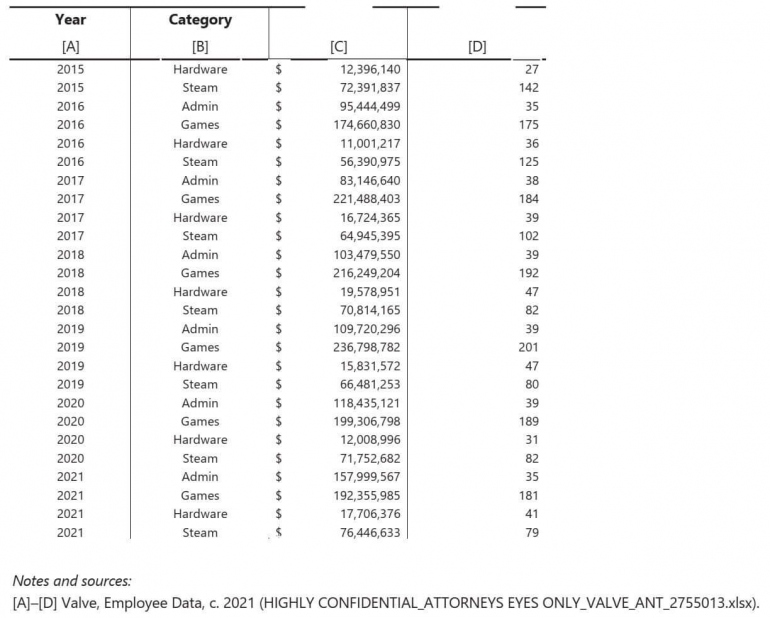
- Valve employs less than 350 people
- Valve’s four main workforce groups are | Administration, Game Developers, Engineers, and Support
- About half of the employees are assigned to the video game department
- There are about 80 people working on Steam. Since 2015, the number of this group has decreased by 1.5 times
- In 2021, Steam made about $2 billion in game sales fees alone
- The average salary of an employee is $1.3 million per year
- The highest salaries are in the administration – about $ 4.0 million per year. Game developers can count on $1.0 million, the Steam team has slightly lower salaries, and engineers earn only $0.4 million
- But the salaries are not as sweet as the huge payouts. They are probably related to departmental performance indicators
- Profit per employee of Valve is several times higher than that of Netflix, Apple, Intel, Amazon, Microsoft
Valve’s office size and employee count are smaller compared to Larian Studios and Bungie. Valve has around 336 employees, while Larian Studios has about 470 employees. Bungie’s office space is also significantly larger, with its headquarters in Bellevue, Washington, covering roughly 200,000 square feet, plus an additional 60,000 square feet in downtown Seattle. The number of employees is ten times less than that of giants like Microsoft, Sony, Nintendo, Ubisoft, or Electronic Arts. Even Epic has twelve times more staff.
Valve does use outsourcing services. However, many users within the Valve ecosystem feel that the company does not allocate sufficient resources and attention to its main products. This sentiment is shared by both players and other companies, who have noticed the impact on the quality and development of Valve’s offerings.

Valve has faced challenges with toxic behavior on Steam. The company has acknowledged the need for better tools to manage this issue, as many developers have expressed frustration with the current moderation capabilities. Gabe Newell, Valve’s co-founder, has shown an understanding of the community’s behavior, including their memes and defiant actions, even if he finds some of it perplexing.