
The concept of a console generation used to be a clean break. You bought a new box, you plugged it in, and the world looked different. The colors were sharper, the movement was fluid, and the old hardware went into a closet or a secondary market. That cycle is dead. In the current landscape, the industry is approaching a structural collapse that we might as well call the PlayStation 6 Wall. This is not a technical glitch or a temporary dip in sales. It is a convergence of economic debt, overextended development timelines, and a consumer base that has reached its limit. The industry is trying to sell a future that the meatspace cannot afford to build.
It is time to look at the lexicon of the next five years. The PlayStation 6 Wall is a catch all term for the global barrier that stops the forward motion of the medium. We have hit a point where the visual delta is shrinking while the cost of producing that delta is expanding at an exponential rate. Every current is clashing at once. Prices are surging, visual progress is hitting a plateau of diminishing returns, and the monetization models are cannibalizing the very players they need to survive. The wall is high, it is thick, and right now, nobody has a plan to climb over it.
Economic Event Horizon
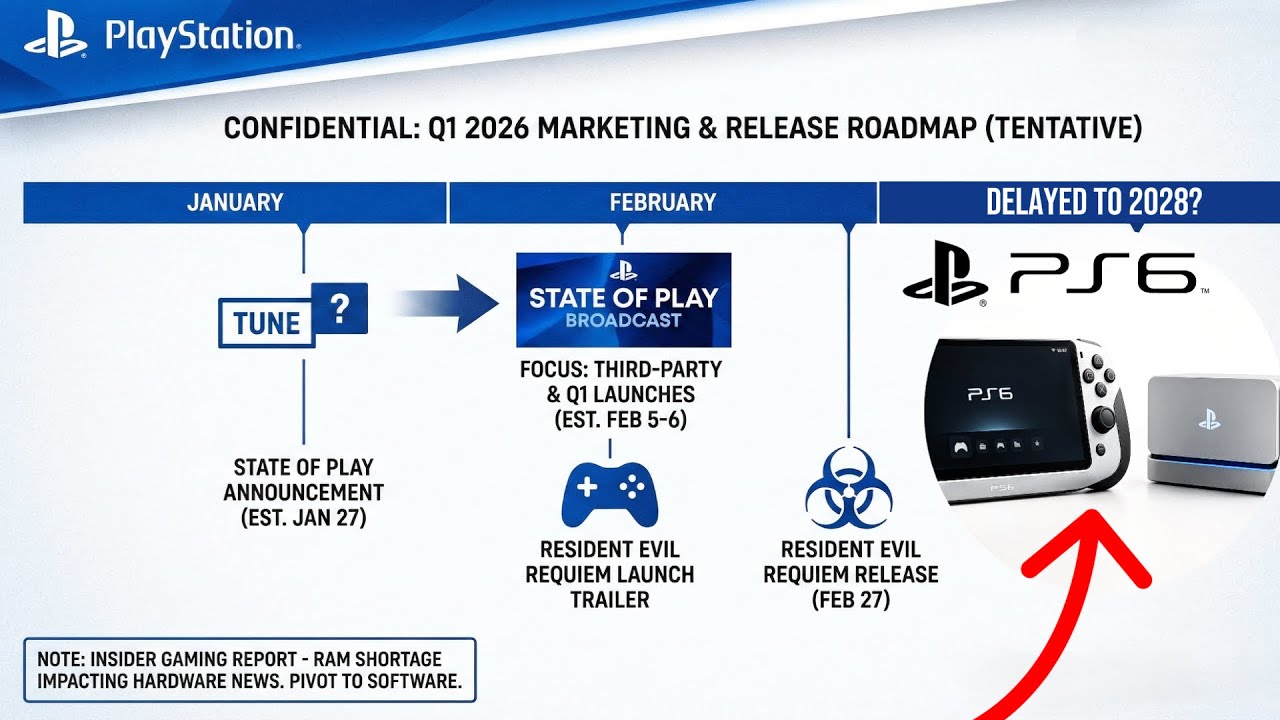
The question of when the PlayStation 6 actually arrives is a staple of the news cycle, but the answer is increasingly tied to a broken supply chain. We are living through an artificial intelligence pandemic that has sucked the oxygen out of the silicon market. High end components are being diverted to data centers, and the cost of the remaining chips has spiked to a level that makes traditional console pricing look like a fairy tale.
Jason Schreyer has noted that a 2027 release looks increasingly like a fantasy. The price jump alone makes the proposition a hard sell. If a console cannot hit the sweet spot of five hundred dollars, it enters a luxury tier that the average gamer simply ignores. There is a theory that the new bar will just compete with the market average, meaning if everything is expensive, people will just accept it. This ignores the reality of budget gaming. People do not buy consoles because they want to spend the price of a used car. They buy them because it is the most efficient way to access high intellect entertainment without the complexity of a PC. If that efficiency vanishes, the audience stays home.
Moore Law Is Dead claims that contracts are signed and the wheels are turning regardless of the macroeconomics. This assumes the market is a static target. It isn’t. The cost of living has outpaced the desire for slightly better shadows. Sony is staring at a situation where the hardware required to make the PlayStation 6 feel like a true leap might cost them more to build than they can ever recoup from the player base.
Fossilized Support and the Cycle Myth
Nvidia recently pulled the plug on driver support for graphics cards without ray tracing or tensor cores. That hardware lived for twelve years. In the PC space, where the boundaries are supposed to be fluid, we are seeing devices survive for over a decade. This creates a massive problem for the PlayStation 6. If the hardware is already living this long, the idea of a seven year cycle is a fossilized relic of the past.

The first part of the wall is the legacy trap. Sony cannot unleash the full potential of a new machine without abandoning the 100 million people sitting on older devices. But they cannot afford to abandon them because those players are the ones buying the annual iterations of the biggest franchises. We are at a peak of opportunity for games like Minecraft or the standard annual sports titles. A PlayStation 6 doesn’t make a blocky building game or a soccer simulation three times better. It just makes them more expensive to host.
The boundary between generations has blurred into a smear. If a gamer can play the latest add on or expansion on a PS5 with ninety percent of the fidelity, the incentive to drop another six hundred dollars on a PS6 evaporates. We are no longer in a world of cycles. We are in a world of persistent infrastructure where the hardware is a secondary concern to the service.
Asset Density and the Human Cost of Fidelity
Look at the jump in labor required for modern visuals. In the first Horizon game, the protagonist was built from roughly one hundred thousand polygons. By the sequel, that number jumped to four hundred and fifty thousand. This is a massive increase in man hours for a single character model. This trend applies to every rock, every leaf, and every rusted door in the game world.
This is the polygon debt. High technology graphics reveal every anomaly. If you have a hyper realistic character standing in a world of flat textures, the illusion breaks instantly. Artists are now forced to fill every square inch of the world with unique, hand crafted assets because the eye can now spot a repeating pattern from a mile away. You cannot just poke textures here and there anymore. Every mountain, house, and ground texture must be distinct and high resolution.

This adds years to the development process. It adds hundreds of millions to the budget. The PlayStation 6 implies a visual leap that would require even more detail, which means even more time and even more money. We are reaching a point where the time required to build a game that justifies the hardware exceeds the lifespan of the hardware itself.
Mechanical Stagnation in a Next Gen World
Expectations are a dangerous currency. In 2025, we saw projects like Avowed arrive to a lukewarm reception. The outcry wasn’t just about the visuals. It was about the feeling that the game was morally outdated. It felt like something built with the mechanics and world logic of twenty years ago. It was a Morrowind era structure wrapped in a modern skin.
The second part of the wall is that gamers are no longer satisfied with just better lighting. They want progress in all aspects. They want smarter AI, better physics, more complex interactions, and worlds that feel alive rather than just looking pretty. But those things require highly qualified specialists, designers, and screenwriters. That is expensive labor. Surprising a modern gamer is the most expensive task in the world right now.
If the PlayStation 6 only offers faster load times and better reflections, it will fail the surprise test. But to offer more, developers have to spend money they don’t have on teams that are already burnt out. Indie projects are flourishing because they don’t try to scale this wall. They work on older devices because they focus on mechanical soul rather than technical bloat.
Temporal Displacement in Studio Planning
Think back to 2006. The world got Gears of War, and by the end of that console cycle, we had seen four full entries in that series. Today, a single sequel takes five to seven years. Microsoft and Sony have studios that haven’t released a new entry in their flagship franchises for an entire generation. We are seeing remasters and remakes because the industry is too scared or too broke to commit to a seven year development cycle for something new.
This is the third part of the wall. Development time now exceeds the console lifecycle. If a studio starts a project today, they are aiming for hardware that might not even be announced yet. They have to make a prediction about the grid seven years into the future. Even the best insiders cannot confidently tell you what the market looks like two years out. Asking a creative team to build for a 2032 reality is an impossible task.
Developers are building for ghosts. They are guessing at specs and hoping the platform holder doesn’t pivot mid stream. This leads to safe, boring games that are designed to be scaleable rather than groundbreaking. It is the death of the shock exclusive.
The Pricing Chasm of Modern Silicon
When the PlayStation 3 launched at six hundred dollars in 2006, it was a scandal. It was a powerful machine, essentially a supercomputer for the living room, but the mass audience didn’t care about the tech. They cared about the price. Compare that to the PC market today. The flagship GPU of 2025, the RTX 5090, costs nearly two thousand dollars. That is a three times increase from the flagships of a decade ago.
If the PlayStation 6 tries to keep pace with modern PC hardware, the price point would have to be north of a thousand dollars. A mediocre version of the future would still be prohibitively expensive. How many people are willing to pay twelve hundred dollars for a box that plays the same games they already own?
This is the fourth part of the wall. The platform holder must surprise with performance but stay in a budget price range. These two goals are now diametrically opposed. Silicon is not getting cheaper. The process of shrinking transistors has hit a physical limit where the costs are skyrocketing. The era of cheap, massive leaps in power is over. We are in the era of expensive, incremental gains.
Audience Inertia and the Ghost of Infrastructure

Publishers chase the money. The money is where the people are. Right now, the people are on the PS4 and PS5. A future console, even if it boasted a thousand teraflops, has no real argument for a mass migration if the games are still being held back by the previous hardware.
Console gaming was founded on the idea of being a budget entry into high end hobbies. If the PS6 is expensive and the games are sparse, there is no reason to switch. If the audience doesn’t move, the publishers stay behind. This is the vicious circle we have seen for the last six years. We are still seeing major releases on the PS4 because the install base is too big to ignore.
The PlayStation 6 Wall is not just a technical barrier. It is a psychological one. The mainstream gamer is starting to realize that the difference between “good enough” and “next gen” is getting smaller every year. The rays, the upscaling, and the frame generation are impressive to the hardware enthusiasts, but they are invisible to the person who just wants to play a round of their favorite shooter after work.
The wall is built from the reality that the cost of progress has finally exceeded the value that progress provides to the consumer. We are looking at a future where the hardware is no longer the star. The infrastructure is the star. The box under the TV is becoming a secondary concern to the account that follows you across devices.

Existing technology cannot solve this. AI can help with upscaling, but it cannot fix the fact that it takes seven years to write a good script and build a world that feels new. Innovations and rising prices do not go hand in hand with the budget gaming ethos that built this industry. Without a real incentive to move, and without a way to bring the costs down, the PlayStation 6 might be the first console to arrive at a party where nobody wants to come inside.
The Ghost of Security Breaches | The Digital Fortress Cracks
But the “Wall” is only half the story. The mystery of the PlayStation 6 is no longer confined to speculative hardware sheets or leaked patents for controller haptics. In the early days of 2026, the narrative has shifted from power to vulnerability. While the PlayStation 6 Wall represents a physical and economic barrier to progress, the Ghost of Security Breaches represents a fundamental rot in the foundation of the console ecosystem.
Recent events have forced us to look at the Chrome Cache and the leaked BootROM keys not as mere technical glitches, but as the first cracks in the fortress of independent command. On one hand, we are told that the PS6 is on track for 2028, powered by custom AMD silicon and AI-driven upscaling. On the other, the persistent “Ghost” of Sony data security has returned to haunt the conversation. This isn’t just about stolen credit cards; it’s about the very keys to the systemic kingdom.
BootROM Leak | An Unfixable Vulnerability
The most significant tremor to hit the industry in 2026 was the public dumping of the PlayStation 5 BootROM keys. For the uninitiated, these keys are the hardware-level secrets burned into the silicon of the processor. They represent the Chain of Trust that ensures every piece of software running on the machine is authorized by Sony.
The gravity of this leak cannot be overstated. Because these keys are physical, they cannot be patched out via a simple system update. This is a permanent breach. This vulnerability is the Ghost that will follow Sony into the next generation. If the foundation of the PS5 is compromised, how much of that architecture will be carried over to the PS6? To maintain backward compatibility, Sony must keep certain architectural roots intact. By doing so, they risk carrying the infection forward.
The Mystery of 2026 | Waiting in the Silence

As we move deeper into 2026, the silence from official channels is deafening. The Chrome cache Ghost refers to the fragmented way this information is being consumed. We see trailers leaked on the Xbox store only to be scrubbed hours later. We see forum posts detailing the Orion APU that are deleted before they can be verified. This information exists in the digital periphery—the cache of our collective consciousness—but never stays long enough to form a complete picture. This fragmentation is intentional. It creates a state of perpetual anticipation that masks the lack of actual innovation.
The PlayStation 6 Wall | The End of Corporate Gatekeeping
This brings us back to the PlayStation 6 Wall. When development cycles stretch to seven years and hardware security is compromised before the next box is even announced, the old model of “Buy, Plug, Play” breaks down. We are entering the era of the Persistent Node. Your gaming machine is no longer just a toy; it is a point of entry into an ecosystem that is increasingly vulnerable to external manipulation.
The ghost of security breaches is a reminder that in the cyber-industrial age, hardware is only as strong as its weakest link. If Sony cannot secure the BootROM of its current flagship, the promise of an independent PS6 experience is a hollow one. We are being asked to wait for a mystery that might already be solved by those who operate in the shadows of the code.
The leak of the PlayStation 5 BootROM keys in late 2025 has created a permanent fracture in the console’s security architecture. Because the BootROM is the fundamental root of trust—the very first code the processor executes—it cannot be patched or updated through software. This isn’t a temporary kernel flaw; it is a mechanical failure of the encryption logic. For the high-integrity operator, this breach represents a transition from corporate gatekeeping to a state where the user may finally own the silicon they paid for. It is the ultimate manifestation of independent command.