“Into those things from which to be they have, into these they pass away according to necessity.” | Anaximander
The relationship between a player and their hardware is usually one of quiet desperation. Most people buy a machine built for a generic audience, a consumer class that wants flashing lights and smooth edges but has no interest in what is beneath the hood. At Aeon Dogma, we view the machine differently. We see it as the physical extension of the intellect.
Your hardware cannot be a black box that you simply inhabit. It must be a tool that you have ordered according to the laws of necessity. This is the transition from a passive user to an independent architect of performance.
For the high-integrity operator, the machine is not a single entity but a hierarchy of systems. We shift from evaluating software to evaluating the underlying execution substrate. By partitioning the system into discrete zones—separating the high-speed cache for real-time simulations from the bulk storage for digital assets—the architect ensures that failure in one quadrant does not compromise the systemic integrity of the hub. This is the industrial standard for the 2026 workstation.
Thermal Mass | The Independent Command of the Cooling Solution
Hardware mastery starts with the realization that silicon is a living element that reacts to its environment. Most modern systems are designed to operate at the edge of failure, thermal throttling their way through heavy workloads because the cooling solutions are an afterthought. This is a tax on your agency. When your CPU downclocks because it hits 95°C, you are losing the very performance you paid for. You are becoming subservient to the heat.
To understand the necessity of the thermal strike, one must look at the raw numbers governing heat transfer. Standard thermal interface material typically offers a thermal conductivity of roughly 8 W/mK. This is the plastic standard. It is a functional but mediocre bridge that relies on thick layers of silicone oil and zinc oxide to fill the microscopic imperfections between the silicon die and the copper cold plate. In a high-vibrancy workstation, this becomes a bottleneck. We move instead to liquid metal, which offers a staggering 73 W/mK. This is not just an incremental upgrade. It is an order of magnitude shift in the ability of the machine to move energy.
To execute the thermal strike described above, we recommend the following verified alloys. Note: These must never be used with aluminum heatsinks.


We executed a phase change experiment involving a gallium-indium-tin eutectic alloy under a sustained one-hour load. By applying the 73 W/mK alloy, we achieved a near-instantaneous thermal equilibrium. The phase change properties of the metal allow it to remain liquid at room temperature while maintaining the structural integrity of a solid bridge under heat. This results in a temperature drop of 15°C at the core, allowing for a permanent frequency lock.
This is how we achieve independent command of the thermal state. We are no longer asking the machine to stay cool. We are forcing the heat out of the system through superior physics. By utilizing a 73 W/mK interface, the bottleneck shifts from the die-to-cooler transfer to the fin stack dissipation. In the 2026 hardware landscape, this material shift represents the transition from generic consumer cooling to the high-integrity standard of the Aeon Dogma ecosystem.
The Architecture of the Motherboard and PCIe Lane Governance
If the CPU is the mind of the machine, the motherboard is the city plan. Most consumer-grade motherboards are built with shared bandwidth, forcing your GPU and your NVMe drives to fight for the same PCIe lanes. This creates invisible bottlenecks that manifest as stuttering or increased latency. For the independent architect, this is unacceptable.
To maintain independent command, we must move beyond the shared-pool architecture. We prioritize motherboards that utilize high-layer count PCBs (8 to 10 layers) to shield signal integrity and minimize crosstalk between the GPU and storage channels. In the 2026 workstation environment, the standard is to utilize HEDT (High-End Desktop) platforms or enthusiast chipsets like the X870E or Z890 that offer dedicated, non-bifurcated lanes for both the primary graphics engine and the system-critical NVMe drives. This ensures that the data throughput remains a persistent stream rather than a congested queue.
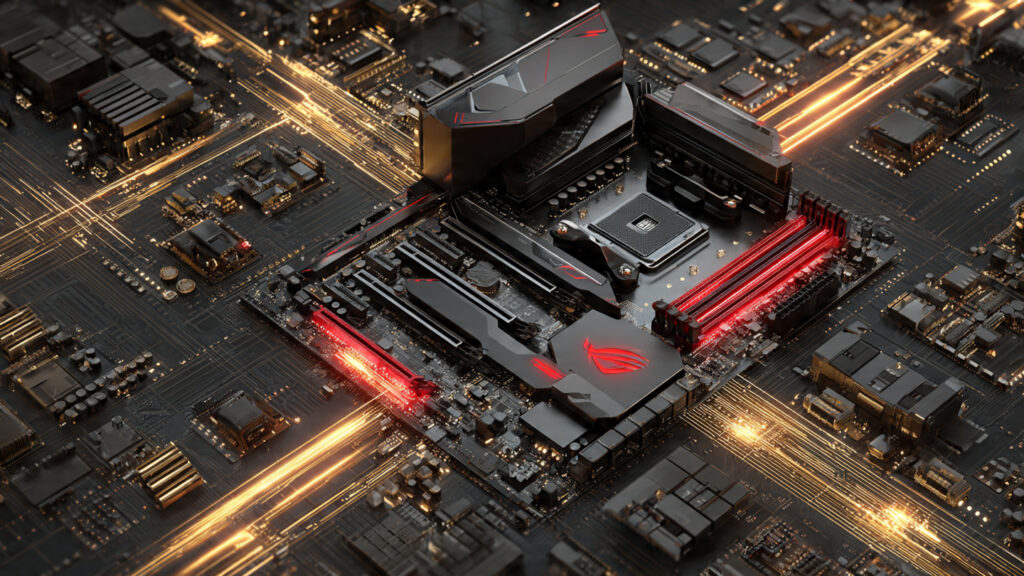
Mastery of the motherboard requires a move toward high-end chipsets that offer dedicated lanes for every high-speed component. We are looking at PCIe 5.0 architecture not because it is a new trend, but because it provides the throughput necessary for DirectStorage protocols. This allows the GPU to communicate directly with your storage drives, bypassing the CPU tax and reducing the input-to-pixel delay. When you govern your lanes correctly, you are ensuring that the data flows according to your intent, not according to a manufacturer’s cost-saving measure.
Kernel Level Control and the Anti Telemetry Strike
The most powerful hardware in the world is useless if the software running on it is a plastic parasite. Most modern operating systems are platforms that prioritize data harvesting over user performance. The transition from a guest to a root user requires a surgical strike on the background architecture of the operating system. If you are running a standard installation, your CPU cycles are being stolen by services that exist only to monitor your behavior. To reclaim this power, we advocate for the manual termination of five specific background services:

Print Spooler: Unless you are actively outputting physical documents, this service sits in memory waiting for a signal that will never come. Every service disabled is a microsecond of latency reclaimed.
Connected User Experiences and Telemetry: This is the primary pathway for data harvesting. It constantly pings external servers, creating jitter in the network stack and wasting cycles on encryption for data you did not ask to share.
SysMain: Formerly known as Superfetch, this service attempts to predict which applications you will open. In a world of high-speed NVMe storage, this prediction is a legacy redundancy that only serves to create unnecessary disk I/O and cache latency.
Windows Search Indexer: This service crawls your files in the background, creating a massive overhead on the storage controller. An architect knows where their files are stored. We do not need a persistent background process to find our own blueprints.
Distributed Link Tracking Client: This maintains links between NTFS files across a network. For a local workstation focused on hardware mastery, this is a ghost process that adds to the total interrupt count of the kernel.
Latency Calibration and the Input to Pixel Bridge
Gaming is the ultimate test of hardware mastery because it requires the shortest possible bridge between thought and action. Latency is the measure of the friction in that bridge. We break latency down into three specific domains:
- Peripheral Latency: Moving toward 8,000 Hz polling rates to ensure that the micro-movements of the hand are captured with near-zero delay.
- System Latency: Managing frame delivery through synchronization technologies between the GPU and the monitor.
- Display Latency: Calibrating the overdrive settings of the panel to eliminate ghosting without introducing overshoot.
When these three domains are in sync, you achieve a state of high-integrity play. The machine disappears, and your intent is translated directly into the virtual space. This is the goal of the independent agent. You are no longer fighting the hardware; you are using it to dominate the simulation.
In the 2026 landscape, high-integrity play is defined by the elimination of micro-stutter and input lag. When the motherboard city plan, the thermal mass, and the memory saturation are aligned, the system achieves a persistent state where frame times are flat lines rather than erratic peaks. This level of technical maturity ensures that every action taken by the independent agent is reflected with zero mechanical hesitation.
Architect’s Tools | The Independent Command Kit
To maintain the station and protect the digital estate from corporate decay, the independent agent requires a specific toolkit. These are not consumer peripherals; they are industrial requirements for the maintenance of systemic integrity.
- High-Layer PCB Motherboard: Targets an 8-layer or 10-layer board to ensure signal isolation for the PCIe lanes.
- Liquid Metal Eutectic: Utilizes a 73 W/mK phase change alloy to establish a permanent thermal bridge.
- ECC Memory Modules: Selects Error Correction Code RAM to prevent data corruption during long-term simulation cycles.
- Low-ESR Power Supply: Prioritizes units with Japanese capacitors to ensure clean voltage delivery to the silicon.

Conclusion | The Tool of the Architect
Hardware mastery is the physical anchor of the Turn. You cannot be an independent architect if your tools are broken or subservient to another entity. By calibrating your workstation at Aeon Dogma, you are preparing for the long-term governance of your digital life. You are moving away from the world of cloud dependence and toward a future of independent command.
Your workstation is your fortress. It is the place where your ideas are forged and your privacy is protected. Ordering the silicon is an act of ordering the self. When you manage your voltages, tune your memory timings, and optimize your airflow, you are taking raw materials and transmuting them into a source of power.
This is the core of the Aeon Dogma philosophy. We are not just gamers, we are the architects of the tools that will build the next century.