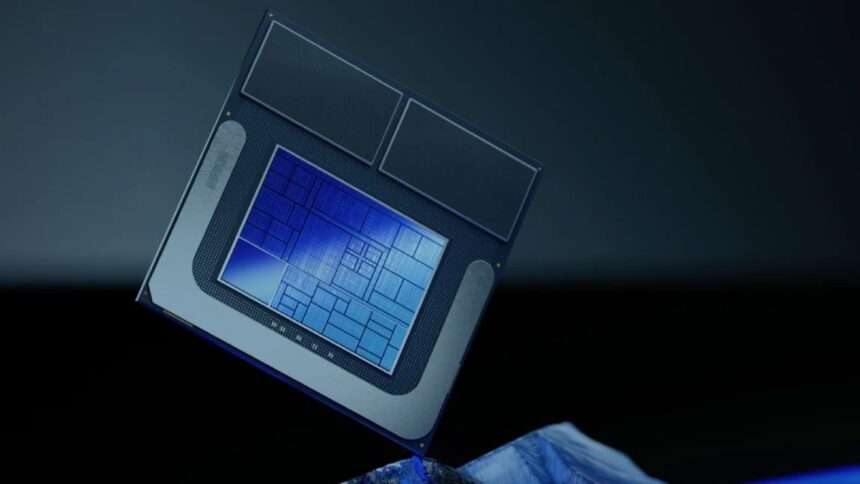
Following the introduction of the new AMD Ryzen AI 300 processors and the latest NVIDIA technologies, Intel has also officially announced its Lunar Lake processors. These processors will be integral to the forthcoming “AI computers” and are set to directly compete with offerings from Red House and Qualcomm’s recent Snapdragon X Elite.
The Lunar Lake series is set to deliver superior core performance, significant advancements in graphics, enhanced energy efficiency, and cutting-edge AI capabilities. Here are the complete details.
Lunar Lake is designed to be more energy-efficient, consuming 40% less power than its predecessors while maintaining comparable core performance. The new SoCs will also introduce improvements in graphics, boasting a 1.5 times increase in performance and AI capabilities that can reach up to 120 TOPS.
These advancements are enabled by a novel 8-core hybrid architecture, which includes 4 E cores from the Skymont family and 4 P cores from the Lion Cove family. This setup, with 2.5 MB of L2 cache and up to 12 MB of L3 cache, works in harmony to enhance the scalability of performance per watt.


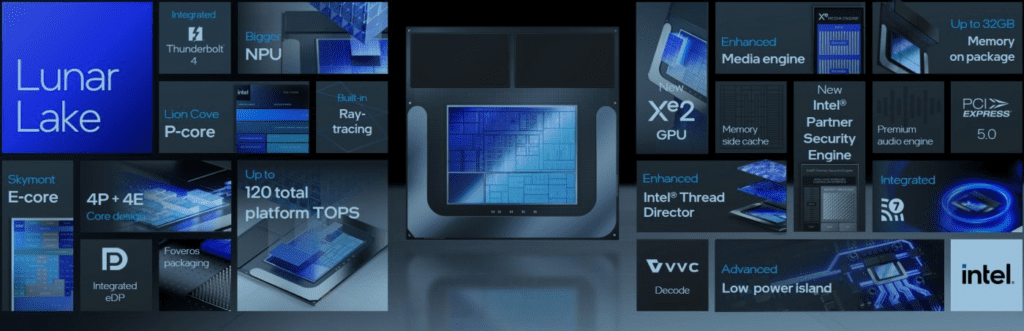
The new Lunar Lake SoCs feature a graphics department powered by the Xe2 GPU, boasting the latest 8 X cores, 8 ray tracing units, 8MB cache, and advanced AI capabilities. Intel promises a 50 percent performance increase over Meteor Lake, with support for real-time ray tracing and AI processing power of up to 67 TOPS.
The most significant innovations lie in AI | Lunar Lake is outfitted with an NPU that includes 6 dedicated neural computing units and up to 9 MB cache, delivering 48 TOPS. Overall, Lunar Lake’s AI computing power totals 120 TOPS across CPUs, GPUs, and NPUs.
Lunar Lake also supports Wi-Fi 7, Bluetooth 5.4, Thunderbolt 4, PCIe Gen 5 and 4, and boasts enhanced security via the Intel Partner Security Engine.
Intel has revealed performance data for Lunar Lake, showing its edge over competitors’ solutions.
In AI, Intel touts a 1.4x performance boost with Stable Diffusion over the Snapdragon X Elite, and the Xe2 GPU is expected to provide 1.5x the performance of the previous generation.
Intel also claims superior per-core performance against the AMD Ryzen 7 8840U and Snapdragon X Elite, with a 30% reduction in power consumption compared to AMD and 20% compared to Qualcomm.
The Lunar Lake processors are anticipated to launch in Q3 of 2024, with the first devices featuring these new SoCs possibly arriving by summer.