Ninja Theory has faced a challenging journey. Their projects, while not flawless, possess a unique charm and originality, earning them critical acclaim and a dedicated fanbase (Bleeding Edge being a possible exception), despite not achieving remarkable sales figures.
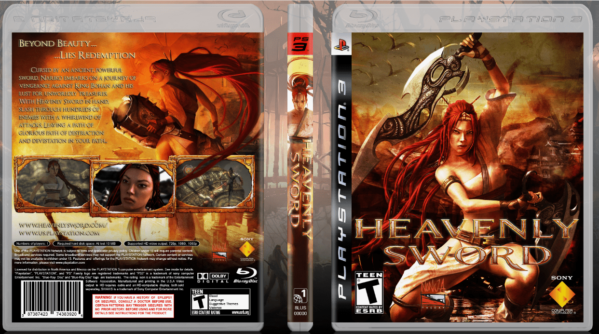
The 2007 release, Heavenly Sword, rivaled the early God of War titles and left a lasting impression with its engaging combat system, stunning design, and vivid characters, such as the main antagonist portrayed by the esteemed Andy Serkis of Gollum fame. However, it also faced criticism for its excessive difficulty, awkward controls, monotonous boss battles, and overall lack of polish, highlighting a vast potential that remained untapped.
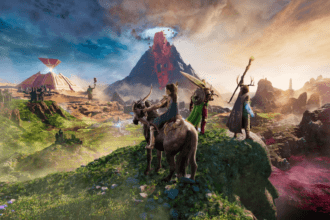
Launched in 2010, Enslaved | Odyssey to the West presented a unique blend of slasher and adventure platformer elements reminiscent of Uncharted. It narrated a road movie-esque tale set in a post-apocalyptic world where overgrown flora envelops deserted cities, and feral humans hide from war machines—a concept that seemed to prefigure the later game Horizon. The title received acclaim for its inventive setting, vibrant characters (with Andy Serkis portraying the lead) and cinematic execution, yet faced criticism for its monotonous gameplay.

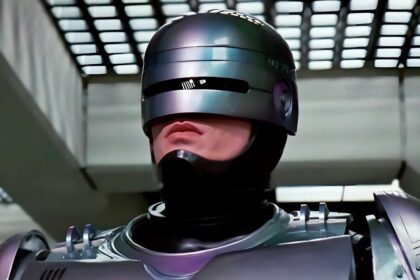
Indeed, DmC has become one of the most discussed games of 2013, though not always favorably. Tasked with rebooting the Devil May Cry series, Ninja Theory proposed styles and character designs close to the original for Japanese audiences, which were ultimately rejected. They also discarded various other concepts, like a Dante resembling a biker-priest, battling demons in a religious-Christian context. Capcom insisted on a more stylish, trendy, and youthful approach. However, when Ninja Theory unveiled a Japanese-approved Dante design and setting in the announcement trailer, it was met with a barrage of dislikes and critical comments about the slender, smoking emo character.
Upon release, the game garnered high ratings from the press and praise from newcomers for its engaging and dynamic combat system, vibrant setting, outstanding soundtrack, and a straightforward yet arguably the most coherent storyline in the franchise. Nevertheless, long-time fans decried the oversimplified combat mechanics, the departure from the series’ original and distinctive style, and the transformation of Dante from a suave, clever heartthrob to a crude, edgy rebel.

Although sales were not impressive, the game has cultivated a dedicated fanbase. The developers of the main Devil May Cry series have not only verbally praised it but also incorporated many of its gameplay and visual elements into the fifth installment.
DmC has rekindled and amplified interest in the series, uniting old fans, drawing in new ones, and significantly contributing to the development of Devil May Cry 5. Yet, despite these successes, the reboot was considered a failure, ending the partnership between Capcom and Ninja Theory. It’s unfortunate, as we adore DmC and would eagerly anticipate its sequel, alongside the progression of the main series.

Following the disappointment of DmC, Ninja Theory chose to operate independently, declining the assistance of major publishers. The studio unveiled their new game, Hellblade, which narrates the tale of a Celtic warrior, in 2014. Released in August 2017, it garnered impressive sales, numerous positive reviews, and sparked significant public discussion with its thematic content, establishing itself as an emblem of independent indie gaming.
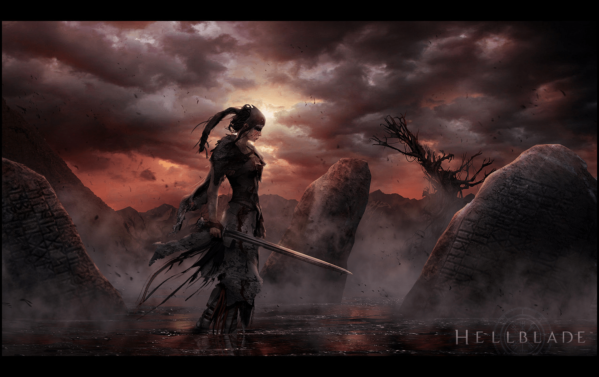
Let’s begin with the plot. At the end of the eighth century, the Scandinavian Vikings launched a significant invasion of the British Isles, decimating and enslaving the indigenous Celtic population.
Senua, a warrior of the Pictish tribe, has endured psychosis since her youth. As a result, she was deemed cursed and ostracized by her own people, including her father. While Senua was away, Vikings devastated her village, murdered her loved ones, and executed her beloved, Dillion, through a ritual known as the “blood eagle”.

Suffering from severe psychological trauma and a sudden onset of psychosis, Senua recalls the tales of a Viking slave who escaped and joined them. She carries her deceased lover’s head and ventures into the land of the Norsemen to seek the entrance to their underworld, hoping to plead with the goddess Hel for her beloved’s return. Her odyssey is a complex tapestry of reality, visions, recounted myths, and personal recollections, which the game vividly portrays…
It’s best to witness the rest firsthand. The core narrative is straightforward and can be summarized in a few sentences. At its heart, it is a profound metaphor and an intense emotional journey through the grief of losing a loved one.

The game lacks sharp turns and vivid conflicts with villains. Instead, the complexity lies in the reevaluation of beliefs and the transformation of Senua’s consciousness. The true conflict resides within the protagonist herself, her memories, and emotions. The principal antagonist is a tragedy that has already occurred, relentless and indifferent.
Despite sequences of battles and pursuits, Hellblade most notably evokes games like What Remains of Edith Finch and Dear Esther in its rhythm and impact. It offers a profoundly personal narrative of an individual braving a solitary journey, deeply engrossed in their thoughts and recollections. Here, however, it is the ordeal of a mentally ill young woman grappling with severe post-traumatic stress, set in the harsh epoch of the early Middle Ages and shaped by tales and myths that could haunt even the most battle-hardened warriors.

Throughout the development process, the game’s creators actively consulted with mental disorder specialists and individuals who have personally experienced psychosis. This collaboration contributed to crafting a highly immersive and genuine experience that encapsulates numerous images, scenarios, and symptoms encountered by real people.
Psychosis is defined as a disconnection from objective reality, primarily manifested through hallucinations (the sensory perception of things that don’t exist) and delusions (unfounded, odd beliefs). Ninja Theory has meticulously integrated both these elements into the game, demonstrating remarkable sensitivity and detail.

Space disintegrates like a torn photograph, awash with bright, luminous colors. The environment blurs with movement, surfaces undulate in waves, and light fades into the periphery. Walls collapse, and bodies seem to float—these are visions drawn from the real experiences of psychosis.
Moreover, the game’s devilish beauty remains striking, even seven years post-release. This stands as a testament to the technical experts’ achievements—their effects, models, and animations rival the quality of contemporary AAA titles.
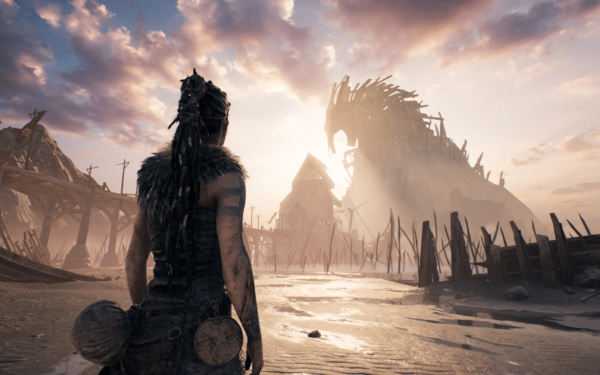
This represents a significant triumph for artists; the locations captivate with their stunning beauty and imagery. Envision a vast, crumbling castle, seemingly cobbled together from ship parts into a dragon-like form. A colossal, desiccated tree, its branches laden with the hanged, and at its roots, a darkening cave. Some scenes are akin to a visceral hell, complete with rivers of blood, blazing light, and legions of the damned.
The characters are equally impressive – Viking northerners, having shed all humanity, resemble menacing monsters, towering over Senua. The gods, born from stark myths, are the stuff of nightmares | the infernal giant Surtr, the beast Gram who guards the realm of the dead, or Hel, the goddess of the underworld.
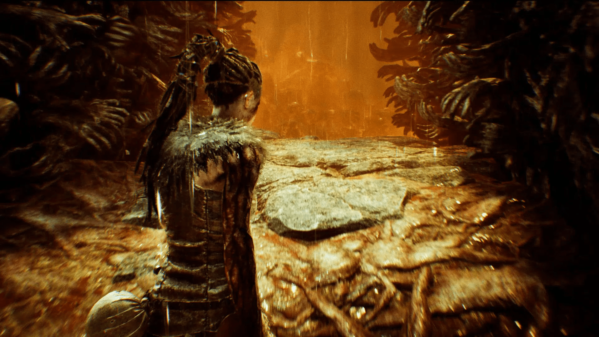
Senua herself is remarkably lively and convincing. Her emotions and experiences command attention and elicit a reaction; you believe in her every moment. Melina Jurgens, who started as a video editor at the studio, so impressed with her acting that she was cast in the lead role. The outcome of her work clearly justifies this decision.
The protagonist moves with vividness and authenticity, whether in tranquil scenes or executing combat techniques. This authenticity extends to the game’s historical accuracy, as the development team meticulously consulted with historians to ensure the era’s appearance was depicted faithfully in every aspect, from the architecture and clothing to the character’s face paint.

Senua appears both nice and beautiful, without seeming exaggerated or unnatural, nor deliberately disfigured. She is an ordinary, yet very attractive girl in excellent physical condition, seemingly representing the peak condition of a woman who is constantly engaged in physical training and fencing, without the aid of specialized equipment or nutrition. Overall, Senua feels alive and authentic. Perhaps she has surprisingly healthy teeth and skin for the Middle Ages, but at times, it’s better to forgo complete realism.
She is captivating to observe, easy to empathize with, and relatable. She is a profoundly lonely and unhappy individual, who grew up with a serious illness that, at the time, was attributed to nothing other than curses and evil spirits. Such individuals, driven insane by trauma, sorrow, and sickness, were termed “gealts” and exiled to the forests to seek repentance and purification. Senua, whose mind was damaged not only by her condition but also by the treatment of others, also lost all her loved ones in one fell swoop, which only exacerbated her psychosis, propelling her on a desperate and perilous quest in hopes of saving her beloved, even if it means risking her own life.

The remaining characters in the game were brought to life through video cutscenes featuring live actors, which were very convincing, without the need for actual game models. This unique approach complements the game’s overall surreal visual style. Remedy later employed a similar technique in Alan Wake 2.
The game’s connection to the Finns’ work is evident in the unconventional camera techniques used in cutscenes. There are numerous original transitions, unique angles, and effects. The camera often adopts the perspective of Senua’s imaginary interlocutor, whom she addresses, creating a more intimate experience as if the heroine is speaking directly to the player.

The visual and auditory components are inseparable and executed at a high level. Every sound in the game’s world, from the murmur of cascading water to the clash of swords, is convincing. The music generally adheres to the spirit of the era and the game’s mood, featuring folk tunes for Senua’s themes or aggressive drums and Norse melodies for Viking themes. Electronic elements are seamlessly integrated, enhancing the mood and melding with the surreal events unfolding. The only outlier is the end credits song, which could leave you ambivalent. It’s modern and well-known, yet it’s also quality music that fits the theme well.
The standout feature of the game’s audio design is undoubtedly the auditory hallucinations. They follow Senua throughout her journey, alternating between whispers and screams. At times they offer encouragement and guidance, at other times they demean and incite panic. They can seem like distinct, almost familiar personalities or a cacophony of many unknown voices. With headphones, their constant movement and varying directions and distances create an experience unlike any other.

The voices also provide guidance in combat and riddles, offering hints and commendations for correct actions. This forms a type of diegetic interface that is largely minimized within the game. There’s no health bar, direction marker, or quest log. The screen dims with sustained damage, and as focus builds, the sword and the mirror on the belt illuminate, guiding the player through the voices and level design. This greatly enhances immersion.
Recall the mention of delusions, another characteristic of psychosis? These too have been woven into the gameplay, serving as the foundation for the game’s puzzles.
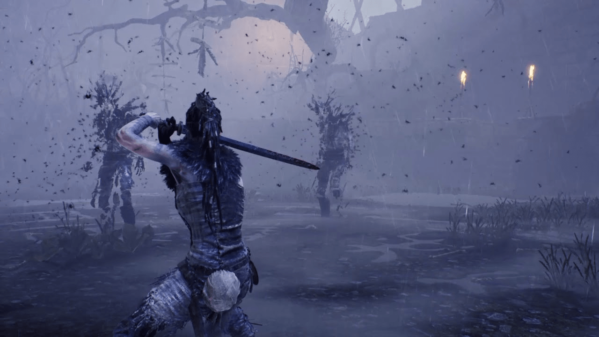
Even individuals who are mentally healthy often subscribe to the power of rituals and omens. Consider beliefs like “never say goodbye over the threshold” or “look in the mirror if you have to return home for something forgotten.” For those experiencing psychosis, such matters can become far more complex and grave. A belief such as “I cannot open the door until I locate the three guards depicted on it, hidden somewhere in this room,” can appear to them as an absolute truth and a perfectly logical situation.
Local puzzles often employ such twisted logic as their foundation. They may involve finding runes concealed within the environment, opening a passage by gazing through a magical archway at just the right spot, racing to the doors while touching a fire source, or fleeing from something terrifying. And indeed, such elements can seem eerily natural in the context of a video game, wouldn’t you agree?

Overall, the riddles are quite engaging; they are seldom repetitive (except for rune searches), and they evolve in complexity, prompting the player to adapt their approach with each encounter. However, it’s possible to grow weary of them since they make up about a third of the game.
The second third is straightforward – it’s a walking simulator with stunning vistas, captivating stories, reflective monologues, and the internal dialogue of voices in the protagonist’s head. My only critique is Senua’s pace, which, while immersive, can become frustrating when you’re retracing your steps across locations to solve puzzles or find lorestones that narrate Scandinavian myths.

The game tends to overuse scenarios akin to “pass three tests to open the door further.” Although the puzzles and game segments are intriguing, this stalling tactic undermines the sense of progression, diminishing the significance of individual episodes. If the episodes were presented linearly and sequentially as part of a cohesive adventure, the game would retain its essence while enhancing the sense of progress and enjoyment.
Regarding the final third of the gameplay, which is combat-focused, it presents a greater challenge. The combat feels precise – every strike lands with impact, the spacing from opponents is easily gauged, and parrying and dodging are intuitive. However, it’s overly simplistic – offering just a strong and a weak attack, two combos for each, and a shove to break blocks. Additionally, there’s a dash and a roll on a double press, and a block that becomes a parry with perfect timing.

In the game, aside from bosses, there are only four types of enemies, and they don’t really require varied tactics. Simply hit and parry on time. For shielded foes, start by breaking their guard with a shove. With larger enemies, dodging is preferable to parrying. Weak shots seem unnecessary. Parrying is the safest method to survive any fight; it has lenient timing, stuns adversaries, and allows for a strong counterattack that freezes nearby enemies. It also significantly boosts focus, a local rage mode that slows down time.
Engaging multiple enemies is common and somewhat awkward, though not as problematic as in other games. Senua is locked onto a single target and moves slowly, and the camera doesn’t allow for a comfortable survey of the surroundings. However, she easily switches targets, parries blows not directly aimed at her, and the camera isn’t so tight that it obstructs the view like in the God of War reboot.
Overall, combat is satisfying due to its impactful feel. However, the sheer number of battles seems excessive for such a straightforward combat system, the enemies are somewhat spongy, and towards the end, the fights become monotonous.
Perhaps, a few simple improvements could save the situation:
To create fewer but more challenging fights, making them more memorable and perceived as a real test, reduce the health of enemies and heroes. Increase the lethality of each hit to enhance the intensity and pace of battles. Assign unique properties to each type of strike and tailor your opponents accordingly.
For example:
- A light attack is unable to break a block, yet it slows the enemy, creating an opportunity for a strong blow that would typically be dodged.
- A strong attack can penetrate a block, except when facing shields; however, it is vulnerable to being dodged by many enemies, and you cannot block during this move.
- After executing a successful dodge, pushing will knock you to the ground.
Implementing such improvements would enrich the combat system, diversify it, and compel players to frequently seek and switch tactics. With a reduced number of battles and shorter durations, this would suffice for a game of this magnitude.
However, the game can feel drawn out and exhausting to many players, even with a brief playtime of 7-9 hours. The persistent spatial puzzles, the regular and lengthy battles with a simplistic combat system, and the walking simulator aspect generally do not appeal to everyone.

Here, we may need to concentrate our attention. Is Hellblade a good game? Absolutely. Is it suitable for everyone? Certainly not.
The concept of elite art is often met with mixed feelings. It’s a common belief that elite art demands extensive education. However, these are simply creations targeted at a specific, rather than a broad, audience. It may seem humorous, but games like World of Tanks and Snowrunner are forms of elite art because they cater to a very particular group of people and aren’t meant for universal appeal.
Looking deeper, elitist works and mass culture (pop) creations are essentially two extremes on the same spectrum, which gauges the breadth of the audience a work addresses. No game, movie, or song is entirely mainstream, as nothing is universally adored. Similarly, nothing is completely elitist, unless perhaps it’s so esoteric that only the creator understands it.

That’s precisely the point. Hellblade stands out as a quintessential piece of elite art, or arthouse. It’s a creation meant for a specific audience. It won’t appeal to or interest every gamer, and that’s perfectly fine.
Who would we recommend it to? Anyone fascinated by themes of psychosis, hallucinations, post-traumatic stress disorder, and the grief of losing loved ones. It’s for those who not only find these subjects intriguing but have also experienced them personally. Additionally, it’s for gamers who enjoy walking simulators and seek a unique emotional journey through unconventional games, rather than the grandeur of blockbusters with their proven gameplay and dramatic visuals.

Hellblade transcends the traditional boundaries of a game. Were it a film, it would resemble an arthouse semi-documentary, rich in artistic flair. It offers a profound emotional journey, plunging us into the life and psyche of a highly unique individual facing extraordinary circumstances and surroundings.
We hold immense respect for the dedication and meticulousness Ninja Theory has invested in addressing and detailing the complex subject matter. The heartfelt letters they receive, expressing gratitude for how the game has facilitated a deeper understanding of psychosis among sufferers and their loved ones, stand as a testament to the authenticity of the portrayal and the triumph of their efforts.
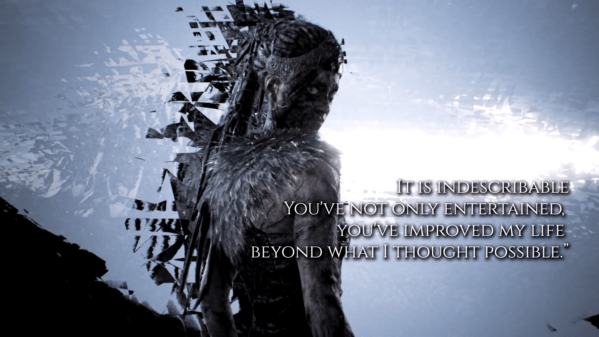
Ninja Theory has garnered much respect for their ability to independently create a project that rivals AAA blockbusters in many respects, though not all. They have rightly become emblematic of the indie scene’s ascent and the success of independent ventures. It would be a stretch, however, to label a team with three AAA titles to their name as merely an ‘indie studio.’
Hellblade, while not without its flaws, offers a unique and memorable experience. It’s a poignant and terrifying yet ultimately uplifting tale, taking players on a journey through a strange and fearsome world as seen through the eyes of an extraordinary individual driven by a deeply personal quest. This quest, while hard to believe in its success, is easy to empathize with.
Assigning an objective rating to Hellblade is challenging; it would likely fall between seven and eight, but such numerical values do not do justice to its distinctiveness and narrative depth. The game was engaging on multiple playthroughs, providing immense enjoyment despite its dark narrative. It comes highly recommended to anyone intrigued by the themes it explores.
The anticipation for the sequel is palpable, though the necessity of its creation is questionable, considering the original stands as a complete work in itself. The lack of a significant marketing push suggests that the publisher may be bracing for a shortfall, potentially relegating Ninja Theory to more commercially viable projects post-release, or worse, facing disbandment akin to Arkane Austin’s fate.

The central question following the trailer for the second part is | How are giants perceived by others? Alternatively, is the action set in a local asylum?