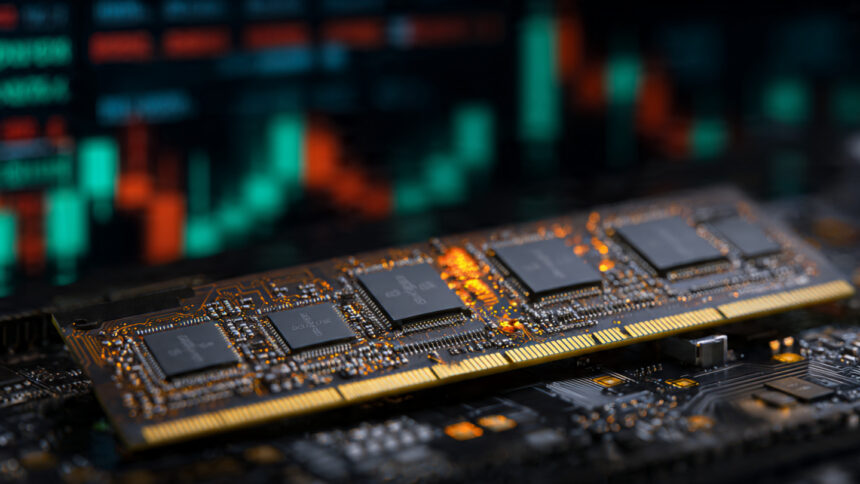
Welcome to the digital wasteland of 2025, where the silicon famine is no longer a ghost story told in hardware forums but a cold, hard reality crashing into your bank account. If you thought building a high-end rig was expensive last year, brace your neural links. The data coming out of the manufacturing hubs is grim. We are witnessing a hardware heist of epic proportions, and the primary suspect is the very AI boom that promised us a brighter future.
While we were busy marveling at chatbots and synthetic art, the heavy hitters of the tech world were quietly buying up every scrap of DRAM they could get their hands on. The result? A market volatility that makes crypto look stable.
The 123 Percent Silicon Tax
Let’s run the diagnostics on the current year. Since January, DDR5 RAM prices have skyrocketed by a staggering 123 percent. To put that in perspective, your memory modules are currently appreciating in value faster than gold or luxury real estate. If you bought 32GB of high-frequency RAM at the start of the year, you are essentially sitting on a digital gold mine.
But here is the glitch in the system. This isn’t a temporary spike caused by a single factory fire or a shipping bottleneck. This is a fundamental shift in how silicon is allocated. The massive server farms required to keep “The Machine” running are hungry, and they eat the same memory chips your gaming PC needs to render those 4K textures.
Currently, a single gigabyte of DDR5 memory is sitting at roughly $10 for standard modules. Once you cross the 32GB threshold into the high-capacity zones, the price curve turns into a vertical wall.
The 2026 Forecast Another 45 Percent Jump Incoming
If you were planning to wait out the storm, I have bad news for your internal sensors. Reports from South Korean industry insiders suggest that we are nowhere near the ceiling. As we transition into 2026, we are staring down the barrel of another 45 percent price hike on top of the already inflated costs.

This isn’t just speculation. It is a matter of supply chain physics. The lead times for new DRAM production lines are measured in years, not months. Meanwhile, the demand from the AI sector is growing exponentially. We are moving toward a reality where “gaming grade” components will be priced as boutique luxury items, reserved for those with heavy pockets or corporate backing.
Hardware Regression and the Return of the 4GB Ghost

The most terrifying part of this intel isn’t just the price tag; it is the inevitable hardware regression. Because manufacturers can no longer afford to pack 16GB or 32GB into affordable consumer devices, we are seeing a shift back to the “Dark Ages” of specs.
- Laptops: Expect new “budget” models to drop back to 8GB as the standard.
- Mobile Devices: High-end smartphones might see a stagnation in memory growth.
- The Nightmare Scenario: Industry analysts are warning that by late 2026, we might actually see 4GB configurations returning to the entry-level market just to keep retail prices from hitting the stratosphere.
The GPU and Console Contagion
The rot is spreading beyond just your RAM slots. Memory is the lifeblood of almost every high-performance component. AMD and Nvidia are currently locked into manufacturing contracts based on older, lower memory prices. Those contracts are set to expire soon.
When the new agreements are signed, the cost of VRAM (Video RAM) will be calculated at the new, hyper-inflated rates. This means the next generation of GPUs will likely launch with higher MSRPs than anything we have seen before. If you thought the “Ti” tax was bad, wait until you see the “Silicon Famine” surcharge.
Consoles Are Not Safe
Even the walled gardens of the console wars are feeling the heat.
- PS5 and Xbox Series X|S: Retail prices could see a late-lifecycle bump of 10 to 15 percent to compensate for rising parts costs.
- Switch 2 | Nintendo’s next-gen handheld is already rumored to be facing production delays as the Big N struggles to secure enough memory modules at a price point that won’t alienate families.
We are looking at a potential delay for the “true” next generation of consoles. Sony and Microsoft may choose to push their 2027 or 2028 plans further back until the DRAM market stabilizes, which industry experts say won’t happen for at least another two to three years.
Survival Protocol for the 2026 Hardware Crisis

So, how do you navigate the grid when the cost of entry is soaring? First, if you are sitting on a decent amount of DDR5 right now, guard it. Do not sell your old modules until you have the new ones in hand. Second, if you need to upgrade, do it now. Waiting for 2026 is a gamble where the house always wins.
The era of cheap, abundant memory is over for the foreseeable future. We are entering a phase where optimization will matter more than raw power. Game developers will have to get creative with how they use limited memory, much like they did in the era of the early consoles.
Keep your cooling systems clean, your drivers updated, and your expectations tempered. The silicon famine is here, and it is hungry for your credits.