Over three centuries ago, a virus nearly wiped out humanity, leaving mutated monkeys to rise in their place. Noah, a chimpanzee from an eagle-breeding clan, harbors a deep fear of “bare-skinned” humans. His fear is justified, especially when other monkeys are considered. Noah’s village lies in the path of the mighty Proximus, who seeks to unite all primates under the legacy of the great Caesar, using fire and electrocution as his tools of conquest.
“The New Kingdom” is built upon the legacy of Caesar’s trilogy, featuring Andy Serkis, which revolutionized “motion capture” technology and stood out as exceptional science fiction. However, this new film is not a continuation but a fresh start. With Caesar long deceased, the film opens with his funeral, tying it to the previous trilogy while signaling its conclusion. A new director and writing team have crafted a narrative for a new age, with fresh faces bringing new characters to life. The film carves out its unique identity, embodying the essence of a grand, costly, and visually stunning blockbuster akin to “Avatar.”
Wes Ball, previously known for the “Maze Runner” trilogy, showcases his talent for depicting post-apocalyptic landscapes—overgrown ruins, echoing rusty metal, damp artificial caverns, and massive concrete blocks. “The New Kingdom” amplifies this aesthetic. Following this film, Wes is likely to distinguish himself from any namesakes, such as Ove, as a director of note.
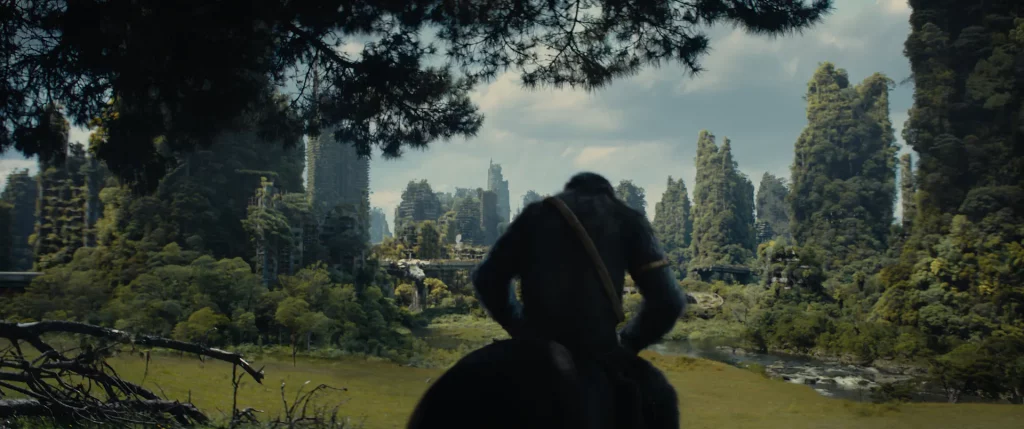
Rarely has such a beautiful post-apocalypse been depicted on the big screen. Many scenes beg to be included in art collections themed “The Land Freed from Humanity.” Nature and ruins blend seamlessly, making it challenging to discern between graphics and on-location filming. Centuries after humanity’s demise, destroyed cities are becoming part of the natural landscape. For instance, Noah’s tribe inhabits a treetop town reminiscent of elves or Na’vi, and it’s only when this “Lorien” burns that you realize the trees were actually power line masts all along.
“The New Kingdom” could be described as a fantasy epic, even though it technically contains no magic. The film embodies the essence of a fantasy narrative, set among the relics of a bygone era. The monkeys resemble not mere intelligent animals, but a noble barbarian tribe | they engage in philosophical English dialogues, ride horses, uphold traditions, and revere nature. The storyline echoes the classic “Conan the Barbarian,” where the protagonist embarks on a quest for vengeance against a tyrant who has established a personality cult, after his home is destroyed by enemies.

The central conflict in this narrative is less complex than in the Caesar films, yet it still incorporates social themes. The continuity of the trilogy is evident in the rotation of antagonists | from unethical businessmen (humans), to the radical Koba (apes), to the fascist colonel (humans), and now back to an ape villain. Proximus Caesar proclaims himself the heir of Caesar and, under this guise, embarks on conquests, subjugating both humans and apes. He exemplifies how even the noblest of doctrines can be perverted to rationalize war and despotism. Caesar’s teaching, “Apes together strong,” is twisted into a call for unification under a single ruler—unity through force.
Yet, the scriptwriters do not delve deeper than this rudimentary concept. Characters vocally debate whether humans and apes can coexist or are fated for strife, labeling humans as ‘greedy reptiles.’ However, the storyline remains straightforward | there are the protagonists—Noah’s clan and their allies; and the antagonists—Proximus and his followers, with one individual representing each side. The narrative lacks a genuine conflict between humans and apes, leaving no room for complexity or nuance.
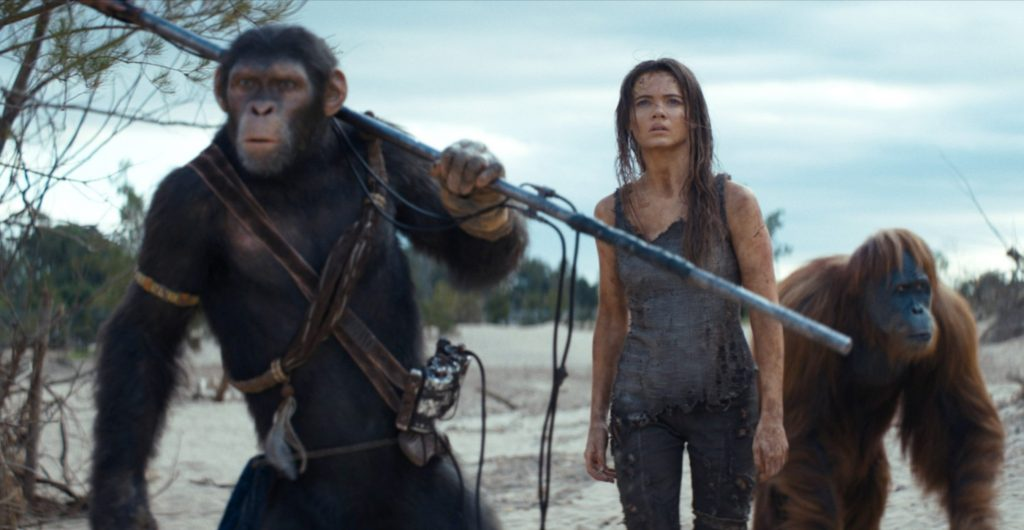
“The New Kingdom” resembles less of social fiction and more of an epic blockbuster, boasting a vibrant universe and opulent sets. Yet, its two-and-a-half-hour runtime feels unjustified, as the film lacks sufficient plot to fill the duration. This shortfall is most apparent in the third act, where the heroes, once captured, inadvertently shift to passive roles. The absence of adventure or exploration, replaced by hollow dialogues where villains inexplicably try to sway the heroes, is puzzling. For instance, why does Proximus obsess over Noah, attempting to recruit him, only to take offense at his failure? Was Noah truly distinct among the many?
The final act’s core issue lies in the ambiguity of the stakes. The screenwriters, in their quest to maintain suspense, withhold too much, leaving the audience guessing. The narrative shifts from a straightforward vengeance for a slain father to a mysterious “box with a secret” and an allegedly invaluable artifact. Emphasis is placed on a human girl, heavily insinuated to have a crucial mission, yet its significance is only revealed in the closing scenes and is underwhelming. Moreover, the formidable leader’s solo confrontation in the climax is unexpectedly comical, undermining what was intended to be a symbolic and poignant moment. Overall, the finale seems hastily revised multiple times, leading to a disjointed conclusion that may leave viewers dissatisfied after an otherwise strong start.
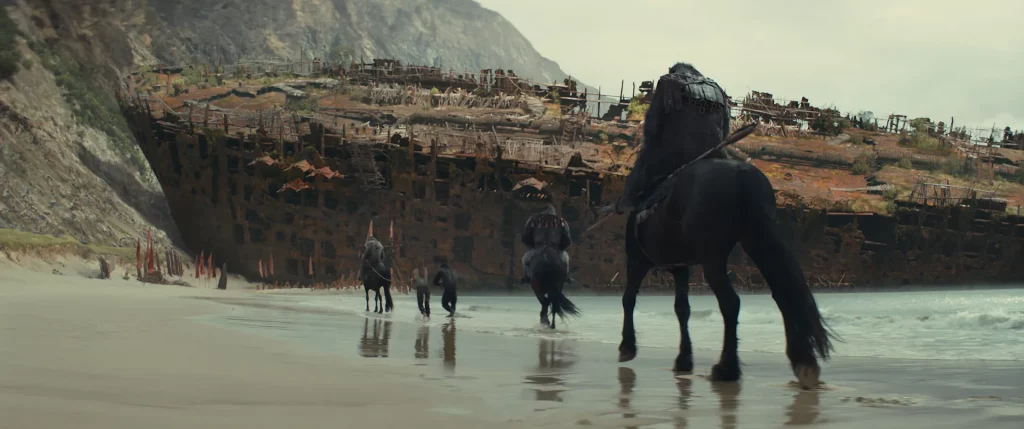
While minor logical inconsistencies should not be seen as severe flaws, “The New Kingdom” is an exhilarating and visually stunning blockbuster, albeit not without imperfections. It would be gratifying to see it transcend the so-called “curse of monkeys” that plagues audience perceptions. When recommending the Planet of the Apes series, we often face resistance due to a reluctance to engage with “silly monkeys,” a stigma not even the acclaimed Caesar trilogy could dispel. Perhaps “The New Kingdom,” with its enchanting beauty and fantastical elements, will be the film to garner these movies the serious recognition they deserve.
“The New Kingdom” is a visually arresting film that explores the theme of a post-human world, weaving an epic fantasy narrative filled with adventure, enigmas, and insightful reflections. Despite a somewhat drawn-out and lackluster conclusion, its charm compels forgiveness by that juncture.