





EXCAVATION Nº 0006 · ANTHROPOLOGY
World: The Wasteland, Fallout
Period: 2077 to 2296 (in-world)
Status: Active
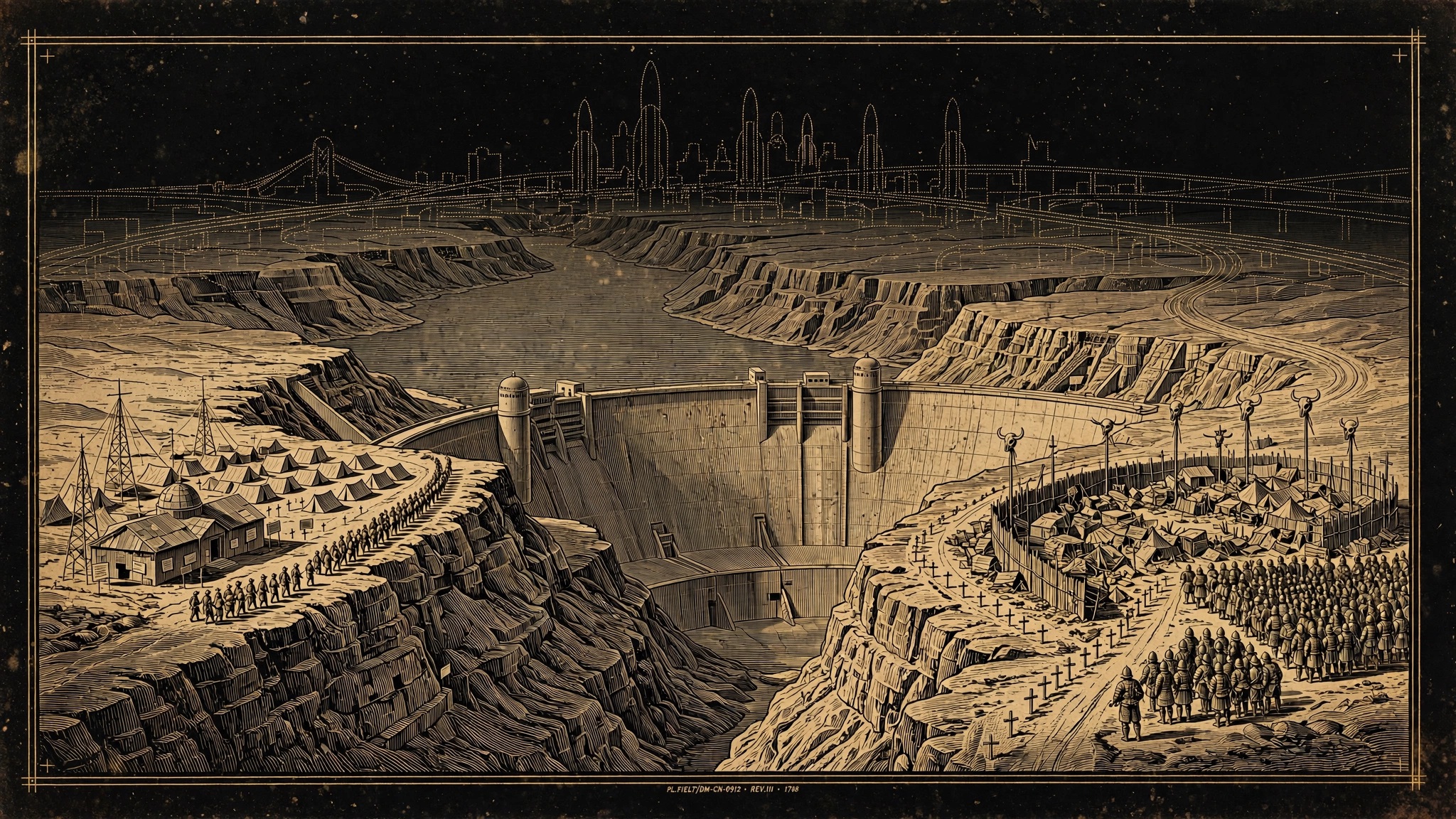
In the Mojave Desert, in the year 2281, two armies face each other across the Hoover Dam. One calls itself a republic. It elects a president, taxes its farmers, and pays its soldiers in paper money that was once backed by gold. The other calls itself a legion. It is led by a man who calls himself Caesar, it speaks in fragments of Latin, and it crucifies its enemies along the roads. Everyone on both sides was born long after the end of the world. None of them has ever seen Washington or Rome. Both armies are copies.
Two centuries after nuclear war destroyed the old United States in a single afternoon, the survivors of the Fallout series have rebuilt almost every institution their ancestors had. There is an order of armoured knights guarding forbidden knowledge. There is a republic that grows into a bureaucracy. There is an empire assembled from history books, a corporation that treats the human race as a test population, and a secret government that believes it alone deserves to survive. The Anthropology department studies how societies organise themselves, and the Wasteland poses the discipline a sharp question. Given a blank slate, why does humanity draw the same picture again?
This Excavation examines five of the civilizations that rose from the ashes, one idea that tried to be genuinely new, and the old world they were all built from.
I. The Knights
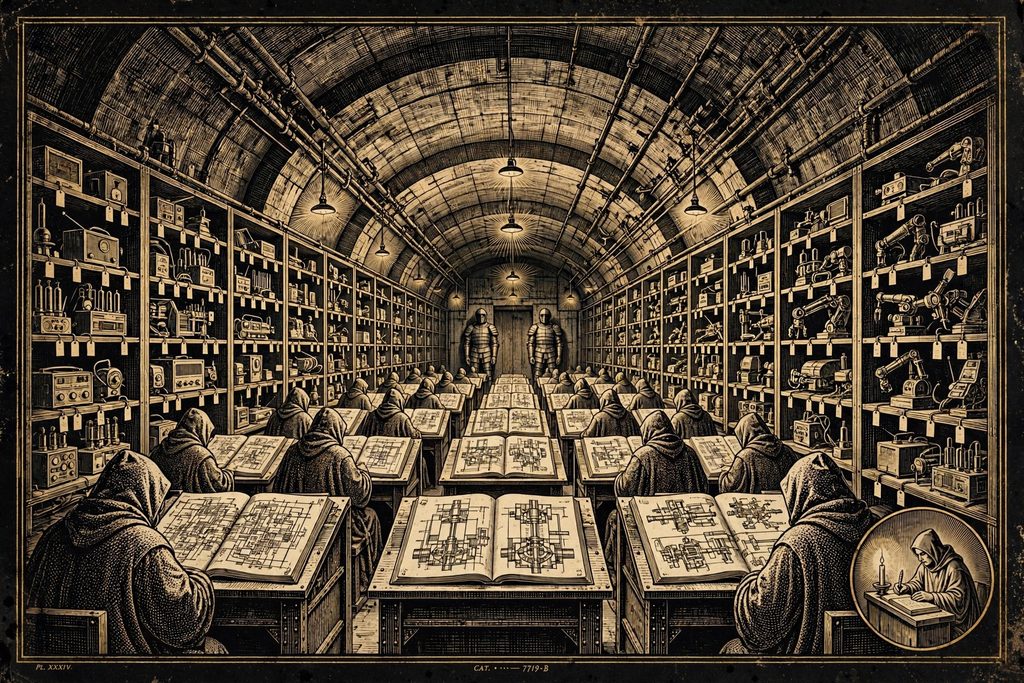
The Brotherhood of Steel began as a mutiny. In the days after the Great War, Captain Roger Maxson, commanding a detachment of the US Army at the Mariposa Military Base in California, discovered that the scientists there had been using military prisoners in experiments with the Forced Evolutionary Virus. He executed the officer in charge, broke with a government that no longer existed, and led his soldiers and their families into the desert. From that act of disobedience grew a closed order with its own ranks of Knights, Paladins, Scribes and Elders. It has a written rulebook called the Codex, and a hereditary line of leaders descended from Maxson himself.
The Brotherhood’s purpose is custodial. It collects pre-war technology, from laser rifles to robots, and keeps it out of the hands of people it considers unfit to use it. It believes humanity came close to extinction because it held power it did not understand, and it has appointed itself the guardian of that power.
Human history has seen this institution before. After the fall of Rome, Benedictine monasteries preserved the learning of the ancient world, copying manuscripts that most people could not read. During the Crusades, military orders such as the Templars combined monastic vows with the sword. The Brotherhood is both at once, a scriptorium with an armoury attached. The Wasteland even produced the legend that goes with it. In Fallout 4, the order’s leader is a young Elder named Arthur Maxson, and his flagship airship is called the Prydwen, the name of King Arthur’s ship in Welsh legend. The parallel was also foreseen in fiction. In 1959, Walter M. Miller Jr. published A Canticle for Leibowitz, in which monks after a nuclear war preserve fragments of scientific knowledge they no longer understand. The Brotherhood is that monastery with power armour.
The order carries the weakness of its models. It is insular and slow to recruit outsiders. When its interests clashed with a growing republic in California, it lost the war and declined on the west coast. It survived by expanding east. In Washington, D.C., and later in Boston, it became more open to recruits and more militant.
II. The Republic
The New California Republic began as a village. Shady Sands was founded by people who left Vault 15, and it grew under the leadership of Aradesh and then his daughter, Tandy. In the late 2180s it became the centre of a new state, and Tandy served as its president for decades. The republic promised what the Wasteland lacked most, which was law, safe roads, trade and elections. It fielded a famous order of Rangers to patrol its territory, and it built a currency.
Then it grew, and growing brought the problems of a large state:
- Currency. The NCR dollar was backed by gold until the Brotherhood of Steel destroyed the republic’s reserves. After that, the currency slid toward inflation.
- Rich landowners. Brahmin barons, the Wasteland’s cattle magnates, gathered political influence.
- Overstretch. By the time the republic reached the Mojave, its lines were stretched, its soldiers underpaid and its administration slow and corrupt.
In Fallout New Vegas, the NCR is at once the most humane power in the desert and the most exhausted.
The anthropologist Joseph Tainter argued in The Collapse of Complex Societies, published in 1988, that civilizations fall when the cost of maintaining their complexity rises faster than the benefits it returns. The NCR in 2281 is a textbook case, a republic spending more and more to hold territory that pays it back less and less.
The republic’s founding city met a darker end. The Fallout television series, which began in 2024, revealed that Shady Sands was later destroyed by a nuclear bomb. The attack was secretly engineered by a surviving Vault-Tec loyalist, as a way of clearing the surface for his own people. The first democracy of the new world was ended by a representative of the old one.
III. The Empire
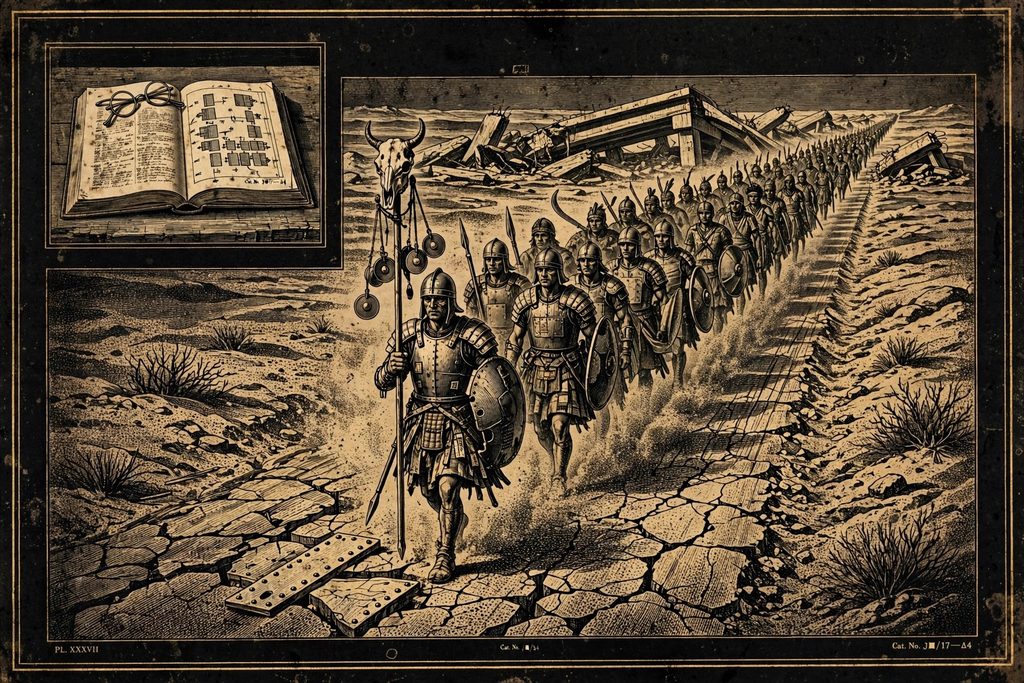
Caesar’s Legion is the most deliberate copy in the Wasteland. Its founder, Edward Sallow, was not a warlord by birth. He was a scholar with the Followers of the Apocalypse, a group that preserved learning and medicine in the ruins. In 2247 he joined an expedition to study the tribes of Arizona, carrying books on Roman history. When a tribe captured the expedition, Sallow taught his captors the military methods he had read about. He then used them to conquer the region. By the time of Fallout New Vegas, the Legion had absorbed eighty-six tribes into a single slave empire with Latin titles, Roman ranks, and an emperor who takes the name of Caesar.
Sallow knew exactly what he was doing. He explains his plan to the player in the language of the philosopher Hegel, as a dialectic. In his view, the republic is a thesis, his Legion is its antithesis, and out of their collision a stronger synthesis will be born. The Legion is not a return to barbarism. It is a theory of history put into practice by a reader.
Human history offers close parallels. On Christmas Day in the year 800, Charlemagne was crowned emperor in Rome, three centuries after the Western Empire had ended, because medieval Europe could not imagine legitimate power in any other form. The fourteenth-century historian Ibn Khaldun described a recurring cycle in which hardy tribal peoples from the desert, bound by intense group loyalty, conquer settled states that have grown soft. The conquerors then settle, grow comfortable and are conquered in turn. The Legion faces the NCR across the Mojave exactly as Ibn Khaldun would have predicted. Sallow’s own followers expected their empire to go the same way after him, settling into the very civilization it set out to replace.
IV. The Corporation
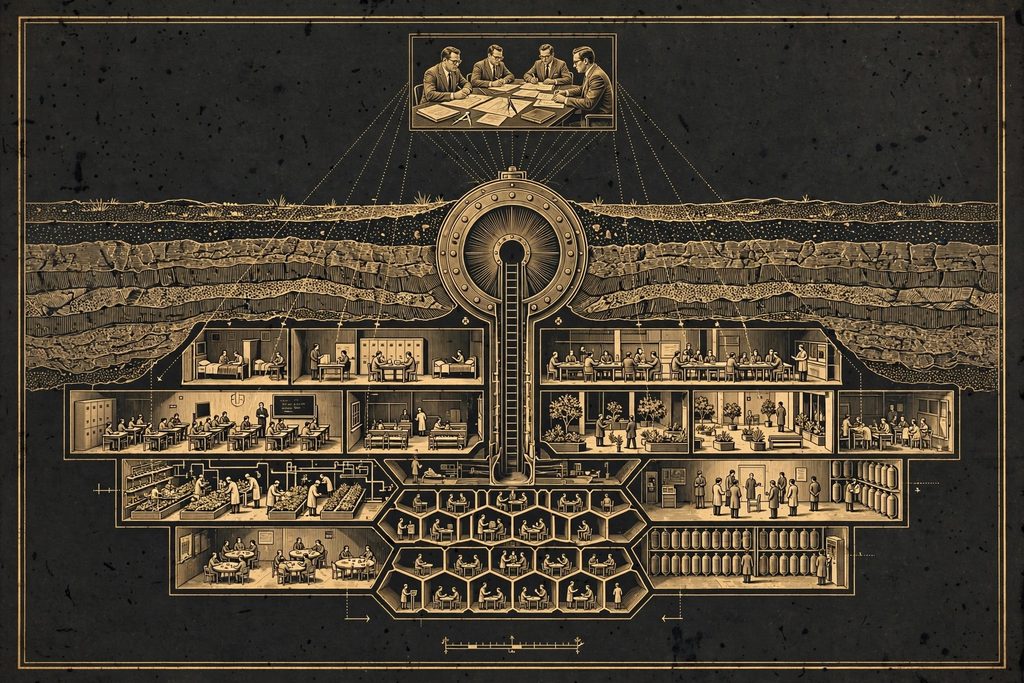
Before the bombs fell, the United States government contracted a company called Vault-Tec to build fallout shelters across the country. More than a hundred Vaults were built, and they were sold to the public as salvation. Most were in fact experiments designed to observe how people behave under engineered conditions:
- The residents of Vault 11 were told they must sacrifice one of their own every year or everyone would die.
- Vault 21 settled every dispute by gambling.
- Vault 111 froze its occupants in cryogenic pods without telling them.
Only a small number of Vaults were genuine control groups, built simply to keep people alive.
The television series took the logic of the corporation a step further. It shows Vault-Tec’s executives before the war, discussing whether to guarantee demand for their product by ensuring the bombs would fall. It also shows the company building a chain of Vaults, 31, 32 and 33, designed to preserve its own management and reintroduce it to the surface when the time came. In this telling, the corporation does not survive the apocalypse by accident. It plans to inherit the world.
Las Vegas shows the same institution in a different form. Robert House, the pre-war founder of the RobCo technology company, foresaw the war and prepared for it. When the missiles came, his systems stopped most of those aimed at Las Vegas. House then preserved himself in a life-support chamber inside his casino tower, the Lucky 38. Two hundred years later, he governs the New Vegas Strip as a private city-state. He has no elections, no ideology and no army beyond his robots. He runs the Strip as a business, and he believes that a sufficiently rational chief executive can steer humanity back to the stars.
V. The Shadow State
The Enclave is what remained of the pre-war government’s inner circle. Its members were officials, military officers and their families, protected in secure facilities while the country burned. For generations they considered themselves the legitimate United States and everyone else in the Wasteland as contaminated by radiation and mutation.
The Enclave’s plans were consistent across two coasts and two games:
- Fallout 2. Based on an oil rig off the California coast, it prepared a modified strain of the Forced Evolutionary Virus designed to kill every mutated human, which in practice meant almost everyone alive.
- Fallout 3. In the capital, it was led by a president who turned out to be a computer, and it planned to poison the water supply so that only its own people could drink it.
Both plans were defeated, and by the time of the television series the Enclave is a shadow of its shadow. Its idea persists all the same.
The Enclave is the state reduced to its most frightening instinct. A self-selected elite decides who counts as the true people and plans to clean the world of everyone else. It is the only faction in the Wasteland that does not need to copy an old institution, because it never stopped being one.
VI. The One New Idea
In all of Fallout’s history, only one faction proposed a genuinely new form of civilization. In 2102, a scientist named Richard Grey fell into a vat of the Forced Evolutionary Virus at the Mariposa base. He emerged fused with organic mass and machinery, a mind called the Master. His vision was Unity. Humanity would be converted into super mutants, strong, radiation-proof and identical, and in that sameness, war, prejudice and hunger would end.
The plan failed for a simple biological reason. The Vault Dweller, the hero of the first Fallout game, discovered that super mutants are sterile. The one truly new civilization anyone proposed had no future generation. Faced with the fact, the Master destroyed himself.
The Institute finds this the most telling detail in the entire series. The Wasteland’s only new idea could not reproduce, while the old ideas reproduce endlessly. Fallout 4 repeated the pattern with the Commonwealth Institute. It is a technocracy hidden beneath Boston that builds synthetic humans and seems to promise a new order. Its opponents immediately recognised it as something old. They formed the Railroad, named after the network that smuggled enslaved people to freedom before the American Civil War, and they revived the Minutemen, the colonial militia of the American Revolution. Boston, faced with a new tyranny, reached for the costumes of 1775.
The ancestor of them all
Every civilization in the Wasteland is a piece of the one that ended. Fallout’s history branches off from ours after the Second World War. Its America kept its vacuum tubes, its mid-century optimism and its faith in the atom, all the way to 2077. It fought the Resource Wars over the last of the world’s oil. It annexed Canada. It fought China in Alaska. It handed its citizens’ safety to a corporation that saw them as test subjects. On 23 October 2077 the bombs fell, and in the words of the first game’s opening narration, the world was reduced to cinders in two hours.
That dead America contained all five institutions at once:
- its army became the Brotherhood of Steel
- its republic became the NCR
- its imperial ambitions, the annexations and the wars for resources, found their open form in the Legion
- its corporations became Vault-Tec’s survivors and Mr. House
- its secret government became the Enclave
The Wasteland did not invent anything. It divided the old body between its heirs, and each heir rebuilt the organ it inherited.
The pattern
The Institute identifies four reasons why the Wasteland keeps rebuilding the same civilization.
The first is the library. Survivors rebuild from the templates they can find. Caesar read about Rome and built Rome. The Brotherhood kept military manuals and built an army. The Minutemen of Boston took their name and their ideals from the history of the city they lived in. A society assembled from salvaged books will resemble the books.
The second is preservation. Some institutions never died. Vaults, bunkers and life-support chambers carried the old world’s elites through the catastrophe intact, with their values unchanged. When they emerged, they did not need to reinvent anything.
The third is scarcity. The pressures that shaped the old world, such as competition for energy, water and security, did not disappear with it. The fight over the Hoover Dam is the Resource Wars again, at the scale of a single river. Similar pressures tend to produce similar solutions.
The fourth reason belongs to the authors. Fallout was created at Interplay in 1997 as a satire of mid-century America. Its first line, spoken over the ruins, is its thesis: “War. War never changes.” A series built on that premise was always going to show humanity repeating itself. The anthropological puzzle is also the joke.
Findings
- The Wasteland divided the old world between its heirs. The Brotherhood, the NCR, the Legion, the corporations and the Enclave each inherited one institution of pre-war America.
- The most successful copies were made deliberately. Caesar built his empire from Roman history books and explained it through Hegel’s dialectic.
- Complexity returned, and so did its costs. The NCR grew from a village into a republic and began to suffer the overextension Tainter described in real collapsing states.
- The only new idea was sterile. The Master’s Unity, the one truly new model of society, could not reproduce, while the old models reproduce endlessly.
- War never changes, because the institutions don’t. The series’ founding line is also its most accurate anthropological finding.
This Excavation draws on the Fallout games and the television series, and treats in-world dates and events as the historical record. Read more about how the Institute works. For the faiths that grew up alongside these civilizations, see The Cults of the Wasteland.
The Institute collects field evidence from people who lived inside these worlds. If you chose a side at the Hoover Dam and still think about it, send us your account.
Sources
- Fallout (Interplay, 1997), Fallout 2 (Black Isle Studios, 1998), Fallout 3 (Bethesda Game Studios, 2008), Fallout New Vegas (Obsidian Entertainment, 2010), Fallout 4 (Bethesda Game Studios, 2015).
- Fallout, the television series (Amazon Prime Video, 2024 onward), and Fallout season 2 (December 2025 to February 2026).
- Mr. House, The Fallout Wiki, for the defence of Las Vegas.
- Walter M. Miller Jr., A Canticle for Leibowitz (1959).
- Joseph A. Tainter, The Collapse of Complex Societies (1988).
- Ibn Khaldun, The Muqaddimah (1377).
- G. W. F. Hegel, Lectures on the Philosophy of History (published 1837).