





EXCAVATION Nº 0011 · ANTHROPOLOGY
World: Tamriel, Skyrim
Period: 4E 171 to 4E 201 (in-world)
Status: Contested
In November 2026, The Elder Scrolls V Skyrim turns fifteen. It was released on 11 November 2011 and has been sold again and again since, in a special edition, a virtual reality edition, a portable edition and an anniversary edition. It has sold tens of millions of copies. Players joke about a condition they call Skyrim syndrome, the habit of abandoning newer games to return to the same frozen province, the same roads and the same small house in Whiterun. For a large part of the player population, Skyrim is less a game than a place they live.
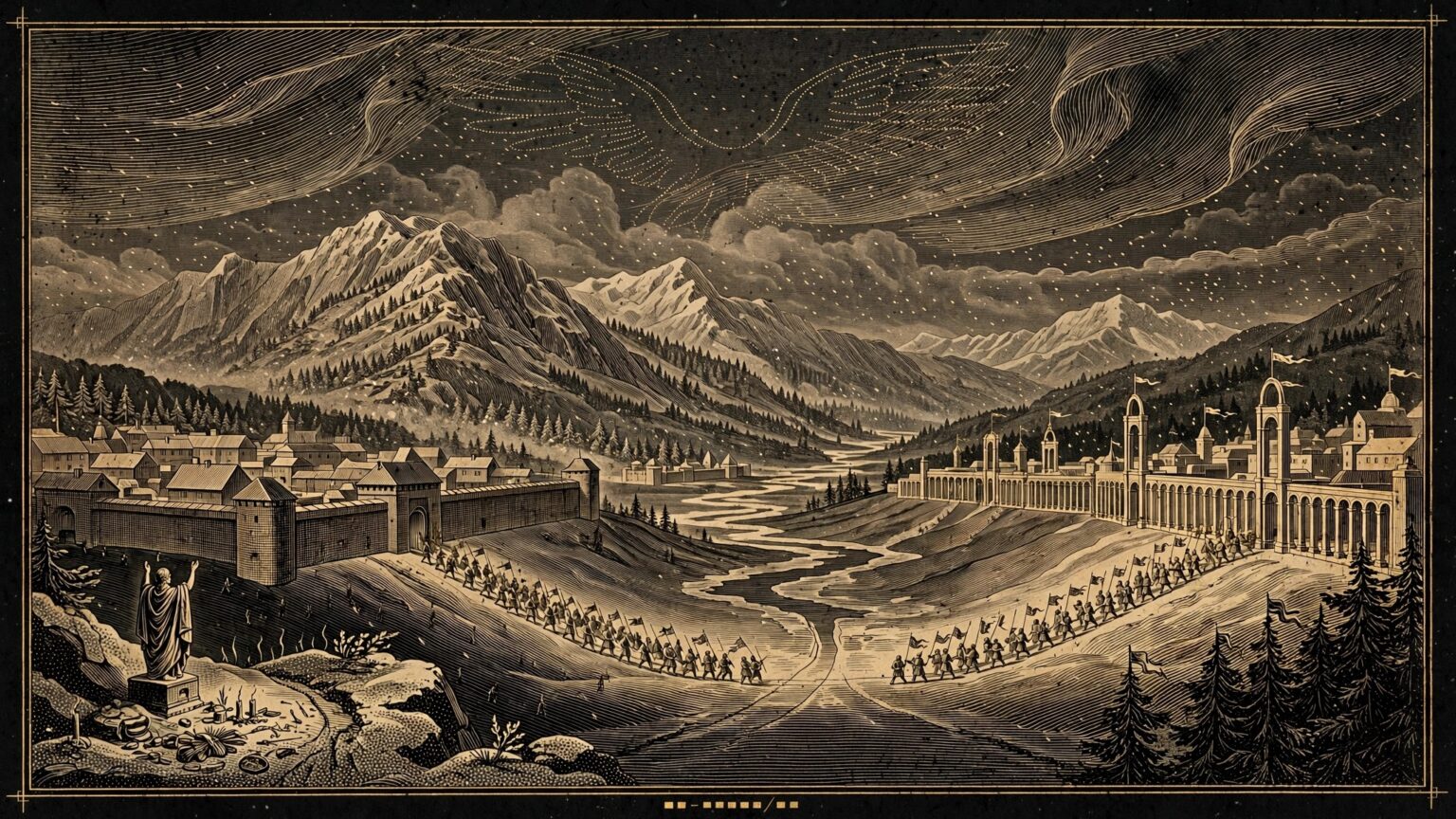
What they return to is a country at war with itself. When the game opens, the province of Skyrim is split between the Empire that has ruled it for centuries and a rebellion of its own people, the Stormcloaks. The cause of that war is not land, gold or succession. It is a god. Five years before the game, a treaty made his worship illegal.
The Anthropology department studies how imagined societies govern, divide and hold together. Skyrim is an unusually rich case. It is a society in which religion, ethnic identity, imperial politics and a thousand years of conquest have fused into a single question that every player is asked to answer, which side are you on?
I. The Treaty
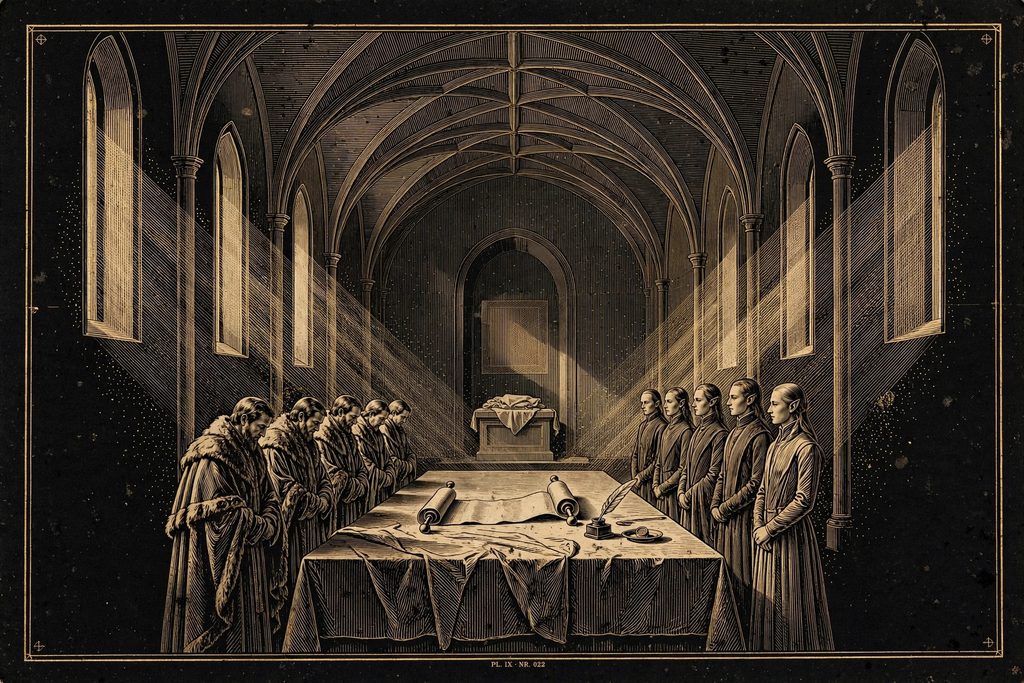
In 4E 171, by the calendar of Tamriel, the continent on which Skyrim lies, the Aldmeri Dominion went to war with the Empire. The Dominion was an alliance of elven nations led by a supremacist faction called the Thalmor. The Great War lasted until 4E 175 and ended in a costly stalemate. To buy peace, the Emperor signed the White-Gold Concordat. Its terms were humiliating. A large part of southern Hammerfell was ceded to the Dominion, the Blades, the Emperor’s traditional guardians, were disbanded, and the worship of Talos was banned throughout the Empire.
The ban was enforced by the Thalmor themselves. Their agents, called Justiciars, were allowed to move through the Empire’s provinces and arrest anyone found worshipping the forbidden god. The province of Hammerfell refused to accept the treaty, fought on alone, and eventually drove the Dominion out. Skyrim’s rulers were paid to stay quiet. Its people were not consulted.
For the Nords, the native people of Skyrim, the ban struck at the centre of their identity, because Talos was one of them.
II. The Forbidden God
Talos was once a man. In the history of the Elder Scrolls games, he was Tiber Septim, the general and emperor who united Tamriel under the Third Empire. Nord tradition holds that he was born in Skyrim, and that he possessed the Voice, the ancient Nord power of shouting words of dragon language that reshape the world. After his death, he ascended and was worshipped as Talos, the Ninth Divine, added to the Empire’s traditional pantheon of Eight.
To the Thalmor, this is intolerable. Their faith holds that the elves are descended from divine beings, and that the mortal world is a kind of prison into which their ancestors fell. A human who became a god is, to them, both an insult and a theological problem. A widely discussed reading of the games’ lore goes further. It suggests that the Thalmor’s real aim in suppressing Talos is to weaken the foundations of the mortal world itself, as a step toward undoing it. Whatever their ultimate purpose, the ban is not simple religious intolerance. It is a war waged through theology.
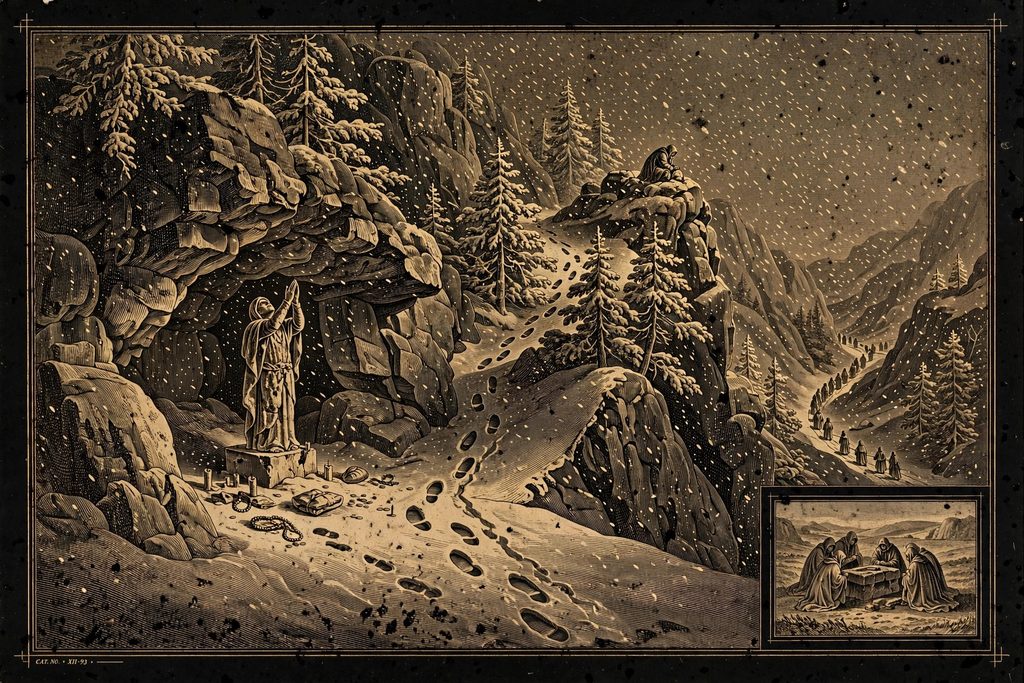
Talos did not disappear from Skyrim. His shrines still stand along the roads and in the mountains, and worshippers still leave offerings at them in secret. In the city of Whiterun, a priest named Heimskr preaches the worship of Talos loudly and every day from beside a Talos statue in the street, and the local authorities choose not to hear him. Banned faiths often behave this way. They move out of the temple and into the landscape, and become more important to their believers because they are forbidden.
Real history offers close parallels. In 186 BC, the Roman Senate issued a decree restricting the worship of Bacchus throughout Italy, after rumours spread of secret, dangerous rites. From the late seventeenth century, the Penal Laws in Ireland imposed severe restrictions on Catholic worship. Irish Catholics gathered in secret at outdoor stones in remote places, now remembered as mass rocks. In Ireland, a suppressed religion became inseparable from national identity. The same thing is happening in Skyrim.
III. The Man Who Used the Voice
The rebellion’s leader, Ulfric Stormcloak, is the ban’s most dangerous product. As a young man he spent nearly a decade training with the Greybeards, the monastic masters of the Voice who live in seclusion on the mountain of High Hrothgar. The Greybeards follow a discipline called the Way of the Voice. It holds that the Thu’um, the Nord power of the shout, is a sacred gift that should be used for contemplation and worship, never for war.
Ulfric left the mountain to fight in the Great War. He was captured by the Thalmor and interrogated. In the game, a Thalmor dossier on him, found in their embassy in Skyrim, classifies him as an asset. The implication is that the elves let him go because a rebellion in Skyrim would weaken the Empire from within. The Dominion that banned Talos may be quietly encouraging the war fought in his name.
After the war, when native Reachmen seized the city of Markarth, Ulfric’s militia took it back. In return, he demanded the open worship of Talos in the city. The Empire, bound by the Concordat, could not allow it. The incident ended with Ulfric imprisoned and the Thalmor given greater freedom to hunt Talos worshippers across Skyrim.
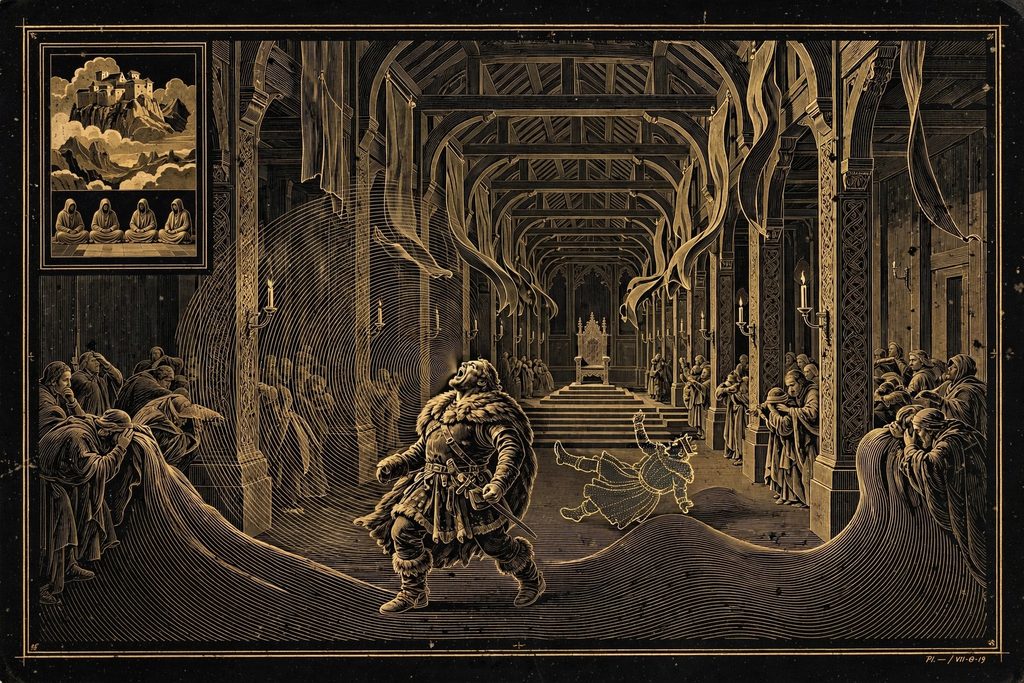
In 4E 201, the year the game begins, Ulfric challenged Torygg, the young High King of Skyrim, to a duel in his own court in Solitude. Such a duel was a legal Nord tradition. Ulfric used the Voice, and Torygg died. The act was entirely in keeping with the Nords’ ancient traditions of combat, and entirely contrary to the Greybeards’ teaching. A man trained in the sacred Voice turned it into a weapon of politics. That is the moment the civil war began.
IV. Two Unfree Choices
Skyrim asks every player to choose a side, and neither side is clean.
The Empire offers order, law, a multi-ethnic state and continued strength against the Thalmor. It also enforces a foreign power’s religious ban on its own citizens. In the game’s opening scene, it marches a cart of prisoners, including the player, to the headsman’s block in the town of Helgen. One of them is on no list, and none has had a trial.
The Stormcloaks offer religious freedom and self-rule for Skyrim. They also carry an ethnic nationalism of their own, the conviction that Skyrim belongs to the Nords. In Windhelm, Ulfric’s capital, Dunmer refugees, the dark elves who fled a catastrophe in their homeland, are confined to a run-down district called the Gray Quarter. Argonians are kept outside the city walls, working the docks. The rebellion that demands freedom of worship for Nords does not extend equal freedom to others.
Players have argued about this choice since 2011, and the argument has never been settled. The Institute believes this is the civil war’s real achievement. It is a political dilemma in which a genuine right, freedom of religion, is bound up with a genuine wrong, ethnic exclusion, and the alternative is a tolerant empire that has surrendered its own sovereignty to a foreign power. Most games give players a villain. Skyrim gives them two compromised causes and an unresolved question.
V. The Older Gods
The Nords have not always worshipped Talos. Skyrim is built on layers of earlier faiths and earlier conquests, and each can still be found underground.
The oldest human rulers of Skyrim were not human at all. In ancient times, dragons ruled the land as gods, and a priesthood of dragon priests governed its people in their name. The Nords rebelled, learning the dragons’ own language to use against them. This was the origin of the Voice, and the dragons were overthrown. Their chief, Alduin, was cast out of time. His return is the main story of the game.
Before that, when the Nords’ ancestors first arrived by sea from the northern continent of Atmora, Skyrim belonged to the Snow Elves. The newcomers, led by the legendary hero Ysgramor, drove them out in a war of conquest. The surviving Snow Elves fled underground, where they were enslaved by another elven race, the Dwemer, and degenerated over centuries into the blind, feral Falmer who haunt Skyrim’s caverns. In the west, the native Reachmen, or Forsworn, still fight the Nord rulers of their land, as they did at Markarth.
The Nords’ own traditional pantheon survives too. It includes Shor, the god of the dead whose hall in Sovngarde receives the souls of brave Nord warriors, and Kyne, the goddess of the sky and storms. In the game’s final act, the player travels to Sovngarde itself.
So the war over Talos is the latest in a long sequence. Each people that ruled Skyrim made its power sacred, from the dragons to the Snow Elves, the ancient Nords, the Empire and now the rebellion. Each was built on top of the people it displaced. Beneath every city in Skyrim lies a ruin belonging to someone else, and the Nords who demand their god back are themselves settlers on conquered ground.

The ancestor of them all
The Nords are modelled closely on the peoples of medieval Scandinavia. Sovngarde, the hall of heroes, recalls Valhalla, and Ysgramor’s sea-borne arrival recalls the voyages of the Norse settlers. The Institute’s study of the Norse underworld in Hellblade traced how those myths reach modern games through the medieval Icelandic sources.
The civil war itself draws on a different inheritance, the long history of empires that tolerate many faiths until one becomes politically dangerous. Rome accepted the gods of the peoples it conquered, but restricted the Bacchic rites in 186 BC and later persecuted Christians, whose refusal to honour the imperial cult looked like disloyalty. Britain’s Penal Laws turned Irish Catholicism into a mark of national identity. In each case, the authorities believed they were suppressing a religion. In practice they were creating a nation.
Skyrim places the player at exactly that moment. It is the point at which a ban meant to keep the peace becomes the cause of a war, and a god becomes a flag.
The pattern
Skyrim’s civil war follows a sequence the Institute sees in real and imagined societies:
- A ban turns belief into identity. Forbidding Talos made his worship a statement about who the Nords are, not only what they believe.
- Outside powers exploit inside divisions. The Thalmor banned the god and may be sponsoring the rebellion fought in his name.
- Sacred power is turned to politics. Ulfric used the Voice, a gift meant for worship, to kill a king.
- Freedom and exclusion arrive together. The movement demanding religious liberty for Nords restricts the freedom of Dunmer and Argonians.
- Every conqueror is built on an earlier conquest. From dragons to Snow Elves to Nords to Empire, each ruling people sanctified its power over the people it displaced.
For another world that keeps rebuilding the institutions of its past, see Why the Wasteland Keeps Rebuilding the Same Civilization.
Findings
- Skyrim’s civil war is a war over a god. Its immediate cause is the White-Gold Concordat of 4E 175, which banned the worship of Talos as the price of peace with the Aldmeri Dominion.
- The ban is theology used as a weapon. A human who became a god is intolerable to the Thalmor, and suppressing him serves both their faith and their strategy.
- Suppression created a nation. Like the Bacchic rites in Rome and Catholicism under the Irish Penal Laws, forbidden worship of Talos became a mark of Nord identity.
- Neither side is clean. The Empire enforces a foreign ban and summary justice. The Stormcloaks combine religious freedom with ethnic exclusion. Players have debated the choice since 2011.
- Skyrim is built on layers of conquest. Dragons, Snow Elves, Dwemer, Nords and Empire each sanctified their rule over someone else, and their ruins lie literally beneath one another.
This Excavation draws on The Elder Scrolls V Skyrim and the published lore of the Elder Scrolls series. Read more about how the Institute works.
The Institute collects field evidence from people who lived inside these worlds. If you chose a side in Skyrim’s civil war and can explain why, send us your account.
Sources
- The Elder Scrolls V Skyrim (Bethesda Game Studios, 2011), and its later editions (2016 to 2021).
- White-Gold Concordat and Ulfric Stormcloak, The Elder Scrolls Wiki.
- Livy, History of Rome, Book 39, on the suppression of the Bacchanalia in 186 BC.
- On the Irish Penal Laws and mass rocks, see S. J. Connolly, Religion, Law, and Power: The Making of Protestant Ireland 1660 to 1760 (1992).