





EXCAVATION Nº 0007 · MYTHOSPHERE
World: Orkney and Helheim, Hellblade
Period: Late 8th to 9th century (in-world)
Status: Active
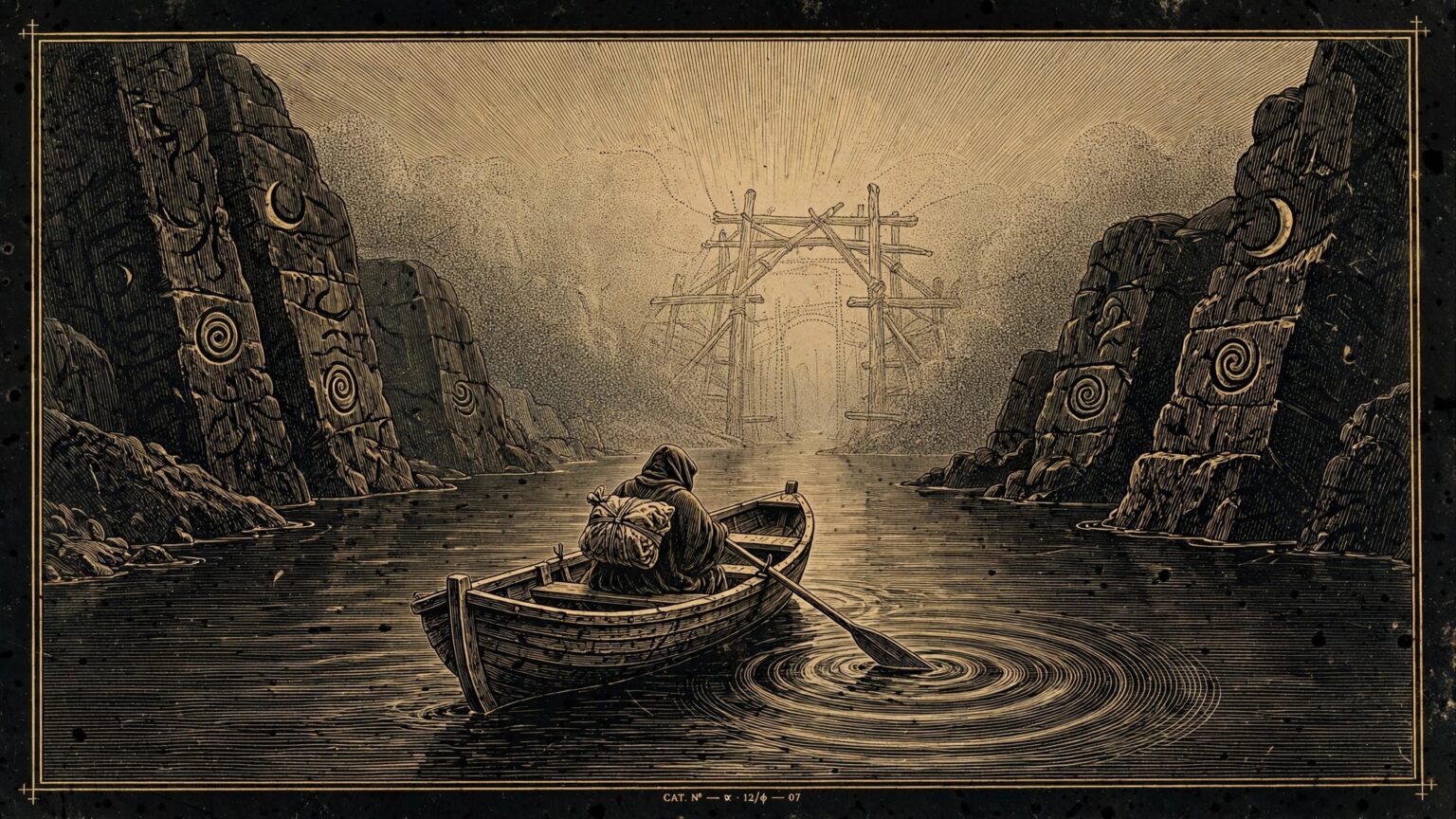
A young woman rows a small boat down a dark river toward a wall of fog. Her face is painted blue and her hair is caked with mud. In her lap she carries a cloth bundle holding what remains of the man she loved. She is going to the land of the dead to ask its queen to give him back. In the voices only she can hear, some encourage her, some mock her, and some tell her she will fail.
This is the opening of Hellblade Senua’s Sacrifice, released by Ninja Theory in 2017. It is also one of the oldest stories human beings tell. The journey into the underworld to recover someone who has died appears in Greece, in Mesopotamia, in Japan and in the North, and it almost always ends the same way. The Mythosphere studies the myths that fictional worlds share and reshape. Hellblade reshapes this one in an unusual way. It tells a Norse descent to the underworld through the eyes of someone who is not Norse, and it builds that underworld out of the structure of a mind in grief and psychosis.
I. The Oldest Journey
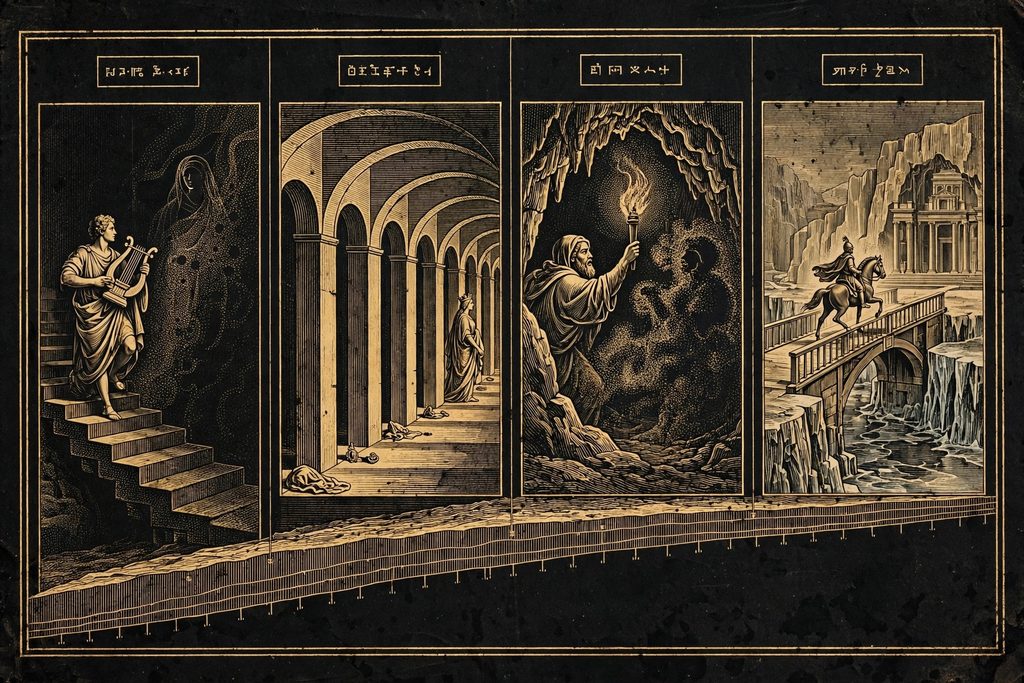
Scholars call it katabasis, the going down. In Greek myth, Orpheus walks into Hades to bring back his wife Eurydice. He charms its rulers with music and is allowed to lead her out on one condition, that he does not look back. He looks back and loses her. In the Sumerian poem of Inanna’s descent, the queen of heaven passes through seven gates, surrendering a garment at each, and arrives before her sister Ereshkigal naked and powerless. In Japan, the god Izanagi follows his dead wife Izanami into Yomi. Against her wishes, he lights a torch, sees what death has done to her, and flees.
The North has its own version. When the god Baldr is killed, the messenger Hermóðr rides for nine nights to the hall of Hel, the goddess who rules the dead, to ask for his return. Hel names her price. If every thing in the world, living and dead, will weep for Baldr, he may go home. Every thing weeps except one, a giantess in a cave, thought to be the trickster Loki in disguise. Baldr stays.
Every version keeps the same rule. The living may enter the land of the dead, but the dead do not come back, and the traveller who goes down comes back changed. Hellblade follows the rule precisely. Senua goes to Helheim to reverse a death, and what she finds there instead is a way to live with it.
II. The Stranger’s Myths
The first thing to notice about Senua’s underworld is that it is not hers. Senua is a Pict, one of the peoples of the far north of Britain, from Orkney in the late eighth century. Her world is Celtic, and her enemies are the Northmen who have begun raiding the coasts of Britain. The raid on the monastery at Lindisfarne in 793 is usually taken as the start of the Viking Age. The Roman name for her people, Picti, is usually taken to mean the painted ones, which is the tradition behind Senua’s blue face paint. The Picts left carved symbol stones across Scotland and almost no writing, so even their own beliefs reach us only in fragments.
So Senua does not travel through her own afterlife. She travels through her enemies’. She knows the Norse gods only from Druth, a man who was once held captive by the Northmen and who told her their stories after he escaped. As the player explores, standing stones called lorestones replay Druth’s voice telling those stories. They cover the creation of the worlds, Odin’s hunger for knowledge, and the coming of Ragnarök. Senua’s Helheim is assembled from the myths of the people who killed Dillion, heard second-hand from a man who survived them.
This is exactly how most of the world knows Norse mythology. Almost everything we know of it comes from two medieval Icelandic sources. The Prose Edda was written by Snorri Sturluson around 1220, more than two centuries after Iceland became Christian. The Poetic Edda survives in a manuscript made around 1270. Both were written by Christians looking back at a religion that was no longer practised. The Norse gods reach us through an interpreter, and Hellblade makes the interpreter visible. Druth’s stories are the Edda of the Picts.
III. The Gatekeepers
The powers Senua faces are drawn from the Norse sources, but each is reshaped around her mind:
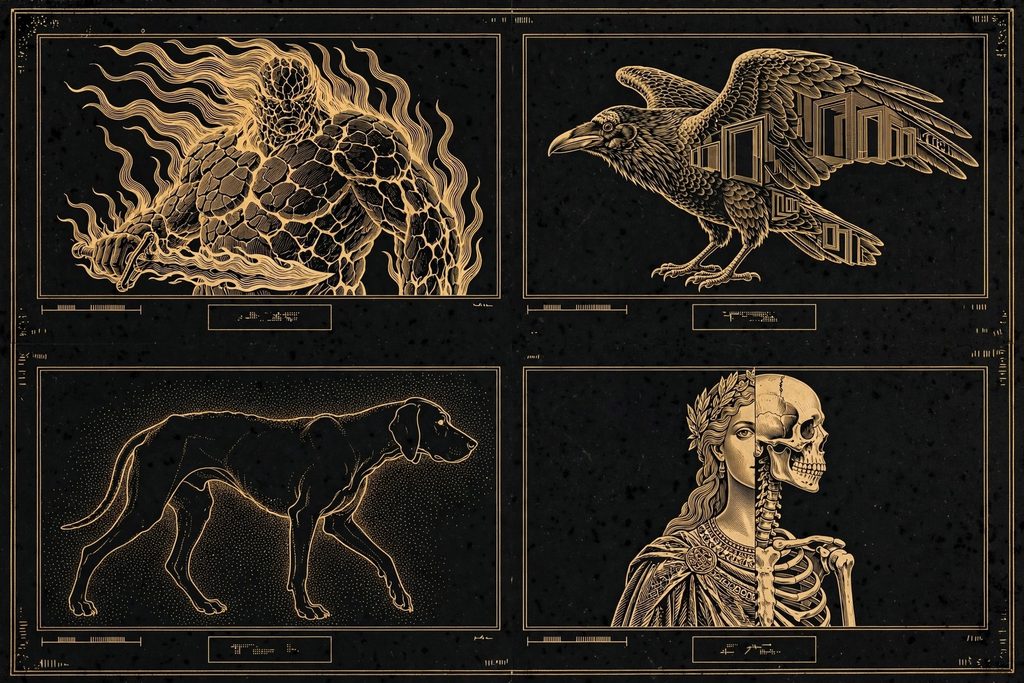
- Surtr is the fire giant who, in the Edda, will come from the burning realm of Muspelheim at Ragnarök and set the world alight. In Hellblade he is a trial of fire that Senua must pass through, a force that consumes everything, including the memory of her village burning.
- Valravn is not an Edda god at all. It comes from later Danish folklore, a raven that has eaten the flesh of the slain. Hellblade turns it into a god of illusion, whose trial is a maze of false doorways and shifting perspectives. It is a fitting master for a player who can no longer be sure that what she sees is real.
- Garmr is the hound that the Poetic Edda places at the entrance to Hel, the best of hounds and the most terrible. In Hellblade it becomes a beast made of darkness, visible only in light, which Senua must fight in shadow.
- Hela herself comes last. Snorri describes Hel as half dark and half flesh-coloured, grim and easy to recognise. Hellblade gives her the same divided body, half living and half rotted, and places her at the end of a bridge over a sea of the dead.
The Institute notes how precise this adaptation is. Surtr stands for loss by fire, Valravn for uncertainty about what is real, Garmr for fear of the dark, and Hela for death itself. Each god is a real figure from Norse sources, chosen because it matches something Senua is already carrying.
IV. The Runes
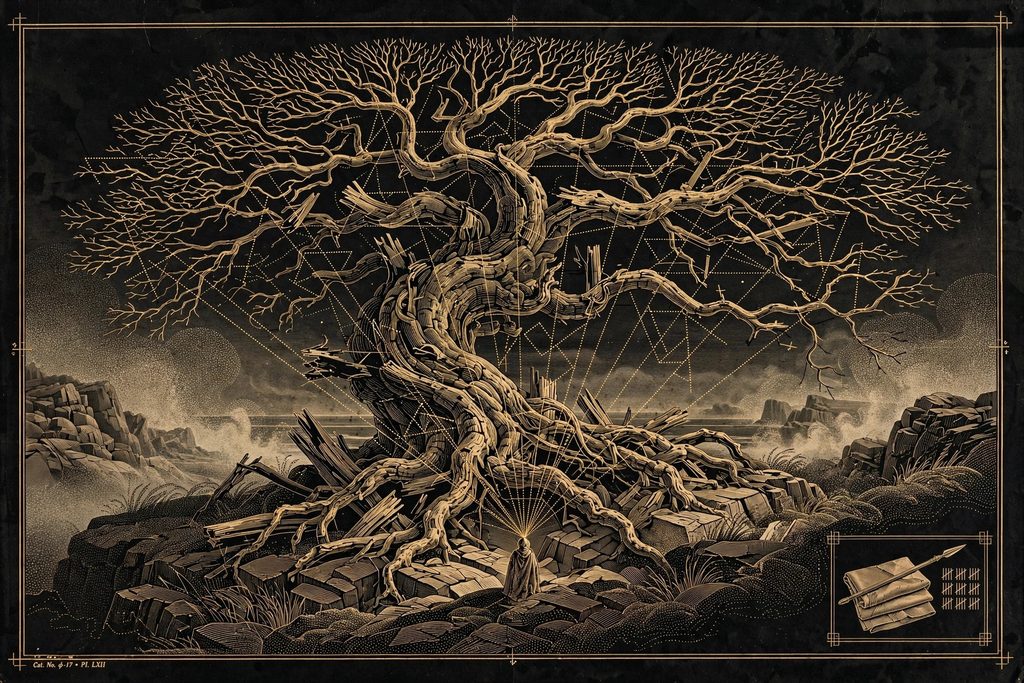
In the Norse poem Hávamál, Odin describes how he won the runes. He hung for nine nights on a wind-swept tree, wounded by a spear, a sacrifice of himself to himself, without food or drink. At the end of his ordeal he looked down, cried out, and took up the runes. In the Norse tradition, the power of writing is gained through suffering and a kind of seeing that ordinary people do not have.
Hellblade builds its central puzzle mechanic on this idea. Senua comes to doors sealed with runes. To open them, she must find the same rune shape somewhere in the world around her. It might be formed by the shadow of a broken beam, the line of two branches, or the edge of a ruined wall, and it only aligns when seen from one exact spot. The player learns to scan the environment for patterns that may or may not be there.
The psychological term for this is apophenia, the tendency to perceive meaningful patterns in random things. Everyone experiences it, and it is often heightened in psychosis. Hellblade takes a symptom and turns it into the Norse path to wisdom. Odin gained the runes by seeing what others could not, and so does Senua. The game never decides whether that makes her cursed, gifted, or simply unwell, and neither does the myth.
V. The Darkness
Senua’s own people gave her illness a mythology too. Her father, Zynbel, a druid, taught her that the voices and visions she experienced were a curse, a darkness inside her that had to be feared and hidden. Senua’s mother, Galena, had experienced the same visions, and Zynbel had put her to death by fire. The trauma Senua carries into Helheim did not begin with the Northmen. It began at home, in the story her own culture told about her mind.
The early medieval Celtic world did have such stories. The Irish tale of Buile Shuibhne tells of a king, Suibhne, who went mad during a battle and became a geilt, a wild man who lived in the treetops, fled from human company and composed poetry. The geilt was pitied and feared, and understood as touched by something beyond ordinary life. Cultures across history have explained experiences like Senua’s through myth, as possession, curse, prophecy or holy madness. Hellblade shows two cosmologies competing to explain the same woman, her father’s darkness and the Northmen’s gods.
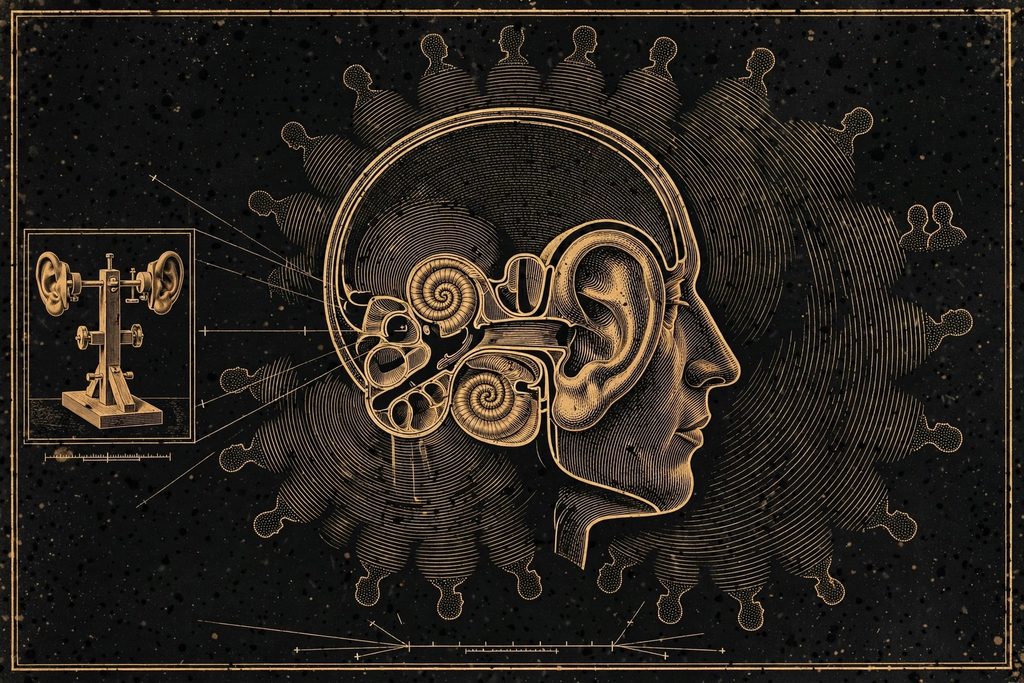
Ninja Theory worked to make that experience accurate rather than exploited. The team, about twenty people, consulted Paul Fletcher, a professor of health neuroscience at the University of Cambridge, and the psychologist Charles Fernyhough, who studies voice-hearing at Durham University. They also worked with people who live with psychosis, with support from the Wellcome Trust. The voices Senua hears, which the game calls the Furies, were recorded binaurally. This technique captures sound as two human ears would hear it, so on headphones the voices seem to move around the player’s head. A short documentary about this research was included with the game.
The result was widely recognised. Melina Juergens, a video editor at the studio who became Senua’s performer, won the BAFTA Games Award for Performer in 2018. The game won several other BAFTAs that year, and it had sold over a million copies by mid 2018. By the end of the game, Senua has not been cured. She stops treating her voices as a curse and accepts them as part of who she is, and she lets go of the man she came to save. The descent works as katabasis always does. She does not bring the dead back. She comes back changed.
VI. The Giants
Ninja Theory returned to Senua in 2024 with Senua’s Saga Hellblade II. The sequel moves her to Iceland in the ninth century, a land the Norse were then settling. She lets herself be captured by slavers in order to free her people, and she is shipwrecked on a coast where the local communities are being destroyed by giants.
In Norse myth, the jötnar, the giants, are the ancient rivals of the gods, forces of chaos, frost and fire that the gods hold back but never finally defeat. Hellblade II keeps the giants but makes their nature uncertain. As Senua learns more, the story suggests that each giant was once a person, transformed by grief, desperation and a search for power. Senua increasingly resolves these encounters through understanding rather than killing. The sequel reshapes the jötnar the way the first game reshaped Hel. A figure of cosmic chaos becomes a human being who has been broken.
The ancestor of them all
Every modern retelling of Norse myth in games and film, from God of War to Marvel’s Thor, descends from the same few manuscripts. Snorri Sturluson wrote the Prose Edda partly as a handbook for poets, so that the old stories and their imagery would not be forgotten after the conversion to Christianity. The Codex Regius, the manuscript that preserves most of the Poetic Edda, was lost for centuries and rediscovered in Iceland in the seventeenth century. Without those two books, most of the Norse gods would be names on runestones.
Most retellings present the Norse cosmos as a world that simply exists, with gods to be fought and realms to be crossed. Hellblade is distinctive because it presents the Norse cosmos as something perceived. Its myths are stories told by an escaped captive, heard by a grieving woman, and projected onto a landscape by a mind that finds meaning in every shadow. In that sense it is closer to the Edda than most adaptations. The Edda, too, is a mythology seen from outside, preserved by people who no longer believed in it.
The pattern
Hellblade follows a pattern the Institute finds across many fictional worlds that borrow from real myth:
- Adaptation selects. Of all the Norse powers available, Hellblade chose the ones that match its protagonist’s inner life, fire for loss, illusion for uncertainty, the hound for fear and Hel for death.
- The borrower changes the myth’s meaning. Told by Norse believers, Hel is a goddess to be feared. Told by a Pictish woman who has lost everything, she becomes a mirror.
- Myth arrives through interpreters. Druth’s stories, Snorri’s Edda and the game itself are all retellings by someone standing outside the original faith.
- The oldest structures survive the adaptation. Even reshaped this far, the story still keeps the katabasis rule that the dead do not return.
Findings
- Hellblade is a katabasis. It retells humanity’s oldest recurring myth, the descent to recover the dead, and keeps its ancient rule that the dead cannot return.
- Its underworld is borrowed. Senua travels through the Norse cosmology of her enemies, learned second-hand from a man who survived them.
- Each god matches a burden. Surtr, Valravn, Garmr and Hela were chosen from Norse sources because each reflects something Senua is already carrying.
- A symptom becomes a path to wisdom. The rune puzzles turn apophenia into Odin’s way of seeing, and the game refuses to decide whether that is a curse or a gift.
- Myth is always an interpretation. Hellblade mirrors the Edda itself, a mythology preserved and retold by people standing outside it.
This Excavation draws on both Hellblade games, the medieval Norse and Irish sources, and published accounts of the games’ development. Read more about how the Institute works.
The Institute collects field evidence from people who lived inside these worlds. If Senua’s journey meant something to you or someone close to you, send us your account.
Sources
- Hellblade Senua’s Sacrifice (Ninja Theory, 2017), including the documentary Hellblade Senua’s Psychosis.
- Senua’s Saga Hellblade II (Ninja Theory, 2024).
- Hellblade: Senua’s Sacrifice and Senua’s Saga: Hellblade II, Wikipedia, for development, consultants, sales and awards.
- Snorri Sturluson, Prose Edda (c. 1220), especially Gylfaginning on Baldr, Hermóðr and Hel.
- The Poetic Edda (Codex Regius, c. 1270), especially Hávamál on Odin and the runes, and Völuspá.
- Buile Shuibhne (The Frenzy of Suibhne), medieval Irish tale.
- The Descent of Inanna, Sumerian poem.