

Every invented world needs a center, and a surprising number of them have chosen the same one. In the mountains of Middle-earth, two trees gave light to the world before the sun existed. Over the Lands Between, a golden tree fills the sky, visible from every corner of the map. On Pandora, a great willow-like tree connects every living thing to the mind of the planet. In the forest of Hyrule, an ancient tree speaks to the children who live beneath it. Writers and game designers who build worlds from nothing keep planting a tree at their heart.
They are inheriting one of the oldest ideas in human religion. Scholars call it the world tree, or the cosmic tree, a single tree that stands at the center of creation, joining the heavens, the world of the living and the world below. Its most famous form is Yggdrasil, the ash of Norse myth, but it grew in many lands long before the Vikings, from Mesopotamia to Siberia, from India to the Maya.
The Institute has followed shared myths before, through the underworld of The Norse Underworld Inside Senua’s Mind and the many lives of the dragon in The Genealogy of the Dragon. This Excavation follows the tree, from its roots in the ancient world to its branches in modern fiction, and asks why its death so often marks the end of an age.
I. Yggdrasil
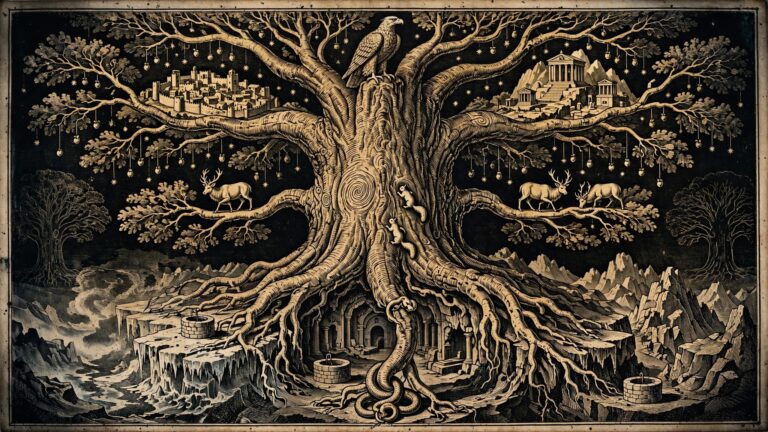
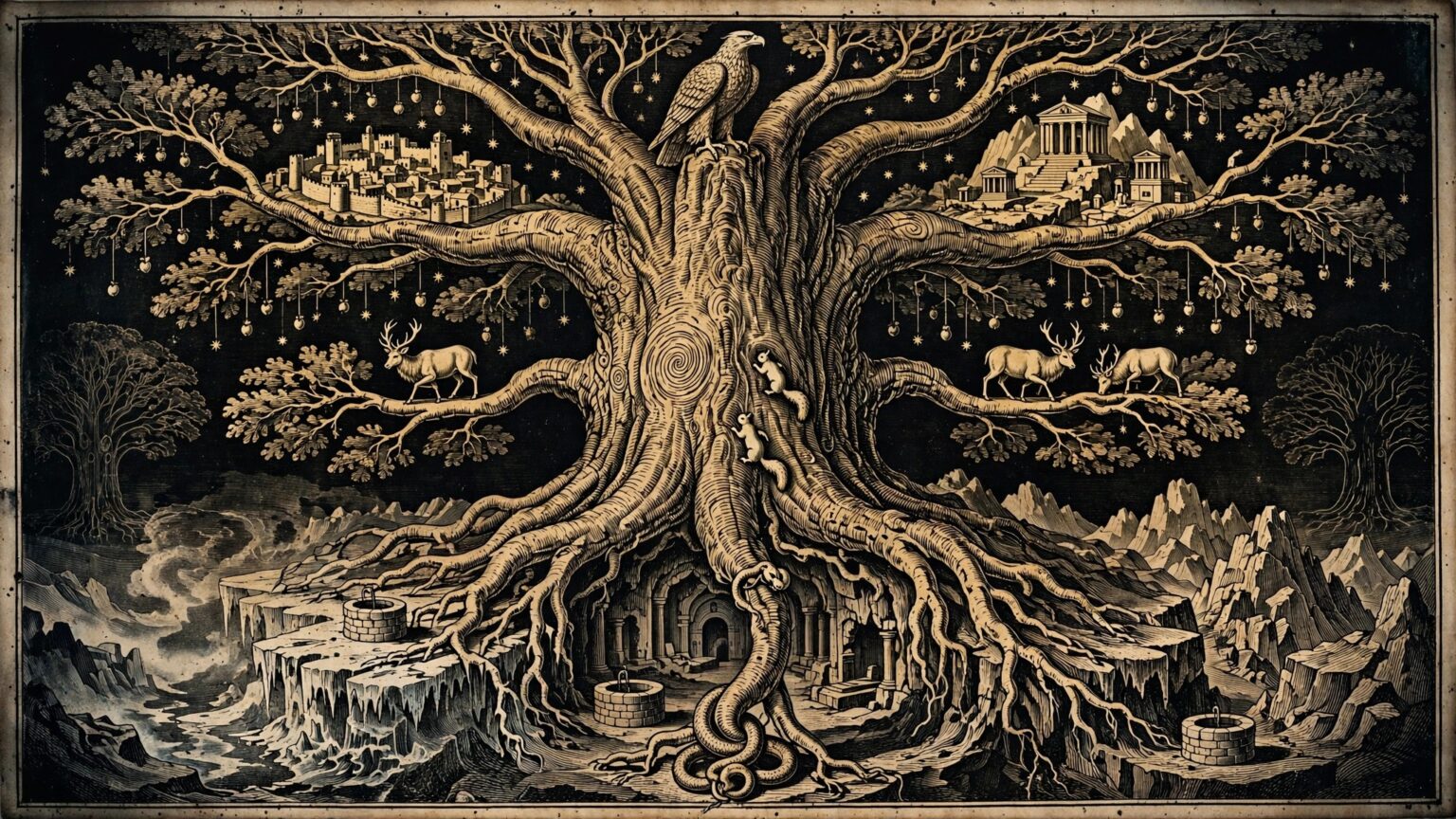
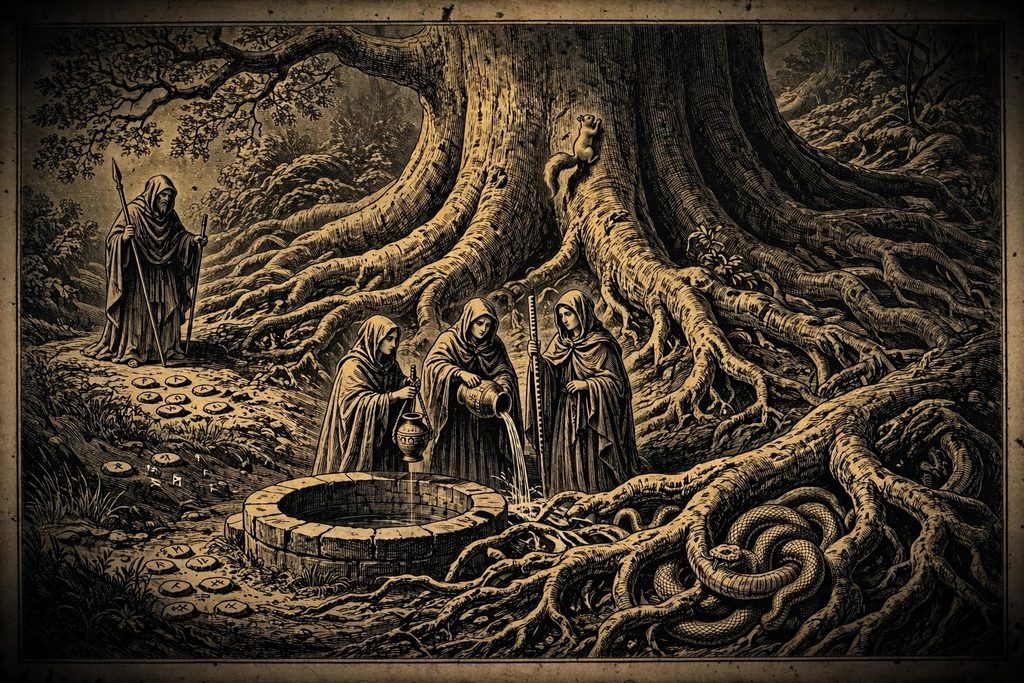
The Norse world tree is known from two medieval Icelandic sources, the poems of the Poetic Edda and the Prose Edda written by Snorri Sturluson around 1220. Yggdrasil is an ash, the greatest of all trees, whose branches spread over the whole world and reach above the sky. It has three roots. Snorri places one among the gods, one among the frost giants and one over Niflheim, the misty realm below. Beneath the roots lie wells, including the well of fate, where three women called the Norns decide the lives of men and water the tree each day so that it will not wither.
The tree is alive with creatures. An eagle sits in its crown. A serpent called Níðhöggr gnaws at its roots. A squirrel named Ratatoskr runs up and down the trunk, carrying insults between the eagle above and the serpent below. Four stags browse on its branches. Yggdrasil is not a calm symbol of order. It is a body under constant attack, suffering from above and below, kept alive by the care of fate itself.
It is also a place of sacrifice. In the poem Hávamál, the god Odin describes hanging on a windswept tree for nine nights, wounded with a spear, given to himself, without food or drink, until he looked down and seized the runes. Tradition has long identified that tree with Yggdrasil, whose very name is usually read as the steed of Yggr, one of Odin’s names, the gallows horse on which the god rode. At the end of the world, at Ragnarök, Yggdrasil shudders, and the old order falls.
II. The Older Trees
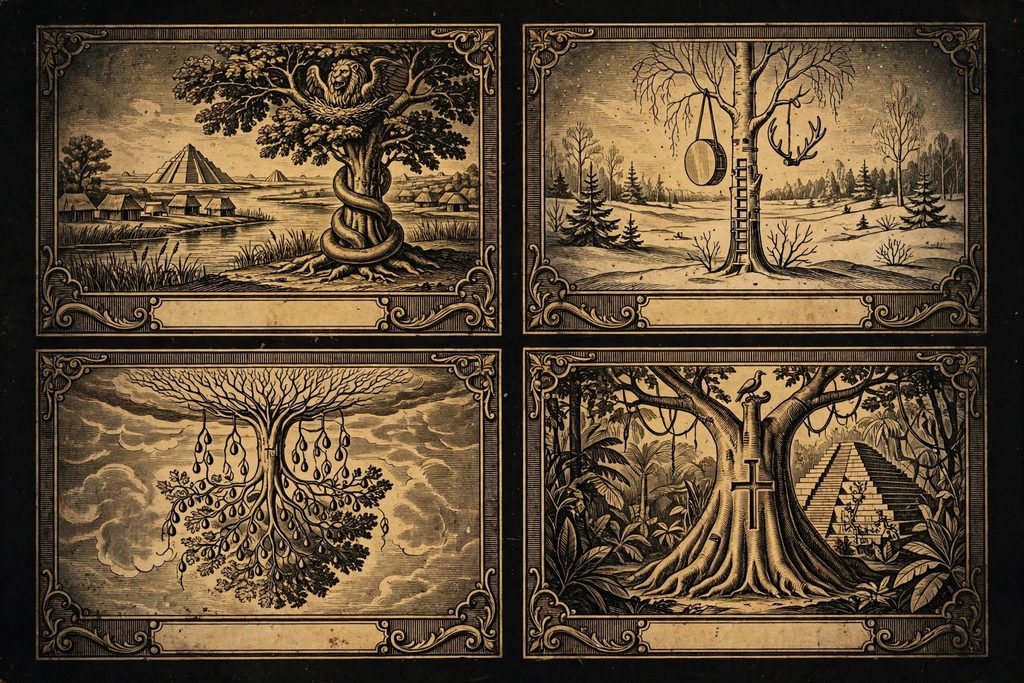
Yggdrasil was not the first world tree. In the Sumerian poem known as Gilgamesh, Enkidu and the Netherworld, written down nearly four thousand years ago, the goddess Inanna finds a tree uprooted by a storm on the banks of the Euphrates and plants it in her garden at Uruk, hoping to make a throne and a bed from its wood. But the tree is occupied. A serpent nests in its roots, a monstrous bird called Anzu raises its young in its crown, and a spirit has made its home in the trunk. It is the same arrangement as Yggdrasil, a serpent below and a great bird above, written down some three thousand years before the Edda.
Across Siberia and Central Asia, shamans spoke of a world tree whose layers corresponded to the levels of the sky. In some traditions, recorded by the historian of religion Mircea Eliade, a shaman would climb a birch trunk cut with notches during a ritual, each notch a heaven, ascending the cosmic tree in trance. In ancient India, the Katha Upanishad and the Bhagavad Gita describe the eternal fig tree, the ashvattha, with its roots above and its branches below, an inverted world tree whose roots are in the divine.
In Mesoamerica, the Maya placed a great ceiba tree at the center of the world, with other trees standing at the four directions. At Palenque, in the Temple of the Cross, a carved tablet shows the world tree in the shape of a cross, with a celestial bird perched on top and the king of the city standing beside it. The tree was cosmology, and it was also political legitimacy. Kings stood at the center of the world because they stood next to its tree.
III. The Two Trees of Valinor
The world tree entered modern fiction through J. R. R. Tolkien, a scholar of the very Old Norse and Old English texts in which Yggdrasil survives. In The Silmarillion, published in 1977, the first light of the world does not come from the sun. It comes from two trees, Telperion the silver and Laurelin the gold, planted in the blessed land of Valinor. Their light waxed and waned in turn, and the hours of the first ages were counted by their shining.
The Two Trees are murdered. Melkor, the great enemy, and the monstrous spider Ungoliant pierce them and drain their light, and darkness falls over Valinor. From their last flower and last fruit, the gods make the Moon and the Sun. All the later light of Middle-earth is the remnant of the dead trees, and the jewels that drive the whole history of the Elves, the Silmarils, are vessels of their captured light.
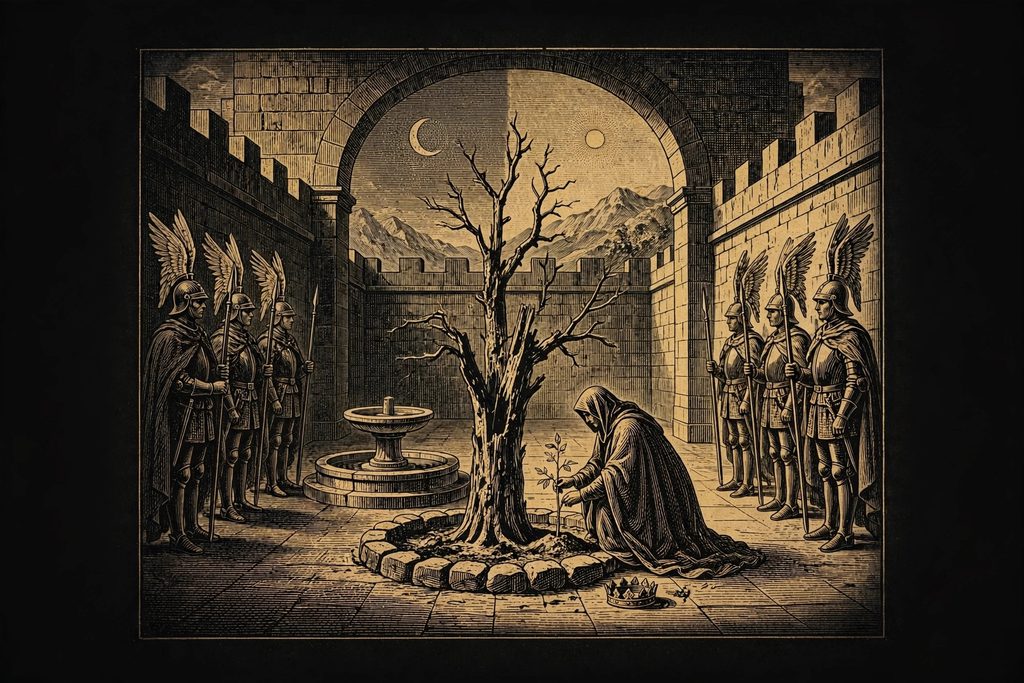
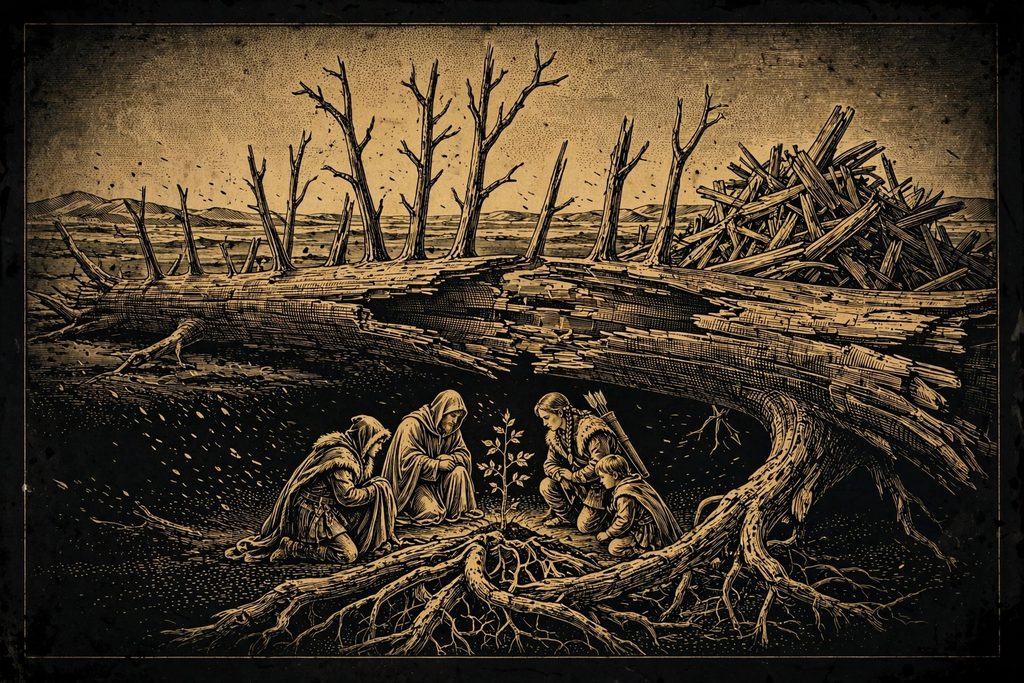
Tolkien then did something the old myths only hinted at. He made the world tree a symbol of kingship. A seedling descended from Telperion was carried to the island of Númenor, and from it a fruit was saved and planted in Gondor as the White Tree, the emblem of its kings. In The Return of the King, the White Tree stands dead in the courtyard of Minas Tirith, a kingdom waiting for its heir. When Aragorn returns, he finds a living sapling on the mountain above the city and plants it in the place of the dead one. The return of the king and the return of the tree are the same event.
IV. The Erdtree
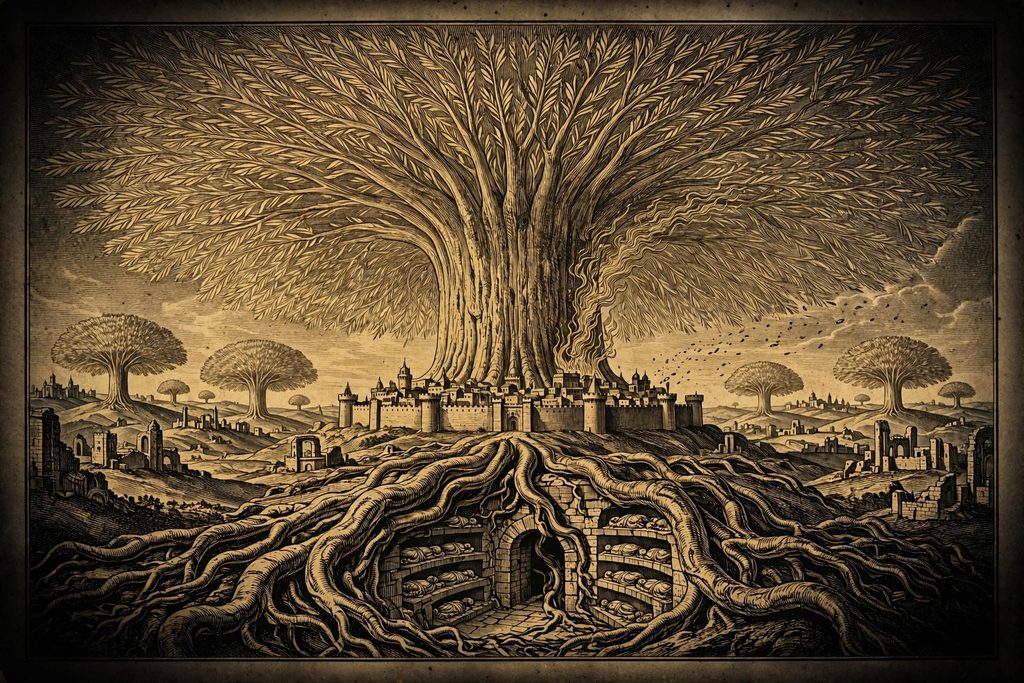
The most spectacular world tree in recent fiction belongs to Elden Ring, released by FromSoftware in 2022 with worldbuilding by George R. R. Martin. Over the Lands Between towers the Erdtree, a colossal golden tree visible from almost anywhere in the game. It is the center of a religion and a political order called the Golden Order, the throne of a godly queen and the seat of a kingdom. Smaller Erdtrees grow across the land like provincial churches.
The Erdtree controls even death. In the age of the Golden Order, true death has been removed from the world, and the dead are returned to the tree’s roots in a practice the game calls Erdtree burial. Catacombs beneath the land are threaded with roots, and the dead are taken into the tree, to be reborn in its image. The tree is not only the center of the cosmos. It is the institution that decides what happens to the soul.
The Institute studied the people of this world in The Message Culture of the Lands Between. Their tree is in decline. Its Golden Order has shattered, its demigods have gone to war, and the tree itself is sealed behind a wall of thorns. Late in the game, the player is asked to do something that the old myths reserved for the end of time. The Erdtree is set on fire. A world tree is deliberately burned, so that a new age can begin.
V. The Living Network
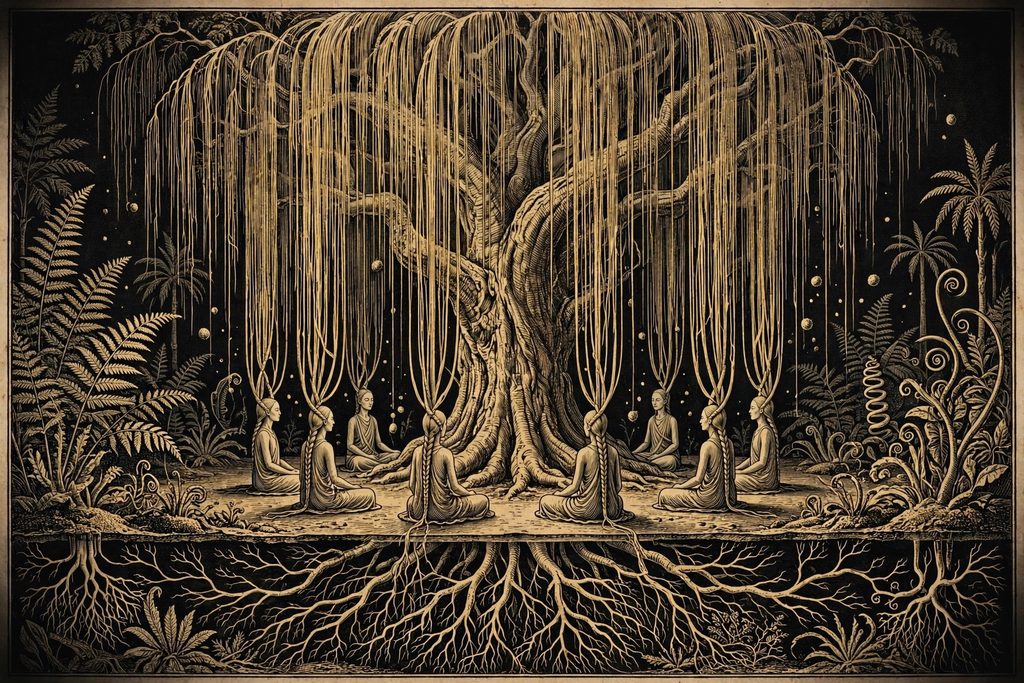
Other fictions have reimagined the world tree as a living network. In James Cameron’s Avatar, released in 2009, the Na’vi of Pandora live inside Hometree, a vast tree that is their village, their fortress and their history. When human miners destroy it, the destruction is the moral turning point of the film. Deeper in the forest stands the Tree of Souls, the holiest place on the planet, where the Na’vi connect directly to Eywa, the planetary mind, and where the memories of their ancestors are kept.
The Institute excavated this ecology in Eywa, Anatomy of a Planetary Organism. In Pandora, the world tree has become a biological fact, a network of roots and signals connecting every organism. It is the old cosmic tree translated into the language of ecology, a single living structure joining all the levels of a world, not as heaven and underworld, but as a nervous system.
Games have made the tree a guardian and a teacher. In The Legend of Zelda, Ocarina of Time, released in 1998, the Great Deku Tree watches over the forest and its children. It is cursed by the villain and dies, and its death sends the hero out into the world. A sapling grows in its place, and the forest goes on. In every version, the tree is something that can be wounded, and when it is wounded, a world is wounded with it.
VI. Why the Tree Must Die
Across all these worlds, one pattern stands out. The world tree is almost never safe. Yggdrasil is gnawed from below and shakes at the end of the world. Inanna’s tree is invaded by a serpent and a monstrous bird. The Two Trees of Valinor are murdered. The White Tree of Gondor stands dead for generations. The Erdtree burns. Hometree falls. The Great Deku Tree is cursed and dies. The tree at the center of the world is defined as much by its vulnerability as by its power.
The reason is structural. A world tree joins everything, the heavens, the living and the dead, the gods and the kings. That makes it the perfect symbol of an order, and every order in fiction must eventually be challenged. To wound the tree is to wound the whole cosmos at once. To burn it is to end an age. To plant a new one is to begin another. Writers who need to show that a world has changed forever have a ready-made image in the death of its tree.
There is also something deeply human in the choice. Trees outlive us. They grow for centuries, they connect earth and sky, and they die slowly. A civilization that places a tree at its center is telling itself that its order is alive, that it grew rather than being built, and that it can therefore also sicken. The world tree is the myth of a living order, and its death is the myth of how orders end.
The ancestor of them all
The world tree was not only an image in poems. In northern Europe it stood in the real world, and it was cut down.
Around 1070, the German chronicler Adam of Bremen described the great pagan temple at Uppsala in Sweden. Beside it, he wrote, stood an enormous tree with spreading branches, green in winter and summer alike, whose kind no one knew. Near it was a spring where sacrifices were made. Scholars have long seen this sacred tree and its well as an earthly image of Yggdrasil and the well of fate beneath its roots.
Further south, the Saxons venerated a great pillar or tree trunk called the Irminsul. A ninth century monk, Rudolf of Fulda, described it as a universal column that held up all things. In 772, during his wars against the Saxons, Charlemagne captured the sanctuary and had the Irminsul destroyed, an event recorded in the Royal Frankish Annals. It was the conversion of a people carried out by cutting down the center of their world.
The oldest images of all come from Mesopotamia. On the walls of the palace of the Assyrian king Ashurnasirpal II at Nimrud, carved in the ninth century BCE, a stylized sacred tree appears again and again, tended by winged spirits, with the king standing beside it. Whatever it meant exactly, and scholars still debate it, the tree stood at the center of the king’s world and of his authority. From Nimrud to Uppsala, from the Irminsul to the Erdtree, the world tree has always been a tree of power, and its fall has always meant that one order was giving way to another.
The pattern
The world tree belongs to a family of mythic structures that historians of religion call the axis mundi, the axis of the world. Mircea Eliade, in his studies of shamanism and sacred space, described how many cultures imagine a single vertical center, a mountain, a pillar, a ladder or a tree, that joins the levels of the cosmos and through which the sacred enters the world. Temples, palaces and capitals were often built to stand at that center, so that their rulers could claim to stand there too.
Three features define the world tree in myth and fiction. The first is verticality, a single structure that joins heaven, the world of the living and the underworld. The second is guardianship, the creatures, keepers and gods who tend it, feed on it or attack it, like the Norns at their well and the serpent at the roots. The third is mortality. The tree can be wounded, poisoned, burned or felled, and its fate is the fate of the world.
Fictional civilizations keep returning to the tree because they need what it offers, a center that is alive. A capital can be conquered, and a throne can be usurped, but when a world tree dies, it means that the cosmos itself has changed. From the Two Trees of Valinor to the burning Erdtree, the modern imagination still tells time the way the Norse poets did, by watching whether the tree at the center of the world still stands.
Findings
- The world tree is one of the oldest shared myths. It appears in Mesopotamia, Siberia, India, Mesoamerica and Scandinavia, always as a single tree joining heaven, earth and the underworld.
- Yggdrasil is a wounded cosmos. The Norse ash is tended by the Norns, gnawed by a serpent, crossed by a squirrel carrying insults and shaken at Ragnarök, and Odin hung on it nine nights to win the runes.
- Tolkien made the tree a symbol of kingship. The Two Trees of Valinor gave the first light of the world, and their descendant, the White Tree of Gondor, dies and returns with its rightful king.
- Modern fiction turns the tree into institutions and networks. The Erdtree of Elden Ring governs life and death through a religious order, and the trees of Pandora join every living thing in a single mind.
- The world tree’s death marks the end of an age. From the Irminsul cut down by Charlemagne to the burning of the Erdtree, the fall of the central tree has always meant the end of one order and the beginning of another.
This Excavation draws on the Poetic Edda and Snorri Sturluson’s Prose Edda, on Sumerian, Indian and Maya sources, on Adam of Bremen and the Royal Frankish Annals, on the works of J. R. R. Tolkien, and on Elden Ring, Avatar and The Legend of Zelda.
The Institute collects field evidence from people who have stood beneath these trees. If a fictional world tree ever made you stop and look up, send us your account.
Sources
- The Poetic Edda, including Völuspá, Grímnismál and Hávamál (Codex Regius, thirteenth century).
- Snorri Sturluson, Edda, Gylfaginning (c. 1220).
- Gilgamesh, Enkidu and the Netherworld, in the Electronic Text Corpus of Sumerian Literature, University of Oxford.
- Katha Upanishad 6.1 and Bhagavad Gita 15.1.
- Adam of Bremen, Gesta Hammaburgensis ecclesiae pontificum, book 4 (c. 1070).
- Mircea Eliade, Shamanism, Archaic Techniques of Ecstasy (1951) and The Sacred and the Profane (1957).
- J. R. R. Tolkien, The Return of the King (1955) and The Silmarillion (1977).
- Elden Ring (2022), FromSoftware, and Avatar (2009), directed by James Cameron.