





EXCAVATION Nº 0002 · ECOLOGIES
World: Pandora
Period: 2154 onward (in-world)
Status: Active
The people of Pandora say she is a goddess. The scientists who came to study them said she was a network. A more recent reading, popular among sceptical viewers, calls her something darker: a parasite that has taken control of an entire moon.
All three readings describe the same thing. Across the forests of Pandora runs a living system that connects every tree, carries signals between them, stores memory, and on at least two recorded occasions has turned the wildlife of a whole region against an invading force. The Na’vi call it Eywa.
This report sets aside the question of worship and examines Eywa the way an ecologist would examine any organism: what it is made of, how it works, what it gives and takes, and how it behaves under threat. The evidence comes from the three films released so far and the world-building published around them. Where the films leave questions open, we mark our reading as interpretation.
The specimen
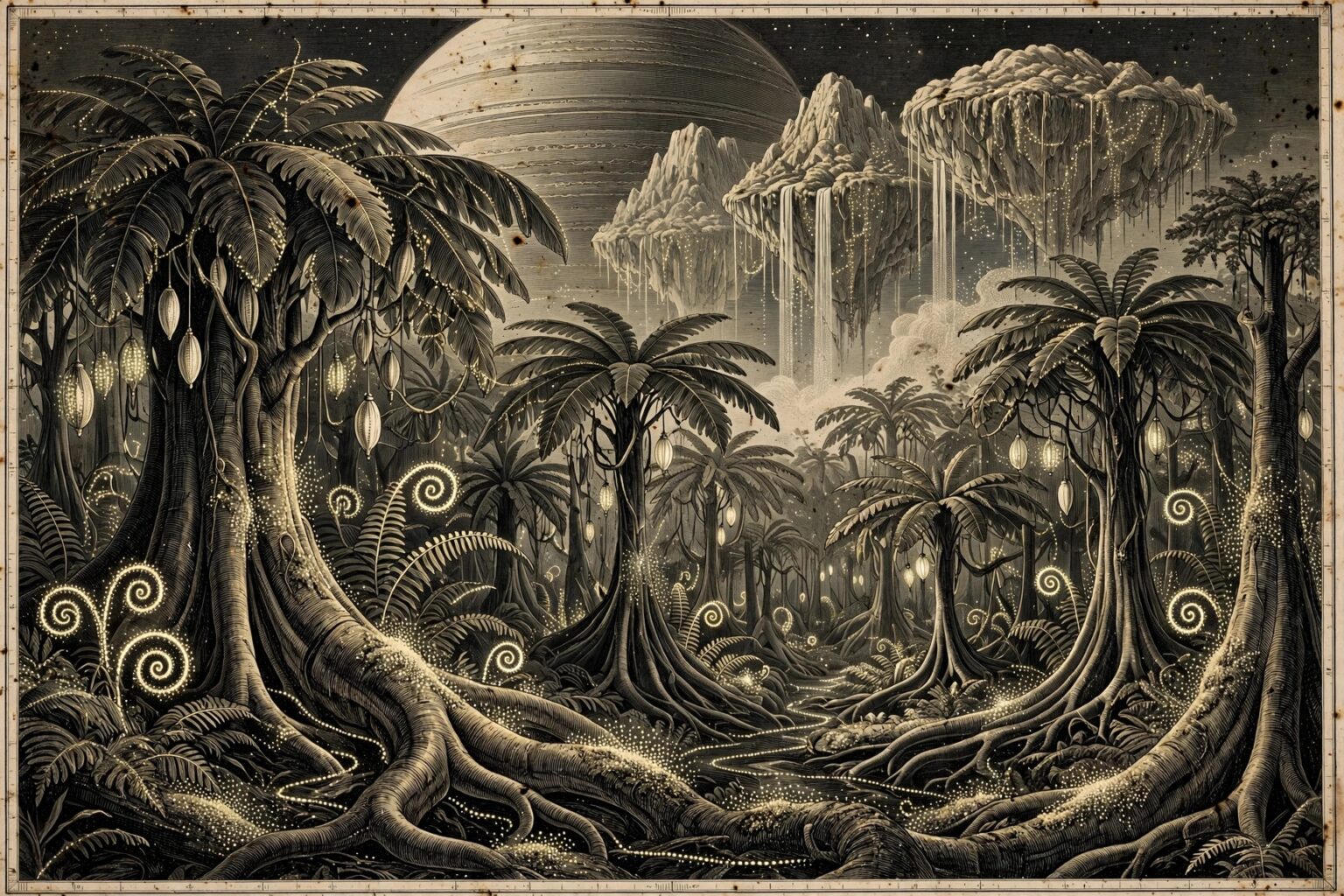
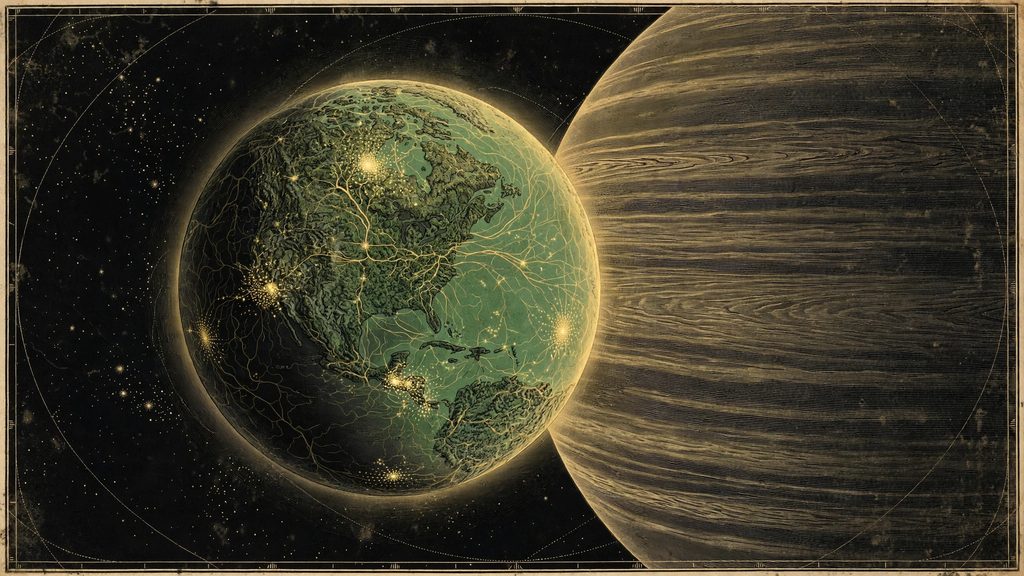
Pandora is a moon, not a planet. It orbits the gas giant Polyphemus in the Alpha Centauri A system, 4.37 light years from Earth. Its air is lethal to humans, who lose consciousness within seconds without a mask. Its larger animals are built on a six-limbed body plan, its forests glow in the dark, and in its most famous region whole mountains float, held aloft over deposits of a superconducting mineral that humans named, with little imagination, unobtanium.
Everything about this world is connected, and the films make that literal. The ecology of Pandora is best understood as a single system with many parts, and Eywa is the system itself.
Anatomy of a network
The clearest scientific description of Eywa comes from the first film’s botanist, Dr Grace Augustine, arguing with the mining administrator who has just destroyed a sacred site.
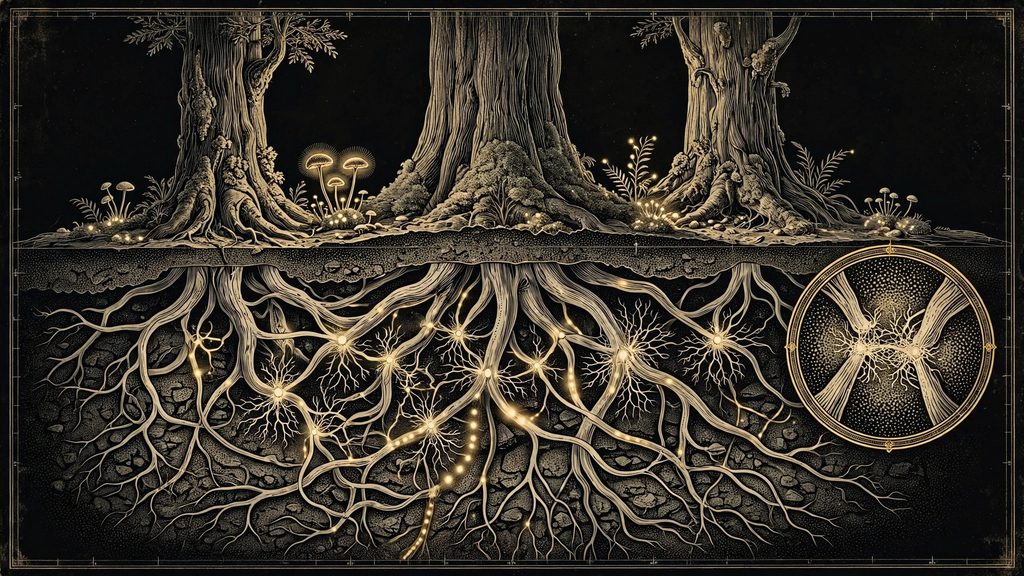
She describes electrochemical communication between the roots of the trees, working like the synapses between neurons. Each tree, she says, has ten to the fourth connections to the trees around it, and there are ten to the twelfth trees on Pandora. The result, in her words, is “more connections than the human brain.”
The arithmetic holds up. Ten thousand connections for each of a trillion trees gives ten quadrillion links. The human brain is usually estimated to have somewhere around a hundred trillion synapses. On Grace’s figures, the forest of Pandora has something like a hundred times as many connections as the organ that produced the people trying to cut it down.
Grace goes further. The Na’vi, she says, can access this network, uploading and downloading data at particular sites. That makes Eywa more than a web of roots. It is a storage system, and the Na’vi use it to hold the voices and memories of their ancestors.
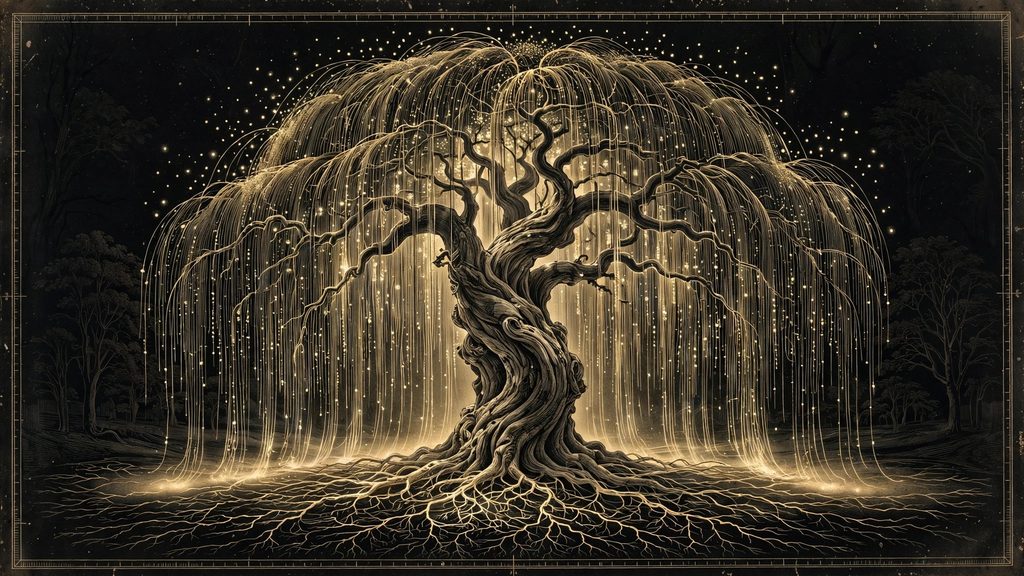
The network has interfaces. The most important is a great tree whose trailing, luminous strands the Na’vi connect to directly. At these sites, and at similar trees elsewhere, the boundary between a person and the forest becomes very thin.
The bond
The Na’vi carry their own interface. At the end of the long braid that hangs from the back of the head is a bundle of living fibres, and when it is joined to the matching structure on an animal, the two nervous systems connect. The Na’vi call this tsaheylu, the bond.
Through the bond, a rider and a mount share intention. A hunter can feel the animal’s fear. With the great flying predators of the mountains, the bond is made once and lasts a lifetime. Between two Na’vi, a mated bond is permanent too, closer to marriage than to any tool.
Ecologically, this is remarkable. On Pandora, the capacity for direct neural connection between species is a basic feature of anatomy. It is the infrastructure through which the whole biosphere talks to itself, and the Na’vi are one participant among many.
Four readings of one organism
What is Eywa? The films offer four answers, and each is worth taking seriously.
The goddess. To the Na’vi, Eywa is the Great Mother, the source of life and the keeper of the dead. They speak to her and she answers. This is a religious reading, and the films never contradict it.
The brain. To Grace and the scientists, Eywa is a planetary neural network, measurable and real, which the Na’vi experience as a deity. Grace’s final line in the first film collapses the distinction. As the network receives her, she tells Jake: “I’m with her, Jake. She’s real.”
The organism. To an ecologist, Eywa looks like something Earth’s own science has proposed. In the 1970s the chemist James Lovelock and the biologist Lynn Margulis put forward the Gaia hypothesis, the idea that life on a planet acts together as a self-regulating system that keeps conditions suitable for itself. Margulis also helped develop the idea of the holobiont, a host and all its symbiotic partners treated as a single ecological unit. Pandora is what a holobiont the size of a moon would look like.
The parasite. The sceptic’s reading starts from the same evidence and draws a darker conclusion. A network that connects to the nervous system of every animal, and can direct their behaviour, is a network that controls them. On this reading, Eywa is a colonial organism that keeps the Na’vi docile with feelings of oneness and uses the wildlife as its body.
The first three readings sit comfortably together. The fourth is the one worth testing.
Testing the parasite hypothesis
Earth offers precise models for what the sceptics describe.
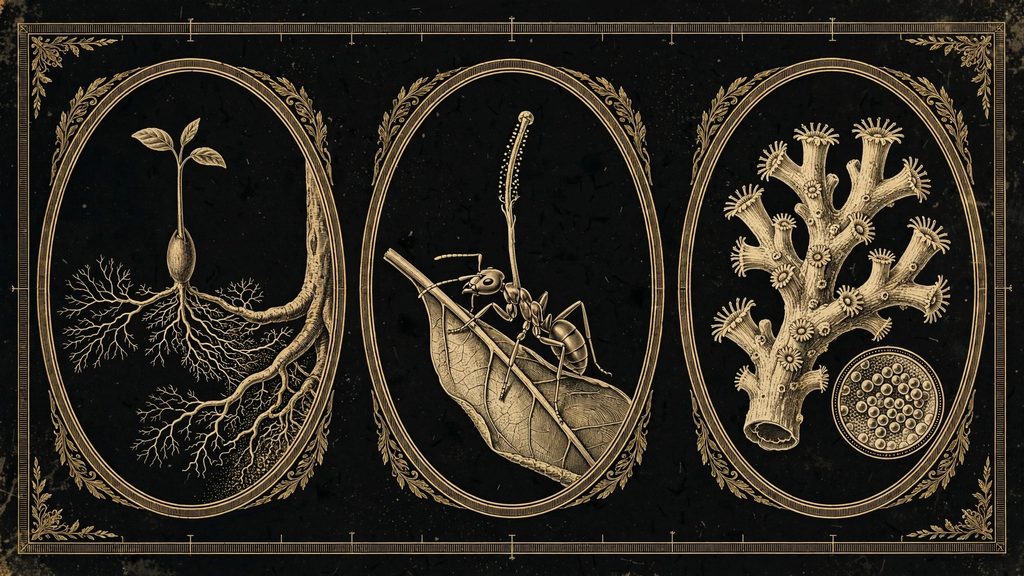
The fungus Ophiocordyceps unilateralis infects carpenter ants and changes their behaviour, driving an infected ant to climb and clamp onto a leaf in exactly the conditions the fungus needs to grow and release its spores. The single-celled parasite Toxoplasma gondii alters the behaviour of infected rodents, reducing their fear of cats, the host in which the parasite reproduces. In both cases an organism reaches into another creature’s nervous system and redirects it for its own benefit.
There is one clear piece of evidence that Eywa can do the same thing. At the climax of the first film, as the invaders march on the great tree, the animals of the forest turn together and attack them. The same thing happens again in the third film, when the wildlife of Pandora is unleashed on the invaders to save the great whale-like creatures of the sea. Large numbers of animals, acting against their normal instincts, moving as one. That is behavioural control.
But the definition of a parasite has a second half. A parasite benefits at the host’s expense. It weakens, sickens or kills the creature it lives in. And here the evidence runs the other way.
The Na’vi who live in closest contact with Eywa are healthy and long-lived. The network keeps their ancestors’ memories. It can hold and transfer a mind, as it tries to do for Grace and succeeds in doing for Jake. The animals of Pandora are not diseased by the bond. They thrive. Nothing in the films shows Eywa consuming, weakening or exploiting the creatures connected to her.
Earth’s closest real analogue is mixed too. The underground fungal networks that link tree roots, studied by the forest ecologist Suzanne Simard since the 1990s and popularised as the wood wide web, move carbon, water and chemical signals between trees. Simard’s work suggests that large “mother trees” can support the seedlings around them through these networks. Other researchers have argued since 2023 that some of the most popular claims about forest cooperation go beyond the evidence. Even on Earth, the line between partnership and exploitation in these networks is still being argued.
The Institute’s reading is that the parasite hypothesis fails on the evidence. Eywa can control behaviour, but she does so to protect the system that her hosts depend on. That describes a mutualist, a partner in a relationship where both sides benefit, one with an unusual capacity for coercion.
Does she take sides?
The films contain an argument about Eywa’s will, and it is the most interesting evidence of all.
Before the final battle of the first film, Jake prays to Eywa for help. Neytiri tells him he is wasting his time:
“Our Great Mother does not take sides, Jake. She protects only the balance of life.”
Then Eywa takes a side.
The contradiction resolves if Neytiri is right about Eywa’s purpose and wrong about what it implies. Look at when Eywa acts at scale. She does not intervene in ordinary hunting, in the deaths of individuals, or in quarrels between clans. She intervenes when the network itself is under attack: when invaders march on the great tree that is its most important interface, and when they threaten a keystone species of the ocean.
That is how an immune system behaves. An immune system does not care which cell is which. It responds to threats against the body as a whole. By that reading, Eywa protects the balance of life exactly as Neytiri says, and an invading industrial army is an infection.
The apostates
The third film adds evidence that no ecologist would have predicted: a people who have renounced Eywa.
The Mangkwan, the Ash People, are a Na’vi clan led by a matriarch named Varang. The film presents them as a people hardened by catastrophe, who turned away from Eywa when she did not save them, and who ally with the human invaders against other Na’vi.
For the study of Pandora, this matters a great deal. Until the Mangkwan, every Na’vi society in the record accepted Eywa. The Ash People show that even in a world where the goddess demonstrably exists and answers, belief is still a choice, and suffering can break it. The theology of that break belongs to the Institute’s Department of Religions, and it will be excavated there.
Findings
- Eywa is a real biological system within her world. The films give her an anatomy (a root network), a scale (on Grace’s figures, about a hundred times the connections of a human brain), interfaces, and a memory.
- The bond is basic infrastructure. Direct neural connection between species is part of Pandoran anatomy, which makes the whole biosphere capable of communication.
- The parasite hypothesis fails. Eywa can control behaviour, but the evidence shows her hosts thriving, not exploited. She is best classified as a mutualist with coercive power.
- She behaves like an immune system. Eywa intervenes at scale only when the network or a keystone species is threatened, which reconciles “she does not take sides” with the times she plainly does.
- Belief remains a choice even when the goddess is real. The Mangkwan’s apostasy shows that suffering can turn a people against a deity whose existence is not in doubt.
In the Institute’s first Excavation, The Final Days of WildStar, we recorded a world that could do nothing to stop its own end. Pandora is the opposite case: a world that notices when it is under attack and fights back. Of all the imagined worlds humanity has built, it may be the one most convinced that it is alive.
Filed under Ecologies. For how the Institute separates evidence from interpretation, see our methodology.