






EXCAVATION Nº 0015 · ECOLOGIES
World: The Ruins of the Ancients, Rain World
Period: Countless rain cycles (in-world)
Status: Active
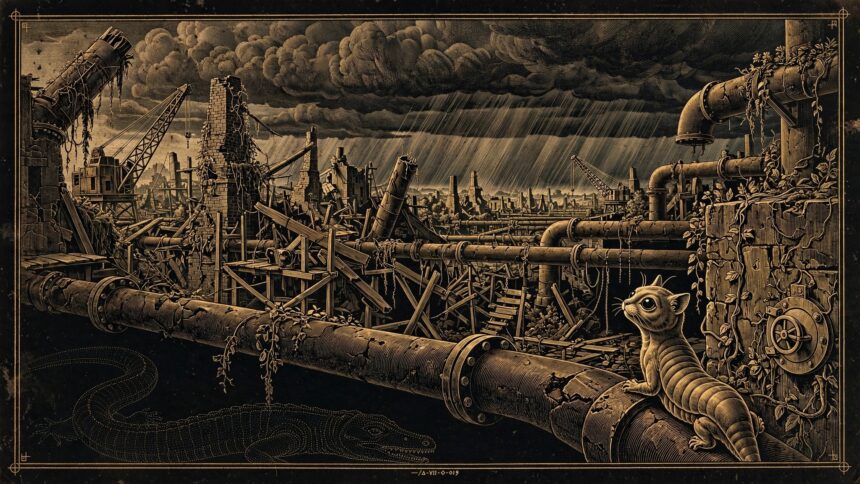
A small creature crouches on a rusted pipe in a ruined industrial city, counting. It has eaten three bat-like insects and one fruit. It needs a little more food before it can sleep safely. The sky is darkening. In a few minutes the rain will come, and the rain on this world is not weather in any ordinary sense. It is a flood from the sky, heavy enough to crush or drown anything left in the open. Below the pipe, in the shadow of a fallen wall, a lizard is waiting. It has been waiting since the creature passed this way an hour ago. It is not waiting for the player. It is simply hungry, and it is patient.
This is Rain World, a game created by the two-person studio Videocult, the artist and programmer Joar Jakobsson and the composer and level designer James Therrien, known as James Primate. It was released in March 2017, after six years of development funded in part by Kickstarter. Its creature, the slugcat, is not a hero. It is a small animal near the bottom of a food chain in a world that was not built for it, and the game is a long lesson in what that means.
The Ecologies department studies how imagined environments work. Most games put the player at the top of the food chain. Rain World puts the player near the bottom, and in doing so produces one of the most convincing ecosystems ever simulated in a game.
I. The Rain
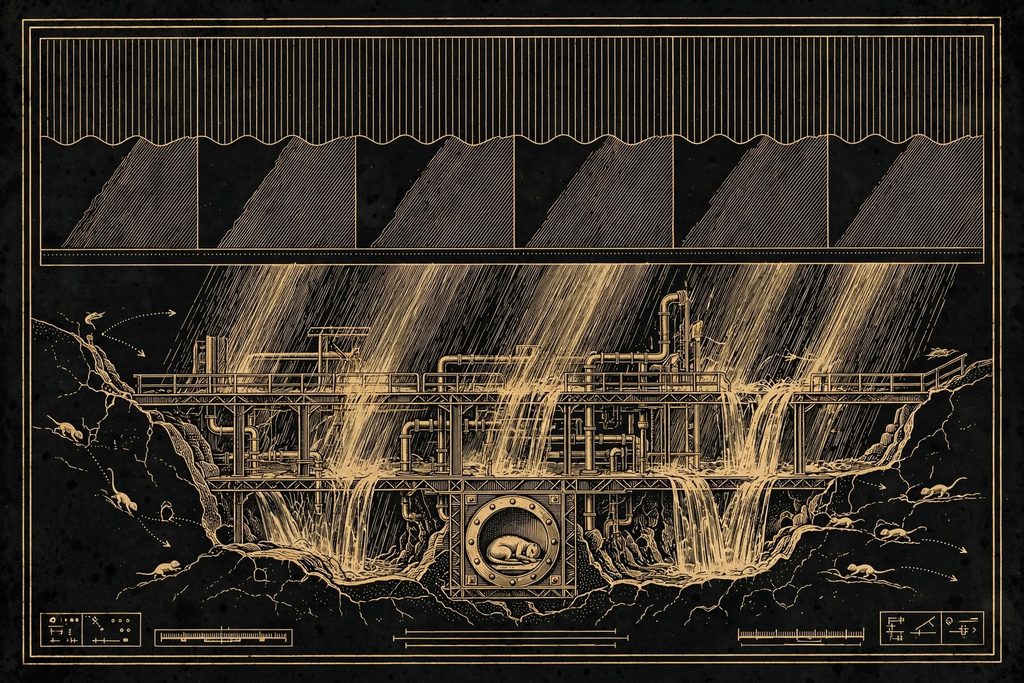
Everything on this world is organised around the rain. Each cycle begins with a period of relative calm, during which the slugcat can move, forage and explore. As the cycle advances, the sky darkens, distant thunder sounds, and finally the rain arrives in a deluge so heavy that nothing survives in the open. To live through it, the slugcat must reach one of the shelters scattered through the ruins, small sealed chambers in which it can hibernate until the storm passes. A new cycle then begins.
Ecologists call a recurring destructive force of this kind a disturbance regime. In real ecosystems, fires, floods, storms and droughts reset communities at intervals, and the creatures that live there are shaped by the timing of those resets. Some species have life cycles synchronised with them. Others depend on refuges, places where they can shelter until the disturbance passes. The ecologist Joseph Connell proposed in 1978 that communities experiencing disturbance at moderate frequency are often the most diverse, because no single species has time to dominate before the next reset.
Rain World is a disturbance regime made playable. Every creature on the planet, predator and prey alike, lives on the same clock. Every plan the player makes is shaped by the knowledge that the rain is coming. It is not a timer imposed on the world from outside. It is the world’s defining ecological fact.
II. The Forager’s Arithmetic
The slugcat cannot simply hide. To hibernate safely, it must eat enough during each cycle. The game shows this as a small row of food pips. A slugcat that reaches a shelter without enough food will survive the rain but starve while it sleeps, and that cycle will count against it. Every cycle therefore poses the same question. How much risk is worth taking for how much food, with how much time left before the rain?
Biologists have studied exactly this problem for decades. Optimal foraging theory, developed from the 1960s by ecologists including Robert MacArthur and Eric Pianka, asks how animals decide where to feed, what to eat and when to move on. In 1976, Eric Charnov formalised one answer as the marginal value theorem. A forager should leave a feeding patch when the rate of food it is gaining there falls below the average rate it could gain elsewhere, taking travel time into account. Real animals, from bees to birds, behave remarkably close to this prediction.
Rain World adds the variables that real foragers also face, predation and deadline. A rich patch of food guarded by a lizard is worth less than a poor patch nearby. A meal far from shelter is worth less as the rain approaches. Players who learn to survive are, without knowing the term, learning to forage optimally. They weigh energy, risk and time with the same arithmetic that governs real wildlife.
III. The Landscape of Fear
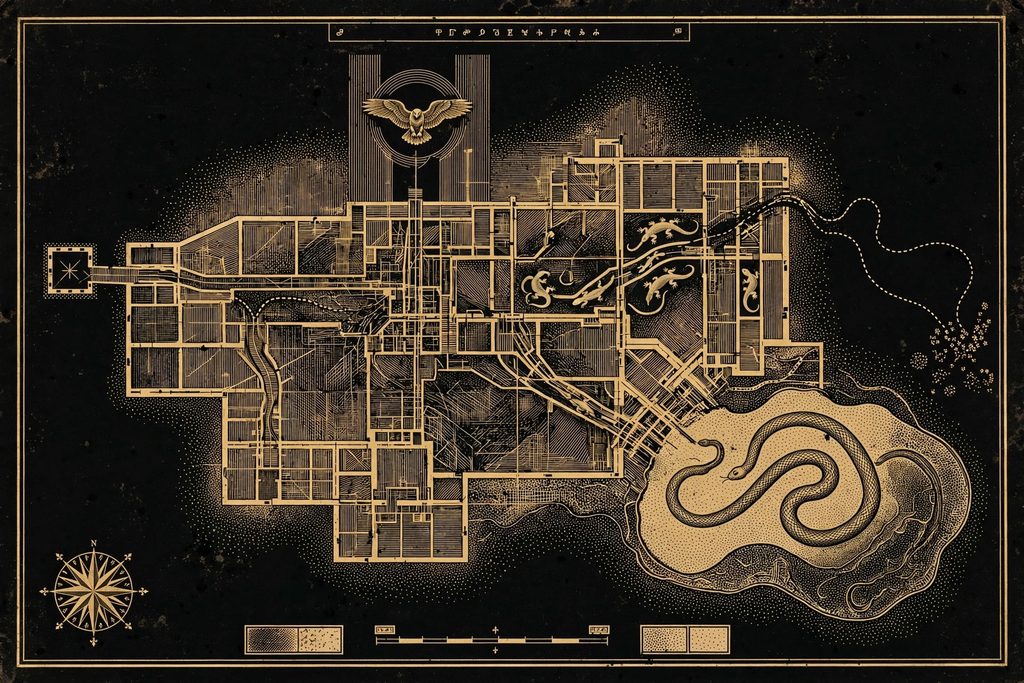
The predators of Rain World are what make it famous. There are lizards of many kinds, each with its own colour, behaviour and temperament:
- Green lizards are slow and heavy.
- Pink lizards are agile climbers.
- White lizards camouflage themselves against the walls.
- Yellow lizards hunt in packs.
- Some lizards are aquatic.
- Some are blind and hunt by sound in the dark.
Great vultures descend from the sky. Vast leviathans move through the deep water. Centipedes, eels and stranger creatures fill the rest of the food web.
What sets the game apart is that these creatures do not exist for the player’s benefit. The game’s systems track creatures as they move through the world even when the player is not watching. Predators hunt each other, compete for territory and pursue their own goals. A lizard may be busy fighting a vulture when the slugcat arrives, or may have learned where the slugcat tends to go. Creatures remember encounters with the player. The world does not pause or arrange itself around the player. It continues, and the player has to fit into it.
Ecologists have a name for the environment this creates. In 2001, the biologist John Laundré and his colleagues described the “landscape of fear”. Their work on elk after the return of wolves to Yellowstone National Park showed that prey animals map their surroundings by the risk of being eaten, and change where they feed, rest and travel accordingly. Fear, not just predation itself, shapes the whole ecosystem. Rain World makes the player inhabit this landscape completely. Every corridor is judged by what might be waiting in it, and the slugcat survives by reading the world the way prey animals read theirs.
IV. Other Minds
Not every creature in Rain World is simply predator or prey. The world also contains relationships.
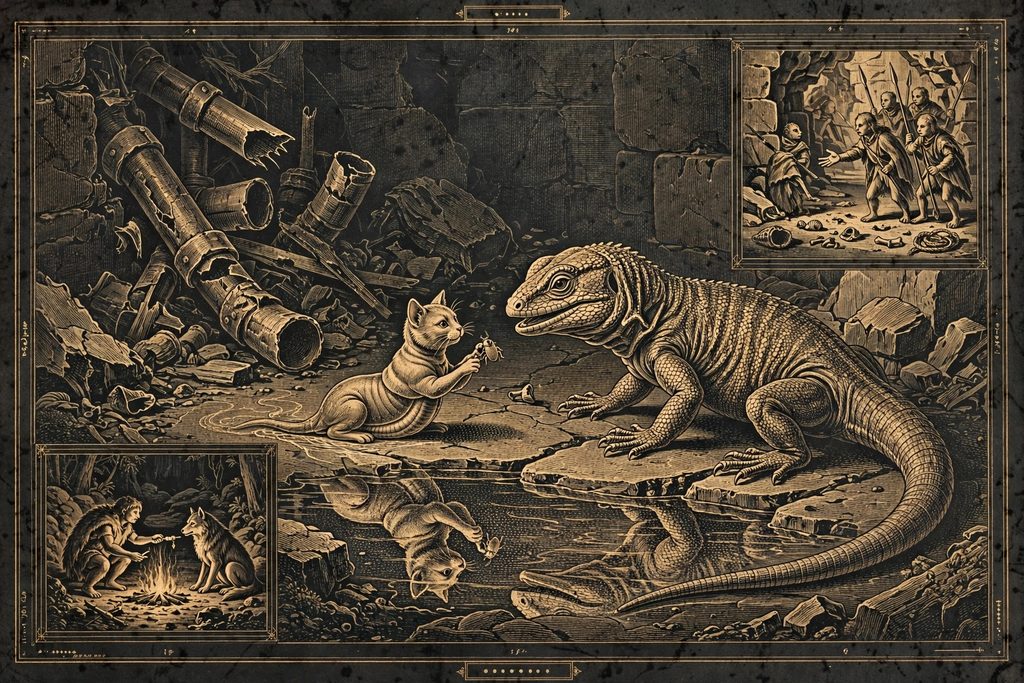
The lizards that hunt the slugcat can, with patience, be tamed. A slugcat that feeds a lizard repeatedly can win its trust, and a tamed lizard will follow it and defend it against other predators. The relationship echoes one of the oldest in human history. Wolves became dogs through a long process in which some animals found it more profitable to stay near humans than to hunt them, and humans found it useful to keep them close. In Rain World, a moment of feeding can turn a predator into a companion, and the player experiences in miniature the beginning of domestication.
The scavengers go further. They are small, intelligent, tool-using creatures that live in groups, carry spears, collect objects and guard passages through their territory. They expect a toll in valuable items before they let travellers pass. They remember how the slugcat has treated them, and their attitude can shift from wary to friendly to hostile over many cycles. In a world otherwise ruled by instinct, the scavengers have something close to a society, with property, trade, reputation and grudges. An anthropologist entering their territory would find a people. An ecologist would find a species that has learned to profit from the ruins.
V. The Ruins and the Gods
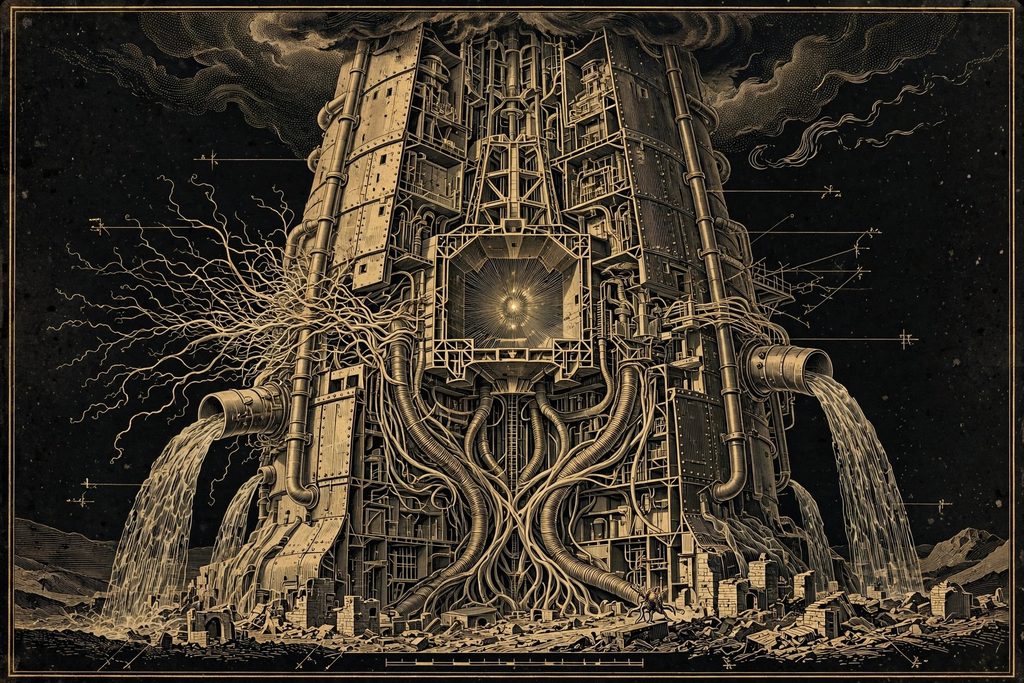
The world the slugcat lives in was once inhabited by a vanished civilization, known to players as the Ancients. Their ruins are everywhere, and the most remarkable of them are the iterators. These are colossal biomechanical supercomputers built on the scale of mountains, which still run, think and speak long after their makers have gone.
The game’s lore reveals that the Ancients were consumed by what the iterators call the Great Problem, the question of how a living being can escape the endless cycle of death and rebirth. The Ancients built the iterators to solve it. Many of the Ancients appear to have found their own way out and left the world entirely. The iterators were left behind, still working on a problem their makers no longer needed answered.
The slugcat’s own existence reflects this theology. The game’s karma system tracks its progress through a cycle of death and rebirth. Every death sends the slugcat back to its last shelter, and its karma rises and falls with how it lives. In this world, even the smallest animal is caught in the cycle the Ancients tried to escape.
The ruins have also become an ecological hazard. One iterator, Five Pebbles, has damaged itself through its own experiments, and a strange growth spreads through its structure and into the creatures around it. A failed attempt at transcendence has become a contamination of the ecosystem, a reminder that the ruins of a civilization continue to act on the life that grows among them.
VI. The Players Who Built More World
Rain World was not an immediate success. Many critics praised its art, animation and atmosphere, but found its difficulty, controls and lack of guidance punishing, and its early reviews were mixed. It found its audience slowly, and the audience stayed.
The community that grew around the game did something unusual. A team of nearly forty modders spent about five years building an expansion called Downpour, which added new playable slugcats, new regions and new modes. It was released officially in January 2023, published with the support of the original creators. It was well received and sold more than 180,000 copies on Steam. A further expansion, The Watcher, followed in 2025.
The Institute notes how fitting this is. Rain World is a game about an ecosystem that does not revolve around any single creature. Its own development became an ecosystem too. Its original makers provided the structure, and a community of players grew new life inside it.
The ancestor of them all
The idea of simulating an ecosystem is older than Rain World. In the 1920s, the mathematicians Alfred Lotka and Vito Volterra independently showed that predator and prey populations rise and fall in linked cycles. Predators multiply when prey is plentiful, prey declines, predators then starve, and prey recovers. Their equations became the foundation of mathematical ecology.
In games, the most important ancestor is Creatures, released in 1996, a pioneering artificial life game designed by the British programmer Steve Grand. It gave each of its creatures a simulated brain, a biochemistry and genes that could be passed on to offspring, so that players raised animals that learned and evolved. Creatures showed that a game could be a living system rather than a sequence of levels.
Rain World inherits both traditions. Its predators and prey interact without the player’s involvement, and its creatures behave as individuals with their own temperaments and memories. Above all, it insists that the world does not exist for the one who is watching it. Lem’s planet in The Machine Ecology of Regis III taught the same lesson through machines. Rain World teaches it through teeth.
The pattern
Rain World follows the ecological logic the Institute looks for in imagined worlds:
- Disturbance structures life. The periodic rain shapes the behaviour of every creature, as fires and floods shape real ecosystems.
- Survival is a calculation. The slugcat’s foraging follows the same trade-offs between energy, risk and time that real animals face.
- Fear shapes the land. Predators change the prey’s world even when they are not attacking, creating a landscape of fear.
- Relationships emerge in hostile worlds. Taming, trade and reputation appear among creatures that might otherwise only hunt each other.
- Ruins remain active. The machines of a vanished civilization continue to shape and contaminate the ecosystem that grew around them.
For another world that does not need its human visitors, see Eywa.
Findings
- Rain World is built on a disturbance regime. Its lethal rains reset the world at regular intervals and synchronise the lives of every creature in it.
- The player forages like real prey. The need to eat enough before each rain reproduces the logic of optimal foraging theory and the marginal value theorem.
- Its predators create a landscape of fear. Persistent, independent creatures make every space a question of risk, as wolves did for elk in Yellowstone.
- Relationships emerge among predators and prey. Taming lizards echoes the origins of domestication, and the scavengers form a society with trade and reputation.
- The world is the ruin of a failed escape. The iterators, built to solve the Great Problem of escaping the cycle of death, still run, and their decay contaminates the ecosystem around them.
This Excavation draws on Rain World and its expansions, published accounts of its development, and the scientific literature on predator and prey ecology. Read more about how the Institute works.
The Institute collects field evidence from people who lived inside these worlds. If you survived the rain, or learned to love a lizard, send us your account.
Sources
- Rain World (Videocult, 2017), Rain World: Downpour (2023) and Rain World: The Watcher (2025).
- Rain World, Wikipedia, for development, release history and the expansions.
- John W. Laundré, Lucina Hernández and Kelly B. Altendorf, “Wolves, elk, and bison: reestablishing the ‘landscape of fear’ in Yellowstone National Park”, Canadian Journal of Zoology (2001).
- Eric L. Charnov, “Optimal foraging, the marginal value theorem”, Theoretical Population Biology (1976).
- Robert H. MacArthur and Eric R. Pianka, “On optimal use of a patchy environment”, The American Naturalist (1966).
- Joseph H. Connell, “Diversity in tropical rain forests and coral reefs”, Science (1978).
- Alfred J. Lotka, Elements of Physical Biology (1925), and Vito Volterra (1926), on predator and prey dynamics.
- Creatures (Millennium Interactive, 1996), designed by Steve Grand.