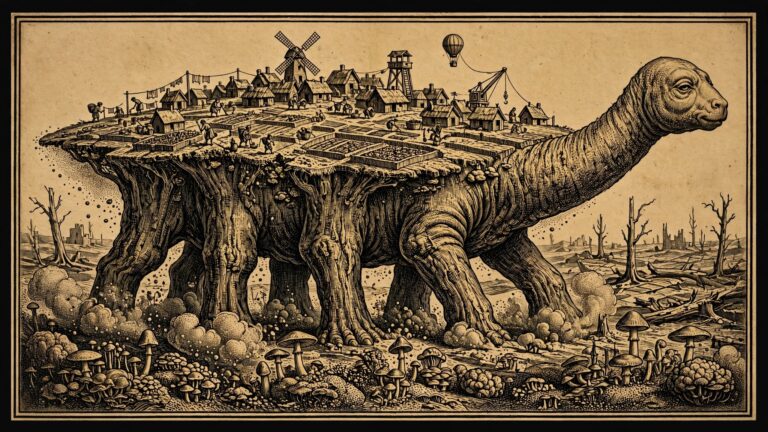


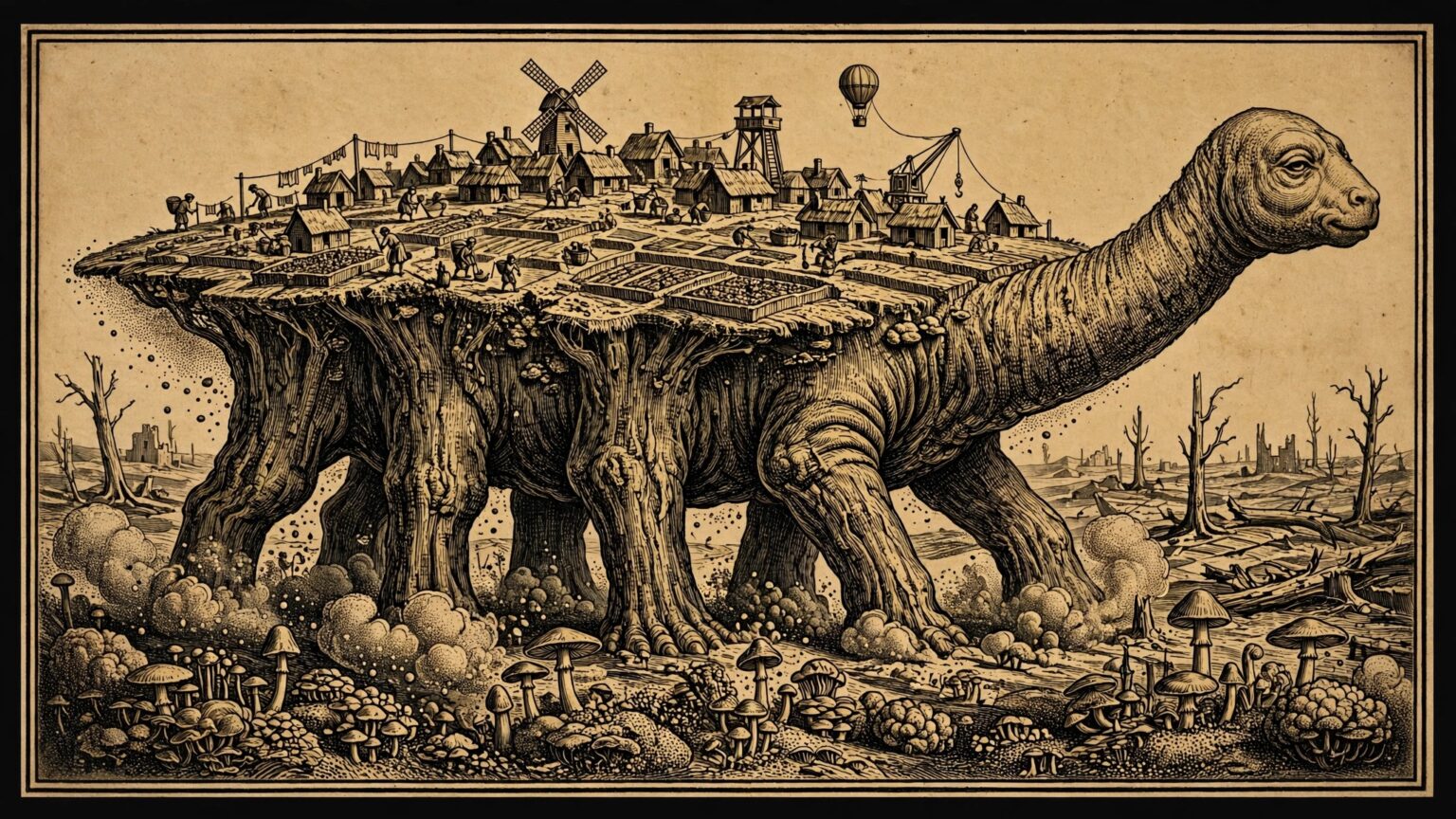
Most civilizations stand on rock or soil. The villagers of The Wandering Village stand on a living animal. In a world smothered by toxic spores, the last safe ground is the broad back of Onbu, a gigantic six-legged creature that walks endlessly across the ruined land. The village lives there, farms there and builds there. Onbu decides where it goes. If Onbu dies, the village dies with it.
The Wandering Village was developed by Stray Fawn Studio, a small team in Zurich, and entered early access on 14 September 2022. After nearly three years of updates shaped by its players, it was fully released on 17 July 2025, and an expansion, The Last Leviathan, has been announced for 2026. Its makers have named Hayao Miyazaki’s Nausicaä of the Valley of the Wind among its inspirations, and the debt is clear. It is a city builder, but the city is not the most important thing in it. The most important thing is the relationship between a society and the body it lives on.
The Institute has studied a forest that poisons humanity while healing the earth in The Toxic Jungle That Was Healing the World, and a world indifferent to the creatures that survive in it in Rain World and the Ecology of Being Prey. The Wandering Village asks a sharper question than either. When your whole world is another living being, are you its partner or its parasite?
I. A World Poisoned by Spores
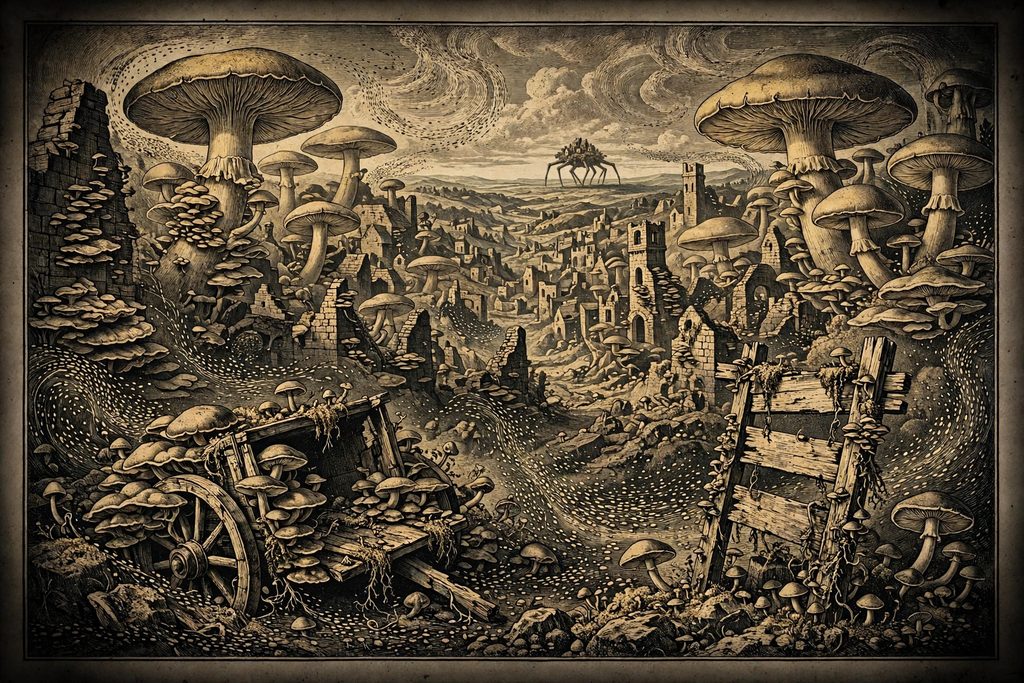
The world of The Wandering Village has been overtaken by a fungal plague. Toxic spores drift across the land, settle on everything and grow. The old towns are gone, and the open ground is dangerous to cross. What caused the catastrophe is one of the game’s mysteries, slowly revealed as the villagers repair an old radio antenna and make contact with other survivors.
The village survives because it found Onbu. A huge, slow, six-legged megasaur, Onbu walks constantly from one region to another, through deserts where water is scarce, grasslands, forests and poisoned zones where the spores are thick. Its back is broad enough for houses, fields, workshops and towers. To the villagers it is a moving island, the only ground in the world that is not slowly being swallowed.
This premise changes everything about how the village must think. A normal city builder assumes a fixed place, with its own soil, water and weather. The Wandering Village has none of these. Its environment changes every few minutes as Onbu travels. Its resources are wherever Onbu happens to walk. Its geography is a body, with a spine, wounds, hunger and moods of its own.
II. A Village on a Living Back
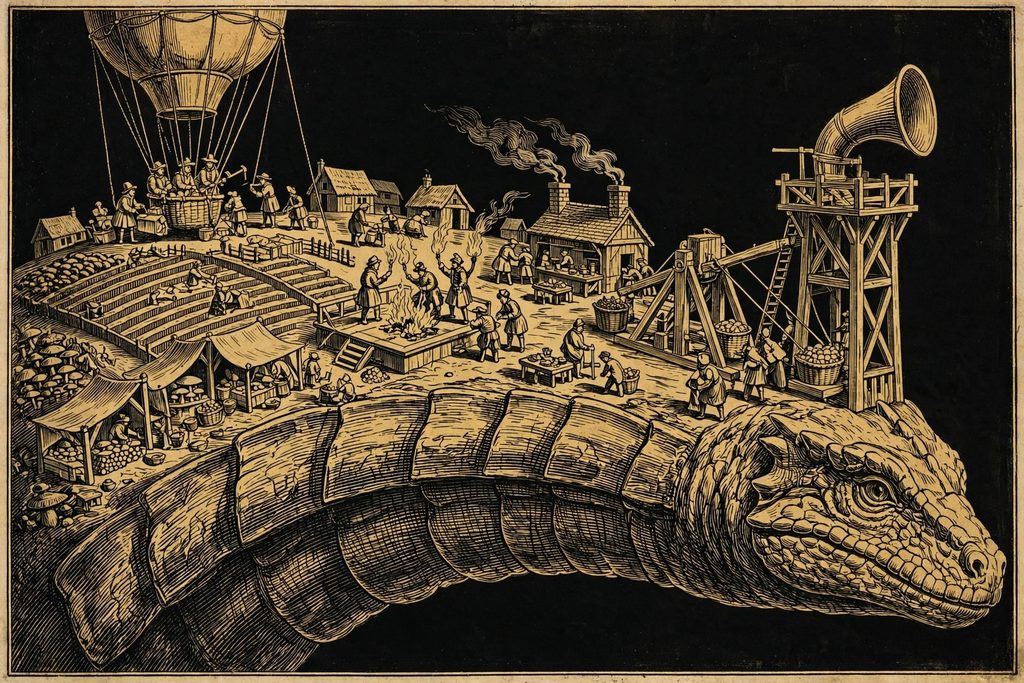
The village on Onbu’s back is a small, careful society. Its people farm terraces, gather water, cook, build and research new technologies. Like any village in a city builder, it needs food, shelter and work for everyone. Unlike any other, it must also look after the ground beneath it. Many of its most important buildings exist not to serve the villagers, but to serve Onbu.
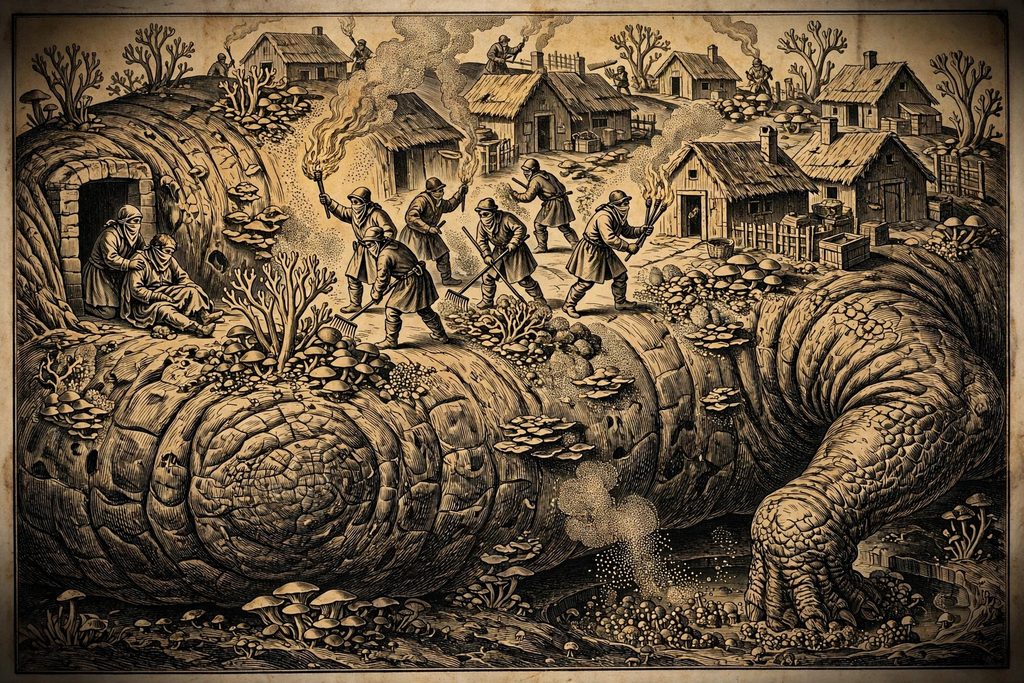
An Onbu Kitchen prepares meals for the giant from mushrooms grown by the village, and a trebuchet launches them into its mouth. A hot air balloon carries doctors who can treat Onbu when it falls ill. A decontamination station, where workers burn away the fungus, keeps spores from spreading across its back. A Hornblower stands ready to call out commands. The village is part farm, part hospital, part stable and part crew.
This makes the village unusual among fictional societies. Its economy has two clients, the people and their host, and the two are tied together. A hungry Onbu walks less well, and a sick Onbu endangers everyone. Caring for Onbu is not charity. It is infrastructure. But it is also something more, because the infrastructure is alive, and it can feel pain.
III. The Language of the Horn
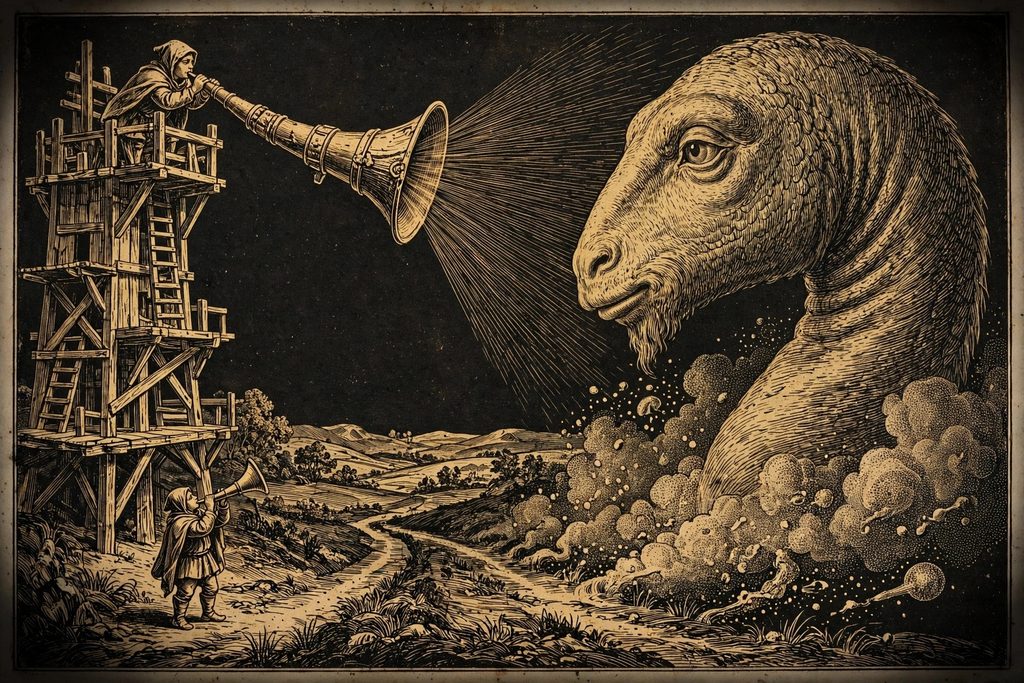
At first, Onbu ignores the village completely. It walks where it wants, stops when it wants and lies down to sleep wherever it is tired, even in the middle of a poisoned zone. The villagers are passengers, nothing more. To communicate with it, they must build a great horn and learn to use it, and even then Onbu does not always listen.
What makes Onbu listen is trust. The village earns it slowly, by feeding Onbu, healing it and letting it rest. As trust grows, Onbu begins to respond to the horn, walking, stopping, lying down or choosing a path where the road divides. As trust falls, it ignores the village again. The relationship is not ownership. It is closer to a long negotiation between two beings who need each other and do not speak the same language.
This may be the game’s most original idea. In most strategy games, the land obeys the player. In The Wandering Village, the land has a will. The village can influence it, persuade it and bargain with it, but never simply command it. For a society, this is a strange and humbling condition. Its government can plan everything except where its own country will go tomorrow.
IV. Pudding From Its Blood
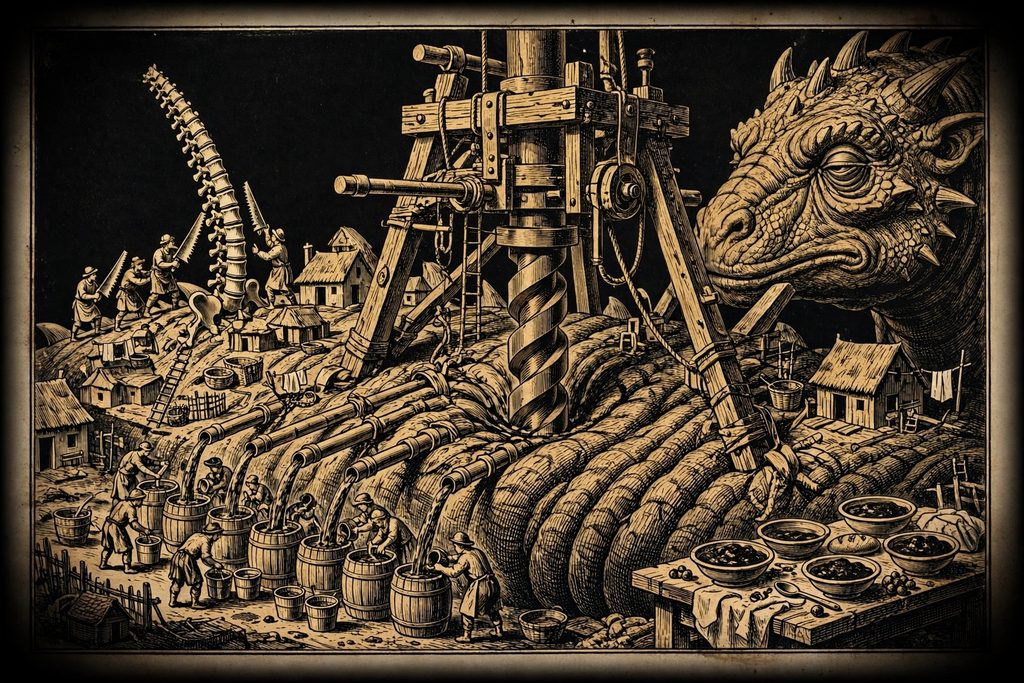
The village can also take from Onbu. Its technology tree offers a dung collector that drills into Onbu’s back to gather waste for fertilizer, and a blood extractor that draws Onbu’s blood to make food for the villagers, a pudding. Onbu’s spines can be harvested for resources. And the village can force Onbu to keep walking long after it is exhausted. Every one of these choices helps the village, and every one of them hurts the host.
The game keeps the accounts honestly. Harvesting Onbu lowers its trust, and some harvesting lowers its health. Overworking it makes it weaker and less willing to obey. Push too far, and Onbu’s health falls to nothing, and the game is over, because a village on a dead animal has nowhere left to stand. The exploitation is tempting precisely because it works, until it does not.
During early access, the player community voted on new technologies, and the options for exploiting Onbu grew darker. Among them was the choice to feed villagers to Onbu, which turns the village into a sacrificial cult. It is a grim joke, and a perceptive one. A society that depends absolutely on one great being will eventually be tempted to worship it, and the line between caring for a god and feeding it can be very thin.
V. The Spores on Its Skin
The village and its host face the same enemy. The spores that poison the land also land on Onbu’s back, take root among the houses and spread quickly. They infect villagers and can cover large parts of the back if left alone. When Onbu walks through poisoned regions, toxins build up in its body as well, and it must be treated by the doctors or led quickly to cleaner ground.
This shared vulnerability is the heart of the game’s ecology. The village cannot protect itself without protecting Onbu, and it cannot protect Onbu without fighting the spores on its own streets. Every decontamination crew burning fungus from the rooftops is also cleaning the skin of the animal. Every choice to march through a poisoned zone for its resources is paid for in two bodies at once.
The game’s longer story points beyond survival. A scientist named Nona guides the village in collecting special seeds that may heal the world, and the repaired radio connects the villagers with others who have survived elsewhere. The hope of The Wandering Village is not escape from Onbu, but a world in which a village and its host might one day walk through living land together.
VI. Partner or Parasite
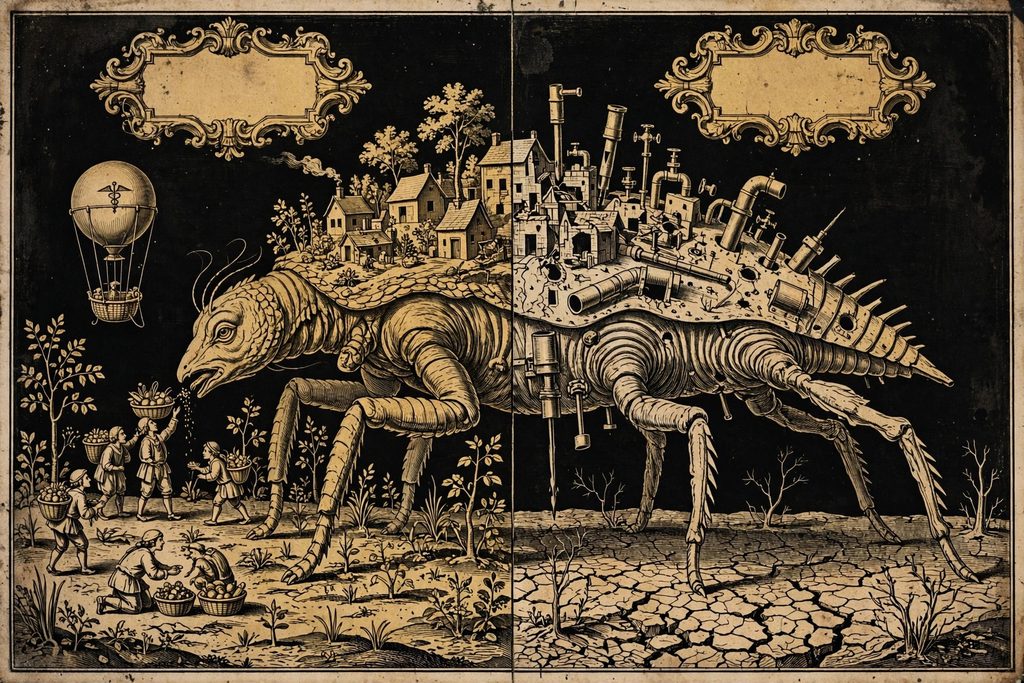
The Wandering Village does not tell players what kind of village to build. It gives them the tools of care and the tools of exploitation and lets them decide. Some players never touch the blood extractor and spend their resources on Onbu’s food and medicine. Others harvest everything they can, managing trust and health as numbers to be kept just above failure. The game makes both possible, and makes the difference visible.
In ecological terms, the choice is between two kinds of relationship. A mutualist gives something back to its host, so that both live better together than apart. A parasite takes, keeping its host alive only as long as it remains useful. The village begins somewhere in between, a passenger that needs Onbu more than Onbu needs it. Everything it builds afterwards pushes it toward one side or the other.
This is why The Wandering Village belongs in an Institute of civilizations and not only in a list of city builders. Its subject is the oldest question in environmental history, what a society owes to the living system that carries it. Most civilizations can pretend that the ground beneath them is inert. The village cannot. Its ground has eyes, and it is watching.
The ancestor of them all
The idea of a community living on the back of a great creature is very old, and it has always come with a warning.
In the Navigatio Sancti Brendani, the medieval account of the voyages of the Irish saint Brendan, the monks land on a bare black island to celebrate Easter. They light a fire to cook their meal, and the island begins to move. It is Jasconius, the largest fish in the sea, and the monks flee to their boat as it swims away with their fire still burning on its back. Older still is the aspidochelone of the Physiologus, the early Christian book of beasts, a sea creature so vast that sailors mistake it for an island, anchor beside it and light fires on it, until it dives and drags them down. The story was read as an allegory of deception. It is also the first warning about a society that forgets its ground is alive.
Nature offers a sharper parallel. Red-billed oxpeckers, the birds that ride on the backs of buffalo, giraffes and cattle in Africa, have long been seen as model partners, cleaning their hosts of ticks. But in a study published in 2000, the ecologist Paul Weeks found that oxpeckers on cattle in Zimbabwe did not significantly reduce tick numbers, and that they fed on blood from wounds and kept those wounds open. The same bird can be a cleaner and a vampire. The Wandering Village builds a whole society on that ambiguity.
The pattern
The Wandering Village belongs to a family the Institute calls the host civilizations, societies that live on or within another living being. Its closest literary relative is China Miéville’s novel The Scar, published in 2002, in which the floating pirate city of Armada summons the avanc, a sea creature of unimaginable size, to pull the whole city across the ocean, and discovers how little control it has over what it has harnessed.
Three features define these civilizations. The first is a living foundation, a ground that eats, sleeps, sickens and moves. The second is a choice between care and extraction, between keeping the host healthy and drawing as much as possible from it. The third is a shared fate, the knowledge that the society cannot outlive the body that carries it, whatever it decides.
The Institute found a mechanical version of this bond in The City That Lived Around a Single Fire, where every law served the Generator that kept the city alive. Onbu is the Generator with a heartbeat. The difference is moral as well as practical. A machine can be pushed to its limit without cruelty. A host can only be pushed so far before the question changes from what it can give to what the village has become.
Findings
- The village lives on a living animal. In a world smothered by toxic spores, the last safe ground is the back of Onbu, a giant six-legged creature that walks where it chooses and carries the whole society with it.
- The host must be persuaded, not commanded. The village communicates with Onbu through a great horn, but Onbu obeys only when it trusts the village, and trust is earned by feeding, healing and resting it.
- Exploitation is possible and always costly. The village can drill Onbu for dung, draw its blood for food, cut its spines and overwork it, but every harvest lowers its trust or health, and its death ends the village.
- Village and host share the same enemy. The spores that poison the land also infect Onbu and the streets on its back, so that protecting the people and protecting the host become the same work.
- The oldest stories warn against forgetting the host. From Saint Brendan’s moving island to the oxpeckers that both clean and wound their hosts, the idea of a community living on a creature has always been a question of partnership or parasitism.
This Excavation draws on The Wandering Village and its development in early access, on reviews and previews of the game, on the medieval Voyage of Saint Brendan and the Physiologus, on field research into oxpeckers and on China Miéville’s The Scar.
The Institute collects field evidence from people who have lived inside these worlds. If you ever refused to touch the blood extractor, or watched Onbu ignore your horn in the middle of a poisoned valley, send us your account.
Sources
- The Wandering Village (early access 2022, full release 2025), Stray Fawn Studio.
- Christopher Livingston, “I built a city on a monster’s back and used a trebuchet to feed it mushrooms in The Wandering Village”, PC Gamer, 17 February 2022.
- John J. O’Meara (trans.), The Voyage of Saint Brendan, Journey to the Promised Land (1976), Dolmen Press.
- Michael J. Curley (trans.), Physiologus (1979), University of Texas Press.
- Paul Weeks, “Red-billed oxpeckers, vampires or tickbirds?”, Behavioral Ecology 11, no. 2 (2000), 154–160.
- China Miéville, The Scar (2002), Macmillan.