





EXCAVATION Nº 0023 · ECOLOGIES
World: The Sea of Corruption, Nausicaä of the Valley of the Wind
Period: A thousand years after the Seven Days of Fire (in-world)
Status: Active
The forest is the most dangerous place on Earth. Its spores kill anyone who breathes them for more than a few moments without a mask. Its insects are the size of houses. It grows a little further every year, swallowing villages, fields and kingdoms, and the people who live at its edge burn every tree that takes root on their side of the line. They call it the Sea of Corruption, or in some translations the Toxic Jungle, and they are certain it is the end of the world.
They are wrong. The forest is not poisoning the world. It is cleaning it.
Hayao Miyazaki built this ecology twice. First in a manga, Nausicaä of the Valley of the Wind, serialized in the magazine Animage from 1982 to 1994, and then in the 1984 film whose success led directly to the founding of Studio Ghibli. The film tells the first part of the story. The manga, across seven volumes and twelve years, follows it to a conclusion so dark and so strange that it changes the meaning of everything before it. This Excavation reads the Sea of Corruption as what it turns out to be, one of the most carefully imagined ecosystems in fiction, and a machine for healing a planet that has no place for the people living on it.
I. A Thousand Years After the Fire
The world of Nausicaä begins with a catastrophe that no one remembers clearly. A thousand years earlier, an industrial civilization of immense power destroyed itself in the Seven Days of Fire, a war fought with giant biological weapons that burned the planet. What survived was a poisoned surface, scattered human kingdoms, and the ruins of machines no one can build anymore.
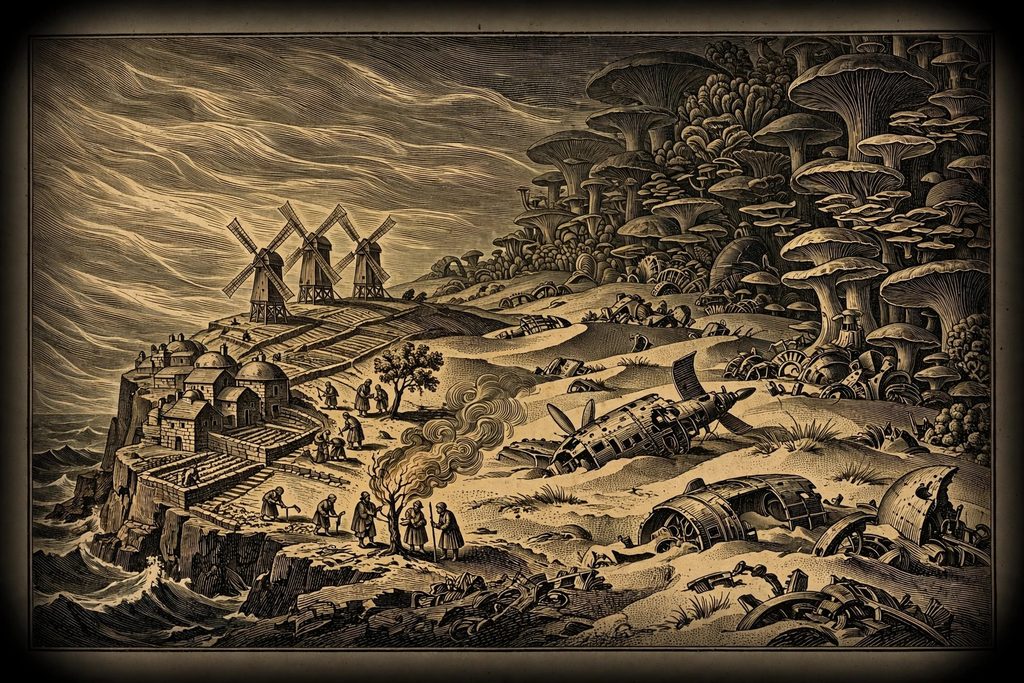
Out of that poison grew the Sea of Corruption. It is a forest of giant fungi and strange plants that release toxic spores, and it spreads across the continent year after year. Humans live only in the gaps. The Valley of the Wind, the small kingdom that gives the story its name, survives because a steady wind from the sea blows the spores away. Its people farm, tend windmills and inspect their trees for spores, which they burn the moment they find them. Even so, the forest reaches them. The valley’s king, Nausicaä’s father, lies sick from the poison, his body slowly hardening.
Every society in this world is defined by its distance from the forest. Kingdoms at the edge live in fear and vigilance. Great powers like Tolmekia and Pejite fight over the remains of the old world, including the dormant body of a giant weapon from the Seven Days of Fire, which each hopes to use to burn the forest away. It is the oldest human response to a wilderness that frightens us. Clear it. The story will show, step by step, that this is exactly the wrong answer.
II. The Anatomy of the Sea
Miyazaki based the Sea of Corruption on two real landscapes, the ancient moss forests of Yakushima, an island in southern Japan, and the Sivash, the shallow, putrid lagoons on the coast of Crimea that are known in Russian as the Rotten Sea. The result is a forest that feels alive at every scale.
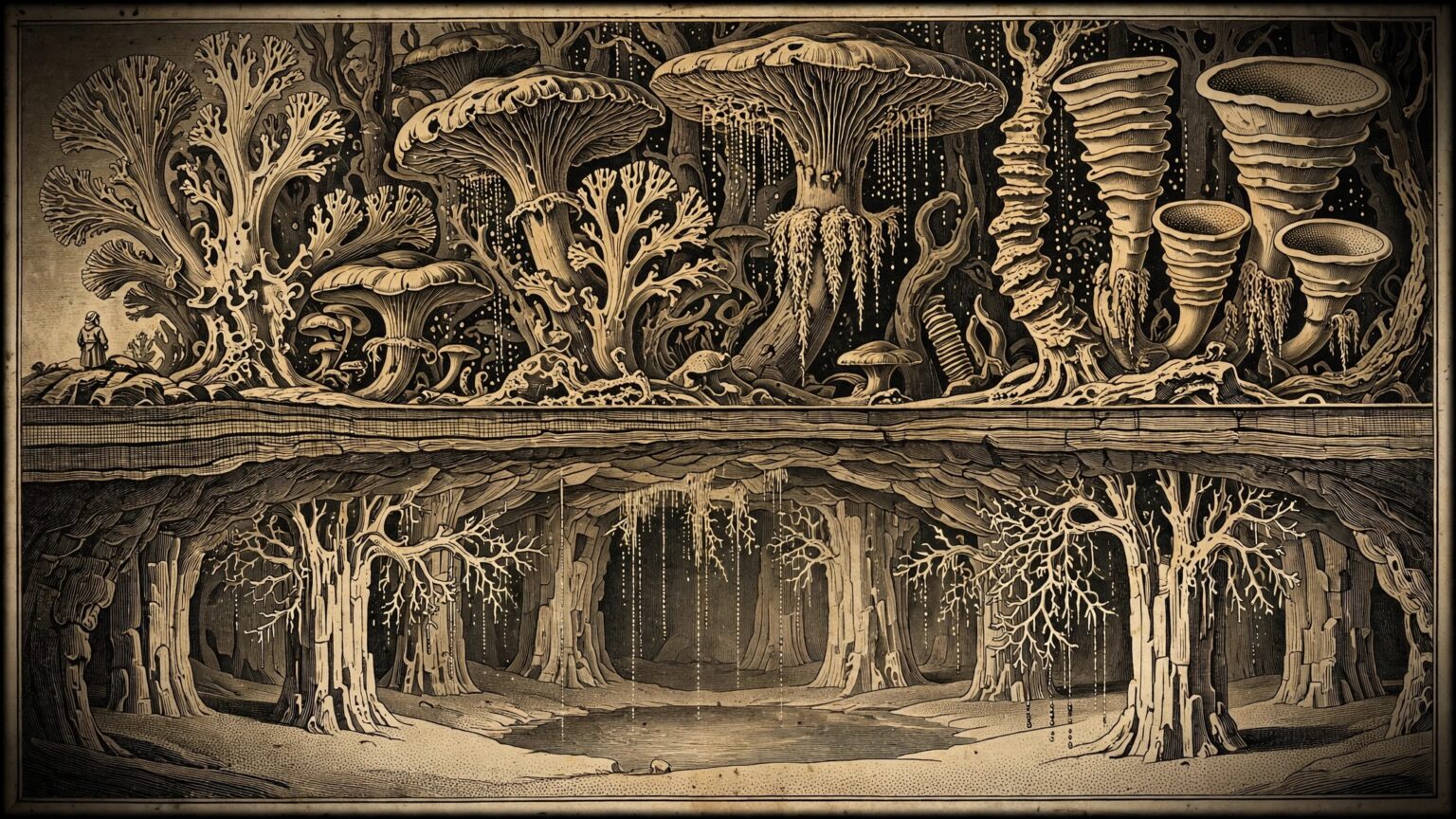
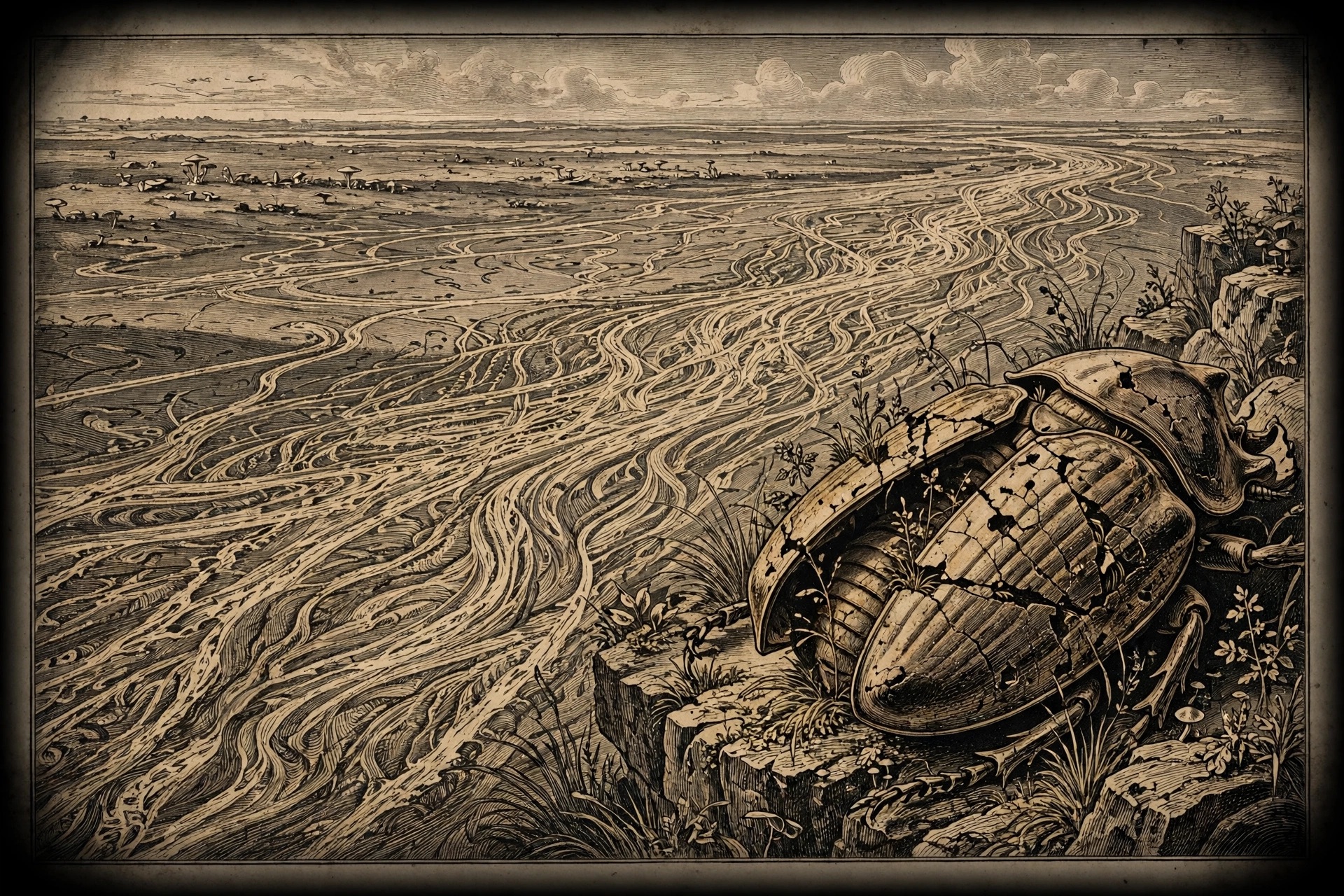
The trees are fungal, rising in columns, cups and branching fans. Spores drift through the air like snow. The ground is a mat of mold and decay. In the deep forest, the light comes filtered through canopies of strange organic shapes, and the air itself is lethal to humans. Everything that lives here is adapted to it. Insects of every size swarm, crawl and fly through the canopy, and the largest of them, the Ohmu, are armored giants whose many eyes turn blue when they are calm and red when they are enraged. Wound the forest, and the insects defend it. Burn it, and they come in their thousands.
Above all, the forest grows. It expands into the lands around it, and it does so in a specific way. Where the insects die, the forest takes root in their bodies. Where the land is poisoned, the fungi spread. The Sea of Corruption advances toward contamination the way a white blood cell advances toward infection. That detail, easy to miss on a first viewing, is the key to the whole world. The forest is not random. It goes where the poison is.
The Institute has studied other living worlds that behave as a single body, from the planetary network in Eywa, Anatomy of a Planetary Organism to the self-assembling swarms of The Machine Ecology of Regis III. The Sea of Corruption differs from both in one essential way. It does not want anything from us. It is simply doing its work.
III. The Garden in the Basement
The truth about the forest is discovered in a basement.
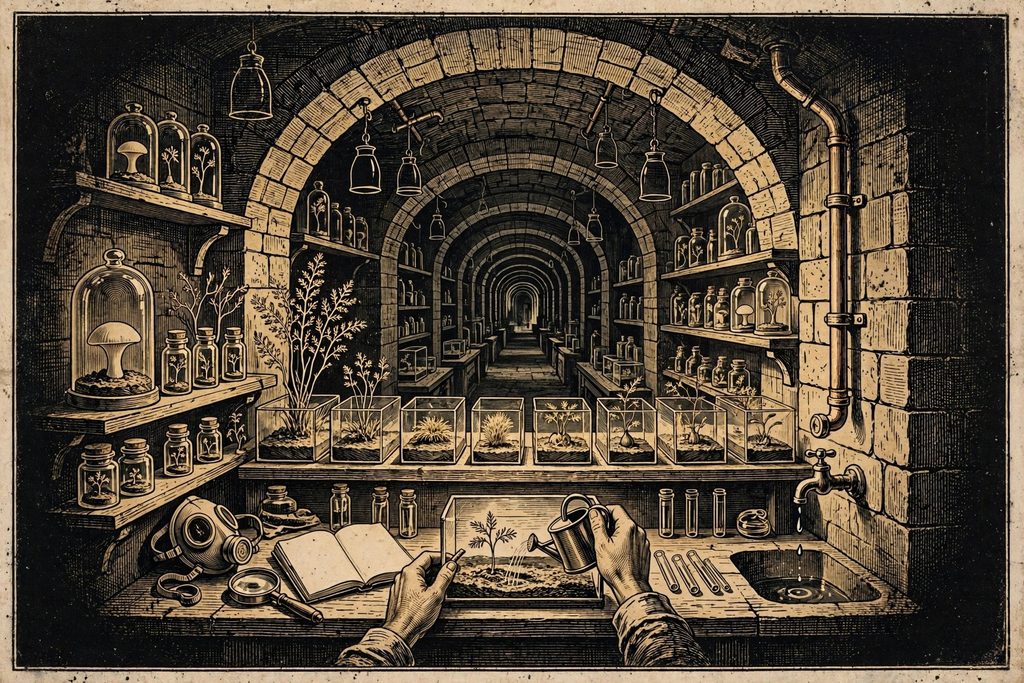
Nausicaä, the princess of the Valley, is a pilot, a fighter and a naturalist. She flies into the Sea of Corruption to collect spores and samples, and beneath her father’s castle she keeps a secret room where she grows them. She waters the plants with clean water drawn from deep beneath the valley and plants them in soil from the same depth. Grown this way, the plants of the Sea of Corruption are harmless. They give off no poison at all. The trees, she realizes, are not toxic. The soil is.
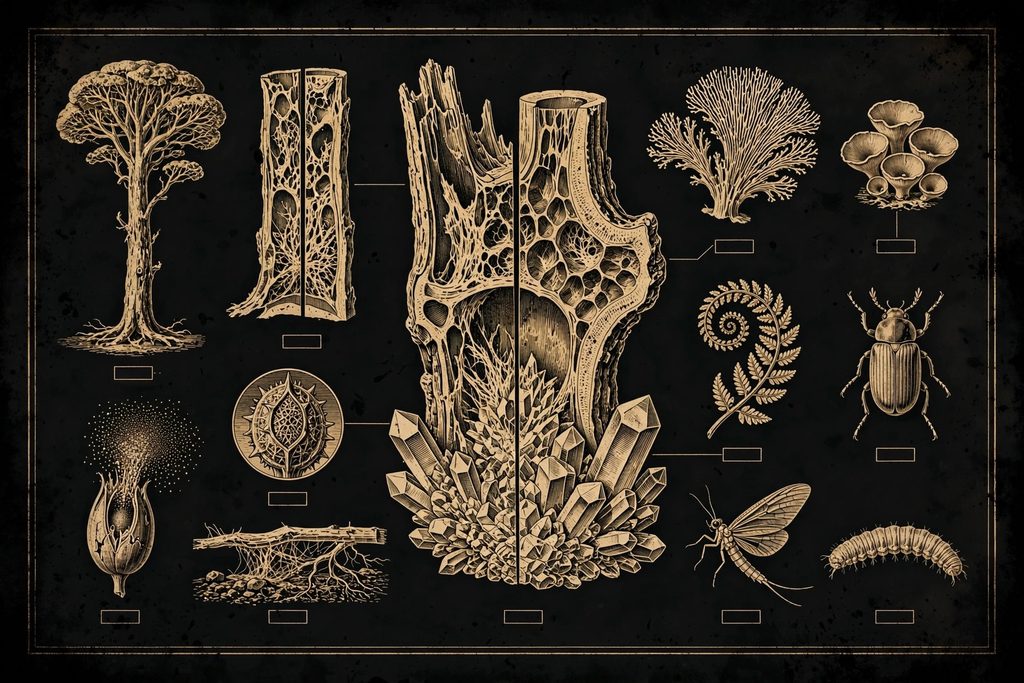
The film then takes her lower still. Fleeing through the forest, she falls through its floor into a vast hidden cavern beneath it. There, the trees of the Sea have died and turned to stone. Their petrified trunks stand like pillars of pale sand, water drips through them clean and clear, and the air can be breathed without a mask. The forest, she understands, draws the poison out of the earth, locks it into its own tissues, dies, and leaves behind pure sand and pure water. Above ground, a thousand years of corruption. Below, the first clean soil the world has seen since the fire.
Real ecology has a name for this. Phytoremediation is the use of plants to pull pollutants out of soil and water. After the Chernobyl disaster, sunflowers were floated on rafts in a contaminated pond near the plant to absorb radioactive cesium and strontium through their roots. The Chinese brake fern can pull arsenic out of soil and store it in its fronds at concentrations that would kill most plants. Fungi do something similar. Mycoremediation uses mushrooms and their mycelium to break down petroleum, pesticides and other toxins. The Sea of Corruption is mycoremediation on a planetary scale, imagined decades before the word became common.
IV. The Keepers of the Forest
If the forest is the healer, the insects are its immune system.
The Ohmu are the forest’s guardians. They are vast, slow and old, and they are not mindless. They respond to the forest’s wounds, to the cries of their young and to the emotions of the people around them. Nausicaä learns to calm them, to read the color of their eyes, and to understand that their rage always has a cause. In the film, the people of Pejite capture a wounded baby Ohmu and drag it behind an airship as bait, so that the furious herd will stampede into the Valley and destroy their enemies. The insects are used as a weapon precisely because humans understand how faithfully they protect their own.
The manga goes further. When the Dorok Empire releases a man-made mold as a weapon, it spreads beyond anyone’s control and threatens to consume the continent. The Ohmu respond in a vast migration. They pour into the poisoned lands and die there, and from their bodies a new Sea of Corruption grows over the catastrophe, enclosing the mold and stopping it. The insects literally become the soil of the cure.
Nausicaä’s attitude to these creatures has deep roots in Japanese literature. Miyazaki cited a tale from the late Heian period, The Lady Who Loved Insects, about a young noblewoman who refuses the fashions of the court and spends her days studying caterpillars, preferring the honest creature to the beautiful butterfly it will become. Behind the princess of the Valley stands that unfashionable girl with her boxes of crawling things, a thousand years older and every bit as stubborn.
Western environmental thought arrived at the same place by another road. Rachel Carson’s Silent Spring (1962) showed how the mass killing of insects with pesticides poisoned birds, rivers and people in turn. Its lesson was the same as the Valley’s. The creatures we fear and destroy are often the ones holding the system together.
V. The Gardeners of the Old World
Here the manga leaves the film behind and turns the story inside out.
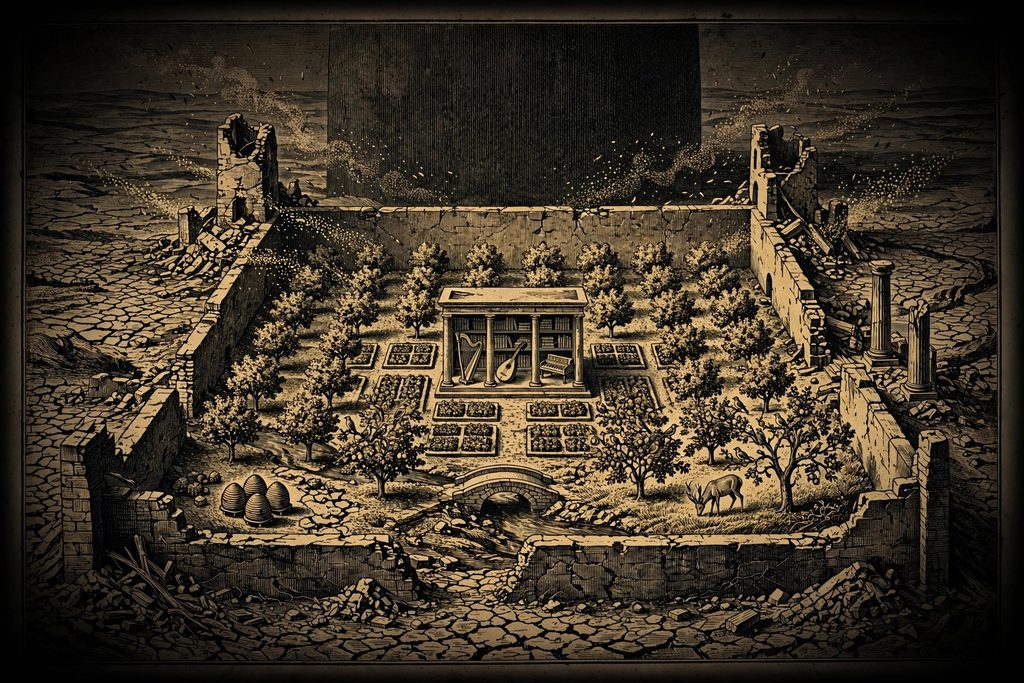
In the final volume, Nausicaä reaches the Crypt of Shuwa, a sealed structure at the heart of the old world’s ruins, and a hidden garden nearby where pure plants, animals, music and art from before the fire are preserved. There she learns the truth. The Sea of Corruption is not a natural response to pollution. It was designed. In the last days of their civilization, the scientists of the old world engineered the forest and its insects as a vast machine for purifying the planet, a process meant to run for many centuries.
They engineered the people too. The humans of Nausicaä’s age are not the humans of the old world. They were altered to survive in the poisoned environment, and as a result they cannot live for long in the clean world that the forest is making. Pure air makes them sick. The hardening illness that afflicts her father is a sign of how fragile that adaptation is. When the purification is complete, the people who have struggled for a thousand years at the edge of the forest will have no place in what they leave behind.
The Crypt holds the rest of the plan. Inside it wait the eggs of a new humanity, gentle and pure, designed by the ancients to inherit the cleansed Earth, along with the knowledge to rebuild their civilization. The forest is a cleaning crew. The people of the Valley, of Tolmekia and of Pejite are a temporary population, kept alive to survive the dirty centuries and then replaced.
The Institute has followed precursor civilizations through many worlds in The Civilization Beneath Every Civilization, and the scientists of the Crypt belong among the strangest of them. They do not leave ruins and riddles. They leave a schedule. And the survivors they engineered to endure the poison resemble no one so much as the ghouls of the Wasteland, a people adapted to the catastrophe and unsuited to the world after it, studied in The People Who Outlived the Bomb.
VI. The Princess Who Refused Paradise
Nausicaä’s answer is the most radical act in the story. She refuses.
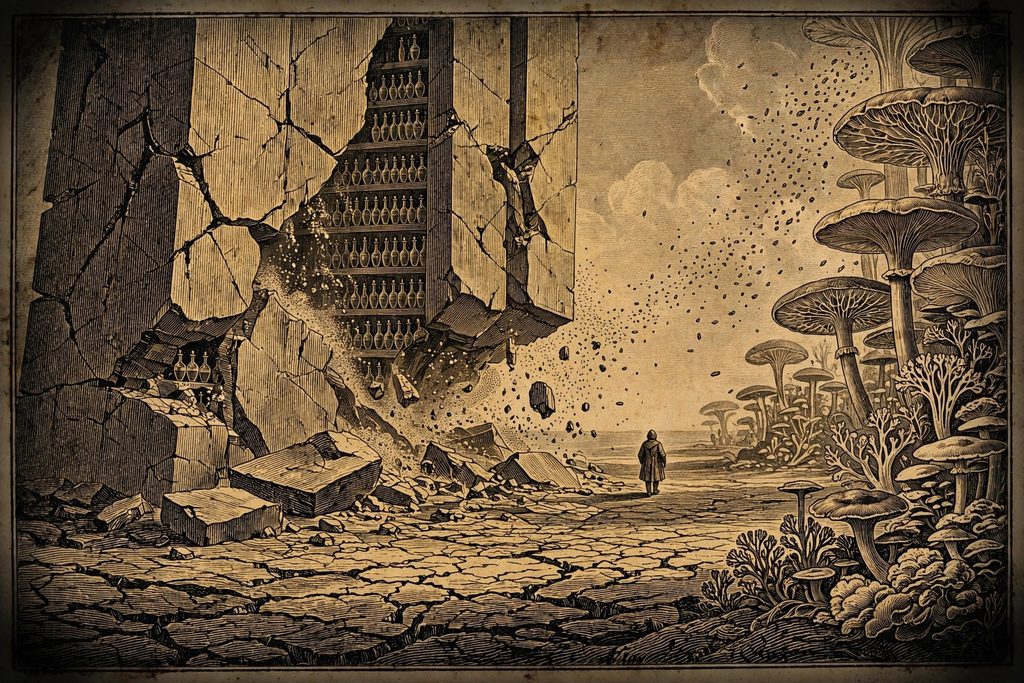
She tells the Crypt that a life designed in advance is not life at all, that living things change and must be free to change, and that a future planned down to its final species is a future already dead. Life, she says, is a light flickering in the darkness. With the help of the giant weapon she has raised almost as a child, she destroys the Crypt, its eggs and its knowledge. She chooses, for herself and for everyone she knows, the uncertain future of a damaged people in a damaged world over a perfect future that would not include them.
It is an extraordinary ending for an ecological story, and it is the reason the manga still unsettles readers decades later. Most environmental fiction promises a return. The forest heals, the wound closes, harmony is restored. Miyazaki takes that promise apart. Healing is real, but it is not for us. The clean world is coming, and we were not designed to live in it. The only honest response, in his telling, is to keep living anyway, to keep changing, and to trust that life will find a way through the poison that no plan could foresee.
The ancestor of them all
The Sea of Corruption has a real ancestor, and it lies on the coast of Kyushu.
From the 1930s until 1968, the Chisso Corporation’s chemical plant at Minamata released methylmercury into the bay. The mercury built up in fish and shellfish, and the people who ate them developed a devastating neurological illness, identified in 1956 and named Minamata disease. Thousands were poisoned. Cats danced and died in the streets. Children were born with severe damage. It became the defining environmental disaster of postwar Japan.
Miyazaki has named Minamata among the sources of Nausicaä, and what struck him was its aftermath. Once the bay was declared poisoned and no one would fish there any longer, sea life in Minamata Bay came back in abundance. Life was returning to a place humans could no longer use. That is the Sea of Corruption in a single image. Nature recovers, and recovers best, precisely where people have been forced to leave.
Even the heroine’s name reaches far back. Miyazaki took it from Bernard Evslin’s dictionary of Greek mythology, from the entry on Nausicaa, the princess of the Phaeacians in Homer’s Odyssey, who finds the shipwrecked Odysseus on the shore and helps him home. Evslin’s Nausicaa loved nature and music more than suitors and palaces. Miyazaki gave that Greek princess a glider, a gas mask and a basement full of spores.
The pattern
The Sea of Corruption belongs to a pattern that real ecology has been confirming for decades. The places most damaged by humans often become the wildest once humans leave.
After 1986, the Chernobyl Exclusion Zone was emptied of people. The pine trees nearest the reactor died so quickly that they turned red, and the area is still called the Red Forest. Within a generation, the zone had become one of the largest unplanned wildlife refuges in Europe, home to wolves, elk, boar, lynx and a herd of endangered Przewalski’s horses released there in 1998. The demilitarized zone between North and South Korea, closed to people since 1953, has become a sanctuary for rare cranes and other species that have vanished elsewhere on the peninsula. In both places, recovery came through the absence of people, and on terms that do not easily include them.
The same idea has reshaped ecological fiction. The old wilderness story was about taming nature. The new one is about nature healing itself at our expense, with landscapes that look like apocalypse but behave like recovery. Nausicaä was one of its first great expressions, and still one of the most uncompromising. Its forest is terrifying because it is beautiful, alive and right, and because its rightness does not need us. The Institute has seen a related idea in Rain World and the Ecology of Being Prey, a world indifferent to the creature trying to survive in it. Miyazaki’s twist is to make the indifferent forest also a healer, and to ask what a people owes a cure that will outlive it.
Findings
- The Sea of Corruption is a purification engine. It grows toward poison, locks toxins into its own tissues, dies, and leaves clean sand and water beneath it. It is mycoremediation imagined on the scale of a planet.
- Its insects are an immune system. The Ohmu defend the forest, respond to its wounds and, in the manga, sacrifice themselves in a vast migration to grow new forest over a man-made catastrophe.
- The ecology was designed. In the manga’s final volume, the forest, its insects and even the humans living beside it turn out to be the work of the old world’s scientists, part of a centuries-long plan to clean the Earth.
- The healed world has no place for its survivors. The people adapted to the poison cannot live in the clean world, and the Crypt of Shuwa holds a new humanity designed to replace them. Nausicaä destroys it and chooses an uncertain, damaged future over a planned paradise.
- Its ancestor is Minamata. A bay poisoned by industry filled with life again once people stopped using it, the same pattern that Chernobyl and the Korean DMZ have since confirmed. Recovery comes through our absence.
This Excavation draws on Hayao Miyazaki’s manga and film Nausicaä of the Valley of the Wind, on the history of Minamata, Chernobyl and the Korean DMZ, and on the science of phytoremediation and mycoremediation.
The Institute collects field evidence from people who lived inside these worlds. If the Sea of Corruption stayed with you, in the film or in the manga, send us your account.
Sources
- Hayao Miyazaki, Nausicaä of the Valley of the Wind, manga, serialized in Animage (1982 to 1994), Tokuma Shoten. English edition, VIZ Media.
- Nausicaä of the Valley of the Wind (1984), dir. Hayao Miyazaki, Topcraft and Tokuma Shoten.
- Hayao Miyazaki, Starting Point 1979 to 1996 (2009), VIZ Media.
- Homer, Odyssey, Book VI.
- Bernard Evslin, Gods, Demigods and Demons, An Encyclopedia of Greek Mythology (1975).
- The Lady Who Loved Insects, from Tsutsumi Chūnagon Monogatari (late Heian period).
- Rachel Carson, Silent Spring (1962), Houghton Mifflin.
- Paul Stamets, Mycelium Running (2005), Ten Speed Press.
- Lena Q. Ma and colleagues, “A fern that hyperaccumulates arsenic”, Nature (2001).
- Timothy S. George, Minamata, Pollution and the Struggle for Democracy in Postwar Japan (2001), Harvard University Asia Center.
- Jim T. Smith and Nicholas A. Beresford, Chernobyl, Catastrophe and Consequences (2005), Springer.
- Tatiana G. Deryabina and colleagues, “Long-term census data reveal abundant wildlife populations at Chernobyl”, Current Biology (2015).