





EXCAVATION Nº 0022 · ANTHROPOLOGY
World: The Wasteland, Fallout
Period: 2077 to 2296 (in-world)
Status: Active
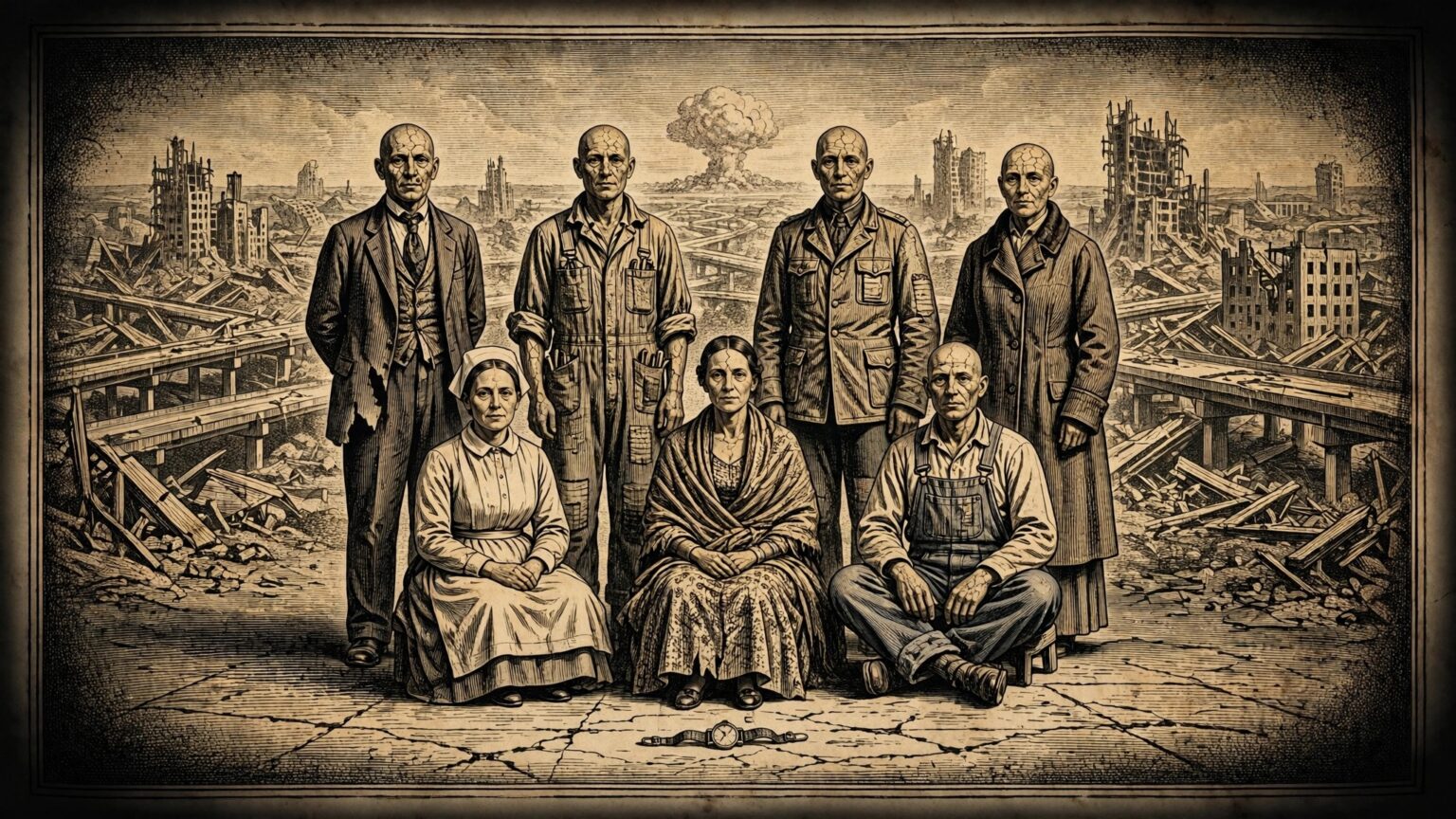
On the morning of 23 October 2077 the bombs fell, and a new people was born. Not in the slow way that peoples are usually born, over centuries of migration, marriage and language, but all at once, out of whoever happened to be standing in the wrong place. Their skin cracked and hardened like old leather. Their hair fell out. Their voices turned to gravel. And then, to everyone’s surprise, including their own, they did not die.
More than two hundred years later, many of them are still alive. The ghouls of Fallout are the oldest people in the Wasteland, and perhaps the strangest civilization in all of fiction. It is a nation in which nearly every citizen remembers the same day, in which no one is ever born, and in which the population grows only through catastrophe. This Excavation studies them as exactly what they are, a people created by a weapon.
I. A People Made in One Morning
The games describe ghoulification as the work of massive radiation exposure, helped in some cases by the Forced Evolutionary Virus and other pollutants drifting through the post-war air. The body rots without dying. Tissue decays and regenerates at the same time, so a ghoul can live for centuries, perhaps indefinitely, unless something kills it from outside. Radiation, which poisons everyone else, heals them.
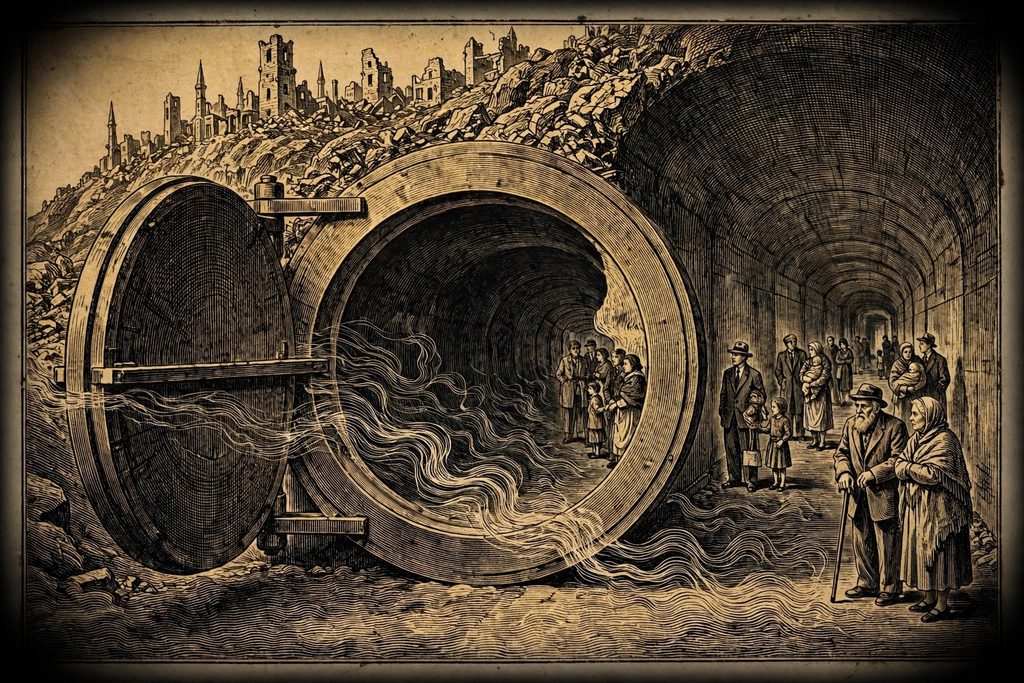
Most ghouls were made by the war. Some were made on purpose. Beneath the ruins of Bakersfield, California, lay Vault 12, built by Vault-Tec for around a thousand people. Its great door had been designed not to close. The residents were never told. They were the subjects of an experiment on the effects of long-term radiation, and decades of exposure turned the whole population into ghouls. When the first Fallout game arrived in 1997, the survivors of that experiment, the same people and not their descendants, had built a city above and around the vault. They called it Necropolis, the city of the dead, and they lived there under the rule of a ghoul overlord named Set.
That origin matters for everything that follows. Real ethnic groups have myths of origin, often a migration, a covenant or a common ancestor. The ghouls have a date and a corporation. Their founding event is a war, and in the case of Vault 12 their founding document is a research protocol. The Institute has followed that same corporation through other ruins in Why the Wasteland Keeps Rebuilding the Same Civilization.
II. A Nation Without Children
The single most important fact about ghoul society is buried in the lore and rarely discussed. Ghouls are sterile. Radiation destroyed their capacity to have children, and nothing in two centuries has restored it.
Consider what that means for a culture. There is no second generation. There are no ghoul children to raise, to teach, to argue with or to rebel. Kinship stops in 2077. Every family that exists among the ghouls is a family of the same age, made of spouses, siblings, friends and strangers who happened to survive together. Nothing is inherited, because there is no one to inherit it. The only way a ghoul community grows is when something terrible happens to humans nearby.
The closest human parallel is not an ethnic group at all. It is a celibate community. The Shakers of America forbade marriage and children and grew only through conversion and adoption. In the mid-nineteenth century they numbered in the thousands, spread across villages from Maine to Kentucky. Today a single village survives at Sabbathday Lake in Maine, with only a couple of members. A people that cannot reproduce must recruit or vanish, and the ghouls, like the Shakers, have very few willing recruits.
What a childless people has instead is memory. The ghouls are the only living witnesses to the world before the bombs. Raul Tejada, the ghoul mechanic of Fallout New Vegas (2010), remembers Mexico City before the war and has spent two centuries drifting from job to job, unable to shake the feeling that he has outlived his own usefulness. Captain Zao, in Fallout 4 (2015), still lives aboard the Chinese submarine whose missiles fell on Boston, and his one wish after two hundred years is to sail home. In the Fallout television series (2024), Cooper Howard, a pre-war actor turned ghoul bounty hunter, carries the memory of a career, a marriage and a daughter across 219 years.
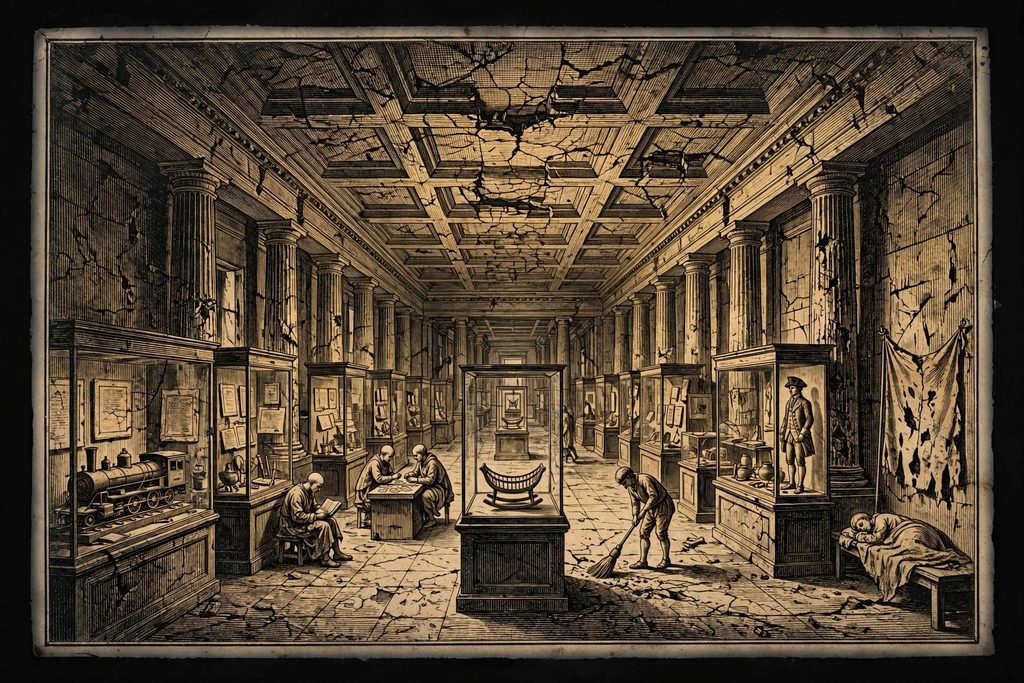
The ghouls of Fallout 3 (2008) made that memory into an address. Their settlement in the ruins of Washington, called Underworld, is built inside the Museum of History. A people of the past lives among the exhibits of the past. Few images in the series say more about what the ghouls have become. They are not just survivors of the old world. They are its last curators, and its last exhibits.
III. The Fear of Going Feral
Every ghoul knows how the story probably ends.
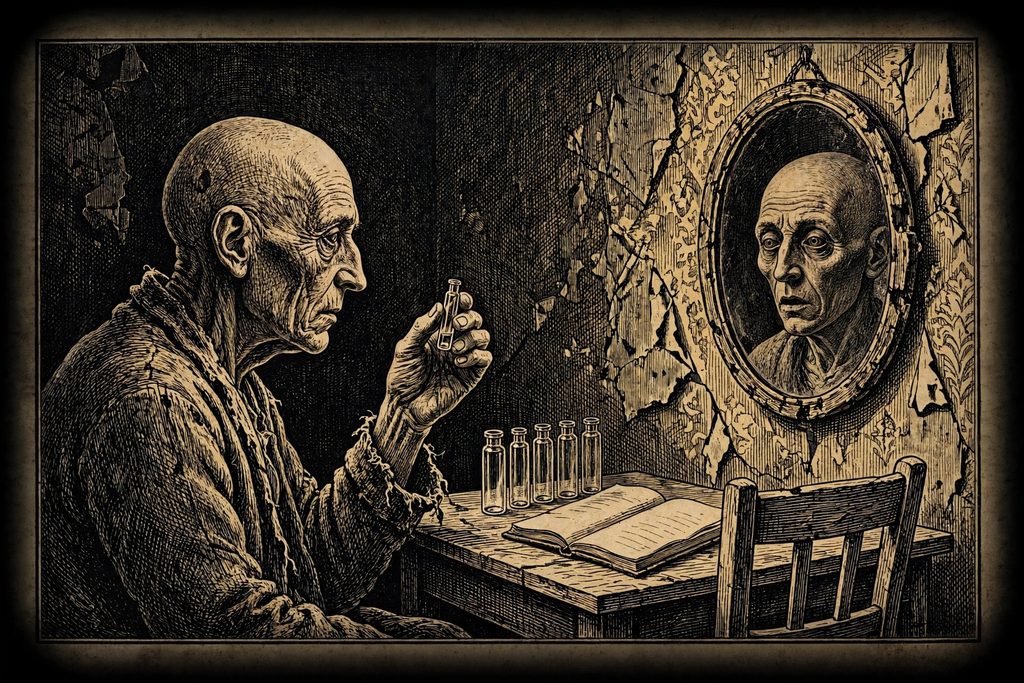
The ghoul body can survive almost anything, but the ghoul mind cannot. Over decades or centuries the brain degrades. Higher thought fades first, then restraint, and what remains is appetite and aggression. A ghoul who reaches that point is called feral, and the Wasteland is full of them, shambling through subway tunnels and ruined hospitals, attacking anything that moves. To a human traveler, a feral ghoul is a monster. To another ghoul, it is a neighbor, a friend or a spouse who did not make it.
That is why going feral is the central fear of ghoul life, and why it maps so precisely onto a human experience. The ghouls are an aging population whose greatest dread is not death but the loss of the self while the body lives on. Their fear has the shape of dementia.
The series has kept returning to it. The Glowing Ones, ghouls so saturated with radiation that they shine, are a dark paradox, the most damaged of their kind and the ones whose radiation can heal other ghouls around them. In the 2024 television series, ghouls hold off the feral state with vials of a scarce drug, and a whole people becomes dependent on a supply that others control, much as human patients depend on insulin or a pharmacy. And when Fallout 76 finally let players become ghouls in the Ghoul Within update of March 2025, it replaced the usual hunger and thirst meters with a Feral Meter. Play long enough without tending to it, and your character slides toward the edge of the mind. For the first time, players carried the ghoul’s oldest fear in their own interface.
IV. Smoothskins and Zombies
Ghouls have a word for humans, smoothskins. Humans have several words for ghouls, and “zombie” is among the politer ones. Across the series, the relationship between the two is written almost entirely in the vocabulary of segregation.
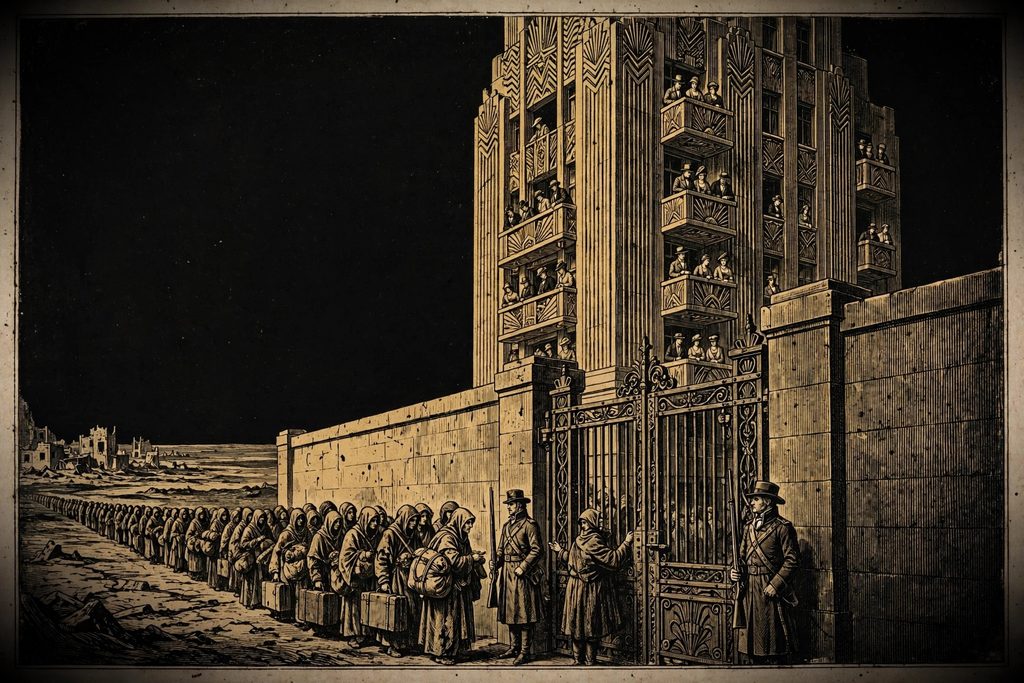
In Fallout 2 (1998), the ghouls of Gecko live beside a failing nuclear power plant, and their neighbors in Vault City, a clean, orderly, prosperous society descended from a sealed vault, regard them with contempt and fear. The player can repair the reactor and turn hostility into trade, or let the conflict end badly. In Fallout 3, a ghoul named Roy Phillips wants to move his people into Tenpenny Tower, a luxury residence whose wealthy human tenants refuse to live alongside ghouls. The player can kill the ghouls, help them force their way in, or broker a peaceful agreement. The peaceful agreement is the trap. Return later, and the human tenants are gone. The ghouls killed them once the player stopped watching. The game refuses the comfortable lesson. Integration negotiated over a deep wound does not heal the wound.
Fallout 4 places its sharpest irony in Diamond City, the great walled settlement built inside a ruined baseball stadium. Its mayor, Mayor McDonough, expelled the city’s ghoul residents in a campaign of fear. The player can later prove that McDonough himself is a synth, an artificial replacement planted by the Institute. The man who drove ghouls out for not being human enough was not human at all.
The sociologist Erving Goffman, in his classic study Stigma (1963), drew a line between the discredited, whose difference is visible at a glance, and the discreditable, whose difference can still be hidden. Ghouls are the discredited in the purest form. They cannot pass. Or at least they could not, until Fallout 76 gave its ghoul players the ability to conceal their condition when dealing with factions that would otherwise turn them away. A game about the end of the world had built a mechanic for passing.
V. The Cities of the Dead
Given a place to live, what do ghouls build?
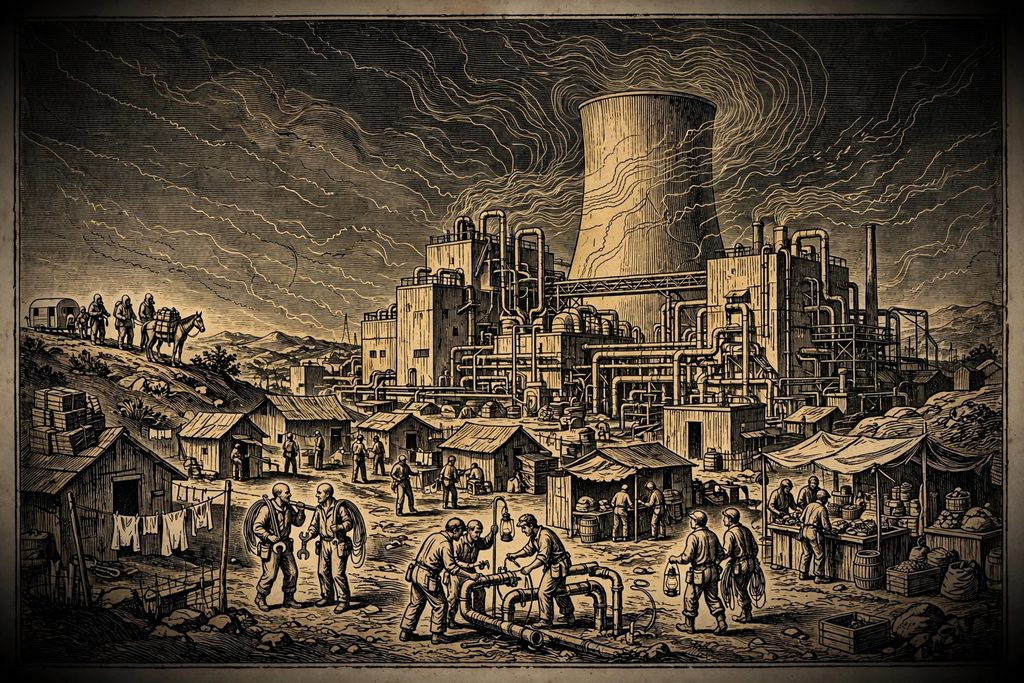
The answer across the series is consistent. They build economies around the one thing humans cannot do. Gecko’s ghouls are the nuclear technicians of the Wasteland, because only they can work inside a leaking reactor without dying. In Fallout 4, the Slog is a ghoul farming settlement with fields, a swimming pool and an open door to any human who will work beside them. Goodneighbor, a rough town on the edge of ruined Boston, takes in ghouls, drifters and anyone else the respectable settlements reject, and its mayor rules under the motto “of the people, for the people”. Underworld runs bars, a clinic and a shop inside the museum, and it lets humans in, mostly.
Their politics range as widely as anyone’s. Necropolis was ruled by a single overlord. Gecko was a working town organized around its reactor. Underworld is something close to a neighborhood association. What unites them is the sense of a minority community defined from outside, by fear and law, and holding itself together from inside, by trade, shared memory and a refusal to disappear.
And like many persecuted minorities, some ghouls have looked for a promised land. In Fallout New Vegas, the ghoul prophet Jason Bright leads his followers to an abandoned rocket test site to launch themselves toward the Far Beyond, a sanctuary among the stars. That pilgrimage, and the other faiths of the Wasteland, are studied in the Institute’s The Cults of the Wasteland.
VI. The Ghoul Who Chose
For most of the series, nobody chose to be a ghoul. Then people began to.
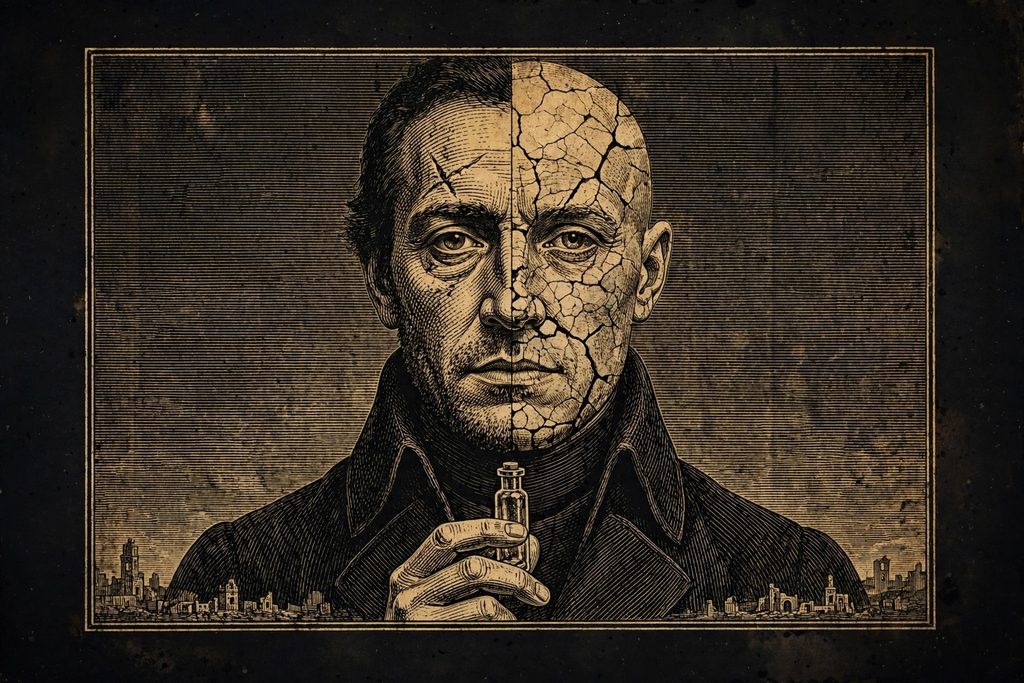
The first was a mayor. John Hancock, who rules Goodneighbor in Fallout 4, was born human. He took an experimental radiation drug and became a ghoul, and he wears the change as a statement of where he stands. A human who joins the ghouls voluntarily turns the old logic upside down. The mark of the outcast becomes a badge of allegiance.
Then the players chose. Fallout 76’s Ghoul Within update made ghoulification a quest that any character can undertake once it reaches level 50. Radiation heals the player, the Feral Meter ticks down, and thirty new perk cards reward the life of the dead. Thousands of players, who could have stayed human, walked into the change.
And finally the ghoul became the face of the whole franchise. In the 2024 television series, Walton Goggins’s Ghoul, once Cooper Howard, became the show’s breakout character. The second season, which premiered in December 2025, follows him into New Vegas. A creature that began in 1997 as a frightening resident of a city of the dead has become the most watched nuclear survivor in popular culture. The monster moved from the background to the center, and then into the narrator’s chair.
The ancestor of them all
The ghouls have a real ancestor, and it has a name. On 6 and 9 August 1945, atomic bombs destroyed Hiroshima and Nagasaki. Those who survived became known in Japan as the hibakusha, the people affected by the bomb.
The hibakusha carried scars, radiation sickness and the fear that their illness might be passed to their children. They also carried stigma. For decades many faced discrimination in marriage and employment, as families and employers feared contamination and inherited disease. Some hid their status. Many spent their lives telling their stories so that the world would not forget, and in 1956 they founded Nihon Hidankyo, the confederation of survivors’ organizations that won the Nobel Peace Prize in 2024.
The hibakusha are, by definition, a population that can only shrink. According to Japan’s health ministry, at the end of March 2026 there were 91,105 of them, with an average age of 86.66. Within a generation, the last living witnesses of the only nuclear attacks in history will be gone, and their testimony will live in archives and museums, among the exhibits of the past.
Fallout’s ghouls compress that history into fiction and then remove its ending. They carry the scars, the stigma and the testimony of the hibakusha, but they never age past the moment of witness. They are survivors frozen in the act of surviving.
Even their name comes from far older fears. The Arabic ghūl is a demon of the desert that lures travelers and feeds on the dead, a creature of pre-Islamic folklore that entered European languages through the first French translation of the Thousand and One Nights in the early eighteenth century. In 1968, George A. Romero’s Night of the Living Dead applied the word to the walking dead, and a news report in the film blames their rising on radiation from a returning space probe. By the time Fallout borrowed the word, a ghoul was already a corpse that radiation would not let rest.
The pattern
Post-nuclear fiction almost always gives its survivors a body that tells the story. In Walter M. Miller Jr.’s A Canticle for Leibowitz (1959), the novel whose monks of the wasteland echo through Fallout’s own Brotherhood, the children born deformed after the Flame Deluge are called the misborn and treated as a stain on the world. In Beneath the Planet of the Apes (1970), the human survivors in the ruins of New York are scarred, telepathic mutants who worship an atomic bomb. In Romero’s film, the radiated dead walk.
Reality has its own versions. After the Chernobyl disaster of 1986, hundreds of evacuees, most of them elderly women, quietly returned to their villages inside the exclusion zone and lived out their lives in contaminated land, preferring home to safety. For more than a century, from 1866, people with leprosy in Hawai’i were forcibly sent to the isolated settlement of Kalaupapa on the island of Molokai, where they built a community of their own, with churches, homes and leaders, in a place designed to keep them out of sight.
The pattern is consistent. A catastrophe marks a group of survivors. The unmarked majority fears contamination and pushes them away. The marked build a community of their own, defined from outside by stigma and from inside by memory. And they become evidence, living proof of something the rest of society would prefer to forget. Fallout’s single great addition is time. Its marked survivors do not fade away. They outlive the people who shunned them, and they are still there, two hundred years later, keeping the museum.
Findings
- The ghouls are a people created by a weapon. Their founding event is the Great War of 2077, and in Vault 12 their founding document is a corporate research protocol. Few fictional peoples have so exact a date and author for their origin.
- They are a nation of one generation. Sterility means no children, no inheritance and no future except through new catastrophe. Memory replaces descent as the core of their culture, which is why they end up living inside a museum.
- Their deepest fear is internal. Going feral is the dementia of an ageless population, and the series has turned it into scarce medicine, healing radiation and, in 2025, a meter on the player’s own screen.
- Their story is told in the language of stigma. Tower gates, expulsions, slurs and, finally, a mechanic for passing make the ghouls Fallout’s longest study of segregation.
- Their ancestor is the hibakusha. As the last real survivors of Hiroshima and Nagasaki grow old, the fictional ghoul has become the most widely seen nuclear survivor in popular culture, carrying their scars without their ending.
This Excavation draws on Fallout, Fallout 2, Fallout 3, Fallout New Vegas, Fallout 4, Fallout 76 and the Fallout television series, on the history of the hibakusha, Chernobyl and Kalaupapa, and on the sociology of stigma.
The Institute collects field evidence from people who lived inside these worlds. If a ghoul in the Wasteland stayed with you, as an enemy, a companion or a neighbor, send us your account.
Sources
- Fallout (1997), Interplay Productions, and Fallout 2 (1998), Black Isle Studios.
- Fallout 3 (2008), Bethesda Game Studios.
- Fallout New Vegas (2010), Obsidian Entertainment.
- Fallout 4 (2015), Bethesda Game Studios.
- Fallout 76 (2018) and The Ghoul Within update (2025), Bethesda Game Studios.
- Fallout, television series, seasons 1 (2024) and 2 (2025), Kilter Films and Amazon MGM Studios.
- Erving Goffman, Stigma (1963), Prentice Hall.
- Walter M. Miller Jr., A Canticle for Leibowitz (1959), J. B. Lippincott.
- Night of the Living Dead (1968), dir. George A. Romero.
- Beneath the Planet of the Apes (1970), 20th Century Fox.
- John Hersey, Hiroshima (1946), Alfred A. Knopf.
- Nihon Hidankyo, Nobel Peace Prize (2024), The Norwegian Nobel Committee.
- Japan Ministry of Health, Labour and Welfare, hibakusha figures as of March 2026, reported by Jiji Press (July 2026).
- The Babushkas of Chernobyl (2015), dir. Holly Morris and Anne Bogart.
- Kalaupapa National Historical Park, U.S. National Park Service.
- Stephen J. Stein, The Shaker Experience in America (1992), Yale University Press.