





EXCAVATION Nº 0003 · RELIGIONS
World: Fallout
Period: 2077 onward (in-world)
Status: Active
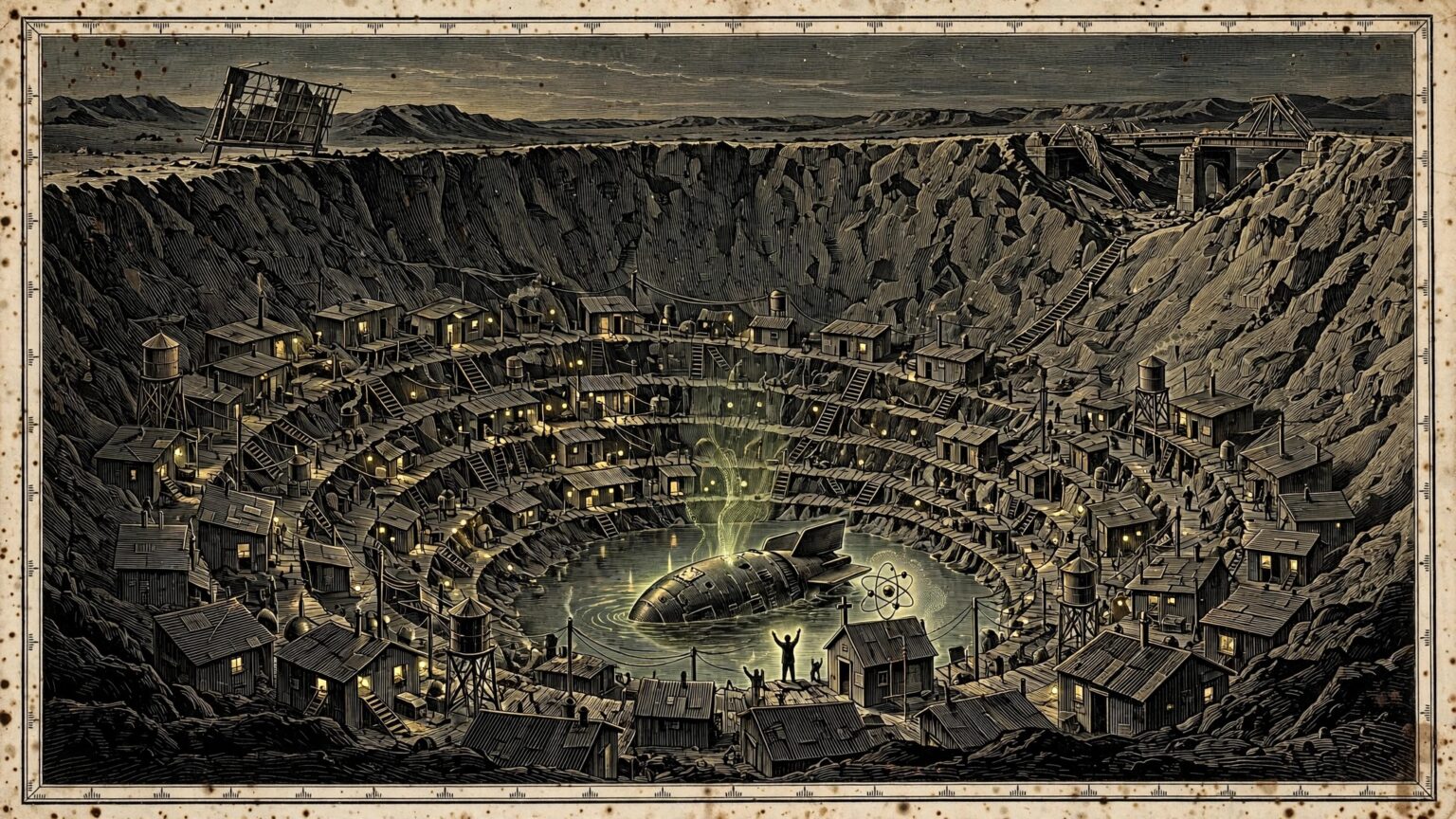
In a town built from scrap metal at the bottom of a crater, a preacher stands beside an atomic bomb and tells anyone who will listen that it is holy.
The bomb never exploded. The town, called Megaton, grew up around it anyway, and the preacher’s congregation was there from the beginning. They had helped build the settlement, and in return the town was built around their god. They call it Atom.
This is the most famous image of religion in the Fallout series, and it is a good place to begin an excavation of the Wasteland’s faiths. On 23 October 2077, a nuclear war destroyed the old world. In the centuries that followed, the survivors did what human beings have always done after catastrophe. They built new beliefs to explain what had happened to them, and to tell them what to do next.
This report examines five of those faiths across the Fallout games, compares them, and asks what they have in common. The evidence comes from the games themselves: their dialogue, locations, terminals and quests. Where the games leave a question deliberately unanswered, we say so.
I. The Church of the Bomb
The Children of Atom worship radiation.
To them, Atom is the creator of this and every other world, and the Great War that ended civilization was a holy event. Their central doctrine is Division. Every atom, they teach, contains a universe of its own, and when Atom splits the atoms of the world, new universes will be born inside each one, filled with new life. A nuclear blast is therefore an act of creation. Radiation is Atom’s glow, and to be touched by it is to be blessed.
The faith appears across the series and in very different places. In the Capital Wasteland, Confessor Cromwell preaches beside the unexploded bomb in Megaton. In the Commonwealth, a congregation led by Mother Isolde lives inside the Crater of Atom, deep in the Glowing Sea, the most radioactive region in the game, which they regard as a gift. On the island of Far Harbor, High Confessor Tektus leads another community from a pre-War military installation known as the Nucleus, where the believers treat the island’s radioactive fog as a sign of Atom’s favour.
The church has a clear hierarchy. Confessors and High Confessors hold authority, zealots defend the faith, and members address each other as Brother, Sister and Mother. Some believers appear to tolerate radiation far better than ordinary humans, which the faithful take as evidence of Atom’s blessing.
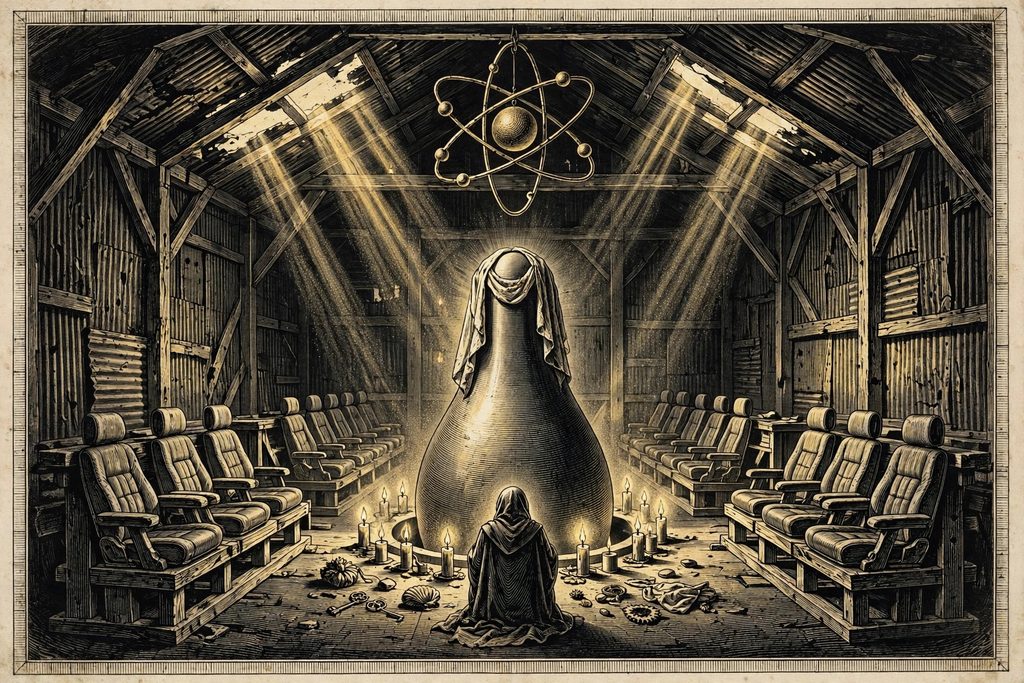
Theologically, the Children of Atom have done something remarkable. They have taken the event that destroyed their world and made it the centre of a religion of creation. The bomb is not the end of the world to them. It is how worlds begin.
The games are fully aware of the irony. In Megaton, the player can defuse the bomb, or detonate it and destroy the town and its congregation in a single flash. The god at the centre of the church is real, and it can be used.
II. The Great Journey
Far to the west, in the Mojave Desert, a different faith looked to the sky.
The Bright Brotherhood is a congregation of ghouls, human survivors disfigured and made long-lived by radiation, and treated across the Wasteland with fear and contempt. Their leader, Jason Bright, is a glowing ghoul, so saturated with radiation that he gives off light. He has had a vision of escape.
He calls it the Great Journey. Somewhere beyond this world lies what he describes as a place of safety and healing, a paradise in the Far Beyond, and the Brotherhood believes it has been chosen to reach it. The means of salvation are very practical. At the abandoned REPCONN test site outside the town of Novac, pre-War rockets still stand. Bright intends to launch his followers into the sky aboard them.
One detail of the Brotherhood is especially revealing. Its technical expert, Chris Haversam, is an ordinary human who believes he is a ghoul. The congregation has accepted him, but he cannot take part in the journey, because the radiation would kill him. The faith was built by and for the people everyone else rejected, and it is so compelling that an outsider wants to belong to it anyway.
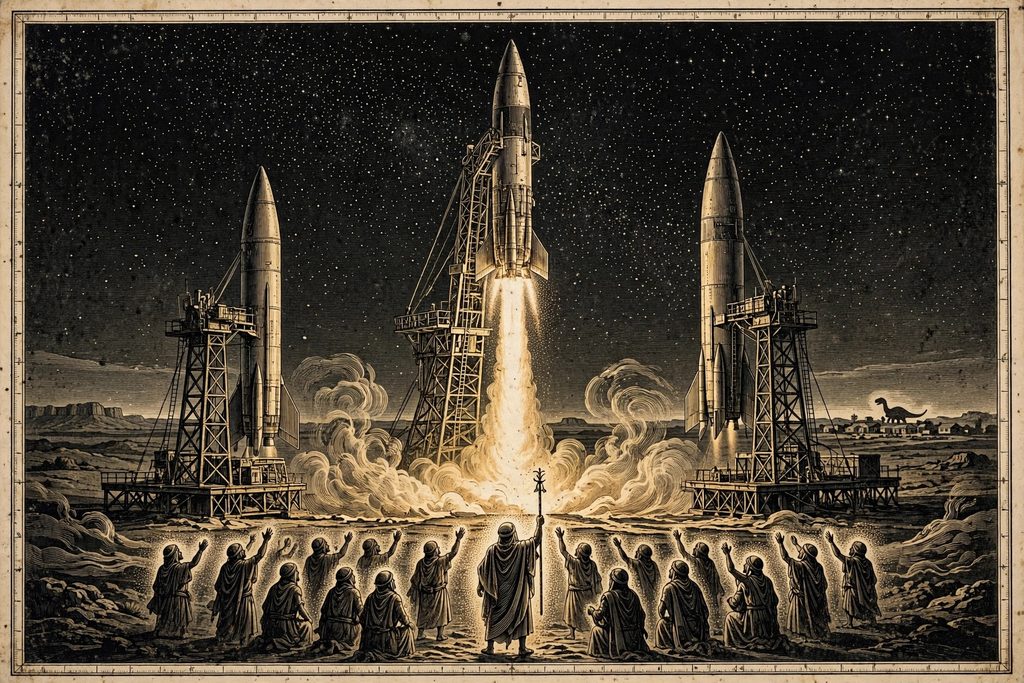
The Bright Brotherhood’s religion is an exodus faith, the oldest pattern of belief among the oppressed: a people told they are chosen, promised a land beyond this one, and led out of their suffering by a prophet. What makes it unusual is that the promised land is reached by rocket, and the player decides whether the launch succeeds.
III. The Old God Beneath
Not every faith in the Wasteland was born from the bombs. One of them is much older.
In the swamps of Point Lookout, on the coast of Maryland, the player encounters the worship of Ug-Qualtoth, a being that belongs openly to the tradition of H.P. Lovecraft. Its scripture is the Krivbeknih, a book with a long and evil history that is said to grant its keepers unnatural power and unnaturally long life. The Blackhall family once held it. The last of the line, Obadiah Blackhall, wants it back, and his mansion hides a secret altar to Ug-Qualtoth in the billiards room.
The swamp’s inhabitants worshipped Ug-Qualtoth under the family’s leadership. When the book was lost, their religion did not disappear. It decayed. What survives, according to the in-game record, is a set of performative chants and rituals cut off from their original meanings.
The oldest evidence ties this faith to the war itself. Beneath the Dunwich Building lies an ancient obelisk, and its discovery is recorded on 23 October 2077, the same day the bombs fell.
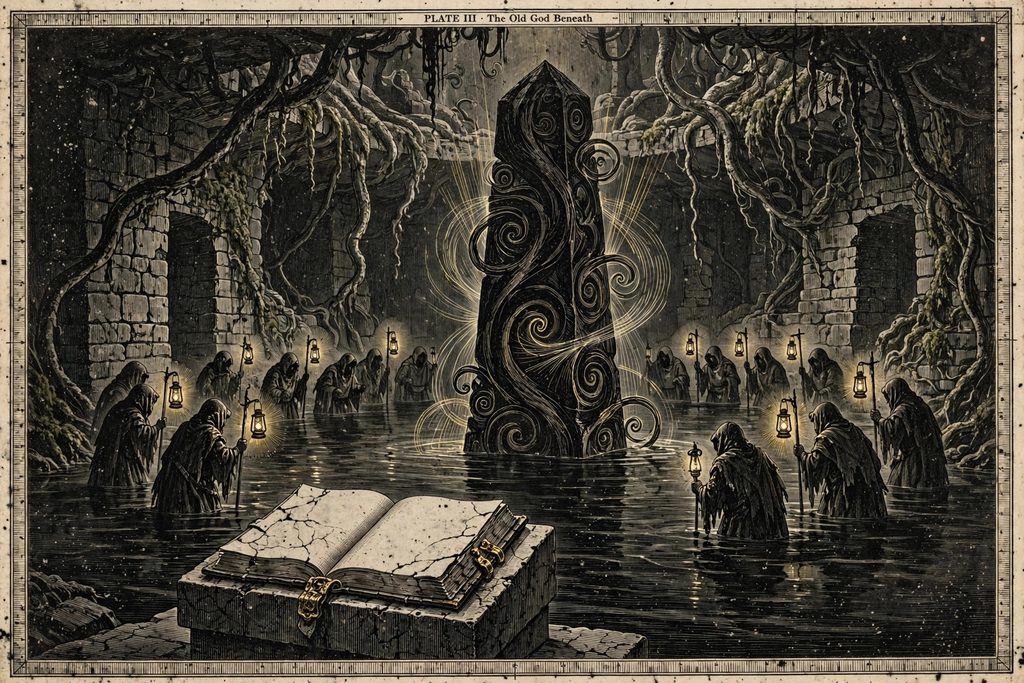
Here the games deliberately refuse to give an answer. The record describes everything about Ug-Qualtoth as shrouded in religious zeal, madness and mutation. It may be a real entity, a shared delusion, or the effect of radiation on isolated minds. The Institute leaves the question open, as the games do.
What the swamp does show clearly is something every student of religion recognises: ritual outlives meaning. The swampfolk still chant, and they no longer know what the chants are for.
IV. The Watcher in the Hills
In the Appalachian hills of West Virginia, a faith grew from a tourist attraction.
Before the war, the town of Point Pleasant made a small industry out of a local legend, a winged creature with glowing eyes called the Mothman. There was a museum. There were souvenirs. The creature was folklore and novelty, nothing more.
After the war, it became a god. The Cult of the Mothman believes the creature is divine, that it guides the worthy, and that rituals can summon it and win its blessing. Then the cult did what religions often do. It split.
The main body, called the Dim Ones by their rivals, worships a red-eyed Mothman they call the Interloper. The Enlightened revere a different being, the purple-eyed Wise Mothman, and their founding story explains why. During the Great War, a man named Charles received a vision from the Wise Mothman that guided a group of people to safety underground as the bombs fell. The Enlightened settled at a church called the Lantern, and during the seasonal Equinox they return to Point Pleasant in pilgrimage while the Dim Ones try to stop them.
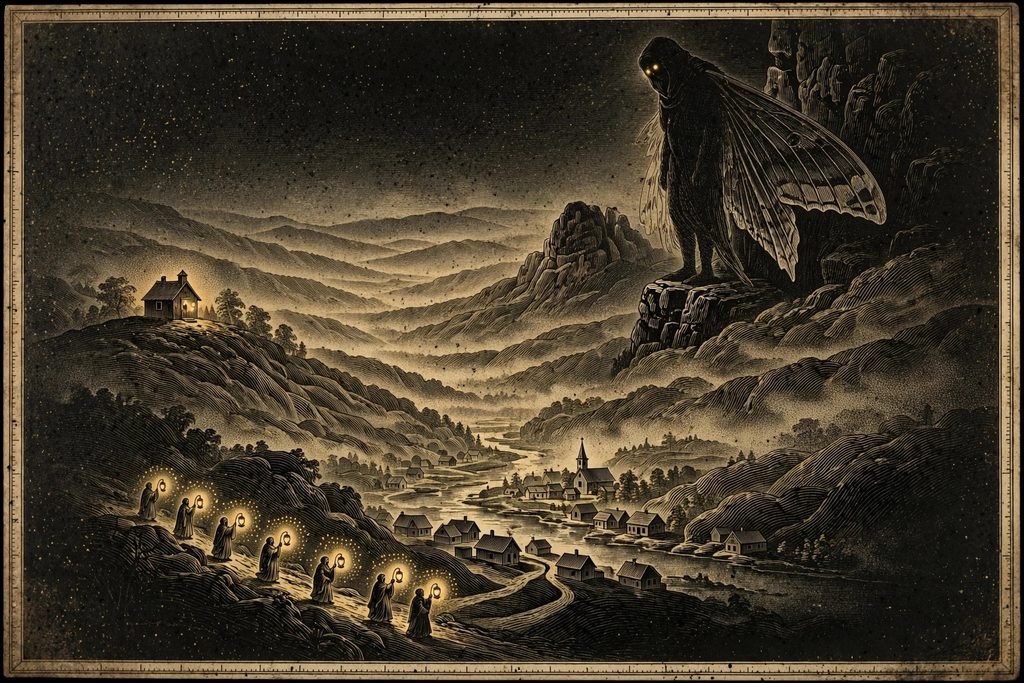
In one region, the Mothman faith shows the whole life cycle of a religion: a local legend, a sacred encounter, a founding miracle, a schism, rival orthodoxies and a pilgrimage calendar.
V. The Church That Sold the Stars
The last faith in this sample is a survivor from before the war, and the games treat it as satire.
Hubology was founded by Dick Hubbell, a pre-War science fiction author. His followers believe humanity is burdened by neurodynes, a kind of spiritual contamination left behind by the dead, which can be removed through paid “alignment” procedures. Converts give up their possessions and pay more at every step of their spiritual progress. The Hubologists’ ultimate goal is to leave Earth and reach a distant planet where their Star Father waits. In one game they try to repair a pre-War space shuttle. In another, they are restoring a “UFO” that is really a decommissioned amusement park ride.
Hubology is a joke at the expense of real-world religious movements, and the games never pretend otherwise. As evidence it still matters, because it shows that the Wasteland did not only invent new faiths. It also inherited old ones, with their fees, hierarchies and promises intact.
The ancestor of them all
The earliest Fallout faith deserves a mention, because it set the pattern for the rest.
In the first game, released in 1997, the Children of the Cathedral ran clinics and hospitals across the Wasteland and preached a doctrine of Unity. They called the nuclear weapons that destroyed the old world the Holy Flame, divine justice upon a corrupt civilization. The church was a front. Behind it stood the Master, a mutant intelligence who used the faith to spy on settlements and to gather converts for a transformation that would end humanity as it had been.
From the very first game, then, the series presented religion in the Wasteland as two things at once: a genuine response to catastrophe, and a tool that the powerful can use.
The pattern
Set side by side, these five faiths share a clear structure.
Catastrophe becomes sacred. Two separate churches, the Children of the Cathedral and the Children of Atom, looked at nuclear war and called it holy. The event that destroyed the world became the centre of worship.
Salvation lies in the sky. Two unrelated faiths, the Bright Brotherhood and the Hubologists, arrived independently at the same answer: build a rocket and leave. When the ground is poisoned, heaven becomes a place you can fly to.
Folklore becomes doctrine. The Mothman went from museum exhibit to deity in a single generation.
Ritual outlives meaning. The swampfolk of Point Lookout still perform the rites of a scripture they have lost.
Faiths divide. The Mothman cult split over which Mothman to worship, and the Children of Atom exist as separate congregations with different leaders and different holy ground.
Taken together, the Wasteland’s religions are not a random collection of oddities. They are a compressed history of religion itself, replayed in a few centuries after the end of the world.
Findings
- The bomb is the Wasteland’s central sacred object. Two churches independently made nuclear war holy, one as divine judgment and one as divine creation.
- Outcast faiths promise escape. The Bright Brotherhood’s exodus by rocket is a religion of the rejected, following the oldest pattern of belief among the oppressed.
- The oldest faith is the least explained. Ug-Qualtoth is deliberately left ambiguous, and its worship survives as ritual after its meaning has gone.
- Religions follow a life cycle. The Cult of the Mothman shows legend, miracle, schism and pilgrimage within a single region.
- Faith can be a tool. From the Children of the Cathedral to Hubology, the series repeatedly shows religion used by the powerful, as well as believed by the faithful.
In The Anatomy of Eywa, the Institute examined a world where the goddess is demonstrably real and answers when called. The Wasteland is the opposite case. Its gods are bombs, rockets, legends and books, and whether any of them are real is almost beside the point. What the survivors needed was a reason for what had happened to them, and a place to go next.
Filed under Religions. For how the Institute separates evidence from interpretation, see our methodology.