





EXCAVATION Nº 0004 · HUMAN ARCHIVE
World: The Lands Between, Elden Ring
Period: 2022 onward (real world)
Status: Active
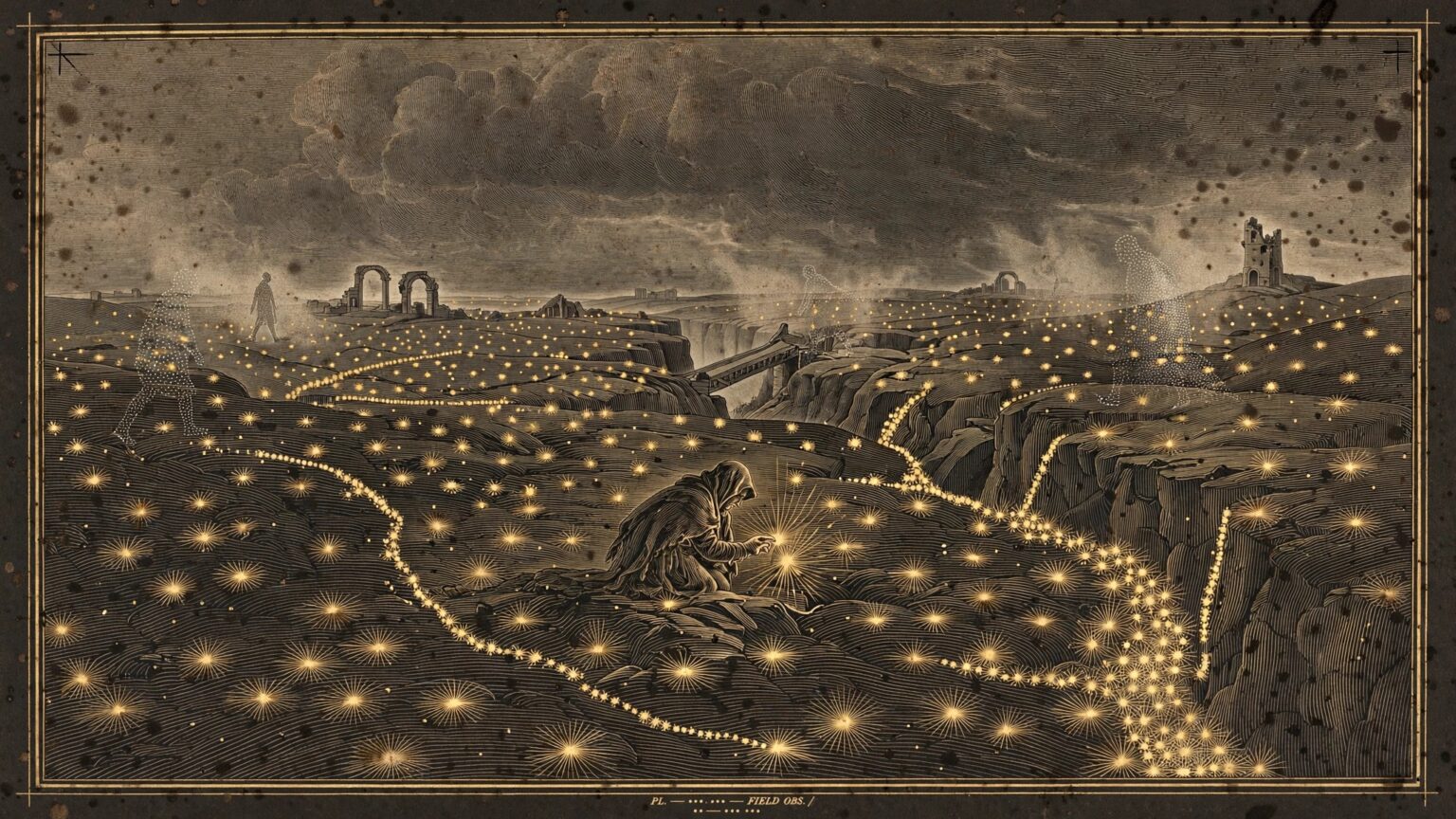
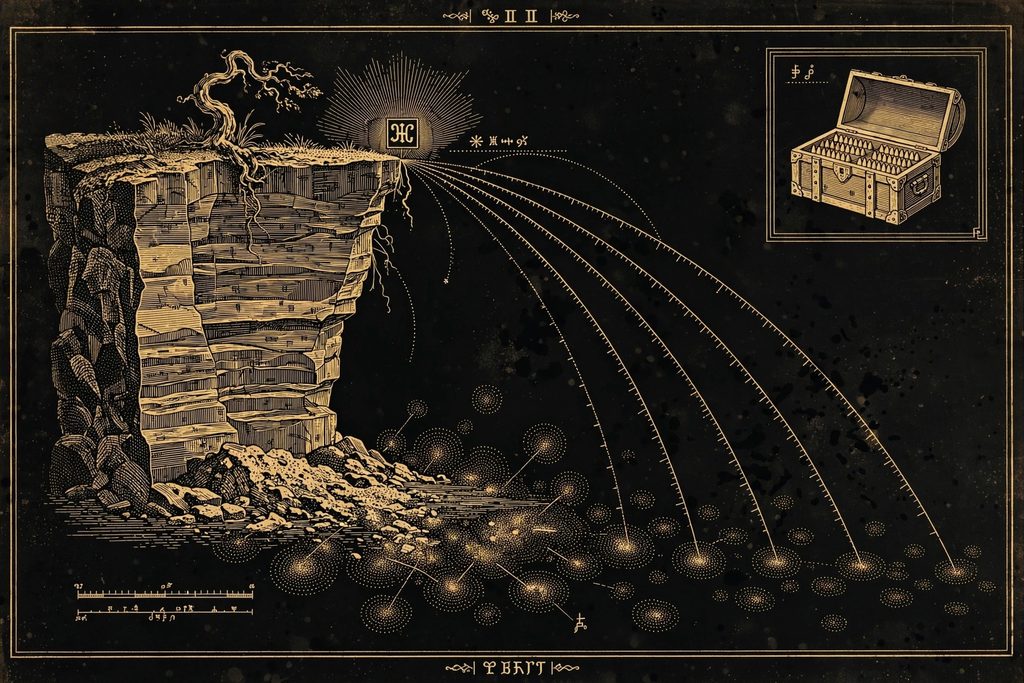
On a cliff edge in Limgrave, a line of orange script glows faintly in the grass. It reads “Try jumping.” Below it is a drop that nobody survives. A stranger wrote it, strangers read it, and at the bottom of the cliff the red stains of the ones who believed it lie across the rocks like a casualty list.
Elden Ring’s players never see each other’s faces, hear each other’s voices or learn each other’s names. Yet in the years since the game’s release in February 2022, they have built something the Institute can only call a civilization. It has a written language with a fixed vocabulary. It has an economy in which kindness is paid in health, a class of professional liars, a school of poets and a priesthood of volunteers. It has a criminal underclass with its own code of honour, and a public record of every death. The Human Archive exists to study exactly this kind of society. It is the one that grows among the people who inhabit a fictional world, rather than inside the fiction itself.
What follows is a survey of that society in seven parts, drawn from the game’s own systems and from the documented history of its players.
I. The Writing Finger
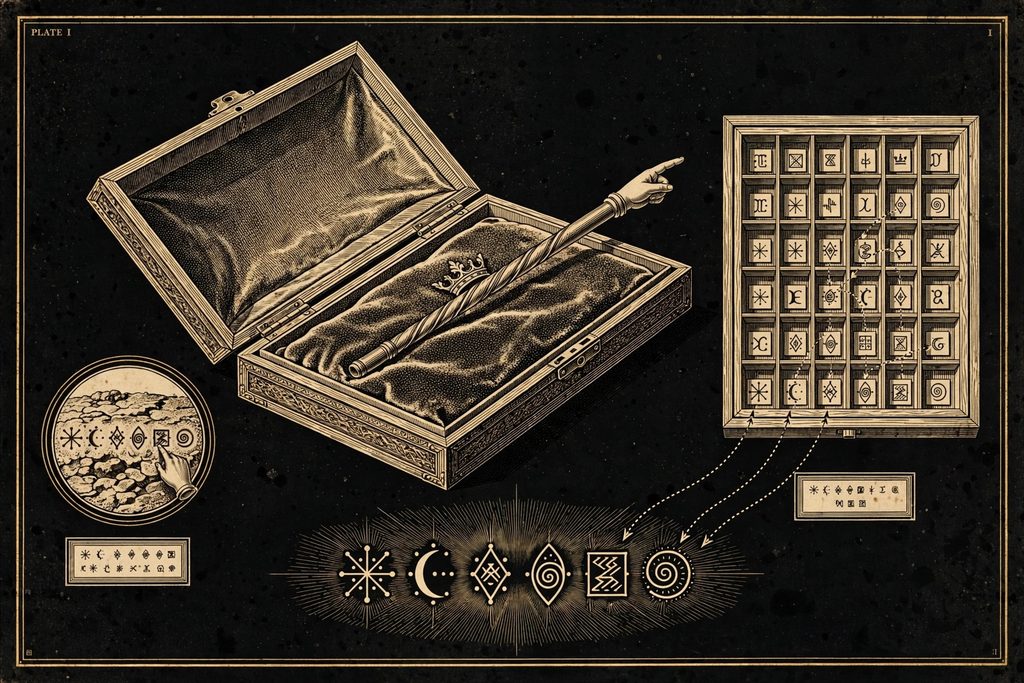
Every Tarnished carries a key item called the Tarnished’s Wizened Finger. With it, a player can write on the ground of the Lands Between, and the message will appear in the worlds of other players who pass the same spot.
The writing is not free. A message is built from one of about two dozen templates, such as “**** ahead”, “Be wary of ****”, “Try ****”, “Could this be a ****?” and “Behold, ****!”. Each template is filled with words chosen from lists in twelve categories, running from Enemies and Places to Body Parts, Affinities and Concepts. Two phrases can be joined with one of ten conjunctions: and then, or, but, therefore, in short, except, by the way, so to speak, all the more, and a bare comma. That is the entire grammar. There is no keyboard, and there is no way to spell a word the lists do not contain.
The restriction has consequences a free text box never could. The game stores the choice of words rather than the letters. So a message written by a player in Osaka appears in French to a player in Lyon, and in Portuguese to a player in São Paulo. The Lands Between has a language every inhabitant reads natively. Philosophers chased this for centuries. Leibniz imagined a universal written character in which any thought could be expressed without ambiguity. In 1887, L. L. Zamenhof published Esperanto in the hope of giving the world a shared second tongue. Elden Ring reached the goal by a cruder route. It removed every word that could not be translated.
The limits also make certain things impossible to say. There are no slurs in the lists and no personal names. There are no plot revelations beyond what the words themselves give away. The Institute notes that restricted languages tend to produce a distinctive style rather than silence. Telegrams, priced by the word, gave the twentieth century a clipped prose of its own. Haiku draws its force from seventeen syllables. The messages of the Lands Between belong to the same family. The culture that grew out of them is shaped at every level by what the grammar allows.
II. The Economy of Approval
Every message can be appraised by its readers. When a reader rates a message as good, the author receives health equal to one Flask of Crimson Tears, at no cost. It arrives wherever they happen to be in their own world at that moment. A player deep in a losing fight can be saved by a stranger who found their warning useful an hour earlier and a continent away.
This is a gift economy in the sense the anthropologist Marcel Mauss described in 1925. The gift is anonymous, but it still creates obligation. Players who have been healed by an appraisal learn to appraise in turn, and the habit spreads without any rule requiring it. The author never learns who paid. The payer never learns whether the payment arrived in time.
The honest messages make up the civic infrastructure of the Lands Between. “Be wary of right” sits before a corner where an enemy waits. “Ambush ahead” marks the edge of a quiet clearing. “Hidden path ahead” stands beside a wall that turns out to be an illusion and vanishes when struck. “Item ahead” points out a narrow ledge that hides something worth the climb. They work the way cairns work on a mountain trail, or the chalk marks travellers once left on gateposts. Nobody is paid to place them, and yet the whole country would be harder to cross without them.
III. The Liars
A fixed vocabulary does not prevent deception. It only limits the words a liar can use. The most famous lies of the Lands Between are the simplest. “Try jumping” appears at the edge of a lethal drop. “Treasure ahead” invites a leap into nothing. “Hidden path ahead” stands beside a wall that is entirely solid, where the only reward for striking it is looking foolish in front of an enemy.
The economy of approval ought to punish these messages, but it does not. Players who fall for a well-placed lie often rate it good after they die, as a form of applause. A clever lie and a useful warning earn the same currency. The Institute regards this as one of the most revealing features of the society. Its members value wit about as highly as truth, and they will pay for a joke played at their own expense.
The culture developed its own correction. A second message placed beside the first, reading simply “Liar ahead”, works as a footnote from a later reader. The bloodstains offer a quieter kind of peer review. A clean patch of ground beneath a message suggests it was honest. A field of stains at the foot of a cliff tells the next reader how many people trusted it before them.
The tradition is older than Elden Ring. In Dark Souls, “Amazing chest ahead” was a common message beside chests that turned out to be Mimics. These are creatures that disguise themselves as treasure and devour whoever opens them. The phrase escaped the game and became community shorthand for any trap dressed up as a reward. It arrived in the Lands Between as inherited folklore, along with the suspicion it taught.
IV. The Poets
Most messages are neither true nor false. They are closer to art. The best known was written before the game was even released. During Elden Ring’s network test in November 2021, players discovered that “finger” and “hole” were both available words, and that “but” was an available conjunction. “Try finger, but hole” appeared on the ground. It spread through screenshots within days and became something like the unofficial motto of the game’s community. Its appeal lies in the fact that the grammar was built to prevent obscenity. The players had found the one sentence it could not stop.
Other inventions show the language growing the way real languages grow. The comma conjunction allowed “fort” and “night” to be joined into “fort, night”. That is a reference to a different game entirely, one the word lists never contained. Borrowing through compounding is one of the oldest ways a language acquires new words. “Behold, dog!”, placed in front of any dog in the Lands Between, became a genre of its own, a poetry of pure observation. The template “****, O ****” gave players an apostrophe in the old poetic sense, an address to an absent thing. They used it for mock laments, invocations and declarations of love to inanimate objects.
The Institute sees a closer parallel in oral poetry than in writing. In the 1920s and 1930s, the scholar Milman Parry showed that the Homeric epics were built from stock formulas. These were fixed phrases, such as “rosy-fingered Dawn”, that a singer could fit into a line when needed. The poets of the Lands Between also compose from formulas. They have fewer of them than Homer, and far more fingers.
V. The Society of Ghosts
Other players appear in the Lands Between only as traces. A bloodstain marks the place where someone died. Touching it replays their last seconds as a red phantom, falling, burning or being cut down by something just out of view. Translucent figures of other players drift through the world for a few moments, walking a path, and then fade. Nobody’s name is shown. Nobody can be spoken to.
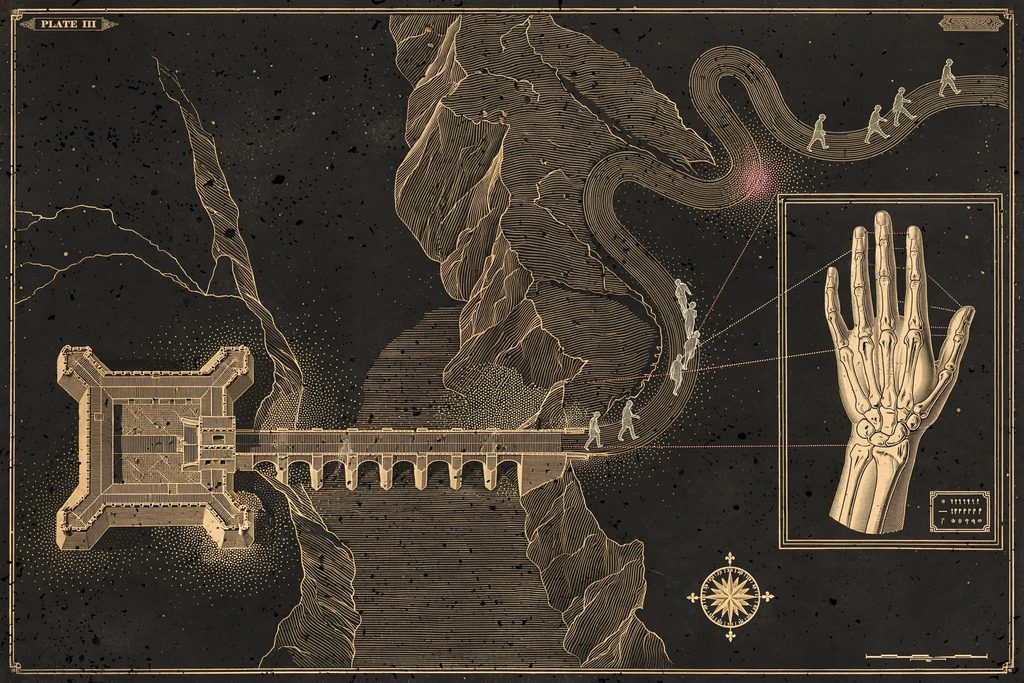
For an archaeologist, the bloodstains are the most valuable record the society keeps. They are burial markers, and they cluster where life was most dangerous. A dense field of stains at the entrance to a castle or the foot of a bridge is a mortality map drawn by the population itself. Players read these clusters the way a public health officer reads a register of deaths, as evidence of where the danger lies and what kind it is.
There is a further detail the Institute considers significant. In the game’s own theology, the Greater Will speaks to the Lands Between through the Two Fingers. Its word has to be interpreted by Finger Readers, who study the movements of those fingers. The gods of this world communicate through fingers, and the meaning has to be pieced together by those who read them.
The players live under the same arrangement, because every social act in the game is conducted by hand:
- Messages are written with the Wizened Finger.
- A player offering help lays down a sign with the Tarnished’s Furled Finger.
- The Furlcalling Finger Remedy makes those signs visible.
- Invaders cross into other worlds with the Bloody Finger.
- The Finger Severer ends a visit.
Whether or not it was planned as a parallel, the society of players and the religion of the setting speak the same sign language.
VI. The Law of the Summoning Pool
Before the most difficult bosses, golden signs gather on the ground. Each belongs to a player offering to cross into a stranger’s world and fight beside them. At the hardest encounters these signs form something close to a standing guild of volunteers. These are people who return to the same arena again and again to help others through it. They are paid only in a share of Runes and in whatever satisfaction the work gives them.
The society’s most famous saint emerged from this guild. A player whose summon sign read “Let Me Solo Her” became known, in the months after release, for helping others defeat Malenia, one of the most feared bosses in the game. He fought with a clay jar on his head and very little else, carried two swords, and usually won while the player who had summoned him stood back and watched. By mid 2022 he had passed two thousand Malenia kills, and the game’s publisher, Bandai Namco, sent him a gift in recognition. Fan art, cosplay and imitators followed. The pattern is familiar from the history of religion. An anonymous figure performs the same act of help over and over. He is known only by a name that describes that act, and he acquires a legend larger than the person.
The summoning pool has a shadow. With the Bloody Finger, a player can invade another world as a red phantom and try to kill its host. Nothing in the game’s rules requires invaders to behave in any particular way, and yet a code of conduct developed:
- Duellists bow before a fight using the game’s gestures.
- Some refrain from healing during one-to-one combat.
- Others treat any unfair advantage as a disgrace.
None of this is enforced by the game. It is held in place only by reputation, within a population that cannot see its own members’ names. It is law without a state, held together by custom and shame, which is how most human law began.
Behind all of it stands an ideal inherited from Dark Souls. There, the knight Solaire of Astora offered to help the player in what he called “jolly cooperation”. The phrase outlived his game and still describes the spirit in which most golden signs are laid.
VII. The Quarrel over Difficulty
On 21 June 2024, FromSoftware released Shadow of the Erdtree, the game’s expansion, and the society went to war with itself. Within days, the expansion’s user reviews on Steam had fallen to Mixed. The complaints were specific:
- Lost power. Much of the power players had built in the base game was set aside by a new system, the Scadutree Blessing, which grows only through fragments found in the expansion’s Realm of Shadow.
- Bosses. They were accused of relentless combinations and inflated health.
- Performance. On PC, many players reported sharp frame-rate drops during the largest fights.
- Content. Some felt that parts of the open areas were empty, and that too many enemies were familiar from earlier games.
FromSoftware later issued patches, including changes to how the Scadutree Blessing worked in the early part of the expansion, and the reviews recovered as players found their footing.
The Human Archive is less interested in who was right than in what the quarrel revealed. The Souls community has long held a moral code summed up in the phrase “git gud”. Difficulty is sacred, suffering is instruction, and complaint is the sign of someone who has not yet learned. Elden Ring brought tens of millions of players into a culture built around that creed, and many of them had never played a FromSoftware game before. The expansion forced the question of whether the creed still applied to everyone.
The argument that followed had the shape of a religious schism. Veterans accused newcomers of wanting mercy from a faith founded on its absence. Newcomers accused veterans of mistaking loyalty for judgment. Both sides appealed to the same founding texts, the earlier games, and read them differently. The Institute has documented the same pattern among the faiths of the Wasteland, where every lasting belief sooner or later divides over what its first teaching actually required.
The ancestor of them all
The Lands Between inherited its customs from thirteen years of earlier worlds. Demon’s Souls, released in 2009, introduced the essential institutions of this society:
- messages built from restricted phrases
- bloodstains that replayed deaths
- phantoms of other players passing through
- summoning for both co-operation and invasion
Dark Souls, in 2011, deepened them with covenants and gestures. It also gave the community its best-known emblem when Solaire’s gesture, “Praise the Sun”, became the salute of players who help others.
The whole system began with a single memory. In an interview with The New Yorker in 2022, Hidetaka Miyazaki, FromSoftware’s president and the director behind these games, recalled a time when his car was stuck on a snowy hill. A group of strangers appeared, pushed the car to the top and left without a word. The online design of his games grew from that encounter. In them, help arrives from people you will never meet, who vanish once the danger is past. Every golden sign in the Lands Between is a reconstruction of that hill.
The pattern
Taken together, the customs of the Lands Between follow a sequence the Institute has seen before in human societies:
- A restricted language did not produce silence. It produced a style, and then a literature.
- A currency of health turned helpfulness into an economy. That economy could not tell a good warning from a good joke, so it rewarded both.
- Deception followed, and so did its correction. It came in the form of footnotes and the silent testimony of the dead.
- Anonymity made legends out of acts rather than people. The most famous member of the society is known only by what his sign promised.
- A shared hardship became a shared identity. When the hardship changed, the identity divided.
None of this was written into the game’s rules. The rules supplied the materials, a finger, a vocabulary, a sign and a stain. The society was built by the people who used them.
Findings
- The Lands Between has a genuine universal language. Messages are stored as choices from fixed lists, so every player reads them in their own language. The game achieved by subtraction what Leibniz and Zamenhof attempted by design.
- Approval is paid in health. A good appraisal heals its author, which makes helpfulness a gift economy with obligations but no names.
- Lies are tolerated when they are funny. The same currency rewards a warning and a trap. The society’s corrections come from later readers and from the bloodstains below.
- The dead are the most reliable witnesses. Bloodstains form a mortality map drawn by the population itself. The society, like its gods, communicates entirely by hand.
- Difficulty is the culture’s constitution. The quarrel over Shadow of the Erdtree divided the society like a religious schism, over whether suffering is the point.
This Excavation draws on the game’s systems as players encounter them, and on the documented history of its community. Read more about how the Institute works.
The Institute collects field evidence from people who lived inside these worlds. If you wrote a message that outlived your save file, or stood in a summoning pool longer than you care to admit, send us your account.
Sources
- Elden Ring (FromSoftware, 2022). Messaging, appraisal, multiplayer items and item descriptions.
- Elden Ring Shadow of the Erdtree (FromSoftware, 2024).
- Demon’s Souls (FromSoftware, 2009) and Dark Souls (FromSoftware, 2011).
- Hidetaka Miyazaki, interview in The New Yorker, 2022, as reported in GamesRadar+.
- Game Rant, on Let Me Solo Her passing two thousand Malenia kills and receiving a gift from Bandai Namco.
- Fextralife Elden Ring Wiki, Messages, for templates, conjunctions, word categories and appraisal.
- Marcel Mauss, The Gift (1925).
- Milman Parry, studies of Homeric formulaic composition (1928 onward).