





EXCAVATION Nº 0008 · HUMAN ARCHIVE
World: Super Earth and the Galactic War, Helldivers 2
Period: 2024 onward (real world)
Status: Active
In the spring of 2024, on a jungle planet called Malevelon Creek, thousands of players dropped into the same losing battle, night after night. The enemy was a robotic army called the Automatons. The jungle was dark and wet and full of ambushes, and players died there in enormous numbers. They kept returning anyway. When the planet finally fell, the players did not forget it. They began to call themselves veterans of the Creek, to trade stories about it, and to speak of it the way real soldiers speak of a campaign that marked them.
None of it was scripted. Malevelon Creek was one planet on a map in Helldivers 2, a cooperative shooter released by the Swedish studio Arrowhead in February 2024. Its players had turned an ordinary battlefield into a place of memory. The Human Archive studies the cultures that players build inside the worlds they enter. Helldivers 2 is an extraordinary case, because the world those players entered is a satire, and the players became its citizens anyway.
I. The Satire
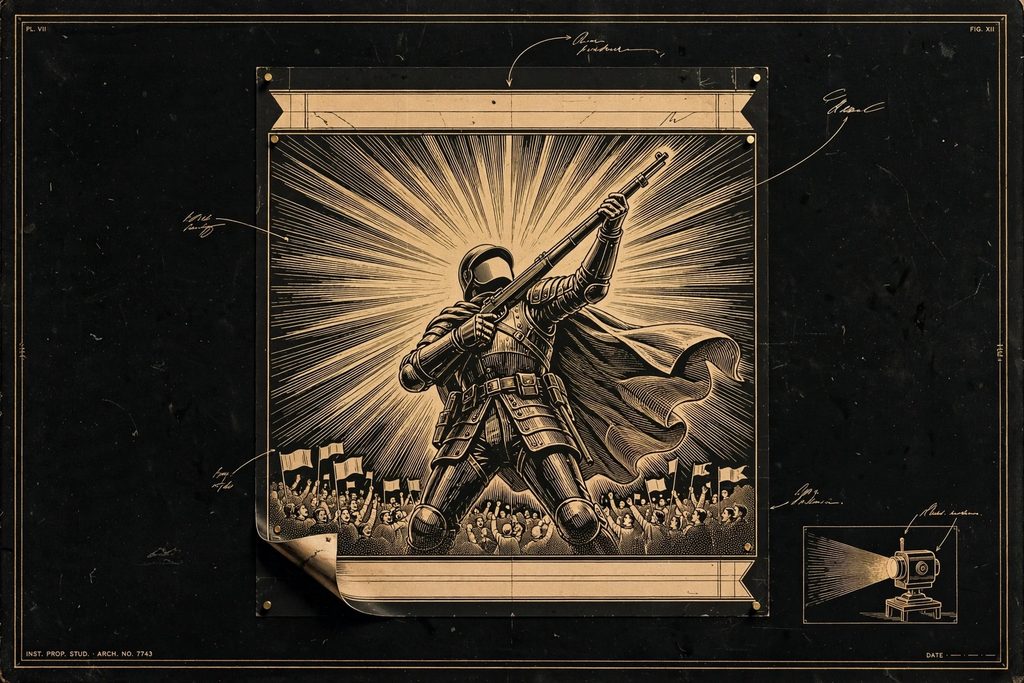
The Helldivers are the elite soldiers of Super Earth, a future human state that calls its political system Managed Democracy. Super Earth is a parody of militarism. Its government speaks only in slogans, its Ministry of Truth manages information, and its soldiers are expendable by design. A Helldiver’s life expectancy is measured in minutes. Every enemy of the state is described as an enemy of freedom, from the insect-like Terminids to the Automatons and the alien Illuminate. The game’s own tone makes clear that the propaganda is the joke.
The lineage is deliberate. In 1959 the novelist Robert A. Heinlein published Starship Troopers, a sincere argument for a society in which only military veterans can vote. In 1997 the director Paul Verhoeven adapted it as a film that turned the argument inside out. It presented the same society as a glossy fascist state, interrupted by cheerful propaganda newsreels that ask the viewer, “Would you like to know more?” Arrowhead’s first Helldivers game in 2015 carried that satirical tone into a top-down shooter. Helldivers 2 moved it into a third-person world shared by millions of players at once.
A satire usually has an audience. Helldivers 2 has a population. Its players do not watch Super Earth from a distance. They live inside it, and the question the Human Archive asks is what a society does when its founding document is a joke.
II. The War That Remembers
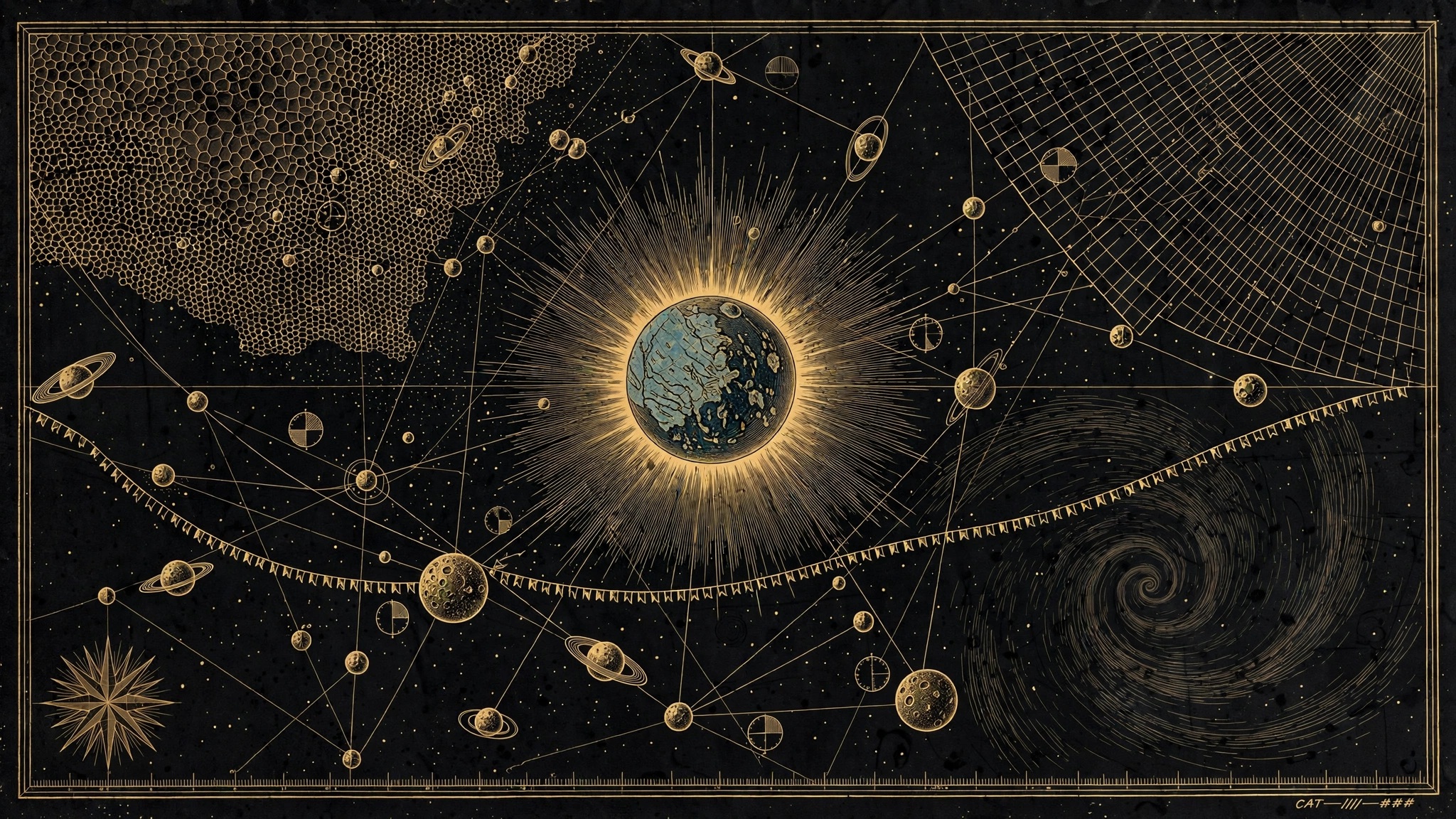
The structure that made this society possible is called the Galactic War. Every mission any player completes adds a small amount of progress to the liberation of a planet on a shared map. Planets are won and lost in real time, and the losses are permanent until players win them back. Above this, the studio issues Major Orders, collective objectives for the entire player population, such as holding a sector, defending a world or delivering a weapon to a target. Success or failure changes the map and the story.
Behind the war stands a person. Arrowhead has openly acknowledged that a game master, a member of staff known to players as Joel, directs events. He decides where the enemy attacks, which fronts open, and how the war responds to what players do. The community treats Joel as an in-world force, part fate and part rival, and players speak of Super Earth High Command as though it were a real authority issuing real orders.
The result is a history. Some of its milestones:
- The long loss of Malevelon Creek in the first months.
- The destruction of a Terminid supercolony on the planet Meridia with an experimental substance called Dark Fluid, which left a rift in space where the planet had been.
- The return of the Illuminate, an ancient alien species, who eventually carried the war to Super Earth itself.
Each of these was decided partly by what millions of people did, or failed to do, in the days before. The war remembers, so the players do too.
III. The Creek
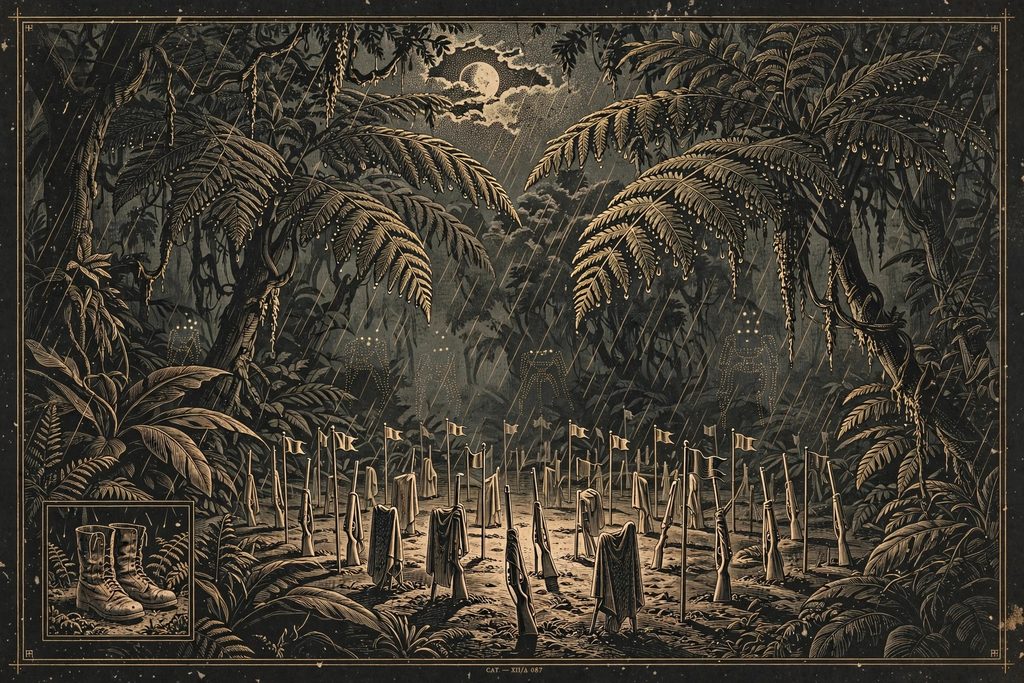
Malevelon Creek became the society’s first shared trauma. The Automaton front there in early 2024 was fought in dense jungle, at night, against an enemy that used cover, artillery and patrols. Players compared it to the Vietnam War almost at once, and a whole culture grew around the comparison. Players posted jokes about flashbacks and thousand-yard stares, and wrote mock war poems. Veterans of the Creek identified each other in the community and treated newcomers who had not served there with a mixture of pride and pity.
To an anthropologist, this is the formation of collective memory. The sociologist Maurice Halbwachs argued in the 1920s that memory is not only something individuals carry, but something groups build together through shared stories, places and rituals. A battlefield becomes sacred because a community returns to it in speech. Malevelon Creek has every feature of such a place. There is a name everyone recognises, a story everyone knows, a group that claims it as its own, and humour that disguises real feeling.
The Creek also shows how quickly this can happen. Real societies take generations to turn a battle into a legend. The players of Helldivers 2 did it in about two months.
IV. The Chroniclers
Where there is a history, historians appear. Almost from launch, players began recording the Galactic War because the game itself kept no complete record. They built live war maps that track every planet’s liberation percentage, wikis that catalogue each Major Order and its outcome, and video archives that narrate the war day by day. One such project, the Super Earth Galactic War Data Archive, a YouTube channel created by a fan, publishes regular accounts of troop movements, orders and turning points. It draws on footage and statistics submitted by other players.
This is how history-writing begins in many real societies. Before states employ official historians, communities keep annals, short year-by-year records of what happened, compiled by whoever cares enough to keep them. The Anglo-Saxon Chronicle began that way in ninth-century England, as brief entries copied and continued in different monasteries. The chroniclers of Super Earth are doing the same work, with better statistics and worse jokes.
They also do something the official fiction cannot. Super Earth’s own Ministry of Truth would never record a defeat honestly. The player-historians record them all, including the Creek.
V. The Citizens
The most striking feature of this society is the way its members talk. Players adopt the voice of Super Earth’s propaganda almost universally. They salute each other with slogans about freedom and democracy, praise the government in exaggerated terms, and denounce enemies of liberty with mock fervour. They accuse players who abandon missions of treason, and call accidental deaths caused by teammates acceptable losses for democracy.
This is role-play, and it is also irony. Nobody in the community believes Super Earth is admirable. The fiction is plainly a joke, and players signal that they understand it by performing it at full volume. The anthropologist Victor Turner described a state he called liminality, a temporary space outside ordinary rules where people can invert, mock and exaggerate the norms of their society. Carnival works this way, and so does Helldivers 2. For the length of a mission, players become loyal citizens of a state they would never tolerate in real life, and the performance itself is the commentary.
The game supports this with its own design. Friendly fire is always on, reinforcements arrive by being fired from orbit in pods, and the tools of war are as dangerous to the soldiers as to the enemy. Arrowhead built a world in which dying absurdly for a cause is the normal experience. The players built the culture that makes it funny.
VI. The Revolt Against High Command
In May 2024, the citizens of Super Earth rebelled, not against the fictional High Command but against the real one. On 3 May, Sony, the game’s publisher, announced that players on PC would soon be required to link a PlayStation Network account. Many players had bought the game in countries where PlayStation Network was not available, and the game was delisted from sale in many of those regions.
The response was immediate and organised. Within two days, more than 84,000 negative reviews had appeared on Steam, and the game’s overall rating collapsed. Players coordinated through forums and Discord servers. Arrowhead’s own leadership publicly signalled sympathy with the players. On 5 May, Sony reversed the requirement.
The Institute finds the irony irresistible. A population that spends its evenings performing unconditional obedience to an authoritarian state turned out to be one of the most effective consumer protest movements the games industry has seen. The satire had taught them exactly what it was meant to teach. When real authority overreached, they did not salute. They organised, and they won within forty-eight hours.
The community has continued to act as a political constituency. After an update in the summer of 2024 weakened many of the weapons players relied on, the backlash was strong enough that Arrowhead announced a sixty-day plan to restore the game’s balance and fun. The relationship between the players and the studio has the shape of a negotiation between citizens and a government. It has pressure, concessions and a long memory.
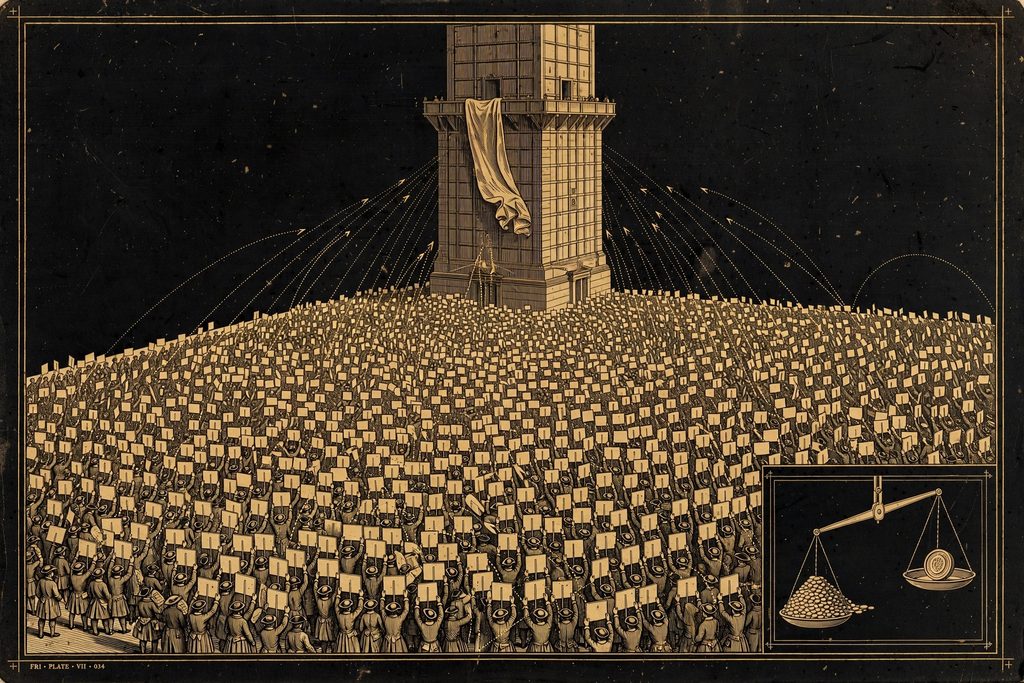
The ancestor of them all
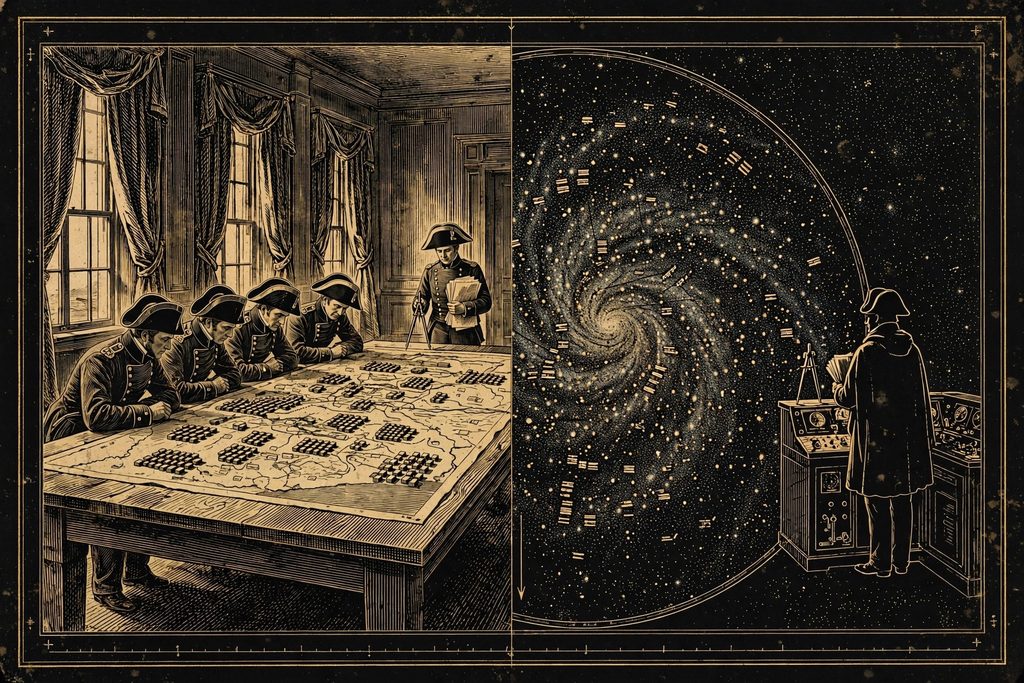
The Galactic War is a new kind of entertainment built on a very old idea. In 1824, a Prussian officer named Georg Heinrich von Reisswitz presented a war game called Kriegsspiel to the Prussian general staff, developing a system his father had begun. Its defining feature was an umpire. The players did not see the whole board. A neutral human controlled information, decided outcomes and introduced the friction of real war. Kriegsspiel became a training tool for generations of officers, and its umpire is the direct ancestor of every game master who has run a campaign since.
Joel is a Kriegsspiel umpire for a player population larger than most armies in history. The same structure that once trained Prussian officers now produces jungle legends, player historians and consumer revolts. The difference is scale. An umpire in 1824 ran a war for a dozen officers around a table. The Galactic War is run for millions, and they remember everything.
The pattern
The society of Super Earth follows a sequence the Human Archive has seen in other player cultures, compressed into months:
- A shared, persistent world creates shared stakes. Because the Galactic War records wins and losses for everyone, individual play becomes collective history.
- Shared stakes create memory. Malevelon Creek became a sacred place within weeks, with veterans, stories and rituals.
- Memory creates historians. Players built the archives, maps and chronicles that the fiction’s own Ministry of Truth would never keep.
- Performed loyalty creates real solidarity. Players who spend their evenings mocking obedience turned out to be very good at acting together against real authority.
The Institute’s earlier study of the message culture of the Lands Between found a society built by players who never meet. Super Earth’s players never meet either, but they share something the Tarnished lack, a single war that belongs to all of them. That shared war turns a player base into a public.
Findings
- Helldivers 2 players live inside a satire. Super Earth is a deliberate parody of militarism descended from Heinlein and Verhoeven, and its players are its citizens.
- The Galactic War is a real shared history. Because outcomes persist and are directed by a human game master, the actions of millions become events that the whole community remembers.
- Collective memory formed in weeks. Malevelon Creek developed veterans, legends and rituals in about two months.
- Players became historians. Fan-built archives, maps and chronicles record the war honestly, including the defeats the fiction would hide.
- Performed obedience produced real organisation. In May 2024 the community reversed a publisher’s decision within two days, the clearest sign that the satire worked.
This Excavation draws on the game, its publisher’s and developer’s public announcements, and the documented history of its community. Read more about how the Institute works.
The Institute collects field evidence from people who lived inside these worlds. If you served at the Creek, or kept a record of the war, send us your account.
Sources
- Helldivers 2 (Arrowhead Game Studios and Sony Interactive Entertainment, 2024), and Helldivers (Arrowhead Game Studios, 2015).
- Helldivers 2, Wikipedia, for release history, sales, the Galactic War and the PlayStation Network controversy.
- Super Earth Galactic War Data Archive, fan-run YouTube channel chronicling the Galactic War.
- Robert A. Heinlein, Starship Troopers (1959), and Paul Verhoeven, Starship Troopers (1997).
- Maurice Halbwachs, On Collective Memory (Les cadres sociaux de la mémoire, 1925).
- Victor Turner, The Ritual Process (1969).
- Georg Heinrich von Reisswitz, Kriegsspiel (1824).
- The Anglo-Saxon Chronicle (from the late ninth century).