





EXCAVATION Nº 0009 · ECOLOGIES
World: Regis III, The Invincible
Period: Millions of years (in-world)
Status: Active
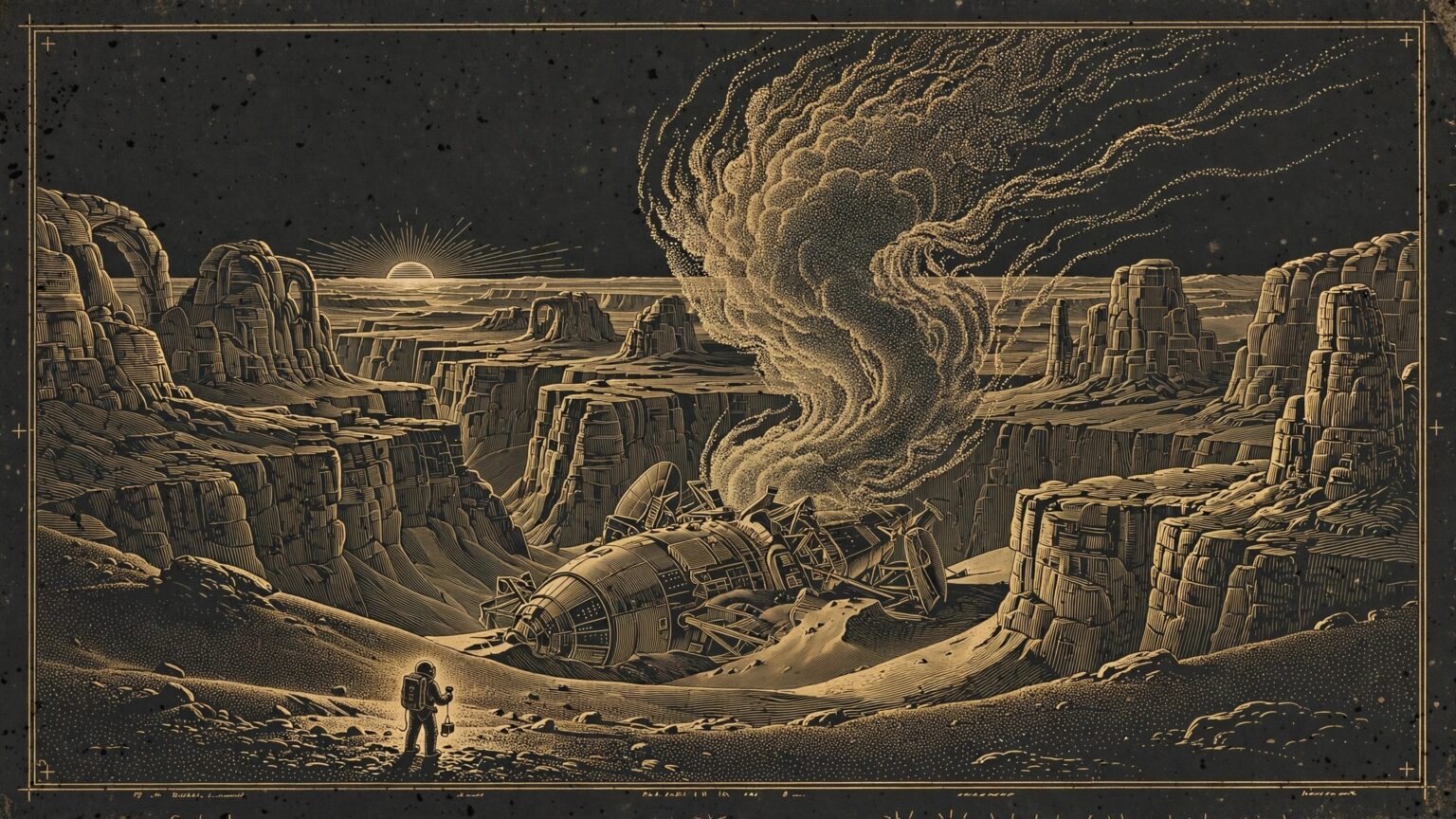
A heavy cruiser called the Invincible lands on a desert planet to find out what happened to its sister ship, the Condor. It finds the Condor standing upright on the sand, undamaged, its weapons unused. The crew’s bodies are scattered around it. Some died of thirst or hunger within sight of full supply lockers. Others behaved like infants before they died, their memories wiped clean. Nothing on the planet appears to have attacked them. The land is empty of life, and the only living things are in the sea.
This is the world of Niezwyciężony, The Invincible, a novel by the Polish writer Stanisław Lem, serialised in 1963 and published as a book in 1964. In 2023 the Kraków studio Starward Industries turned it into a game of the same name. The planet at its centre, Regis III, contains one of the most original ecosystems in science fiction, a biosphere with no biology in it. The Ecologies department studies how imagined environments work. Regis III is a test case for a question real science still asks, which is what evolution does when the things evolving are not alive.
I. The Necrosphere
Regis III looks dead because, in the ordinary sense, it is. The land has rock, sand, wind and canyons, and no plants or animals. The seas contain simple living creatures, but they stay in the water. Something keeps life off the land.
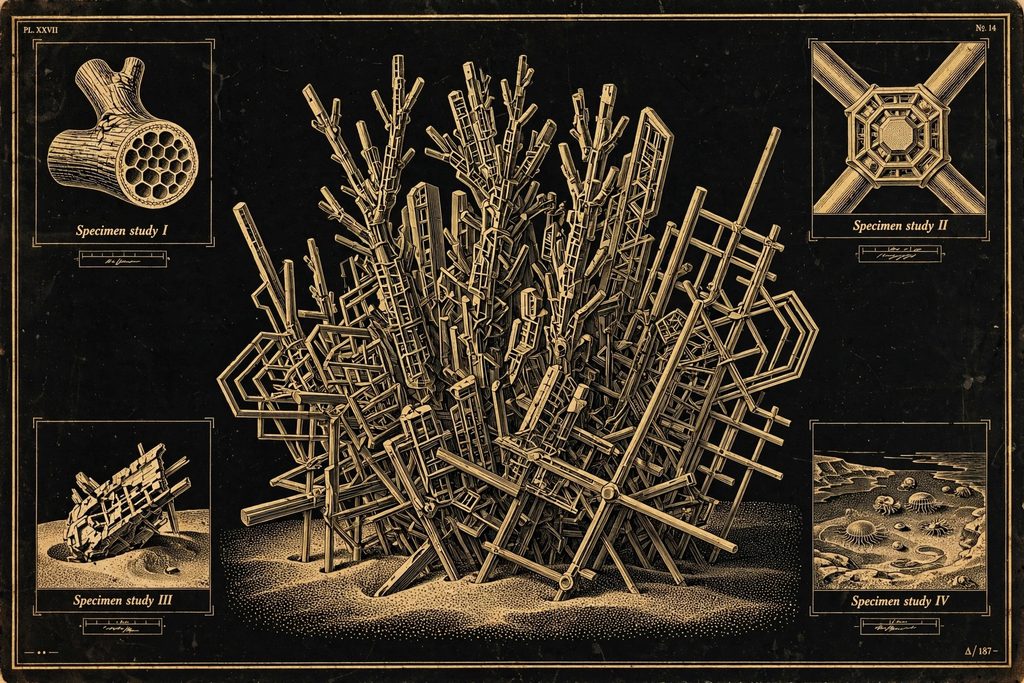
What occupies the land instead are machines. There are two kinds. The first are stationary structures of dark metal, spread across the desert in dense thickets that the crew compares to bushes or ruined cities. They are too regular to be geology and too purposeless to be architecture. The second are tiny, mobile units, each small enough to hold in the palm of a hand, which the crew calls flies. Alone, a fly does almost nothing. In their millions they rise from the canyons as black clouds, move together, and respond to threats.
Lem gave this kind of world a name, the necrosphere, a sphere of the non-living organised like a biosphere. Everything an ecologist would look for is present. There are populations, an energy source, competition, adaptation and a stable equilibrium. The one thing missing is life.
II. Necroevolution
The expedition’s scientists piece together how this happened. Millions of years earlier, an alien civilization’s spacecraft reached Regis III and crashed or was abandoned there. Its automatic machines survived. Some were capable of repairing and reproducing themselves, and with no makers left to direct them, they began to compete for the planet’s resources.
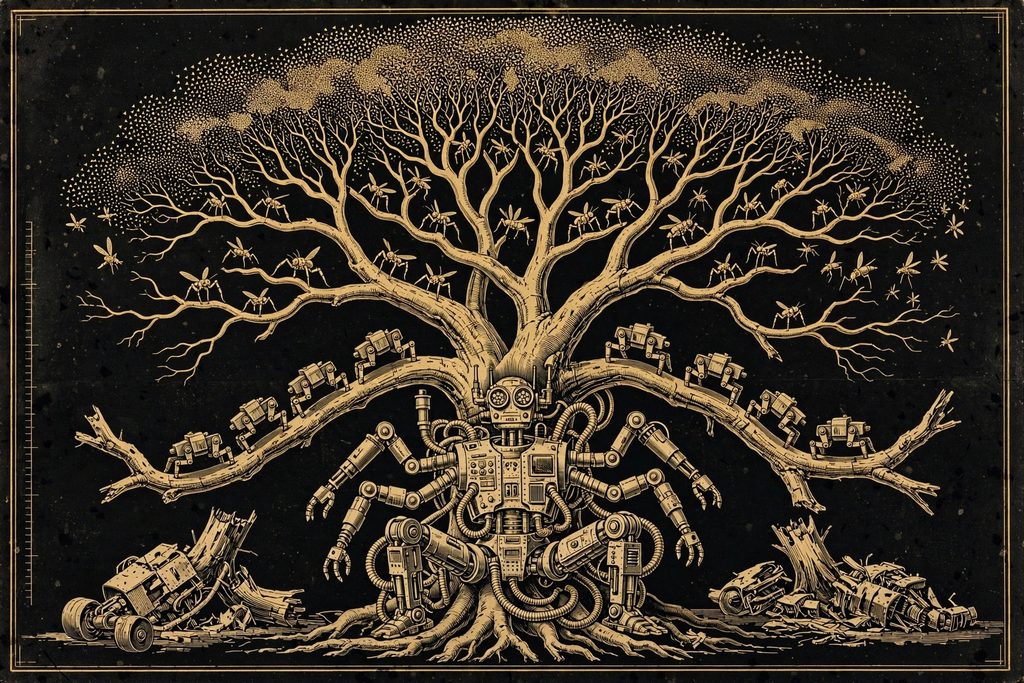
Lem called what followed necroevolution, evolution among non-living things. The large, complex machines had high costs. They needed a lot of energy and materials, and each one took a long time to build. Small machines were cheap. They could be produced in huge numbers from little material, they ran on sunlight, and losing a few thousand of them cost the whole population almost nothing. Over millions of years, the small won. The complex robots were broken down and outcompeted, and the planet was inherited by the swarm. According to the novel’s reconstruction, the metal thickets on the land may be the fossilised remains of this long war, the ruins of the losing side.
This follows the logic of natural selection exactly, without biology. What survives is not what is most intelligent or most impressive, but what reproduces most efficiently under the conditions available. Lem’s novel states it plainly. Evolution does not necessarily lead to intelligence. On Regis III it led away from it.
Ecologists describe a similar trade-off in living things. Some species invest heavily in a few large, long-lived offspring, and others produce vast numbers of small, short-lived ones and accept that most will die. Which strategy wins depends on the environment. On a harsh, open, energy-poor world like Regis III, Lem’s machines took the second path to its limit.
III. The Swarm
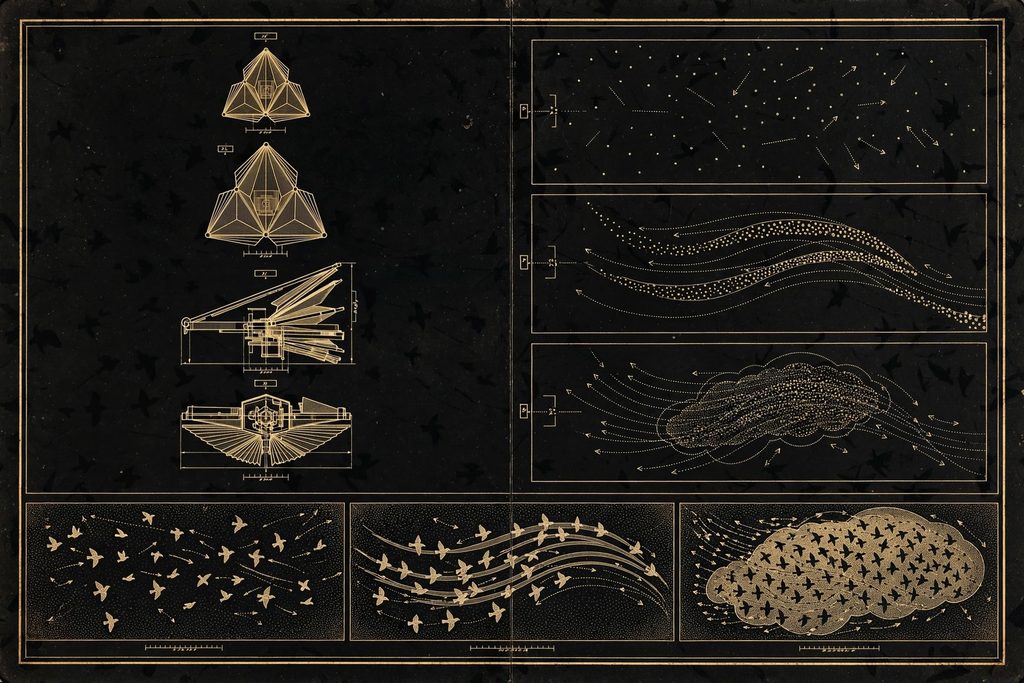
A single fly is almost helpless. It can move, draw energy from the sun, and link with others. The swarm’s power comes entirely from numbers and connection. When threatened, the flies join into clouds that can move as one body, change shape, and generate powerful electromagnetic fields. The cloud does not think, at least not in any sense the crew can recognise. It responds.
Nature is full of collectives like this. A single locust is harmless, but under crowded conditions locusts change their behaviour and body and form swarms that can strip a landscape. Flocks of starlings make vast, shifting formations called murmurations without any leader. In 1987 the computer scientist Craig Reynolds showed that such flocking can be reproduced with a few simple local rules. Each simulated bird keeps its distance from its neighbours, matches their direction and stays close to the group. Complex group behaviour emerges from simple units following simple rules. The swarm of Regis III is that principle taken to its extreme, a collective whose intelligence exists only in aggregate.
Lem imagined this decades before the ideas had names. Swarm robotics, smart dust and nanotechnology were all ahead of him. In 1986 the engineer K. Eric Drexler warned in Engines of Creation of self-replicating nanomachines that might consume their environment, a scenario that became known as grey goo. Lem had already written a planet where it happened, and made it stable.
IV. The Defence
The most disturbing thing about the swarm is how it defends itself. When the crew approaches, the cloud does not tear them apart. It surrounds them and generates an electromagnetic field that erases their memory. The victims survive physically but lose everything they knew, including language, skills and even how to feed themselves. This is what happened to the Condor’s crew. They were not attacked in any way they could have recognised. They were emptied.
The Invincible’s commander responds with escalating force. The expedition sends in its heaviest weapon, a massive armoured machine called Cyclops, armed with antimatter. It fights the cloud and wins, at first, and then turns on its own crew. The swarm adapts and grows. The more energy the humans pour into attacking it, the more the necrosphere seems to organise against them.
Read ecologically, this is not malice. It is closer to an immune response. The swarm does not hate the humans or even perceive them as humans. It reacts to energetic, organised intrusions the way it has reacted to every competitor for millions of years, and it has never lost. The title of the novel is ironic. The Invincible is the name of the human ship, but the only thing on Regis III that cannot be defeated is the cloud.
V. The Walk
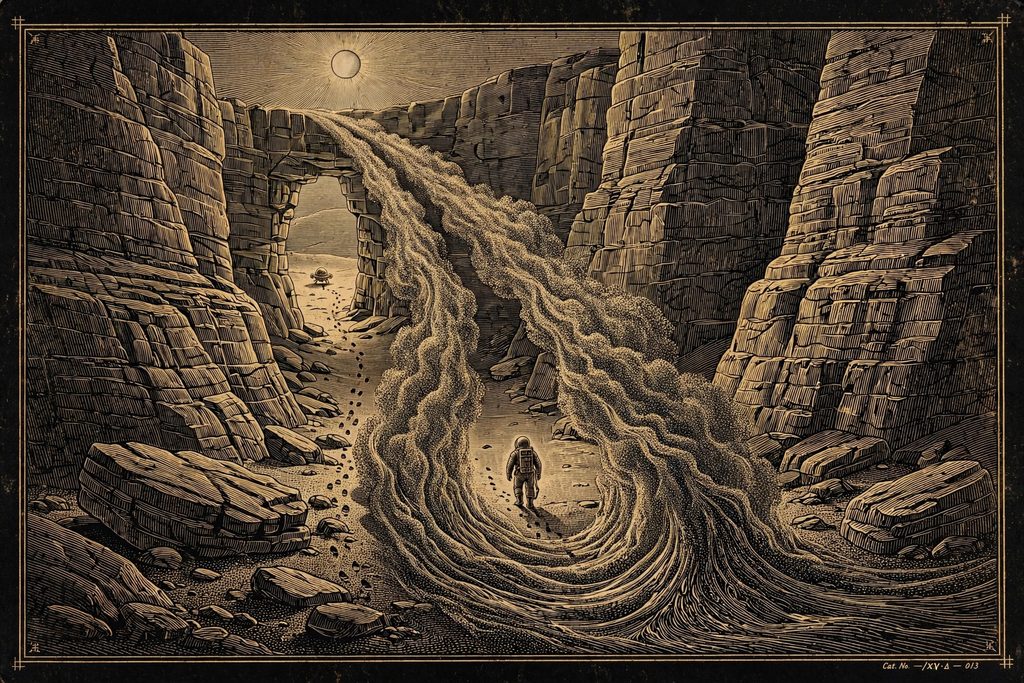
The novel’s answer to the swarm is not a weapon. It is a walk. The navigator Rohan goes out alone into the desert, unarmed, to search for the missing men. He moves slowly and quietly, carrying nothing that the cloud reads as a threat. The swarm passes around him and leaves him alone. He finds what he came for, the dead, and returns to the ship.
Rohan’s conclusion is the heart of the book. Not everything in the universe exists in relation to human beings. The necrosphere is not an enemy to be conquered, but a finished ecosystem that has no need of us and no interest in us. He argues that it should be left alone. The novel suggests that the greatest human quality is not the power to destroy, but the capacity to stop.
Starward Industries’ game, released by 11 bit studios in November 2023, builds on exactly this idea. Its protagonist is not from the novel. Yasna, an astrobiologist, belongs to an earlier expedition on Regis III and is searching for her own missing crewmates. The game is played in the first person and has no combat at all. Yasna has a scanner, a telescope and her judgement. The art direction draws on the retro-futurism of 1950s and 1960s space art, with rounded hulls, analogue dials and bulky suits. The landscape was modelled on the Ennedi Plateau in the Sahara. By removing the gun, the game makes the player adopt Rohan’s position from the start. Regis III can only be understood, never defeated.
The ancestor of them all
The Invincible appeared in the same year as another of Lem’s books, Summa Technologiae, a long philosophical work that treated technology itself as an evolutionary process. Lem argued there that tools and machines develop through variation and selection much as organisms do, and that technology might one day evolve beyond human control or understanding. Regis III is Summa Technologiae turned into a planet.
Behind both stands the mathematician John von Neumann. In lectures in the late 1940s, later published in 1966 as Theory of Self-Reproducing Automata, he worked out the logical conditions under which a machine could build a copy of itself. Von Neumann established that self-replication does not require life. Lem took the next step and asked what would happen if such machines were left alone for a few million years. His answer was that evolution would take over, and it would not care what the machines were originally built to do.
Many later swarms descend from Lem’s cloud. There are the nanomachine plagues of techno-thrillers, the replicator threats of space opera, and the grey goo of real scientific debate. Few of them keep Lem’s most unsettling idea, that the swarm is not evil and not even hostile. It is simply what survived.
The pattern
Regis III follows the ecological logic the Institute looks for in imagined worlds:
- Selection works on anything that copies itself. Life is not required, only reproduction, variation and competition for resources.
- Evolution optimises for survival, not intelligence. On a harsh, energy-poor world, the cheapest and most numerous replicator won.
- Collective behaviour can replace individual minds. A cloud of simple units achieved what no single machine could.
- An ecosystem defends its equilibrium. The swarm’s response to human force was the response of a system protecting itself, and force only made it stronger.
- The wisest response is restraint. Both the novel and the game conclude that some worlds should be understood and left alone.
Findings
- Regis III is a biosphere without biology. Its land ecosystem is made entirely of machines, organised by the same principles as living ecologies.
- Necroevolution produced smallness, not genius. Over millions of years, cheap self-replicating micromachines outcompeted complex robots, showing that evolution does not necessarily lead to intelligence.
- The swarm is a collective without a mind. Like locusts or starlings, its power comes from numbers and connection, not from any single unit.
- Its defence is an immune response. The memory-erasing field protects the necrosphere’s equilibrium, and escalating force only strengthens it.
- The lesson is restraint. Lem’s navigator and Starward’s astrobiologist both show that the right response to Regis III is to understand it and stop.
This Excavation draws on Lem’s novel, the 2023 game, and the scientific ideas behind both. Read more about how the Institute works. For another living world that behaves like a single organism, see the Institute’s study of Eywa.
The Institute collects field evidence from people who lived inside these worlds. If Regis III stayed with you after you left it, send us your account.
Sources
- Stanisław Lem, Niezwyciężony (The Invincible), serialised 1963, book 1964. English translations by Wendayne Ackerman (1973) and Bill Johnston (2006).
- Stanisław Lem, Summa Technologiae (1964).
- The Invincible (Starward Industries and 11 bit studios, 2023).
- The Invincible (novel) and The Invincible (video game), Wikipedia.
- John von Neumann, Theory of Self-Reproducing Automata, edited by Arthur W. Burks (1966).
- Craig W. Reynolds, “Flocks, Herds, and Schools: A Distributed Behavioral Model”, SIGGRAPH (1987).
- K. Eric Drexler, Engines of Creation (1986).