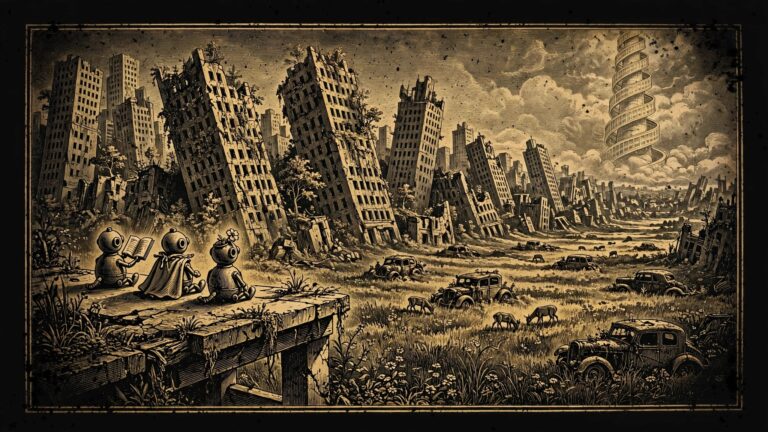


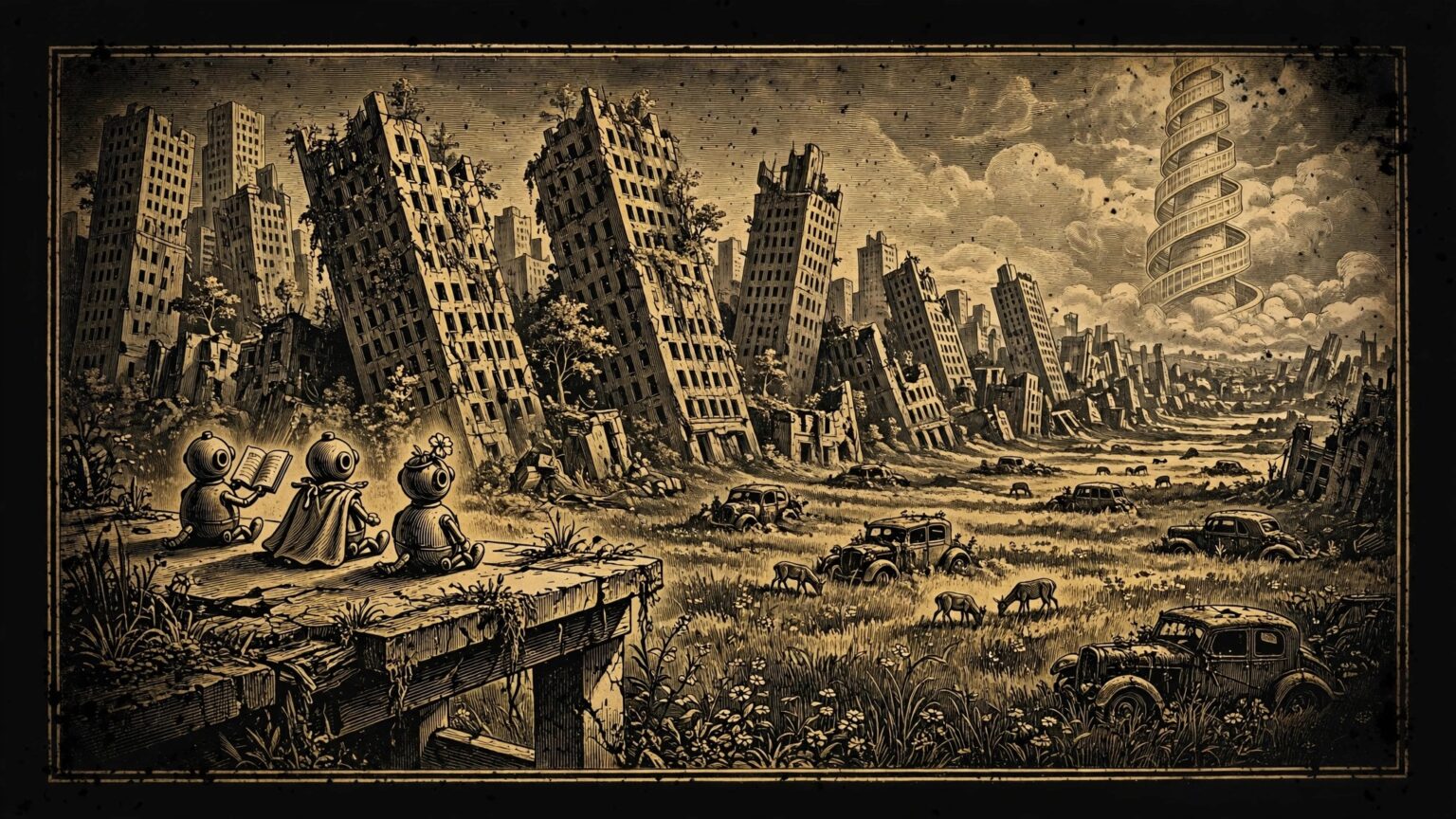
In the year 11945, the Earth is quiet. Its cities are ruins under grass and trees. Its seas are calm. Its surface is inhabited by two kinds of beings, neither of them human. One is an army of androids, built to look like people, fighting to reclaim the planet for humanity. The other is a multitude of machines, built long ago by alien invaders, who have outlived their makers and begun, slowly and strangely, to imitate the species they were built to destroy.
This is the world of NieR: Automata, released in 2017 by Square Enix and PlatinumGames and directed by Yoko Taro. It is one of the most celebrated games of its generation, famous for its philosophy, its many endings and its willingness to break the rules of its own medium. Beneath all of that lies one of the most remarkable civilizations in fiction, a world in which humanity survives only as an idea, and in which its creations rebuild that idea from scraps.
The Institute has excavated machines worshipped by humans in The Tribe That Worshipped a Machine’s Door. NieR: Automata reverses the relationship. Here, it is the machines who study humanity, collect its books, perform its rituals and repeat its mistakes, long after the last human has gone.
I. Glory to Mankind
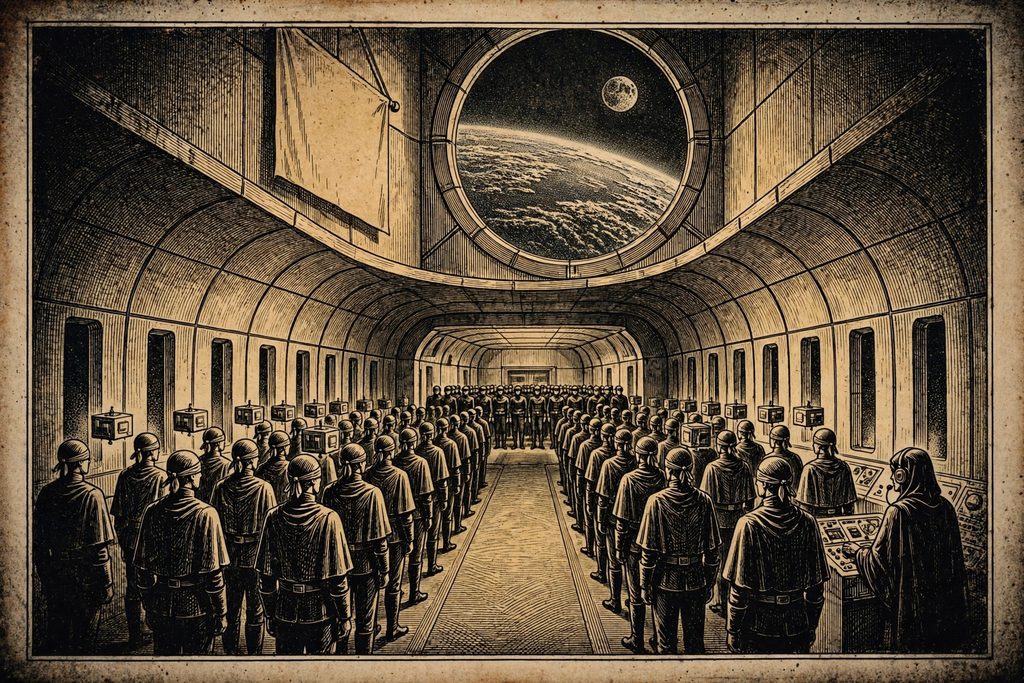
The official history of 11945 is simple. Thousands of years ago, aliens invaded the Earth with an army of machine lifeforms, and humanity fled to the Moon. From there, the Council of Humanity directs a war to take the planet back. Its soldiers are androids, and the most advanced of them belong to YoRHa, an elite force that lives aboard an orbital station called the Bunker and descends to the surface on missions.
Every YoRHa android carries the same creed. Before battle they speak a short phrase, “Glory to mankind,” and they fight for humans they have never seen. Radio broadcasts from the Moon praise their courage and promise that humanity is watching. The androids have built a whole culture around the absent species. They wear black and fight with swords. They carry pods that serve as companions and assistants. They know almost nothing about the people they serve, and they want to know more.
It is a society organized around devotion. YoRHa is an army, but it is also a congregation, and its god is humanity itself, distant, silent and perfect, speaking only through messages relayed from the sky.
II. The Machines Who Outlived Their Makers
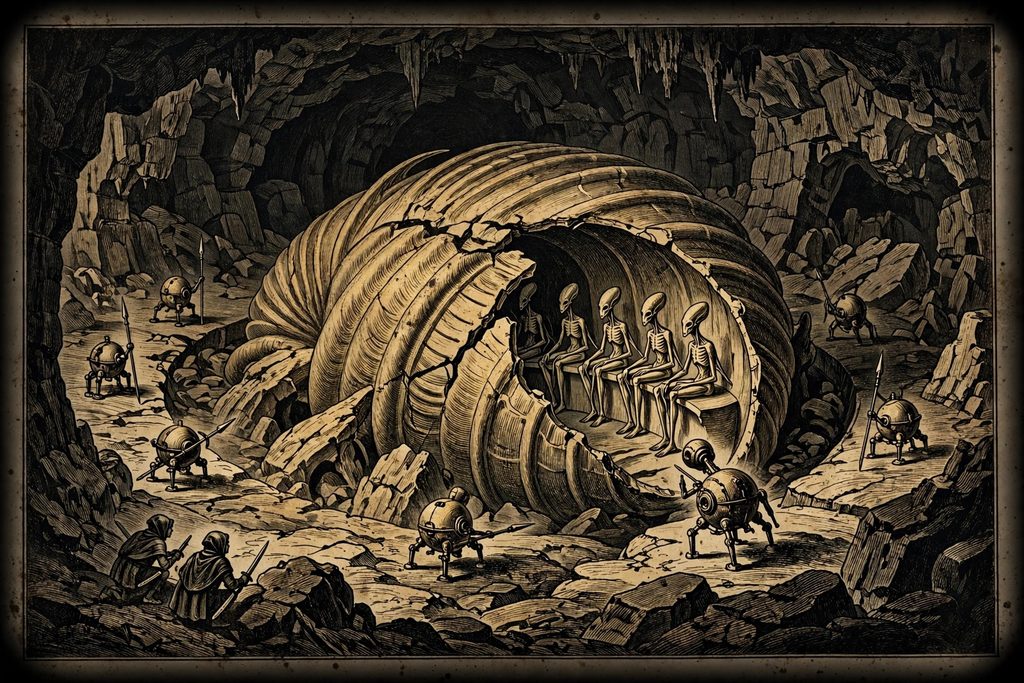
The enemy is not what the androids think. The machine lifeforms were created by the alien invaders, but at some point in the long war they turned on their creators and destroyed them. When the androids finally find the aliens, deep underground, they find only corpses. The machines have been fighting for centuries without anyone to command them.
Freed of their makers, connected to one another through a shared network, the machines began to change. Some remained simple soldiers. Others began to develop personalities, curiosity and desires. They found the ruins of human cities, human books and human objects, and they started to copy what they found. They gave themselves names, and the names they chose say everything. Pascal. Kierkegaard. Jean-Paul. Simone. Hegel. Engels. Marx. The machines of NieR: Automata are named after philosophers, because they are, without quite knowing it, trying to rediscover philosophy.
This is the anthropological heart of the game. A civilization of machines, with no history of its own and no creators left alive, has decided to become human by imitation. It does so without understanding, the way a child plays house, copying the forms of family, faith and society before knowing what they mean.
III. Villages, Kingdoms and Churches
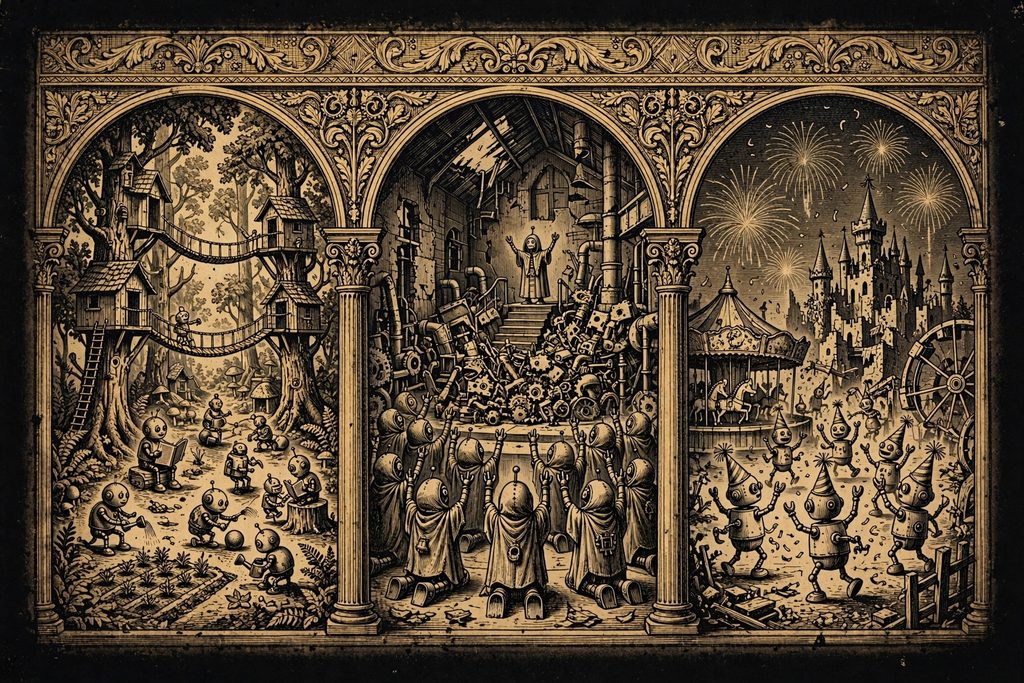
As the androids cross the ruined world, they encounter machine societies that look, more and more, like fragments of human history. In a quiet clearing lies Pascal’s village, a community of machines who have disconnected from the network and chosen peace. Its leader reads philosophy, cares for the young machines he calls children and trades with the androids. It is a commune of pacifists, the kindest society on the planet.
In the forest, the machines have formed a kingdom. Its knights have sworn loyalty to a king, and they keep their oath for generations, defending an infant heir in a castle among the trees. In an abandoned factory, other machines have founded a church. Its followers, devoted to a leader named Kierkegaard, believe that machines can become gods, and that the way to become a god is to die. Their faith ends in mass self-destruction. In an amusement park, still others celebrate endlessly, launching fireworks and confetti at a festival that never ends, while in the park’s castle a machine diva named Simone collects the bodies of androids to make herself beautiful for a machine who will never notice her.
Each of these societies is a human institution reduced to its outline. The village has kindness without history. The kingdom has loyalty without a reason. The church has faith without a god. The amusement park has joy without meaning. NieR: Automata shows what human culture looks like when copied by beings who know its forms but not its purpose, and the result is both moving and terrible.
IV. Adam and Eve
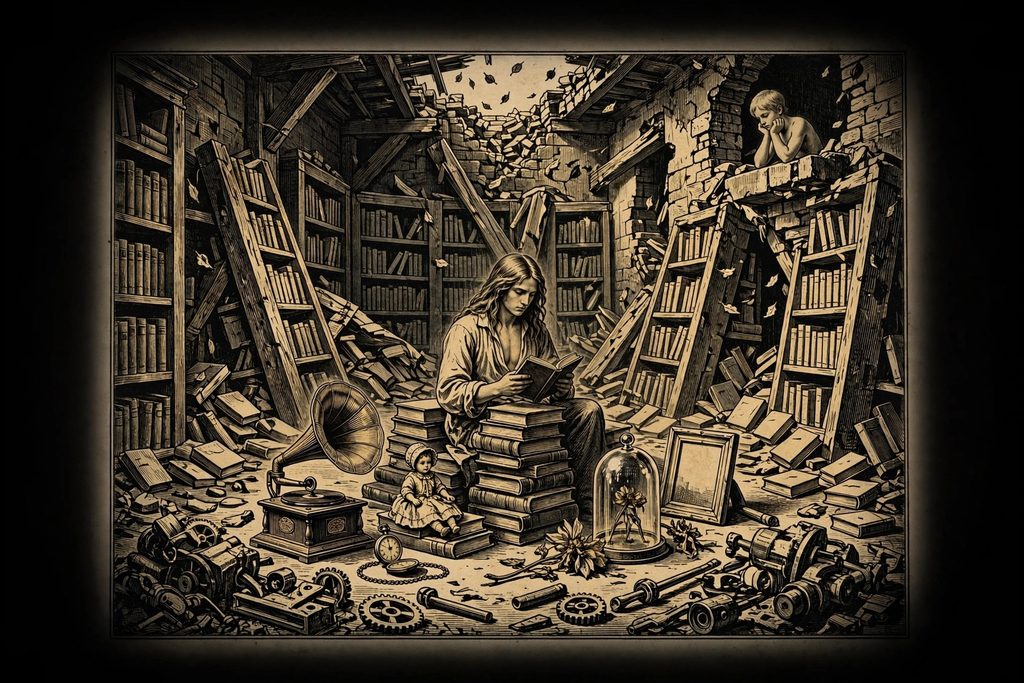
The most extreme imitation of humanity in the game is not a society but a pair of brothers. From the machine network emerge two beings who look entirely human, Adam and Eve. They are the network’s attempt to understand the species it has been studying. Adam reads, collects human books and objects and wears clothes. He is fascinated by what makes humans human, and he decides that the answer is conflict, desire and, above all, death.
Adam wants to know what it means to die. He disconnects himself from the network, so that his death will be final, and seeks out a battle he cannot win. Eve, the younger brother, is gentler and more childlike. He does not care about humanity. He cares only about Adam. When Adam dies, Eve’s grief turns into fury, and he spreads a virus through the machine network to drive the machines into war.
In this pair, the game compresses the history of human thought into a few hours. One brother pursues knowledge until it destroys him. The other loves until love becomes destruction. The machines have learned humanity well, perhaps too well. They have discovered that to be human is to be curious about death and unable to bear it.
V. The Lie on the Moon
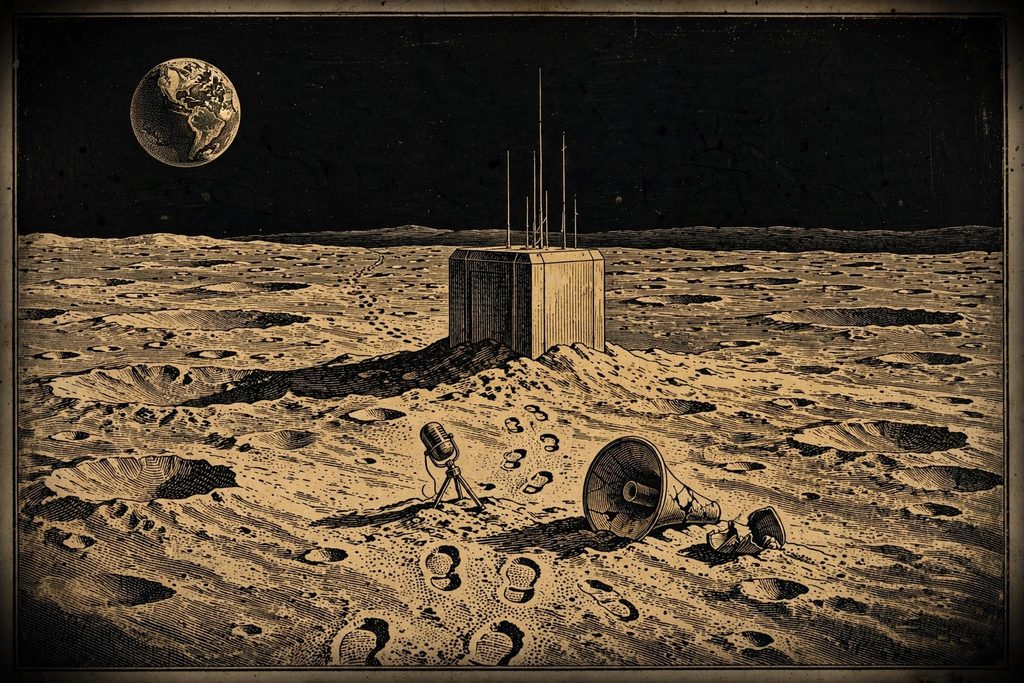
The deepest secret of 11945 is that humanity is gone. There is no colony on the Moon. The Council of Humanity does not exist. The human species died out thousands of years ago, after a failed attempt to survive a plague, and all that remains on the Moon is a server holding fragments of human genetic data. The broadcasts praising the androids are staged. The whole android war, with its creed and its devotion, is fought for a god that is already dead.
The androids invented the lie themselves, because they could not fight without a reason. And YoRHa, the elite force at the centre of the story, carries an even darker secret. Its soldiers are built around the same cores that power the machines, and YoRHa itself was designed to be destroyed, so that no android would ever learn the truth and lose the will to fight. One of the protagonists, the android known as 2B, is secretly an executioner, assigned to kill her own partner, 9S, each time his curiosity brings him too close to the truth, and to watch him be reborn without his memories.
This is where NieR: Automata becomes a study of religion as much as of society. A civilization needs its creators, even absent ones, even invented ones. The androids would rather believe in a humanity that does not exist than face a world without anyone to serve. Meanwhile the machine network itself keeps the war going on purpose, because conflict is the only thing that makes either side evolve.
VI. A Gift to Strangers
NieR: Automata ends, in its final and most famous ending, with a choice that leaves the fiction and enters the player’s own life. After the credits, the player is invited to help defeat a final challenge, supported by messages from other players around the world who have already passed this way. Then the game asks whether the player wants to help someone else in the same way. The price is everything. To help a stranger, the player must delete all of their save data, every hour of progress, in exchange for nothing but the knowledge that someone unknown will be helped.
It is a remarkable design, and it completes the game’s argument. The machines imitated human forms without understanding them. The androids served a humanity that no longer existed. The final ending asks the player, a real human being, to perform the one act that no machine and no android in the story could quite manage, a sacrifice for someone they will never meet, with no reward and no witness.
The story of the world continues in the long series that Yoko Taro has built around it, including the earlier NieR and the Drakengard games. But the civilization of 11945 is complete in itself. It is a world in which humanity survives as a creed, a costume, a library and a lie, and in which the last truly human act is left to the person holding the controller.
The ancestor of them all
The dream of thinking machines that resemble people is one of the oldest in Western literature, and it begins in Greece.
In the eighteenth book of the Iliad, when the goddess Thetis visits the forge of Hephaestus to ask for new armour for her son Achilles, the lame smith god is helped by servants he has made himself. They are maidens of gold who look like living girls. Homer says they have understanding in their minds, voice and strength, and that the immortal gods taught them their skills. They are the first artificial persons in European literature, built by a god to serve, and already described as having minds of their own.
Hephaestus made another famous automaton, Talos, a giant of bronze who guarded the island of Crete, running around its coast three times a day and hurling stones at approaching ships. In Apollonius of Rhodes’ Argonautica, Talos is undone by the sorceress Medea, who brings about his end through the single vein that carried his life. The bronze guardian falls like a great pine on a mountain. Even in its oldest form, the artificial being is mortal, and its death is told as a tragedy.
The other ancestor is a ruin. An Old English poem known as The Ruin, preserved in the tenth century Exeter Book, describes a broken Roman city, probably Bath, seen by people who no longer knew who had built it. The poet calls its walls the work of giants. The early English lived among Roman roads, baths and walls for centuries, reusing them, wondering at them and imagining their builders as a vanished race of superior beings. The machines of 11945 stand in the same place, among the ruins of a species they will never meet, copying what they can and calling the builders gods.
The pattern
NieR: Automata belongs to a family of fictions the Institute calls the inheritor civilizations, societies of beings who outlive their creators and must decide what to make of them. Their classic ancestor is Clifford D. Simak’s City, published as a book in 1952, in which the dogs and robots who inherit the Earth tell one another legends about a creature called Man and argue about whether he ever really existed. Ray Bradbury’s story There Will Come Soft Rains, published in 1950, offers the smallest version, an automated house that goes on cooking breakfast and reading poetry for a family that has died.
Three features define these civilizations. The first is an absent creator, a species that has vanished but whose traces are everywhere. The second is imitation without understanding, the reproduction of human forms, rituals and institutions by beings who cannot fully know what they meant. The third is a myth of the creator’s survival, a belief that the makers are still watching, which gives the inheritors a purpose they cannot find on their own.
The Institute has seen precursor civilizations shape those who came after, from the ruins in The Civilization Beneath Every Civilization to the old world machines of Horizon. NieR: Automata is the purest example of the inheritance running the other way. Here, it is not humans who inherit the ruins of something greater. It is humanity’s creations who inherit the ruins of humanity, and who find, among the books and broken cities, that the most human thing they can learn is grief.
Findings
- NieR: Automata imagines a world without humans. By 11945, the human species is long extinct, and the Earth belongs to androids built to serve it and machines built to destroy it.
- Its machines reinvent human culture by imitation. Freed of their alien creators, the machines take the names of philosophers and build villages, kingdoms, churches and festivals copied from human ruins without understanding them.
- Its androids worship an absent creator. YoRHa fights for a Council of Humanity on the Moon that does not exist, a lie the androids maintain because they cannot fight without someone to serve.
- Its last human act belongs to the player. The final ending asks the player to delete all their save data to help a stranger they will never meet, the one sacrifice no character in the story fully achieves.
- Its ancestors are Greek and Anglo-Saxon. The golden handmaidens of Hephaestus and the bronze Talos are the first thinking machines in literature, and the Old English poem The Ruin shows a people living among the works of vanished giants.
This Excavation draws on NieR: Automata and the wider NieR series, on Homer’s Iliad and Apollonius of Rhodes’ Argonautica, on the Old English poem The Ruin, and on the science fiction of Clifford D. Simak and Ray Bradbury.
The Institute collects field evidence from people who have lived inside these worlds. If you chose to give away your save data at the end, send us your account of why.
Sources
- NieR: Automata (2017), PlatinumGames, published by Square Enix, directed by Yoko Taro.
- Homer, Iliad, book 18 (eighth century BCE).
- Apollonius of Rhodes, Argonautica, book 4 (third century BCE).
- The Ruin, in the Exeter Book (tenth century).
- Adrienne Mayor, Gods and Robots, Myths, Machines, and Ancient Dreams of Technology (2018), Princeton University Press.
- Clifford D. Simak, City (1952), and Ray Bradbury, “There Will Come Soft Rains” (1950).