





EXCAVATION Nº 0021 · OBSERVATORY
World: Comparative, Many Worlds
Period: Bronze Age to the present
Status: Active
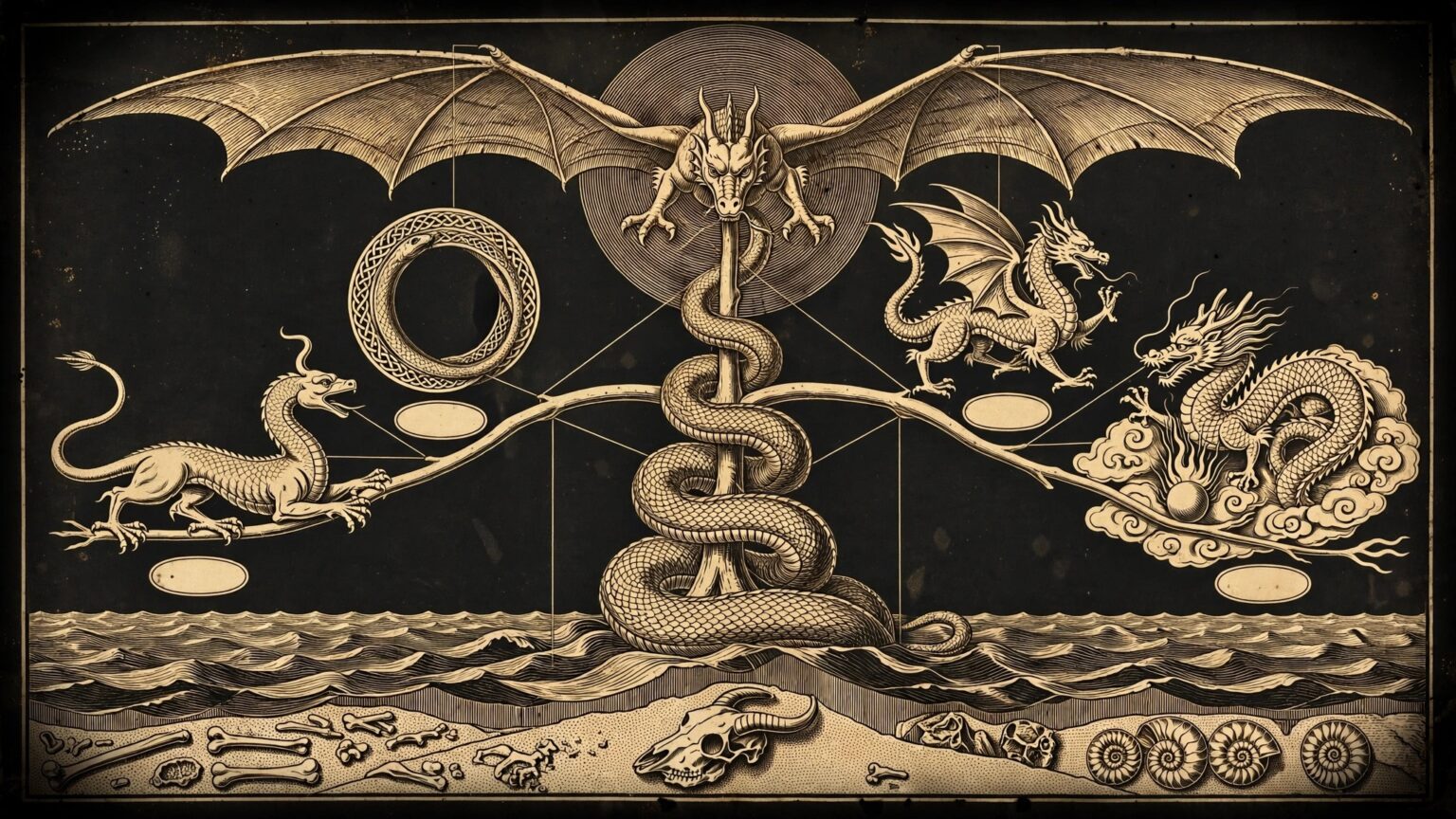
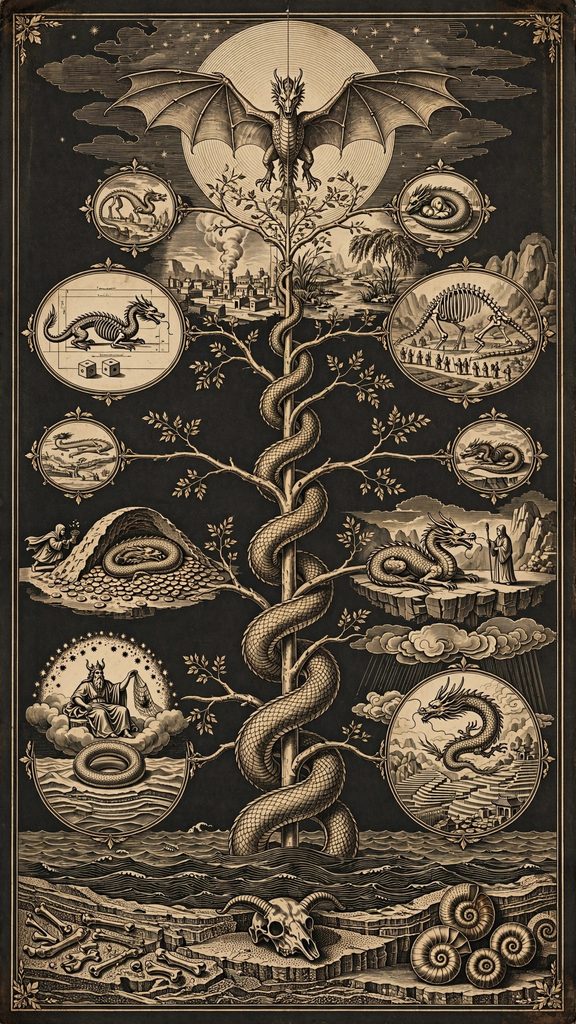
One creature has never gone extinct in the human imagination. It coiled in the salt water before the Babylonian world was made. It held back the rivers of the Rigveda, brought the rain to Chinese fields, slept on gold in an English barrow, stood for the Devil in the Book of Revelation, and learned to talk in an Oxford study in the 1930s. It was given hit points and a color code in the 1970s. Today it is the final boss of half the games ever made, and the best friend of a Viking boy in a children’s film.
The Observatory follows ideas rather than worlds. Its question here is easy to ask and hard to answer. How did an animal that never existed survive four thousand years of history, crossing every border, every religion and every medium, and still stay recognizable at a glance? Traced generation by generation, the answer is that the dragon never stayed the same thing. It kept the shape and changed the job.
I. The Serpent Before Creation
The oldest written dragons are not monsters at the edge of the world. They are the world, before anyone arranged it.
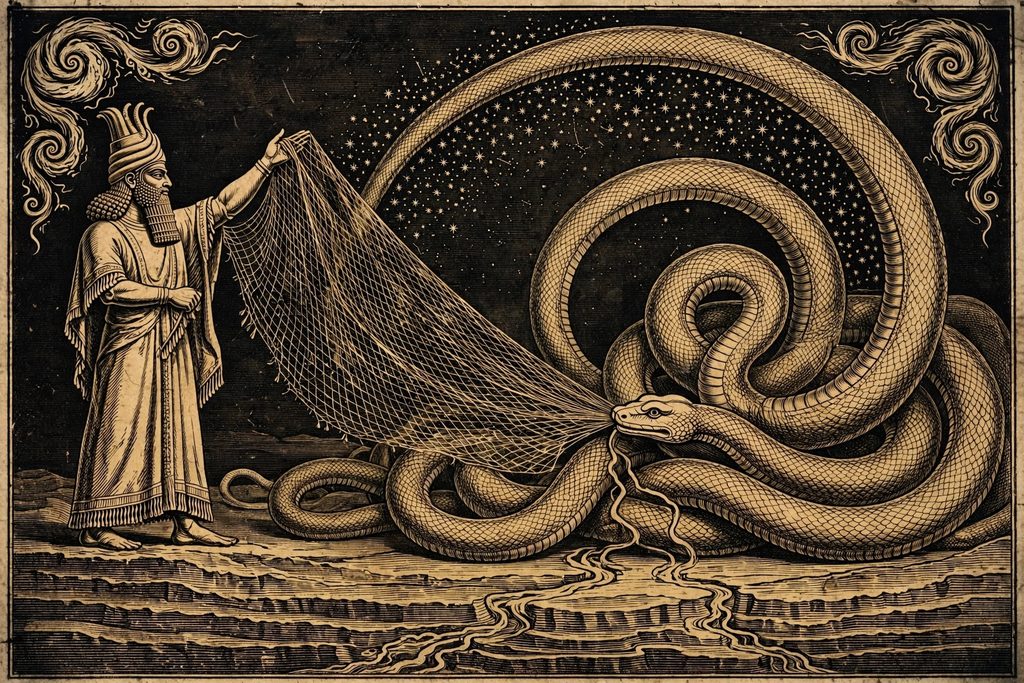
In the Babylonian Enuma Elish, the creation epic recited at the New Year festival in Babylon, the universe begins as two mingled waters, Apsu the fresh and Tiamat the salt. When the young gods disturb her peace, Tiamat goes to war and gives birth to an army of monsters, among them horned serpents, lion demons, scorpion men and the mušḫuššu, the “furious serpent”. The storm god Marduk meets her with winds and a net. He splits her body in two like a fish laid out to dry, raises one half as the sky and lays down the other as the earth. Her eyes become the sources of the Tigris and the Euphrates.
The victors kept the image. The mušḫuššu, born in Tiamat’s brood, later became Marduk’s own sacred beast, and it still strides in blue glazed brick along the Ishtar Gate, built around 575 BCE under Nebuchadnezzar II and now reassembled in Berlin.
Modern readers usually picture Tiamat herself as a dragon, though the tablets never clearly describe her body. That picture is part of the genealogy too, as we will see. What the text makes plain is her role. The first dragon is chaos, and creation is an act of violence against it. The world we live in is the corpse of the thing that came before.
The same story runs across the ancient Near East and beyond. At Ugarit, on the Syrian coast, Baal defeats Litan, “the twisting serpent, the mighty one with seven heads”. The Hebrew Bible keeps the memory of that fight in Leviathan, and Isaiah promises that the Lord “shall slay the dragon that is in the sea”. In Egypt the serpent Apep attacks the boat of the sun god Ra every night and must be cut down again every night, because Egyptian chaos is never killed, only held off. In Anatolia the Hittite storm god defeats the serpent Illuyanka. In the Rigveda, Indra kills Vritra, the coiled serpent who had trapped the waters inside a mountain, and the freed rivers run down to the sea like lowing cattle.
In 1995 the linguist Calvert Watkins showed that this was more than a family resemblance. In How to Kill a Dragon he traced a single inherited formula through Vedic Sanskrit, Hittite, Greek, the Germanic languages and others. A hero slays a serpent, and the words used to say so descend from one ancestral phrase. The dragon fight is among the oldest sentences that linguists can reconstruct. Biblical scholars already had a name for the pattern. In 1895 Hermann Gunkel called it the Chaoskampf, the battle against chaos.
The first generation of the dragon leaves one inheritance above all others. The dragon is what stands between the world and its order, and a god earns his throne by killing it. That inheritance will run, almost unchanged, all the way to the end credits of a video game.
II. The Dragon Who Brings the Rain
On the other side of Asia, the same long scaled body meant something else entirely.
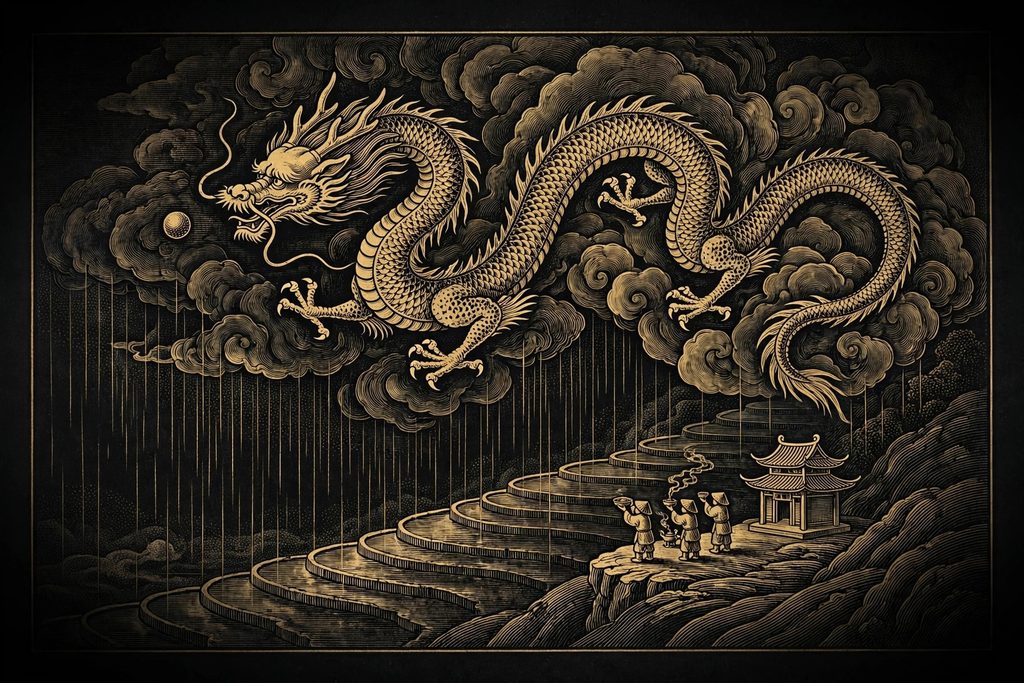
The Chinese lóng is not chaos. It is the order of the seasons. The Shuowen Jiezi, the great dictionary compiled around 100 CE, calls it the chief of all scaled creatures, able to be dark or bright, tiny or vast, short or long, rising into the sky at the spring equinox and diving into the deep at the autumn one. The lóng lives in rivers, lakes and clouds. It brings the rain that rice needs, and when the rain fails, people pray to it. Each of the four seas had its Dragon King, with a palace under the water, a court of fish and crab officials, and the temper of a provincial governor. Later writers listed the nine animals the lóng resembles, among them a camel’s head, a deer’s antlers, a snake’s neck, a carp’s scales and an eagle’s claws, as if the creature were a sum of everything powerful in the landscape.
Because it governed the weather, it came to govern the state. Emperors sat on the Dragon Throne and claimed the dragon as their emblem. Under the Ming and Qing dynasties, the five-clawed dragon on a robe belonged to the emperor and those he chose to honor, and wearing one without the right was a serious offense.
Japan received this dragon and gave it native waters. Ryūjin, the dragon god of the sea, keeps a palace beneath the waves and the two jewels that command the tides. But Japan also kept a monster. In the Kojiki, compiled in 712, the storm god Susanoo meets Yamata no Orochi, a serpent with eight heads and eight tails that has eaten seven of an old couple’s eight daughters. He gets it drunk on strong sake, cuts it to pieces, and finds a sword inside one of its tails. That sword, Kusanagi, became one of the three imperial regalia of Japan. The dragon carried the sword of the state inside its own body.
The gap between the two lineages became a modern argument. During the 2024 Year of the Dragon, Chinese state broadcasters including CCTV and CGTN began writing the word in English as “loong”. The reasoning offered by supporters was simple. The Western dragon carries Revelation, Saint George and the Devil. The lóng carries rain, luck and the emperor. To translate one as the other, they argued, had been a mistake for centuries. Whatever one makes of the politics, it is a rare event. A civilization formally rejected a word for a creature that does not exist.
III. The Hoard, the Saint and the Skull
In the West, the Greek language gave the creature its name. Drakōn comes from a verb meaning to see clearly, to stare, and the Greek dragon is above all a watcher. Ladon coils around the tree of golden apples in the garden of the Hesperides. A sleepless dragon guards the Golden Fleece in Colchis until Medea drugs it. Apollo kills the serpent at Delphi and takes its oracle for himself. Cadmus kills the dragon of Ares, sows its teeth in a field, and armed men rise from the furrows to become the first families of Thebes.
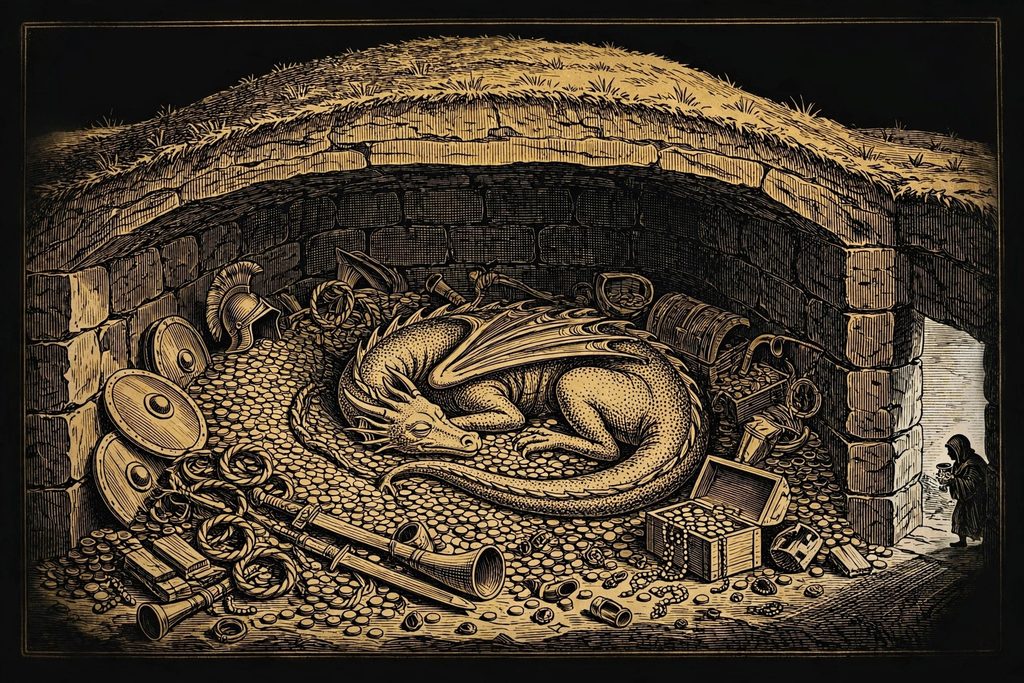
The Germanic north added the feature that would define the Western dragon for the next thousand years. Gold. In the Norse Saga of the Volsungs, Fáfnir is not born a dragon. He is a man who murders his own father for a cursed treasure and, lying on it year after year, turns into a serpent out of greed. The hero Sigurd digs a pit across the path the dragon takes to the water, stabs it from below, and roasts its heart. When he burns his thumb on the meat and puts it in his mouth, he suddenly understands the speech of birds.
The Old English Beowulf ends with the same creature in a darker mood. A dragon has guarded a barrow full of ancient treasure for three hundred winters. A fugitive steals a single jeweled cup, and the dragon wakes and burns the land. The aged king Beowulf goes out to fight it, kills it with the help of one loyal companion, and dies of its venom. The poem closes not with a victory but with a funeral pyre and a people who know their enemies are coming. The dragon has become the thing a hero dies fighting.
Norse cosmology kept the oldest role alive as well. Níðhöggr gnaws the roots of the world tree Yggdrasil. Jörmungandr, the World Serpent, lies in the ocean around the world of men with its tail in its mouth, waiting for Ragnarök, when Thor will kill it and fall dead nine steps later from its poison. The Institute traced that cosmology through one modern descent in The Norse Underworld Inside Senua’s Mind.
Christianity then fixed the Western dragon in place. The Book of Revelation describes “a great red dragon, having seven heads and ten horns”, and names it outright as “that old serpent, called the Devil, and Satan”. From then on the dragon was sin. The archangel Michael spears it. Saint Margaret bursts out of its belly. Saint George, a soldier martyred in the early fourth century, only acquired his dragon many centuries after his death, and The Golden Legend, compiled by Jacobus de Voragine around 1260, gave Europe the standard version. A pagan town, a princess offered as tribute, a knight with a lance, and a city converted on the spot. Medieval encyclopedias treated the creature as natural history. Isidore of Seville, writing in the seventh century, called the dragon the largest of all serpents and noted that its strength lay not in its teeth but in its tail, which could crush an elephant.
Sometimes the ground supplied evidence. In 1335, near Klagenfurt in Austria, a huge skull came out of a gravel pit and was taken for the head of the Lindwurm, the dragon of local legend. When the sculptor Ulrich Vogelsang carved the great Lindwurm fountain in 1590, he is widely believed to have modeled the head on it. The skull still survives. It belonged to an Ice Age woolly rhinoceros. In China, fossil bones sold as “dragon bones” were ground into medicine for centuries. People were excavating the dragon long before the Institute picked up a trowel.
By the end of the Middle Ages, the Western dragon had collected its permanent features. It hoarded. It guarded. It breathed fire, which most ancient dragons never did. It grew bat wings in the painters’ workshops. And it stood for evil, so killing it was always a righteous act. The Eastern dragon kept its rain, its luck and its throne. Two different creatures now shared one English word.
IV. The Dragon Learns to Speak
The modern dragon was born in a lecture hall.
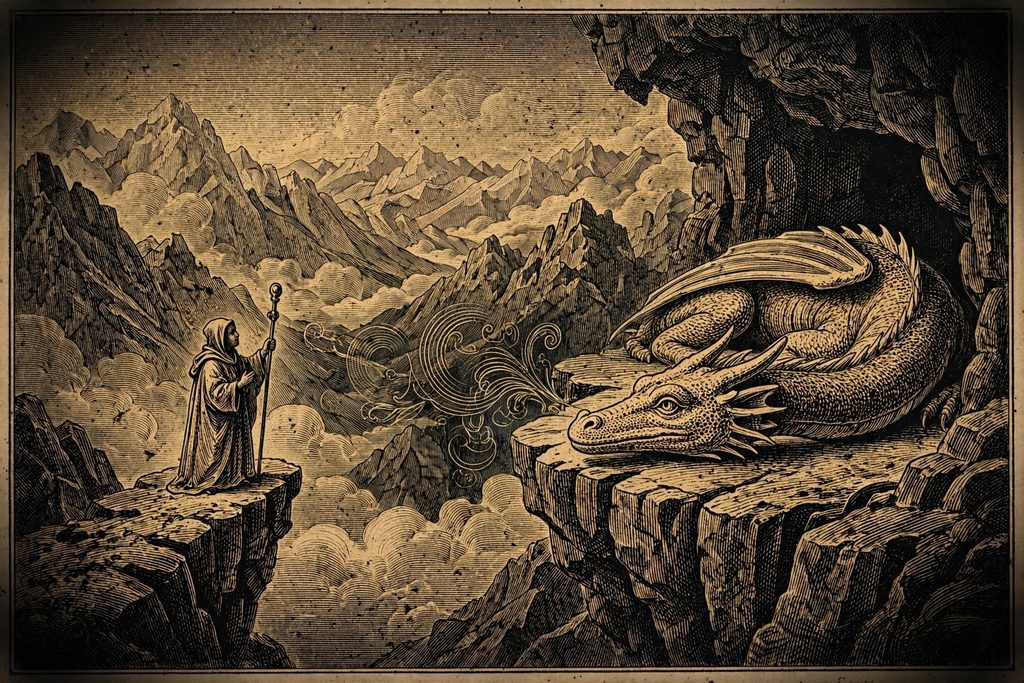
On 25 November 1936, J. R. R. Tolkien addressed the British Academy with Beowulf: The Monsters and the Critics. The scholars of his day treated the dragon in Beowulf as a childish distraction from the poem’s real history. Tolkien argued the reverse. The monsters were the point. “A dragon is no idle fancy,” he told them. Three years later, at the University of St Andrews, he confessed something more personal in the lecture On Fairy-Stories. “I desired dragons with a profound desire.”
The Hobbit had already appeared in 1937, and Smaug is what that desire produced. Smaug is not a beast. He talks. He is vain, sarcastic, cunning and quick to catch a lie, and his riddling conversation with Bilbo in the dark under the Lonely Mountain is one of the great scenes of modern fantasy. Tolkien built him in plain sight of his sources. A small thief takes a cup from a sleeping dragon’s hoard, exactly as in Beowulf, and the dragon wakes and burns a town. Tolkien wrote in a letter that Beowulf was among his most valued sources, though he said the episode had arisen naturally as he wrote. The bare patch in Smaug’s jeweled belly echoes the blow Sigurd struck from below. And the gold carries Fáfnir’s curse. Tolkien called it dragon-sickness, the greed that takes hold of anyone who stays too long near a hoard.
Behind Smaug stood a whole mythology. In the legendarium later published as The Silmarillion (1977), dragons are the creatures of the dark lord Morgoth. Glaurung, the father of dragons, speaks and enchants, and his gaze can bind a mind and wipe away a memory. Ancalagon the Black is so vast that his fall shatters the towers of Thangorodrim. Tolkien gave the dragon what Western tradition had never quite allowed it. A mind of its own.
The writers who followed took that gift in two directions, and both arrived in 1968. In Ursula K. Le Guin’s A Wizard of Earthsea, dragons are the native speakers of the Old Speech, the language in which the true name of a thing is the thing, which human wizards master only with years of labor. To talk with a dragon in Earthsea is to stand before the grammar of the universe. Decades later, in The Other Wind (2001), Le Guin revealed that dragons and humans had once been a single people who chose to part. In Anne McCaffrey’s Dragonflight, the dragons of Pern bond telepathically with a human rider at the moment of hatching, and fight beside them against Thread, a deadly spore that falls from a wandering planet. Later books revealed that the human colonists had bred the dragons themselves from a small native species.
In a single generation the dragon went from the thing you kill to the thing you talk to, and then to the thing you ride. It was the largest change in four thousand years, and it happened in about thirty.
V. The Dragon Gets Statistics
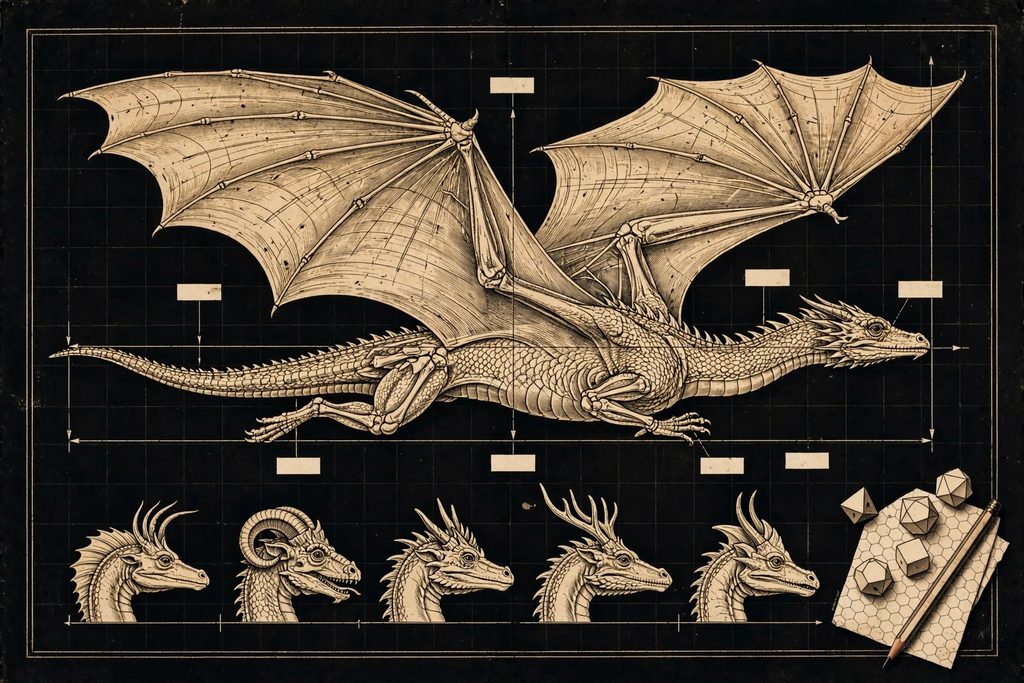
In 1974 the creature entered the rulebook. Gary Gygax and Dave Arneson’s Dungeons & Dragons put it in the title and gave it something no myth ever had. Numbers. A dragon now had hit dice, an armor class, a breath weapon with a range, and a percentage chance of being asleep when the players walked in. The Greyhawk supplement of 1975 and the Monster Manual of 1977 sorted dragons into families by color and by moral alignment. The chromatic dragons were evil, each with its own breath, fire for the red, lightning for the blue, acid for the black, poison gas for the green and frost for the white. The metallic dragons, gold, silver, bronze, brass and copper, were good.
Two names in that taxonomy show how a genealogy of ideas really works. The queen of the evil dragons, a giant with five heads, one for each color, was named Tiamat in 1977. The game brought the Babylonian goddess back as the dragon she may never have been, and for millions of players that is now simply who Tiamat is. Her opposite, the king of the good dragons, was named Bahamut. In medieval Arabic cosmology, Bahamut is not a dragon at all. It is an immense fish swimming in the abyss, carrying a bull, which carries a rock, which carries an angel, who carries the earth. A fish became a platinum dragon in a game manual, and in 1987 Final Fantasy made Bahamut the king of dragons, a role he has kept in almost every entry since. Ideas do not descend in straight lines. They are adopted, renamed and remade by whoever needs them.
Video games inherited the rulebook. The first dragons on a home console arrived in Atari’s Adventure in 1980. They were called Yorgle, Grundle and Rhindle, and the hardware was so limited that their designer, Warren Robinett, admitted they looked more like ducks. In 1986 Dragon Quest built the Japanese role-playing game around a final meeting with the Dragonlord, who at the last moment offers the hero half of the world if he will join him. It is the oldest temptation in scripture, staged in a throne room of pixels, and when the hero refuses, the Dragonlord shows his true form.
From there the dragon became a measure of difficulty and a filing system. Pokémon made it a type in 1996, rare and slow to mature. World of Warcraft gave its dragons cosmic offices as the Aspects, guardians of life, magic, time, dreams and the earth, until the earth’s guardian Deathwing went mad and tore the world apart in the Cataclysm of 2010. In Dragon Age, the Old Gods once worshiped by an ancient empire turn out to be dragons sleeping deep underground. And in Monster Hunter, which began in 2004, the dragon becomes a problem of taxonomy. The game’s scholars use the term Elder Dragon for any creature that defies ordinary classification, so the category holds beasts shaped like horses, whales and squid. The oldest monster in human memory has become the label for whatever science cannot yet explain.
VI. The Age of Dragons Is Always Over
Somewhere in the last twenty years, fantasy games made a quiet decision. The dragons came first.
In The Elder Scrolls V Skyrim (2011), dragons once ruled the ancient Nords as tyrants, served by a caste of human Dragon Priests, until a rebellion broke their rule. Their leader, Alduin, firstborn of the dragon god Akatosh, is called the World-Eater, and his return signals the end of time. The wider theology of that world, Akatosh included, appears in the Institute’s study of The Living Gods of Morrowind. What sets Skyrim’s dragons apart is their language. They do not merely speak it. They are made of it. A dragon’s name is usually a shout of three words, and the player who learns those words takes their power. Paarthurnax, the old dragon who betrayed his kind and taught humans the Voice, carries his original nature in his name, Paar Thur Nax, ambition, overlord, cruelty. He spends his days on the highest mountain in the world, meditating to hold that nature down. Asked whether he can be trusted, he answers with a question. Is it better to be born good, or to overcome your evil nature through great effort?
Skyrim fuses Tolkien’s talking dragon and Le Guin’s language of making with the oldest myth of all, the god dragon whose death begins or ends the world. Alduin is Tiamat and Jörmungandr at once.
Dark Souls (2011) reaches further back. Its opening tells of an Age of Ancients, a grey world of fog and great stone trees ruled by everlasting dragons whose stone scales made them immortal. Then came fire, and lords who drew power from it, and one dragon, Seath the Scaleless, who betrayed his own kind and revealed the secret of their scales. The age of gods, of humans and of history begins with the fall of the dragons. Some of the game’s pilgrims still try to become dragons again, remaking their own bodies on the long road back to the time before fire.
Elden Ring (2022) completes the reversal. Before the Erdtree and its golden order, the Lands Between had an Elden Lord who was a dragon, Placidusax, and he still waits at the eye of a storm at the edge of time for a god who left and never returned. His city, Crumbling Farum Azula, drifts in ruins in the sky. And in a cathedral in the rotting province of Caelid, the player can kill dragons, take their hearts and eat them in order to breathe their fire. Dragon Communion is Sigurd’s roasted heart turned into a sacrament. The players of Elden Ring left their own record of this world in the messages the Institute studied in The Message Culture of the Lands Between.
Sekiro (2019), from the same studio, brought the other lineage home. Its Divine Dragon is a long serpentine Eastern dragon, said to have come from the West, the source of a gift of immortality that spreads a sickness called dragonrot among the living.
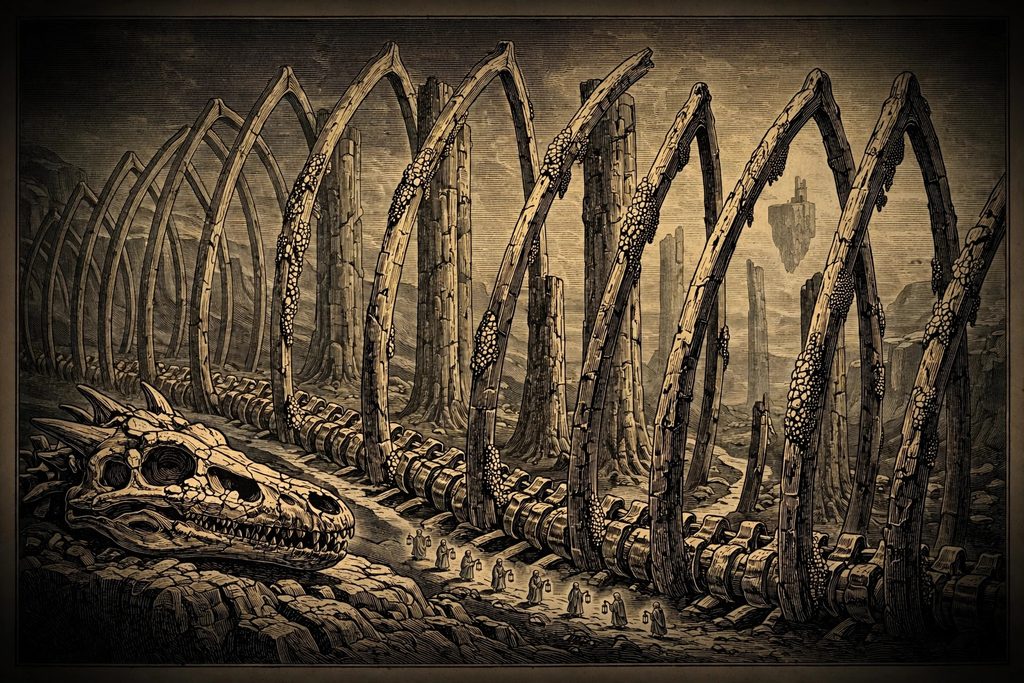
These games share a premise the Institute has met before. The dragon has become the precursor, the vanished master race whose ruins lie beneath the present, one of the many described in The Civilization Beneath Every Civilization. In myth the dragon came before creation, and creation was made from its body. In modern games the dragon came before history, and history is built on its bones. Four thousand years apart, the structure is the same.
VII. The Weapon and the Friend
In 2011 George R. R. Martin explained the dragons of A Song of Ice and Fire in one comparison. “Dragons are the nuclear deterrent,” he told Vulture, and only one character had them. In Fire & Blood (2018) and its television adaptation House of the Dragon (2022), the Targaryens rule a continent because they own the only weapons of mass destruction in the world, and lose almost everything when they turn those weapons on each other. The civil war known as the Dance of the Dragons ends with most of the dragons dead. Martin did not invent the fear. He gave the dragon the job the twentieth century needed done, the image of a power so total that using it destroys the user.
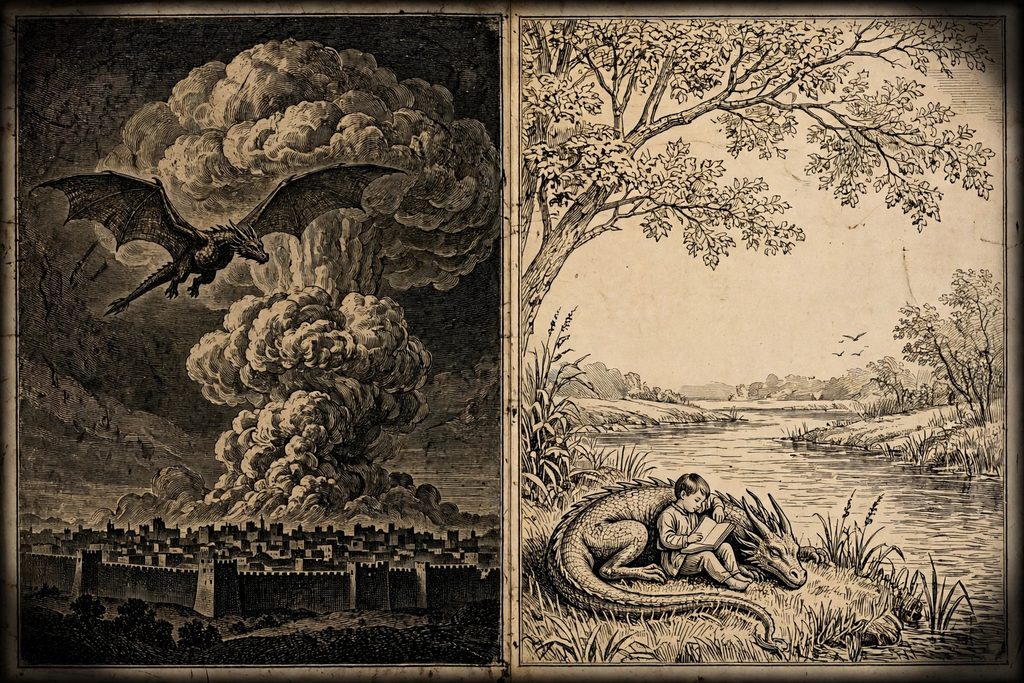
In the same years the dragon became a child’s best friend. Cressida Cowell’s How to Train Your Dragon (2003) became a DreamWorks film in 2010, in which a Viking village at war with dragons learns that the war was a mistake, and a boy and a wounded Night Fury become inseparable. A live-action version followed in 2025. In Hayao Miyazaki’s Spirited Away (2001), the dragon Haku turns out to be the spirit of a river that was filled in and built over with apartments. He is the oldest Eastern dragon of all, a god of the waters, homeless in a modern city. Disney’s Raya and the Last Dragon (2021) drew on the nāga of Southeast Asia and made its dragon a water spirit whose trust in the people who feared her becomes the lesson of the whole film.
The dragon of modern culture has split in two. One half is the weapon, total and terrible, the thing that must never be used. The other is the partner, misunderstood and loyal, the thing we were wrong to fear. In games, meanwhile, the oldest function never left. Skyrim alone has the player kill dragon after dragon and absorb their souls. Four thousand years after Marduk, the dragon is still the creature whose death proves who you are.
The ancestor of them all
If every dragon descends from an older dragon, where does the line begin? Archaeology offers one image. At Xishuipo in Puyang, in central China, excavators in 1987 opened a grave of the Yangshao culture, numbered M45. A tall man lay between two figures laid out in white clamshells, a tiger on one side and a long scaled creature on the other. The grave is more than six thousand years old, and Chinese archaeologists call the shell figure the first dragon of China.
Anthropology offers a deeper answer. In An Instinct for Dragons (2000), the anthropologist David E. Jones argued that the dragon is a composite of the three predators our primate ancestors feared most, the snake, the big cat and the bird of prey. Look at any dragon and the parts are there, the serpent’s body, the lion’s claws and teeth, the raptor’s wings. The primatologist Lynne Isbell went further. In The Fruit, the Tree, and the Serpent (2009) she proposed that snakes helped shape the evolution of primate vision itself, so that spotting a coiled shape in the grass is wired into us more deeply than language. Both theories are debated. Both point the same way. The dragon may be the oldest fear we have, given a body by every culture that ever told a story.
The earth seemed to confirm it. A woolly rhinoceros skull in Klagenfurt, dragon bones in Chinese pharmacies, and, as the historian Adrienne Mayor has shown in The First Fossil Hunters, the bones of extinct animals that ancient peoples found eroding out of hillsides and explained with the monsters of their myths. The dragon is the one imaginary animal that the ground itself kept producing.
The pattern
Follow the dragon across four thousand years and one rule appears. Every age keeps the shape and changes the meaning. The shape barely moves. Long, scaled, clawed, ancient, enormous, tied to water or to fire. The meaning follows whatever a civilization fears or needs most at its edges.
For the cities of Mesopotamia it was the chaos before order. For the rice farmers of China it was the rain. For the Germanic north it was gold and the greed that gold breeds. For medieval Christianity it was sin. For the twentieth century it was the bomb. For the twenty-first it is the lost precursor, and the stranger we misjudged.
Two long movements cut across that sequence. The first is distance. The dragon has come steadily closer to us, from the primordial ocean to the far mountain, from the mountain to the cave, from the cave to a conversation, from a conversation to a saddle, and finally into the family home. The second is the joining of two lineages. For two thousand years, the slain serpent of the West and the rain dragon of the East were separate creatures that happened to look alike. Modern fiction, and Japanese games above all, braided them together, so a single world can now hold a dragon to kill, a dragon to worship and a dragon to befriend.
Findings
- The dragon is the longest-lived idea in human fiction. From a shell figure in a Neolithic grave to Elden Ring, it has survived every change of religion, empire and medium without falling out of use.
- It survives by changing jobs. Chaos, rain, treasure, sin, intelligence, nuclear power, lost history and friendship have all worn the same scaled body. The shape stays and the meaning moves.
- There were always two dragons. One is the serpent of the Near East and the Indo-European world that a god must kill. The other is the Chinese lóng that brings the rain and crowns the emperor. The 2024 “loong” debate is the newest chapter of a very old divergence.
- Culture inherits through its mistakes. Tiamat became a dragon in later imagination and then in Dungeons & Dragons. Bahamut was a fish before he was a dragon king. Ideas descend through misreadings, renamings and adoptions as often as through faithful copying.
- Modern games have made the dragon a precursor. Skyrim, Dark Souls and Elden Ring place an age of dragons before the age of humans, and so repeat the oldest myth of all, a world built from the body of the dragon that came before.
This Excavation draws on Mesopotamian, Ugaritic, Hebrew, Egyptian, Hittite, Vedic, Greek, Chinese, Japanese and Norse sources, on medieval literature and natural history, on the works of Tolkien, Le Guin, McCaffrey and Martin, on Dungeons & Dragons, and on games from Adventure to Elden Ring.
The Institute collects field evidence from people who lived inside these worlds. If a dragon in a game, a book or a film stayed with you, send us your account.
Sources
- Enuma Elish (second millennium BCE), in Stephanie Dalley, Myths from Mesopotamia (1989), Oxford University Press.
- The Baal Cycle, Ugaritic tablets (c. 14th century BCE).
- Isaiah 27 and Revelation 12, King James Version (1611).
- Rigveda 1.32, Hymn to Indra (c. 1500 to 1000 BCE).
- Hesiod, Theogony (c. 700 BCE), and Apollonius of Rhodes, Argonautica (3rd century BCE).
- Xu Shen, Shuowen Jiezi (c. 100 CE).
- Kojiki (712).
- Isidore of Seville, Etymologies (7th century).
- Beowulf (c. 8th to 11th century).
- The Saga of the Volsungs (13th century) and the Poetic Edda.
- Jacobus de Voragine, The Golden Legend (c. 1260).
- Hermann Gunkel, Schöpfung und Chaos in Urzeit und Endzeit (1895).
- Jorge Luis Borges, The Book of Imaginary Beings (1957, expanded 1967).
- J. R. R. Tolkien, Beowulf: The Monsters and the Critics (1936), The Hobbit (1937), On Fairy-Stories (1939, published 1947), The Silmarillion (1977).
- Ursula K. Le Guin, A Wizard of Earthsea (1968) and The Other Wind (2001).
- Anne McCaffrey, Dragonflight (1968) and Dragonsdawn (1988).
- Gary Gygax and Dave Arneson, Dungeons & Dragons (1974), Greyhawk (1975) and Monster Manual (1977), TSR.
- Calvert Watkins, How to Kill a Dragon (1995), Oxford University Press.
- David E. Jones, An Instinct for Dragons (2000), Routledge.
- Adrienne Mayor, The First Fossil Hunters (2000), Princeton University Press.
- Lynne A. Isbell, The Fruit, the Tree, and the Serpent (2009), Harvard University Press.
- Adventure (1980), Warren Robinett, Atari.
- Dragon Quest (1986), Chunsoft and Enix.
- Final Fantasy (1987), Square.
- Pokémon Red and Green (1996), Game Freak.
- World of Warcraft (2004) and Cataclysm (2010), Blizzard Entertainment.
- Monster Hunter (2004), Capcom.
- Dragon Age Origins (2009), BioWare.
- The Elder Scrolls V Skyrim (2011), Bethesda Game Studios.
- Dark Souls (2011), Sekiro Shadows Die Twice (2019) and Elden Ring (2022), FromSoftware.
- George R. R. Martin, A Song of Ice and Fire (1996 onward) and Fire & Blood (2018), and interview with Vulture (2011).
- House of the Dragon (2022), HBO.
- Cressida Cowell, How to Train Your Dragon (2003), and the films by DreamWorks Animation (2010) and Universal Pictures (2025).
- Spirited Away (2001), Studio Ghibli.
- Raya and the Last Dragon (2021), Walt Disney Animation Studios.
- Radio Free Asia, “Year of the Dragon is now Year of the Loong, according to China” (2024).
- Excavation reports on the Xishuipo site, Puyang, Henan (1987 to 1988).