





EXCAVATION Nº 0019 · MYTHOSPHERE
World: Comparative, Many Worlds
Period: Deep time (in-world)
Status: Active
Medium: Many
Polity: Various
Origin: Ruins
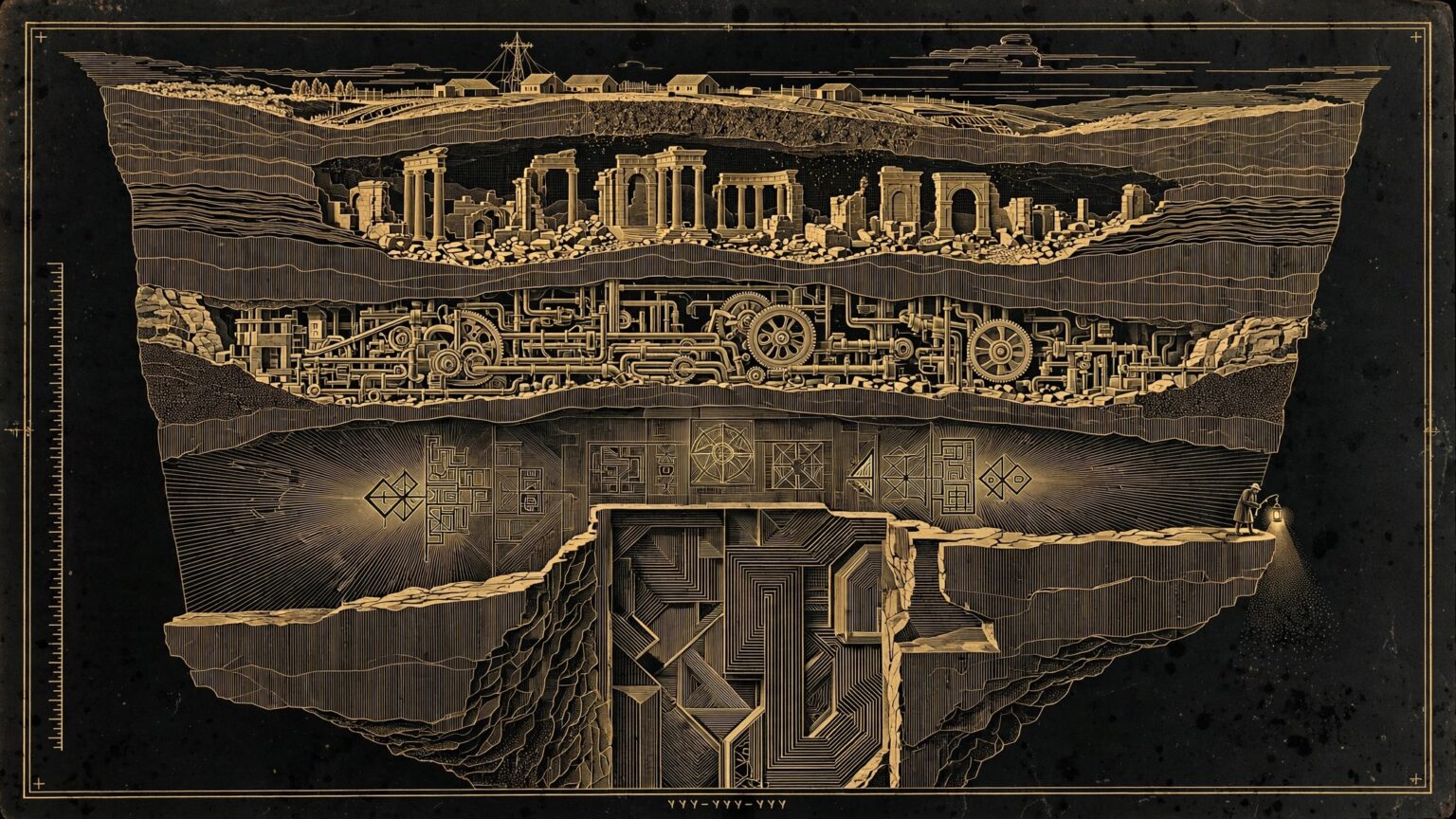
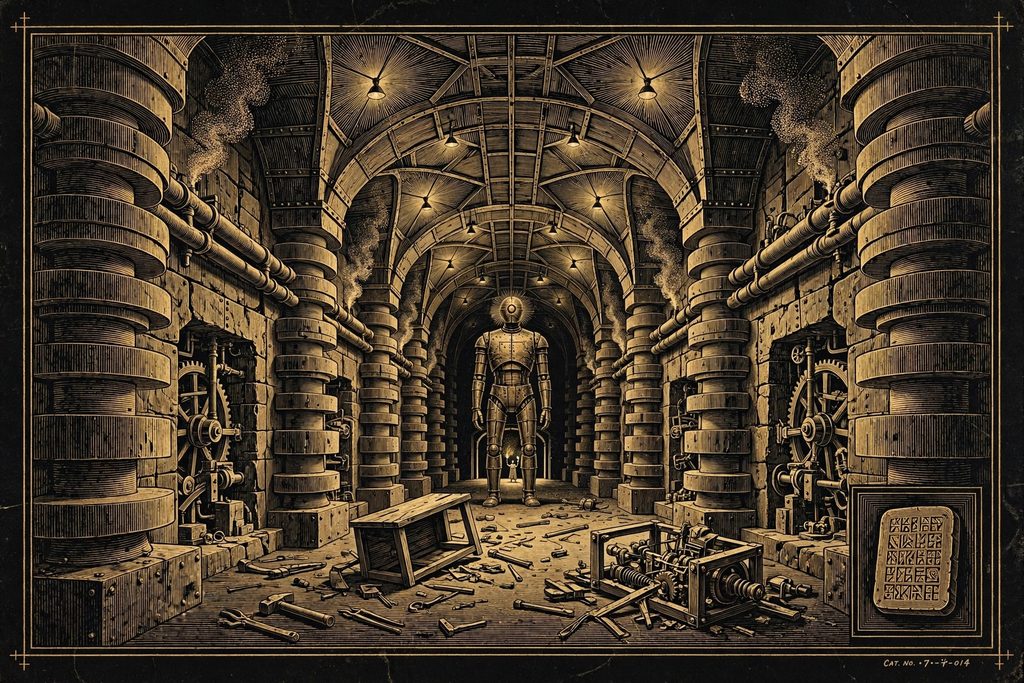
A traveller descends into a ruin beneath the mountains of Skyrim. The stone corridors give way to bronze. Steam hisses from pipes that should have rusted long ago. Mechanical sentinels stand guard and, when disturbed, still march. Lamps still burn. The machines still work. But there is no one here. The people who built this place, the Dwemer, vanished from the world in a single moment more than four thousand years earlier, every one of them at once, and no one knows where they went.
It is one of the most familiar experiences in modern fiction. The heroes of Mass Effect walk through the infrastructure of a galaxy built by a species that disappeared fifty thousand years ago. The soldiers of Halo fight on ring-shaped worlds built by beings who vanished a hundred thousand years ago. The assassins of Assassin’s Creed uncover artefacts left by the race that created humanity. Again and again, the present is built on the ruins of a civilization that was older, wiser and more powerful, and is gone.
The Mythosphere studies the myths that fictional worlds share and reshape. The precursor civilization is perhaps the most widespread myth in modern fiction. This Excavation asks why it appears so often, what it means, and where it came from. It also asks why the myth deserves more caution than it usually receives.
I. The Ruins Below
The Dwemer of the Elder Scrolls series are the archetype of the vanished precursor. They were an elven people of extraordinary technical genius. They built underground cities of bronze and stone, automatons that still patrol their halls, and machines whose workings scholars still cannot fully explain. They rejected the gods and studied the structure of reality itself. At the Battle of Red Mountain, around 1E 700, while their chief engineer worked on the Heart of Lorkhan, the entire Dwemer race disappeared at once, as the Institute recorded in its study of the living gods of Morrowind.
Their ruins are everywhere in the series. In Skyrim, they lie beneath the mountains, under the Nord cities that the Institute described in The Civil War Over a Forbidden God as built on layers of conquest. Players loot their metal, fight their machines and read their untranslated script. The Dwemer are present everywhere through what they left and absent everywhere as a people.
This is the first function of the precursor in fiction. It explains the ruins. Fantasy and science fiction worlds are full of dungeons, tombs and abandoned cities, and every one of them needs a builder. A vanished civilization supplies one, along with mystery, treasure and danger. The precursor turns the landscape into an archaeological site.
II. The Road Built for Us
Mass Effect, released by BioWare in 2007, gives the precursor myth a sinister twist. The civilizations of its galaxy travel between stars using the mass relays, a network of ancient gateways. They govern themselves from the Citadel, a vast station they did not build. Everyone believes these structures were left by the Protheans, a great civilization that vanished fifty thousand years ago.
The truth is darker. The relays and the Citadel were built by the Reapers, immense machine intelligences that return every fifty thousand years to destroy every advanced civilization in the galaxy. They leave their technology behind deliberately, so that each new set of civilizations will develop along predictable lines, depend on the same infrastructure and gather in the same places, ready for the next harvest. The Protheans were not the builders. They were the previous victims.
This is the second function of the precursor. It raises the question of inheritance. To inherit a predecessor’s tools is to inherit their path, and possibly their fate. Mass Effect’s galaxy believes it is building on the gifts of a wise ancestor. In fact it is walking a road laid down by a predator.
III. The Ones Who Were Worshipped
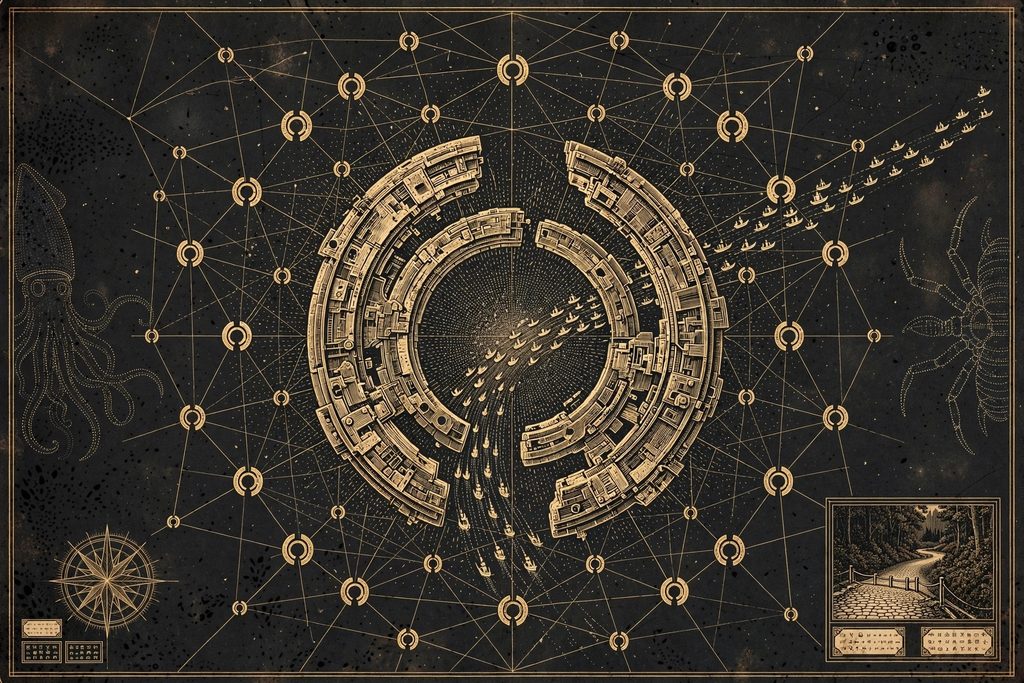
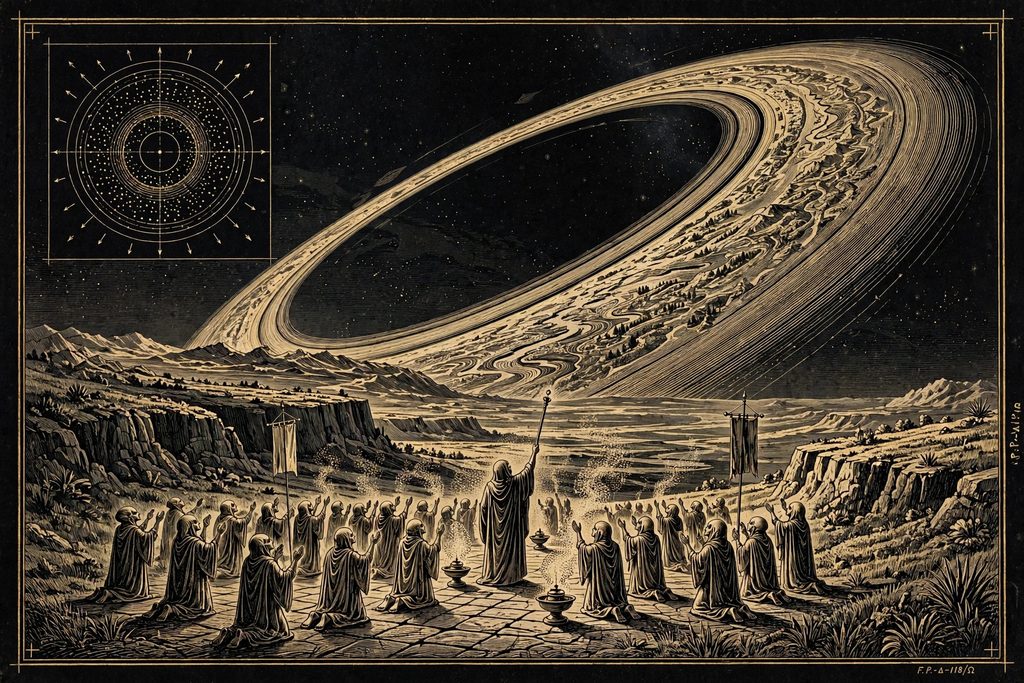
In the Halo series, which began with Bungie’s Halo Combat Evolved in 2001, the precursors are the Forerunners. They were an ancient and enormously advanced civilization that built the Halo rings, colossal ring-shaped worlds. Fired together, the rings could destroy all sentient life in the galaxy in order to stop the Flood, a parasitic organism that consumed and absorbed the living. The Forerunners fired the rings about a hundred thousand years ago and vanished.
The Covenant, the alliance of alien species that humanity fights in the early games, worships the Forerunners as gods. Its central doctrine, the Great Journey, teaches that activating the rings will carry the faithful to transcendence. The Covenant’s religion is built on a catastrophic misreading. The rings are not gates to paradise but weapons of extinction. A civilization’s theology has been constructed from the ruins of another civilization’s last act of desperation.
This is the third function of the precursor. It becomes divine. When a people encounters works far beyond its own abilities, it may explain them by worshipping their makers. Halo shows that worship and archaeology can be the same activity, and that a faith built on misunderstood ruins can drive a civilization toward disaster.
IV. The Ones Who Made Us
The boldest form of the myth goes further still. In it, the precursors did not just come before us. They created us.
In Assassin’s Creed, the precursors are the Isu, known to the series’ characters as Those Who Came Before. They were an advanced civilization that created humanity as a race of servants, controlled through artefacts called the Pieces of Eden. Humanity rebelled, and the war between them ended in a global catastrophe tens of thousands of years ago. The few surviving Isu were remembered by humans as gods, and their names survive in human mythology as Jupiter, Juno, Minerva and others.
The same idea appears across science fiction:
- Prometheus (2012). In Ridley Scott’s film, a pale, towering being called an Engineer dissolves into a river at the dawn of life on Earth, seeding the planet with the genetic material that will become humanity.
- Star Trek. In “The Chase”, a 1993 episode of The Next Generation, an ancient species is revealed to have seeded the galaxy’s many humanoid races, explaining why so many aliens look like people.
- StarCraft. The Xel’Naga shape the evolution of other species.
- Metroid. The Chozo raise the series’ heroine.
The Institute’s archive contains quieter versions of the same theme. The Lyran makers of Lem’s swarm in The Machine Ecology of Regis III and the Ancients who built the thinking machines of Rain World left worlds shaped by their absence.
This is the fourth function of the precursor. It answers the question of origins. If we were made, we have makers, and the story of the precursors becomes a creation myth told in the vocabulary of science.
V. The Danger in the Myth
The precursor myth is not only a story. It has a real-world history, and parts of that history are troubling.
In the nineteenth century, many European colonisers in southern Africa refused to believe that the great stone city of Great Zimbabwe had been built by Africans. They credited it instead to Phoenicians, Arabs or the court of the Queen of Sheba. In 1905, the archaeologist David Randall-MacIver, and in 1929 the archaeologist Gertrude Caton-Thompson, showed that it was the work of the ancestors of the local Shona people. The colonial authorities continued to promote the foreign-builder theory for decades. In the United States, nineteenth-century writers developed the myth of a lost race of “Mound Builders” to explain the great earthworks of North America, rather than accept that they had been built by Native American peoples. A Smithsonian study by Cyrus Thomas, published in 1894, demolished the theory.
The modern “ancient astronaut” theory, popularised by Erich von Däniken’s Chariots of the Gods? in 1968, repeats the pattern. The pyramids, the Nazca lines and other ancient monuments are credited to visitors from elsewhere, rather than to the human societies that built them. Archaeologists have repeatedly shown how these works were made by people.
The Institute’s view is that the precursor myth is powerful precisely because it touches something real, the humbling experience of standing among ruins we did not build. But when it is applied to real history, it has often been used to deny the achievements of real peoples. Fiction is the right home for the precursor. In fiction, the vanished builders are invented. In history, the builders were someone’s ancestors.
The ancestor of them all
The myth is far older than science fiction. In Works and Days, written around 700 BC, the Greek poet Hesiod described humanity’s history as a decline through five ages, from a golden race that lived like gods, through silver and bronze races and an age of heroes, down to the present age of iron. In the dialogues Timaeus and Critias, written around 360 BC, Plato told of Atlantis, a great and advanced island power that sank beneath the sea in a single day and night thousands of years before his time.
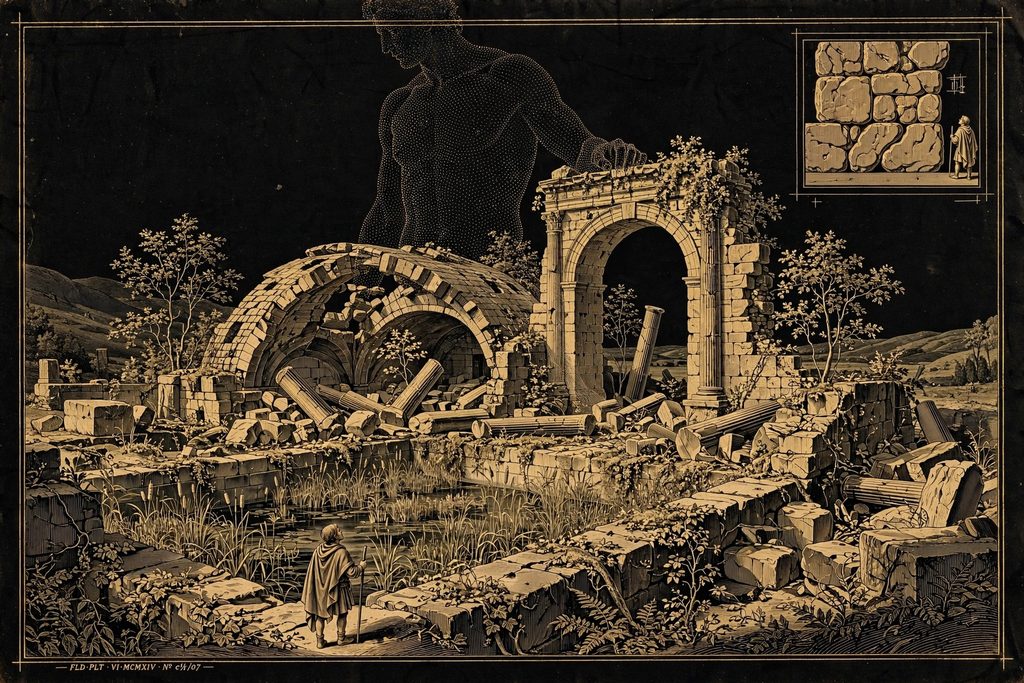
The myth also grew from real encounters with real ruins. The Greeks called the huge irregular stone walls of Mycenae and Tiryns Cyclopean. They believed, as the traveller Pausanias recorded, that only the giant Cyclopes could have lifted such stones. An Old English poem called The Ruin, preserved in the tenth-century Exeter Book, describes a crumbling Roman city, probably Bath, as “enta geweorc”, the work of giants. Its Anglo-Saxon author stood among Roman baths and walls and could not imagine that people had built them.
In modern literature, the clearest ancestor is H. P. Lovecraft’s At the Mountains of Madness, published in 1936. Explorers in Antarctica discover the ruins of the Elder Things, an alien race that built vast cities on Earth hundreds of millions of years ago and may have created life on the planet by accident. Every precursor in this Excavation, from the Dwemer to the Engineers, descends from that discovery in the ice.
The historian of religion Mircea Eliade described how traditional societies looked back to a sacred time of origins, in illo tempore, “in that time”, when the world was made and the gods walked among people. The precursor civilization is the modern, secular form of that sacred time. It is an age before our own, when the world was greater, and whose relics still lie beneath our feet.
The pattern
The precursor civilization follows a consistent structure across fiction and myth:
- It explains the ruins. Every abandoned city, dungeon and machine needs a builder, and the precursor supplies one.
- It raises the problem of inheritance. To use a predecessor’s tools is to inherit their path, as Mass Effect’s galaxy discovered.
- It becomes divine. Those who encounter works beyond their understanding may worship the makers, as the Covenant worshipped the Forerunners.
- It answers the question of origins. In its boldest form, the precursor is humanity’s creator, a creation myth in scientific language.
- It must be handled with care. Applied to real history, the myth has repeatedly been used to deny the achievements of real peoples.
Findings
- The precursor is fiction’s most widespread myth. The Dwemer, Protheans, Forerunners, Isu, Engineers and many others share the same structure, a vanished civilization greater than the present.
- It serves four functions. It explains ruins, raises the problem of inheritance, becomes an object of worship and answers the question of human origins.
- The best versions turn the myth against itself. Mass Effect reveals the precursors’ gifts as a trap, and Halo shows a religion built on misread ruins leading to catastrophe.
- It is ancient. Hesiod’s golden age, Plato’s Atlantis, the Cyclopean walls of Mycenae and the Old English “work of giants” all record the same response to the ruins of the past.
- In real history it carries a danger. From Great Zimbabwe to the Mound Builders to ancient astronauts, the myth has been used to deny real peoples credit for their own monuments.
This Excavation draws on the Elder Scrolls, Mass Effect, Halo, Assassin’s Creed and other works, on classical and medieval sources, and on the history of archaeology. Read more about how the Institute works.
The Institute collects field evidence from people who lived inside these worlds. If a precursor ruin in a game or a book stayed with you, send us your account.
Sources
- The Elder Scrolls III Morrowind (2002) and V Skyrim (2011), Bethesda Game Studios.
- Mass Effect (BioWare, 2007) and its sequels.
- Halo Combat Evolved (Bungie, 2001) and its sequels.
- Assassin’s Creed series (Ubisoft, 2007 onward).
- Prometheus (Ridley Scott, 2012), and Star Trek The Next Generation, “The Chase” (1993).
- Hesiod, Works and Days, and Plato, Timaeus and Critias.
- Pausanias, Description of Greece, on the walls of Tiryns.
- The Ruin, in the Exeter Book (tenth century).
- H. P. Lovecraft, At the Mountains of Madness (1936).
- Mircea Eliade, The Myth of the Eternal Return (1949).
- Gertrude Caton-Thompson, The Zimbabwe Culture (1931).
- Cyrus Thomas, Report on the Mound Explorations of the Bureau of Ethnology (Smithsonian Institution, 1894).