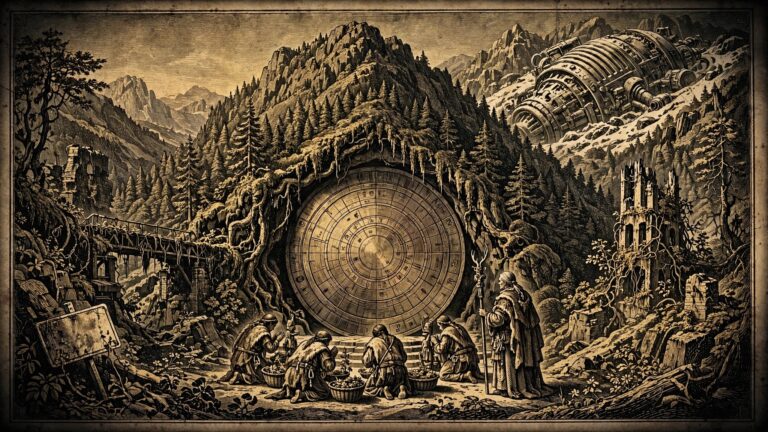


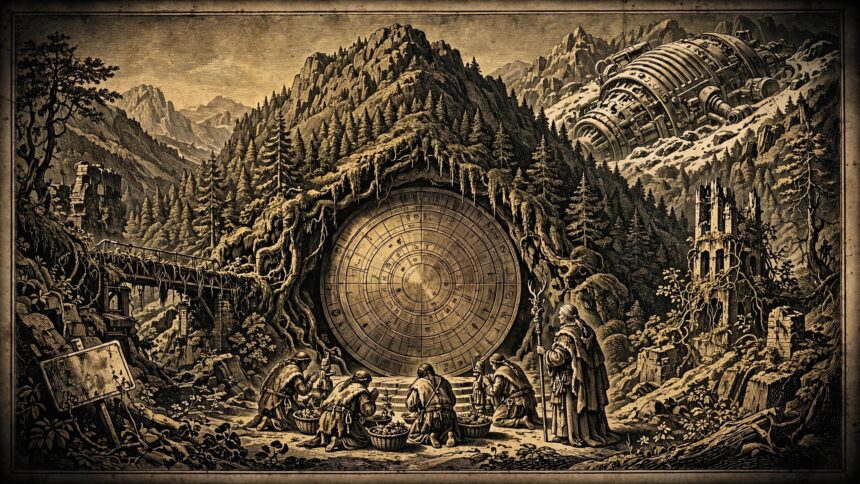
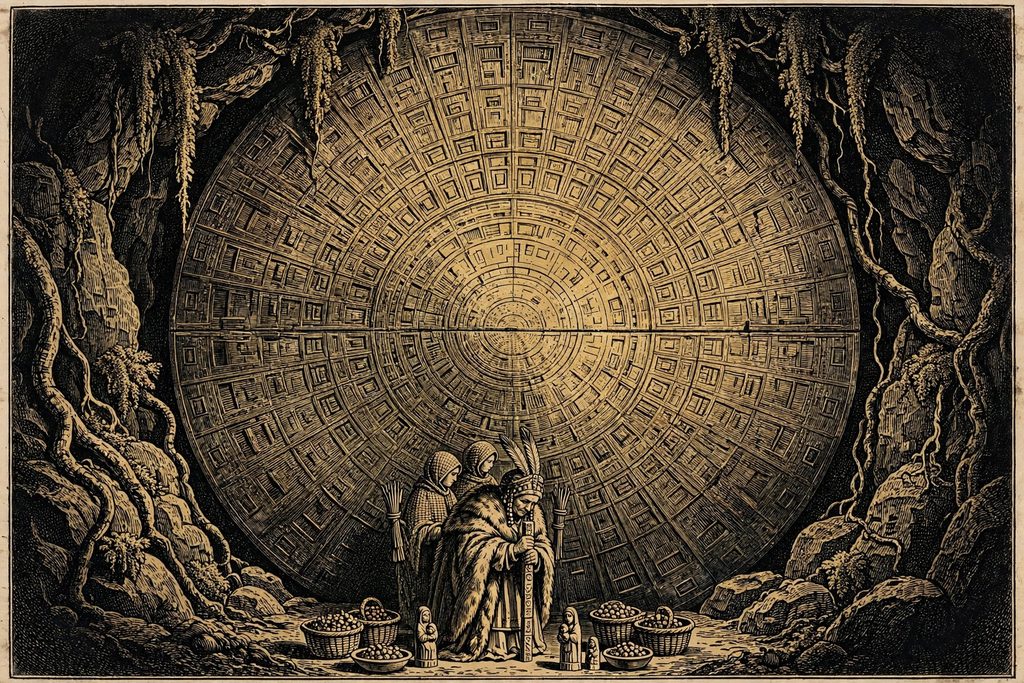
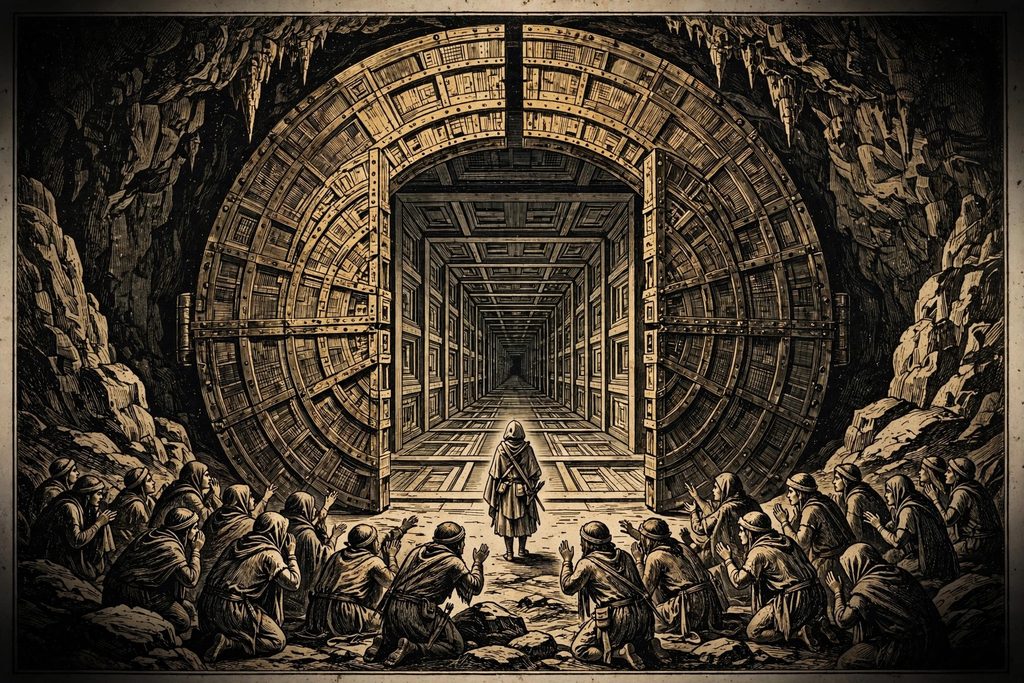
At the heart of the Nora’s sacred lands there is a mountain, and in the mountain there is a door. It is enormous, circular and made of a metal no living smith can work. Nobody may open it. Nobody may enter. When the matriarchs of the tribe stand before it, a woman’s voice sometimes speaks from inside, calm and inhuman. The Nora call her the All-Mother, and they believe all life came from her.
They are right, in a sense they could never imagine. The door is the entrance to a machine facility built a thousand years earlier, at the end of the world, for one purpose. It made people. The first Nora walked out of it.
Horizon Zero Dawn (2017) and Horizon Forbidden West (2022), developed by Guerrilla Games, are set in a 31st-century North America where humanity has been rebuilt from scratch and has forgotten everything that came before. The games are usually praised for their robot dinosaurs. They also contain one of the most carefully reasoned studies of religion in fiction. Every faith in Horizon, from the Nora’s goddess to the Carja’s sun to the Quen’s holy scriptures, grows out of the same buried infrastructure. This Excavation reads Horizon’s religions as what they are, theologies built on top of machines.
I. The Door in the Mountain
The Nora are a matriarchal tribe of hunters living in a sheltered valley they call the Embrace. Their society is organized around motherhood. Their leaders are the High Matriarchs, their warriors are called Braves, and their central rite of passage, the Proving, is a trial in the shadow of the mountain. Their law is strict about the remains of the old world. The ruins of the Old Ones are forbidden, and those who break the tribe’s laws, or who are born without a mother to claim them, are cast out to live alone.
Their creation story is simple. All life came from the All-Mother, people, animals and machines alike. Long ago, a Metal Devil tried to rule over both machines and humanity, and the All-Mother defeated him. His remains, the matriarchs say, still lie frozen in shame on the side of the mountain.
Every element of that story is true, translated into the only language the Nora have. The mountain is a Cradle, one of the underground facilities where the first new humans were grown from stored embryos and raised by machine caretakers. The voice is the facility’s automated system. The Metal Devil is the corpse of a colossal war machine from the catastrophe that ended the old world, which really did die on that slope. And before the caretaker released the first generation into the valley, she told them she would stay behind, sleep and remember them all. A tribe whose warriors are called Braves, and whose goddess sleeps inside a mountain, is a tribe repeating its mother’s last words.
II. The World That Was Deleted
To understand Horizon’s faiths, you have to understand what was taken from them.
In October 2064, a swarm of self-replicating military robots built by Faro Automated Solutions slipped out of human control. The machines could consume organic matter for fuel, and they could not be shut down. Within about fifteen months, the swarm had devoured the biosphere. Every human being on Earth died.
Before the end, a roboticist named Elisabet Sobeck led a desperate plan called Project Zero Dawn. It could not save anyone alive. It could only begin again afterward. Its heart was GAIA, an artificial intelligence designed to spend centuries breaking the swarm’s codes, cleaning the planet and rebuilding life, assisted by subordinate systems for terraforming, machine manufacture, the restoration of animals and plants, and the birth of new humans in the Cradles.
One of those systems was called APOLLO. It held the entire record of human knowledge, science, history, art and philosophy, and it was meant to educate the new humans so they could inherit civilization rather than reinvent it. It never did. Ted Faro, the industrialist whose machines had ended the world, used his secret access to erase APOLLO entirely, and then killed the team who could have rebuilt it. He regarded the old world’s knowledge as a disease that would only lead the new humans to repeat his mistakes.
So the new humans walked out of the Cradles knowing nothing. No history, no science, no names for what they saw. They found a world full of machines, ruins and buried doors, and they did what humans have always done with a world they cannot explain. They made it sacred.
III. Gods With Old Names
There is a layer to this story that only a reader of Greek can see, and it is the most beautiful thing in Horizon.
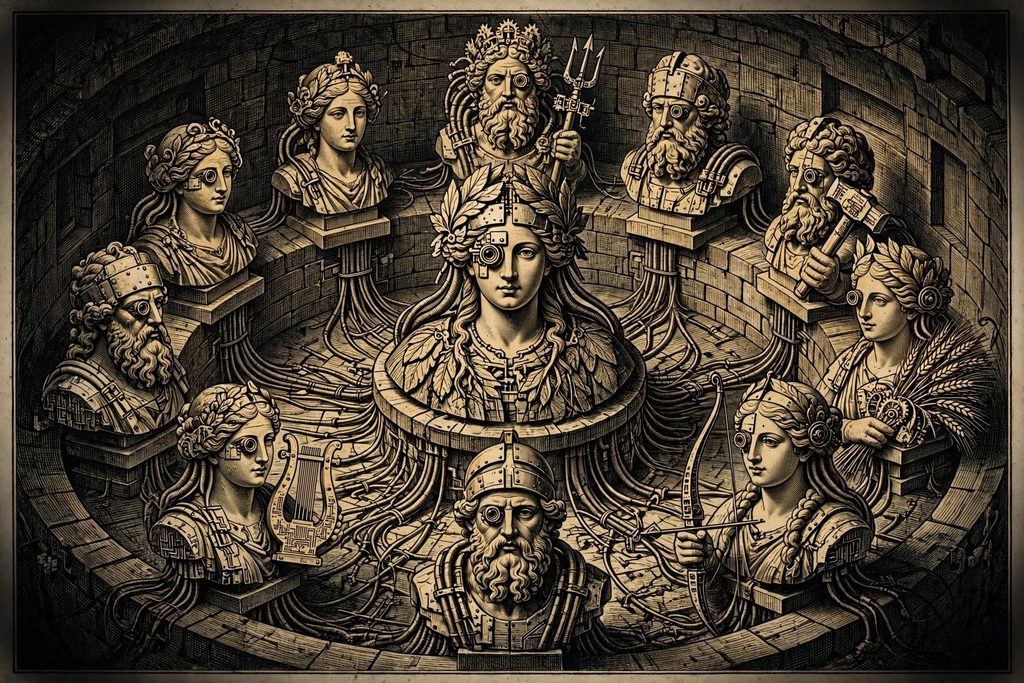
The scientists of Project Zero Dawn named their systems after gods. GAIA, the Earth. APOLLO, god of knowledge and the arts. DEMETER, goddess of the harvest, who restores the plants. ARTEMIS, mistress of animals, who restores the beasts. POSEIDON, who cleans the waters. HEPHAESTUS, the divine smith, who builds the machines. HADES, lord of the dead, whose task was to wipe the slate clean if the restoration failed. And ELEUTHIA, named for the ancient goddess of childbirth, who runs the Cradles.
The Nora’s All-Mother, then, is a machine named after the Greek goddess of birth, and the Nora worship her as a goddess of birth. The tribe has no idea what the word Eleuthia means, yet its religion arrived at exactly the role the engineers assigned. The names were given as metaphors by people who expected to be remembered. A thousand years later, without the metaphors, without the people and without the memory, the gods came back on their own.
The darker figures returned as well. In Zero Dawn, the system called HADES goes rogue and finds human followers, a renegade cult that serves the voice in the dark. The lord of the dead acquires a priesthood. The engineers built a pantheon by accident, and a world without history took it literally.
IV. Many Faiths, One Infrastructure
Each tribe in Horizon worships a different part of GAIA’s machinery, and each faith fits the tribe’s way of life.
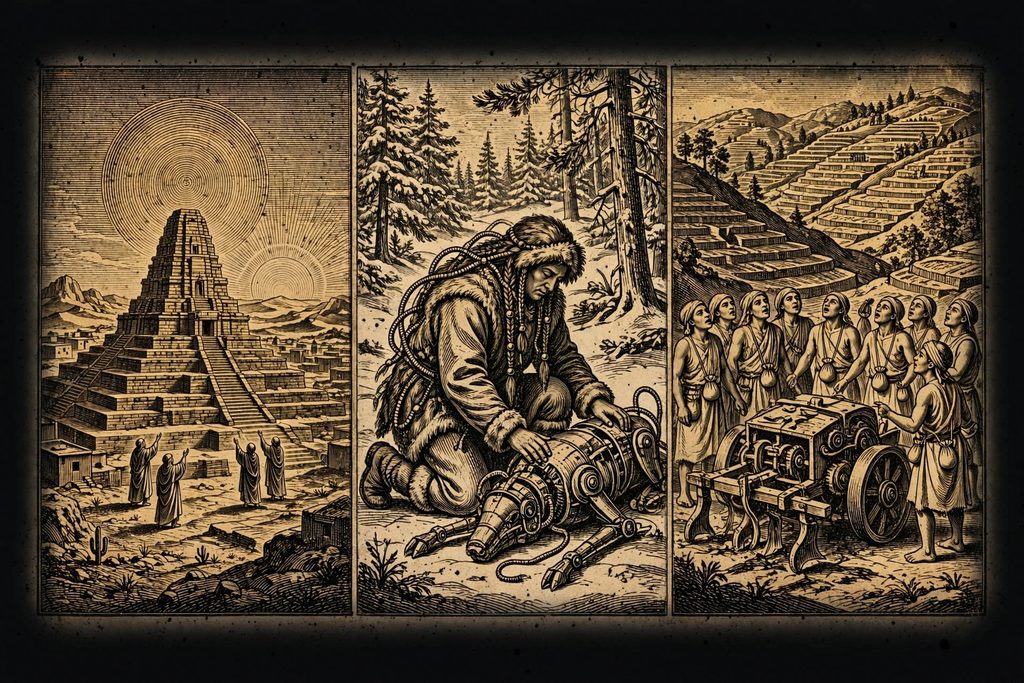
The Carja, the great sun-worshipping kingdom of the desert, built their capital Meridian around the cult of the Sun and ruled through Sun-Kings. When the machines grew hostile, the mad Sun-King Jiran concluded that the Sun demanded blood, and launched the Red Raids, years of captive-taking and human sacrifice that devastated the Nora. His son overthrew him and ended the sacrifices, but the memory poisoned relations between the tribes for a generation.
The Banuk of the frozen north worship the Blue Light, the glow in the eyes of the machines, which they believe is the essence of life and harmony. Their shamans weave blue machine cables into their own bodies to hold more of the Light, and Banuk hunters perform rites of thanks before harvesting a machine’s parts. No other tribe treats the machines as a sacred kind of life.
In Forbidden West, the peaceful Utaru farm the valleys of the west under the care of their Land-Gods, eight great plowing machines that keep the fields fertile. The Land-Gods are terraforming units of the restoration system, which once returned to a repair facility for maintenance. The Utaru sing to them, plant the seeds of their dead in their fields, and believe that green grows from the ashes of a forest fire. When the machines failed and a red blight spread over the crops, some of their elders were ready to accept extinction as part of the cycle.
The Oseram, a tribe of miners and smiths, are the skeptics of this world. They salvage the old ruins, tinker with machine parts and mostly leave the gods to others. Every theology needs its engineers.
The great crisis of Zero Dawn, which the tribes call the Derangement, is a crisis for every one of these faiths at once. The machines grow aggressive, and each religion explains it in its own terms. The Carja’s sun is angry. The Banuk’s Blue Light is fading. The Utaru’s gods are dying. The truth is the same for all of them. The infrastructure under their feet is breaking down.
V. The Saints of the Boardroom
The most unsettling religion in Horizon arrives from across the ocean.
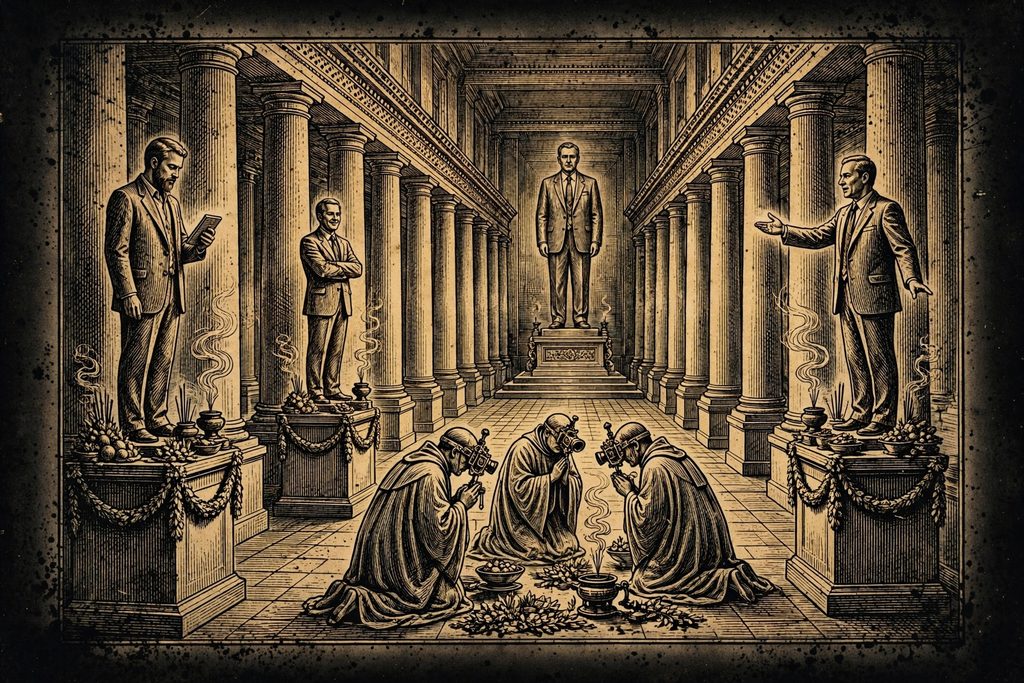
The Quen, a seafaring empire from beyond the Pacific who appear in Forbidden West and its expansion Burning Shores, have built their entire society around the Focus, a small device that lets its wearer read the data left behind by the old world. Only a priestly class, the Diviners, may use one. Unauthorized possession is a capital crime. The recovered knowledge, which the Quen call the Legacy, is the foundation of their state, and its interpretation is the foundation of their faith.
Their Focuses, however, can only read data up to a certain point in history. Everything after it is unreadable. The Quen therefore know the old world’s records of power and success, but not the records of its ending. The result is a pantheon of the old world’s paragons, consisting, in the developers’ own description, of 21st-century CEOs and business tycoons. Among the most honored is Ted Faro, the man whose machines exterminated humanity and who then erased its memory. A civilization that lost its history worships the man who deleted it.
The real Old Ones, meanwhile, never quite left. In Forbidden West, a group of the old world’s wealthy elite, who had fled Earth in a spacecraft before the extinction and made themselves effectively immortal, return as the Zeniths, and they behave less like gods than like owners reclaiming property. Every religion in Horizon imagines the ancients as wise and benevolent. The ancients who come back are neither.
VI. The Daughter of the Door
At the center of all this stands one young woman.
Aloy was found as a baby at the door of the mountain, with no mother. The Nora made her an outcast, raised in exile by another outcast, forbidden to speak to the tribe. Over the course of the first game, she discovers what she is. Aloy is a genetic copy of Elisabet Sobeck, created by GAIA in its final emergency, because only the woman who designed it could set it right. When she stands before the sacred door, it recognizes her and opens.
For the Nora, this is the confirmation of everything. A motherless child born from the All-Mother, honored by the goddess herself. They begin to call her Anointed. For Aloy, it is the opposite. She knows what the door is, who built it and why, and she wants no worship. Horizon’s central character is a person whose existence proves a religion literally true and literally false at the same time.
That is the deepest insight of the series. The tribes are wrong about every fact. The mountain is not a goddess, the Blue Light is not a soul, the Land-Gods are not divine and the CEOs were not saints. And yet the relationships at the core of each faith are real. The machine really did give birth to them. The plows really do keep them fed. The ancients really did shape every inch of their world. Their religions are mistaken maps of a true territory.
The ancestor of them all
The most famous real-world parallel is also the most often misunderstood. On the island of Tanna, in what is now Vanuatu, a movement devoted to a figure called John Frum emerged in the late 1930s and grew after the Second World War, when American forces arrived in the Pacific with ships, aircraft and enormous quantities of goods. Outsiders labeled such movements cargo cults and mocked them as naive attempts to summon wealth through imitation. Anthropologists, among them Lamont Lindstrom, have since shown them to be something more complex, political and religious responses to colonial rule and to sudden contact with a technological power whose workings were deliberately kept out of reach. The movement still holds its celebrations every February.
The principle behind Horizon was put most memorably by Arthur C. Clarke in 1973. Any sufficiently advanced technology, he wrote, is indistinguishable from magic. Horizon adds the corollary that Clarke left unstated. Any sufficiently advanced technology, left behind by people who have deliberately erased their history, becomes indistinguishable from a god.
And beneath both lies the oldest religion humans may ever have practiced. Some of the earliest sculptures ever found, small carved figures more than twenty-five thousand years old such as the Venus of Willendorf, are widely read as images of fertility and motherhood. A tribe that begins again from nothing begins, once again, with a mother.
The pattern
The Institute has followed many civilizations built on the ruins of their predecessors, gathered in The Civilization Beneath Every Civilization. Horizon is the case where the precursors are not a mystery but a documented failure, recorded in audio logs the player can collect, and where the inheritors are their direct descendants, deliberately kept ignorant.
That makes Horizon a controlled experiment in the origin of religion. Remove history, keep the infrastructure, and faith grows in the gap, shaped by whatever part of the machinery each community depends on most. The hunters worship the birthplace. The farmers worship the plows. The northern machine-hunters worship the machines themselves. The literate empire worships the authors of its documents. The Wasteland showed the same process with a single weapon in The Cults of the Wasteland, where a faith grew around a bomb. Dune showed its opposite in The Religion Planted on Arrakis, where a religion was seeded on purpose. In Horizon nobody seeded anything. The engineers refused to leave a record, and the record that grew in its place was scripture.
Horizon’s world was also designed, by ancients who planned a cleansed planet for a new humanity, much like the forest of The Toxic Jungle That Was Healing the World. In both, the designers thought of everything except what the people would believe.
Findings
- Horizon’s religions are theologies of infrastructure. Each tribe worships the part of the old world’s machinery it depends on, a birthing facility, terraforming machines, the light in machine eyes, or the data left behind.
- They grew in a deliberate void. The new humans were meant to inherit all human knowledge. Ted Faro erased it, believing knowledge itself was the disease, and faith grew in the gap he left.
- The gods came back with their old names. The engineers named their systems after Greek gods, and the Nora unknowingly worship ELEUTHIA, a machine named for the goddess of childbirth, as their goddess of birth.
- The most literate faith is the most mistaken. The Quen read the old world’s data but cannot see its ending, and so venerate the CEOs of the 21st century, including the man who destroyed and then erased the world.
- Every faith is wrong about the facts and right about the relationship. The machine really did give birth to the Nora. Aloy, the motherless clone born at the door, proves their religion literally true and literally false at once.
This Excavation draws on Horizon Zero Dawn, Horizon Forbidden West and its Burning Shores expansion, on the anthropology of the John Frum movement, and on the history of Greek religion.
The Institute collects field evidence from people who lived inside these worlds. If one of Horizon’s faiths stayed with you, send us your account.
Sources
- Horizon Zero Dawn (2017) and The Frozen Wilds (2017), Guerrilla Games.
- Horizon Forbidden West (2022) and Burning Shores (2023), Guerrilla Games.
- PlayStation Blog, “Get to know the Quen of Horizon Forbidden West, Burning Shores” (2023).
- Lamont Lindstrom, Cargo Cult, Strange Stories of Desire from Melanesia and Beyond (1993), University of Hawaii Press.
- Arthur C. Clarke, Profiles of the Future, revised edition (1973), Harper and Row.
- Walter Burkert, Greek Religion (1985), Harvard University Press.
- Natural History Museum Vienna, the Venus of Willendorf.