

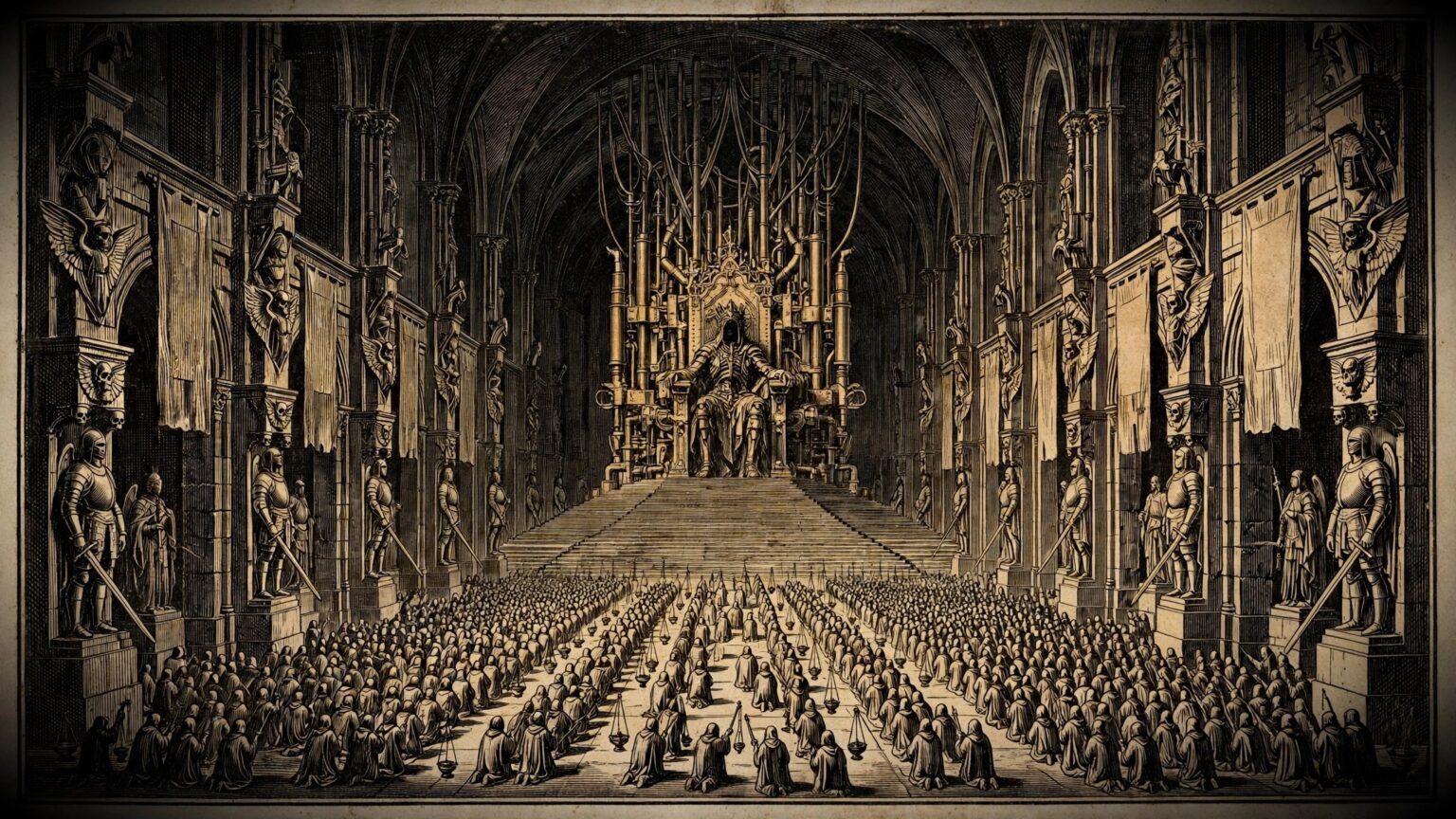
Ten thousand years ago, a man who did not believe in gods conquered the galaxy in the name of reason. He forbade religion across every world he ruled. Then he was mortally wounded in a civil war, placed on a machine that keeps his body from dying, and worshipped as the one true god by a million worlds. The church built in his name is now the most powerful religious institution in fiction, and it prays daily to a corpse that cannot answer.
This is the Imperium of Man, the human empire at the center of Warhammer 40,000, the setting created by Games Workshop and first published in 1987 as the tabletop game Rogue Trader. Over almost four decades it has grown through miniatures, novels, video games and rulebooks into one of the largest fictional universes ever built, famous for a single line of introduction. In the grim darkness of the far future, there is only war.
The Institute has studied religions engineered by their founders in The Religion Planted on Arrakis and a church built on the blood of gods in The Church That Healed Its City With the Blood of Gods. The Imperial Cult is a stranger case still, a faith built around a god who explicitly refused to be one, and who can no longer object.
I. The Corpse on the Golden Throne
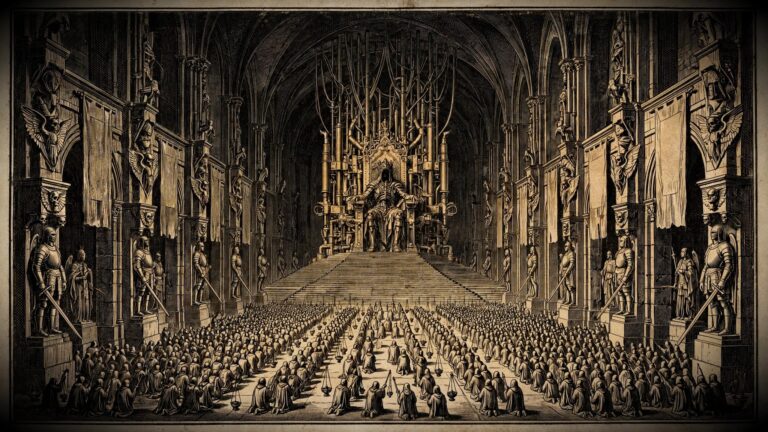
At the heart of the Imperium, on Terra, the ancient homeworld of humanity, sits the Emperor of Mankind. He has not moved, spoken or breathed in ten millennia. His body, ruined in battle, is sustained by the Golden Throne, a vast and ancient machine whose workings are no longer fully understood. To keep him alive, the Imperium feeds the Throne with the souls of psykers, humans born with psychic powers, gathered from across the galaxy by the Black Ships. By most accounts, as many as a thousand die each day.
The Emperor is not merely a relic. He is infrastructure. His mind powers the Astronomican, a psychic beacon that allows starships to navigate the Warp, the chaotic dimension through which faster-than-light travel passes. Without it, the empire’s ships would be lost and its worlds cut off from one another. His mind also holds back, it is believed, the powers of Chaos that wait in the Warp. If the Emperor truly died, the Imperium might collapse within a generation.
This is the first and most important fact about the Imperial Cult. Its god is a body kept alive by sacrifice, and its worship is not simply belief. It is a matter of survival. The Imperium does not pray to the Emperor because it hopes he exists. It prays because it cannot afford for him to die.
II. The God Who Forbade Gods
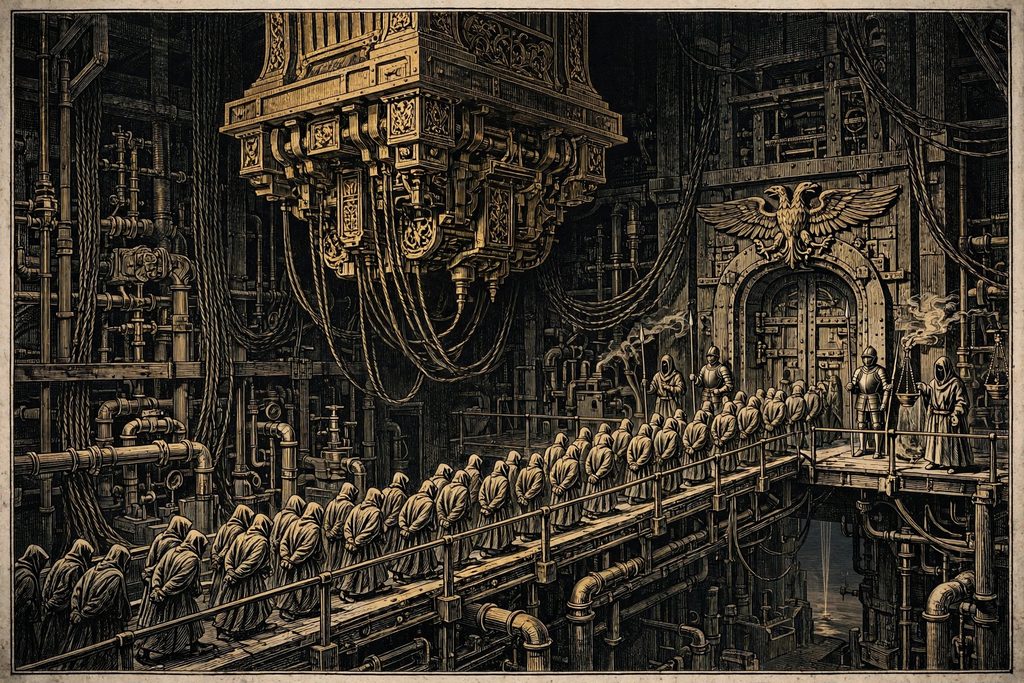
The great irony of the Imperial Cult lies in its origins. Before his fall, the Emperor led the Great Crusade, a campaign to reunite the scattered worlds of humanity after a dark age known as the Age of Strife. His ideology was called the Imperial Truth. It was secular and rationalist. Religion, the Emperor taught, was superstition, and superstition was dangerous, because belief itself could feed the powers of the Warp. His armies burned temples on the worlds they conquered. He denied, repeatedly and publicly, that he was a god.
Some refused to listen. Lorgar, one of the Emperor’s own sons, the superhuman generals called Primarchs, built cathedrals to his father and wrote a holy book proclaiming his divinity. The Emperor rebuked him publicly and ordered his greatest city destroyed. The humiliation helped drive Lorgar toward the gods of Chaos, and he became one of the architects of the civil war that ended the Emperor’s life as a man. Meanwhile, among ordinary soldiers and citizens, a secret text called the Lectio Divinitatus spread from hand to hand, teaching that the Emperor was a god whether he admitted it or not.
After the Emperor was placed on the Golden Throne, the forbidden faith won. Within a few centuries, the worship of the Emperor had become the state religion of the entire Imperium. The man who outlawed gods had become the god of a million worlds, and he could no longer say no.
III. The Ministorum
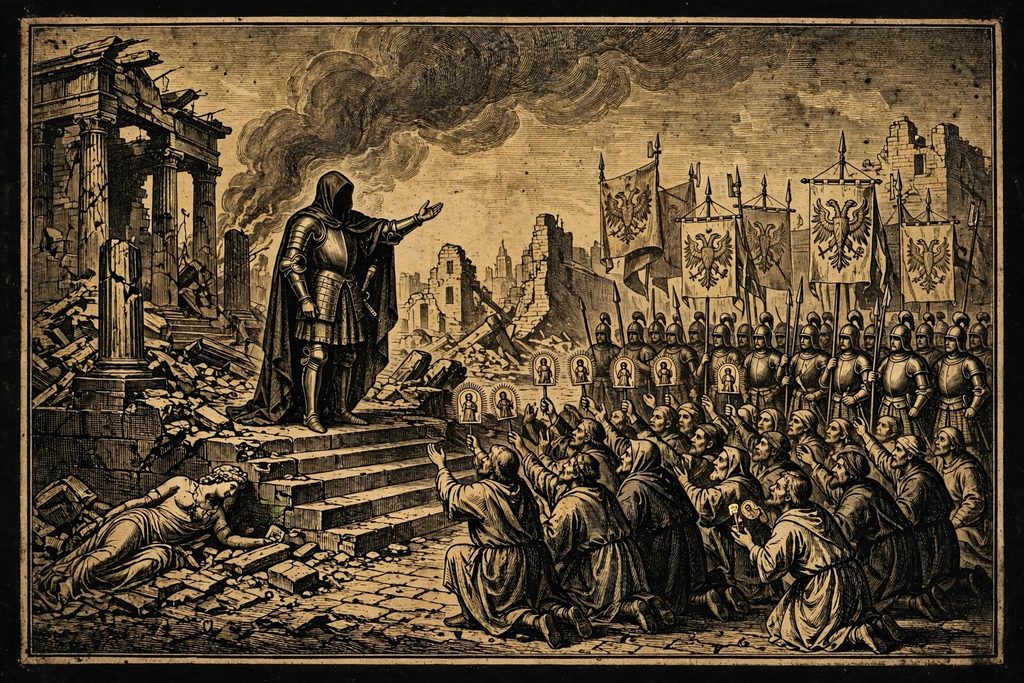
The church of the Emperor is the Adeptus Ministorum, usually called the Ecclesiarchy. Its leader, the Ecclesiarch, sits among the High Lords of Terra who govern the Imperium in the Emperor’s silence. Below him spreads a hierarchy of cardinals, bishops, confessors, preachers and missionaries reaching across a million worlds. Its cathedrals cover entire continents. Some planets, called shrine worlds, exist only as places of worship and pilgrimage.
The Imperial Creed is one faith in name, but it is practised in thousands of local forms. On one world the Emperor is a sun god, on another a warrior king, on another a stern judge of souls. The Ecclesiarchy tolerates these variations as long as the central truth is kept, that the Emperor is god and the Imperium is his will. Its preachers march with armies, its missionaries convert newly discovered worlds, and its saints, mortals believed to have been touched by the Emperor’s power, are venerated in shrines and relics across the galaxy.
What makes the Ministorum fascinating to a student of religion is that its miracles may be real. In the Warp, belief has power. The faith of billions may itself be strengthening the Emperor, or creating a god where there was only a man. Living saints appear in battle and perform impossible deeds. The Imperial Cult began as a mistake, but in a universe where belief shapes reality, a mistake repeated by a trillion people may become true.
IV. The Reign of Blood
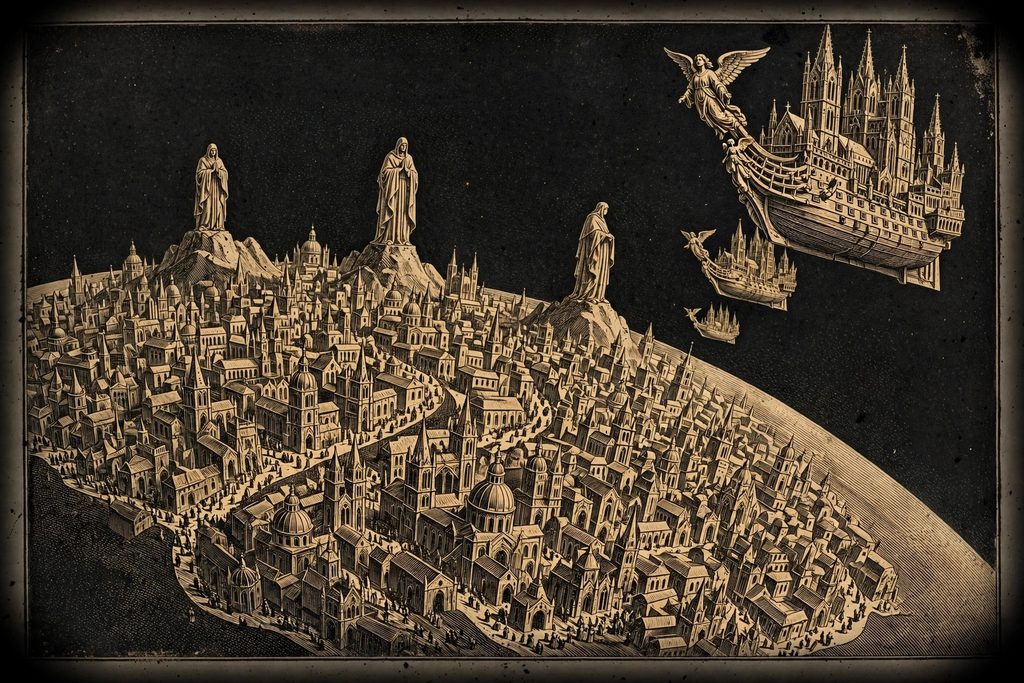
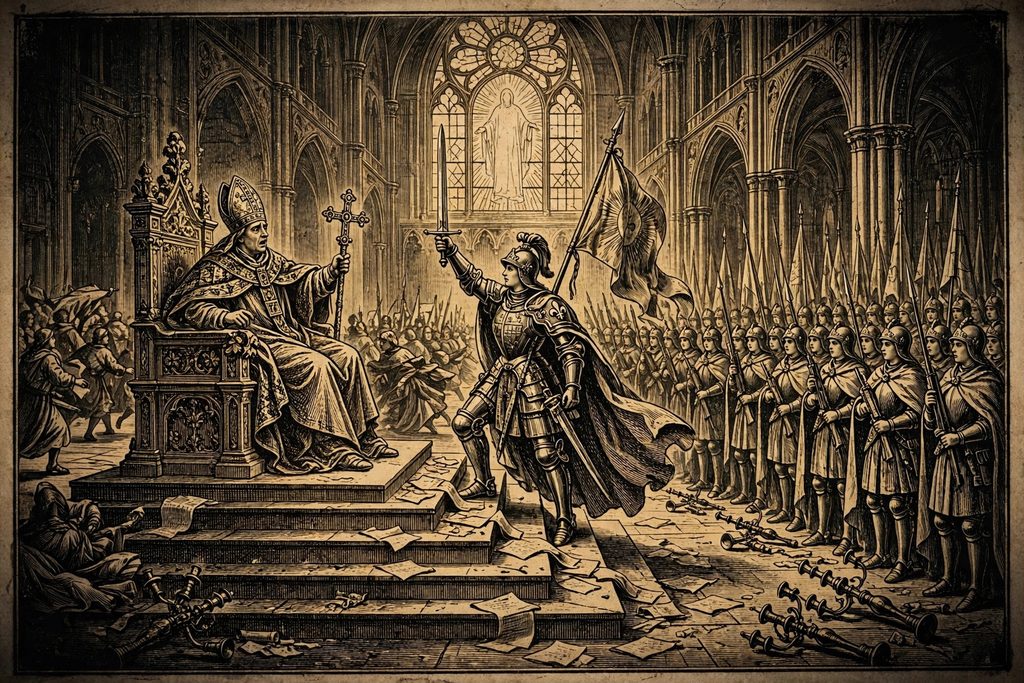
The Ecclesiarchy’s power once grew so great that it nearly destroyed the Imperium. In the thirty-sixth millennium, during a period remembered as the Age of Apostasy, a single man named Goge Vandire made himself master of both the Administratum, the Imperium’s vast bureaucracy, and the Ecclesiarchy. His rule, known as the Reign of Blood, was a theocratic tyranny of purges, executions and madness, enforced by armies loyal to the church.
It ended through a reformation. A preacher named Sebastian Thor led a popular movement against Vandire’s corruption, the Emperor’s own guardians turned against the tyrant, and Vandire was executed by the leader of an order of warrior women he had once controlled. The reformed Ecclesiarchy was then bound by a new law, the Decree Passive, which forbade it to maintain men under arms. The church would never again command its own army.
The church found its way around the law with remarkable precision. It could not keep men under arms. So it kept women. The orders of the Adepta Sororitas, the Sisters of Battle, became the Ecclesiarchy’s armed force, fierce, devout and technically legal. It is one of the most realistic details in the whole setting, a perfect portrait of how institutions survive the rules imposed to restrain them, by obeying them to the letter.
V. The Machine God
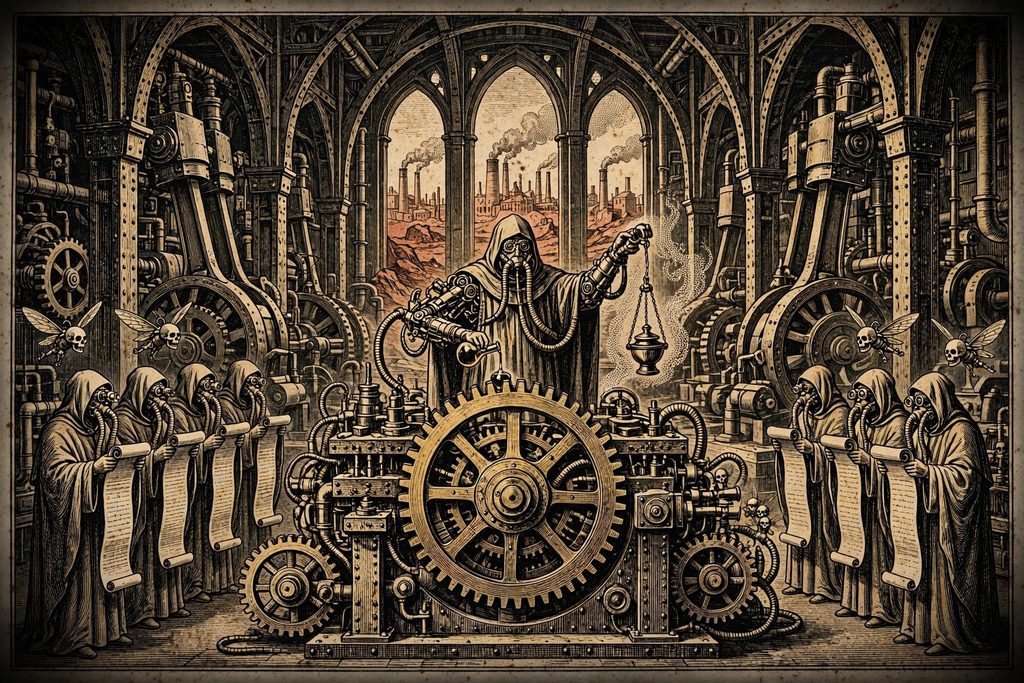
The Imperial Cult is not the only faith of the Imperium. On Mars, the ancient forge world, lives a second church, the Adeptus Mechanicus, the priesthood of technology. Its members worship the Machine God, the spirit of all knowledge and all machines, and believe that every device contains a machine spirit that must be honoured. Its tech-priests replace their flesh with metal, anoint engines with sacred oils, chant litanies before starting a reactor and treat engineering as liturgy.
The Mechanicus and the Imperium are bound by an ancient treaty. The Mechanicus accepted the Emperor’s rule on one condition, that he be recognized as the Omnissiah, the living avatar of the Machine God. Two religions thus meet in the same figure on the Golden Throne. For the Ecclesiarchy, the Emperor is the god of humanity. For the Mechanicus, he is the god of machines. Neither fully accepts the other’s theology, and neither can afford to say so.
The Machine Cult has a consequence that shapes the whole Imperium. Because knowledge is sacred, innovation is suspect. New inventions are treated as possible heresy. Tech-priests search the galaxy for Standard Template Constructs, ancient design databases from humanity’s golden age, rather than design anything new. A civilization that crosses the stars has forbidden itself to progress, and its science has become a form of archaeology.
VI. The Son Who Remembered
The most dramatic recent turn in the history of the Imperium came with the return of a figure from the time before the faith. In 2017, Games Workshop advanced the story into the forty-second millennium. A catastrophe tore the galaxy in two with a vast rift in reality, and Roboute Guilliman, one of the Emperor’s sons, was revived after ten thousand years in stasis to lead the Imperium as its Lord Commander.
Guilliman knew his father as a man. He remembered the Imperial Truth, the burning of temples and the Emperor’s contempt for religion. He returned to find his father worshipped in cathedrals, his name invoked in prayers, his image on every altar, and the church he would have forbidden grown into one of the pillars of the state. For the first time, the Imperium’s faith had to face someone who had known its god before he became one.
And yet Guilliman cannot abolish the Cult. The faith holds the Imperium together, gives its soldiers courage and binds a million worlds that have nothing else in common. Whatever the Emperor wanted, the Imperium needs a god. The returned son must govern an empire built on a belief he knows to be, at least in its origins, untrue. It is one of the most honest pictures of religion and power in modern fiction.
The ancestor of them all
The worship of a ruler as a god was not invented in the far future. It was one of the great institutions of the ancient Mediterranean, and Rome made it the religion of an empire.
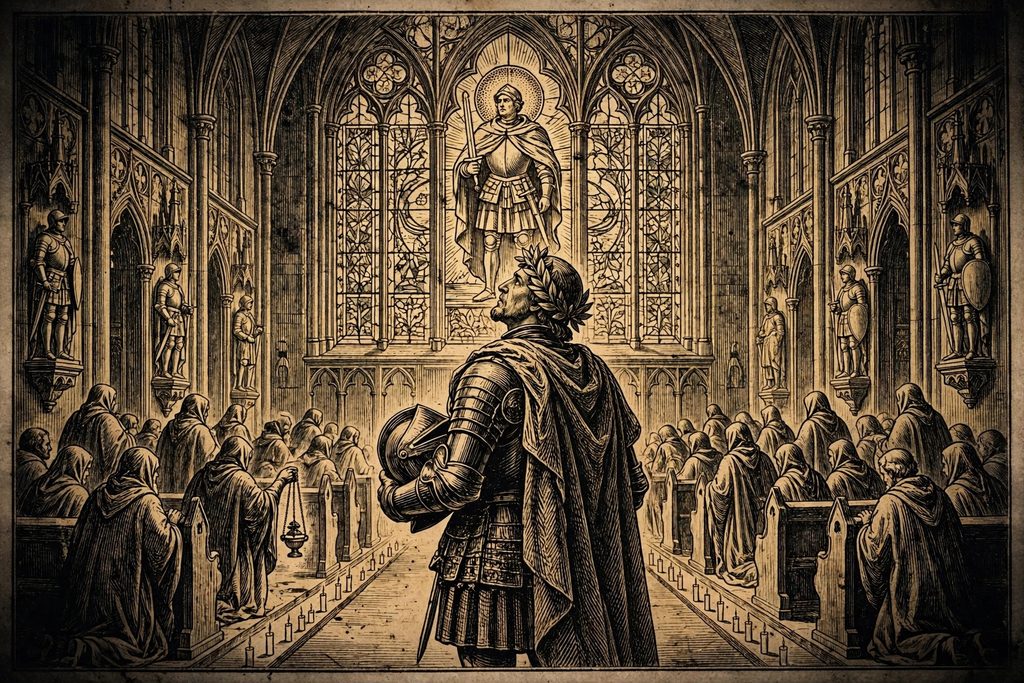
Alexander the Great was honoured as a god in his own lifetime, and the Hellenistic kings who divided his empire, the Ptolemies of Egypt and the Seleucids of Asia, received cults, temples and priests. Rome adopted the practice cautiously. After the assassination of Julius Caesar, a comet appeared in the sky during the games held in his honour, and it was taken as a sign that his soul had joined the gods. In 42 BCE he was officially deified. His adopted son Augustus was worshipped across the provinces in his lifetime and declared a god by the Senate after his death. From then on, emperors who died in favour were consecrated as divi, divine ones, with temples and priests of their own.
The Romans were not always solemn about it. The historian Suetonius reports that the emperor Vespasian, feeling death approach, remarked, “Alas, I think I am becoming a god.” The cult was political as much as religious. Around 112 CE, Pliny the Younger, governor of Bithynia, wrote to the emperor Trajan explaining how he tested people accused of being Christians. He asked them to offer incense and wine before the emperor’s image. Refusal to honour the emperor was treated as disloyalty to the state itself.
The modern world produced its own version. In 1924, the body of Vladimir Lenin was embalmed and placed on public display in a mausoleum in Moscow’s Red Square, where it remains a century later, the preserved body of a man who rejected religion displayed for the veneration of a state built in his name. The Imperium of Man combines all of these, a ruler made into a god against his own principles, a cult that measures loyalty to the state, and a body preserved forever at the center of the empire.
The pattern
The Imperial Cult belongs to a family the Institute calls the god-emperors, fictional religions centered on a ruler who becomes, willingly or not, the object of worship. Their most famous relative is Leto II in Frank Herbert’s God Emperor of Dune, who chooses to become a god and rules for three and a half thousand years. The Institute has met others, from the Tribunal of The Living Gods of Morrowind to the Pale King of The Kingdom That Tried to Forget Its God.
Three features define these religions. The first is a ruler made divine, by his own design, by his followers or by the needs of the state. The second is a church that grows around him and outgrows him, developing its own hierarchy, politics and interests. The third is the god as infrastructure, a divinity whose survival is tied to the functioning of the world, whether through a Golden Throne, a dead god’s heart or a kingdom’s seal.
What sets the Imperium apart is the depth of its contradiction. The Pale King demanded worship. Leto II engineered it. The Emperor of Mankind forbade it, and was worshipped anyway, and the worship may now be keeping him alive. Warhammer 40,000 offers no clear answer about whether the Imperial Cult is true. It offers something more unsettling, the suggestion that in a universe where belief has power, a lie told long enough by enough people may become a god.
Findings
- The Imperium worships a body kept alive by sacrifice. The Emperor of Mankind has sat on the Golden Throne for ten thousand years, sustained by the souls of psykers and powering the Astronomican that holds the empire together.
- Its god forbade religion. The Emperor’s Imperial Truth was secular and rationalist, and he rejected his own son Lorgar’s worship, yet after his fall the forbidden faith became the state religion.
- Its church outgrew its god. The Ecclesiarchy governs from among the High Lords of Terra, covers entire worlds with cathedrals and once seized the whole Imperium during the Reign of Blood.
- Its institutions survive by obeying the letter of the law. Forbidden to keep men under arms after the Age of Apostasy, the church armed women instead, creating the Sisters of Battle.
- Its ancestors are the ruler cults of antiquity. From the deified Caesar and Augustus to Vespasian’s dying joke and Pliny’s loyalty test, Rome made worship of the emperor a measure of loyalty to the state.
This Excavation draws on the Warhammer 40,000 rulebooks, codexes and novels published by Games Workshop and the Black Library, on Suetonius, Pliny the Younger and the history of the Roman imperial cult, and on the history of Lenin’s mausoleum.
The Institute collects field evidence from people who have lived inside these worlds. If you have spent years painting the armies of the Imperium, send us your account of the faith they fight for.
Sources
- Warhammer 40,000, Rogue Trader (1987), Games Workshop, and later editions to the tenth (2023).
- The Horus Heresy and The Siege of Terra novel series (from 2006), Black Library.
- Suetonius, The Lives of the Caesars, Vespasian 23 (early second century CE).
- Pliny the Younger, Letters 10.96, to the emperor Trajan (c. 112 CE).
- Simon Price, Rituals and Power, The Roman Imperial Cult in Asia Minor (1984), Cambridge University Press.
- Nina Tumarkin, Lenin Lives! The Lenin Cult in Soviet Russia (1983), Harvard University Press.