

EXCAVATION Nº 0028 · EXTINCT WORLDS
World: Hallownest, Hollow Knight
Period: The age of the Pale King to the fall (in-world)
Status: Extinct
Medium: Game
Polity: Monarchy, Theocracy
Origin: Revelation, Ruins
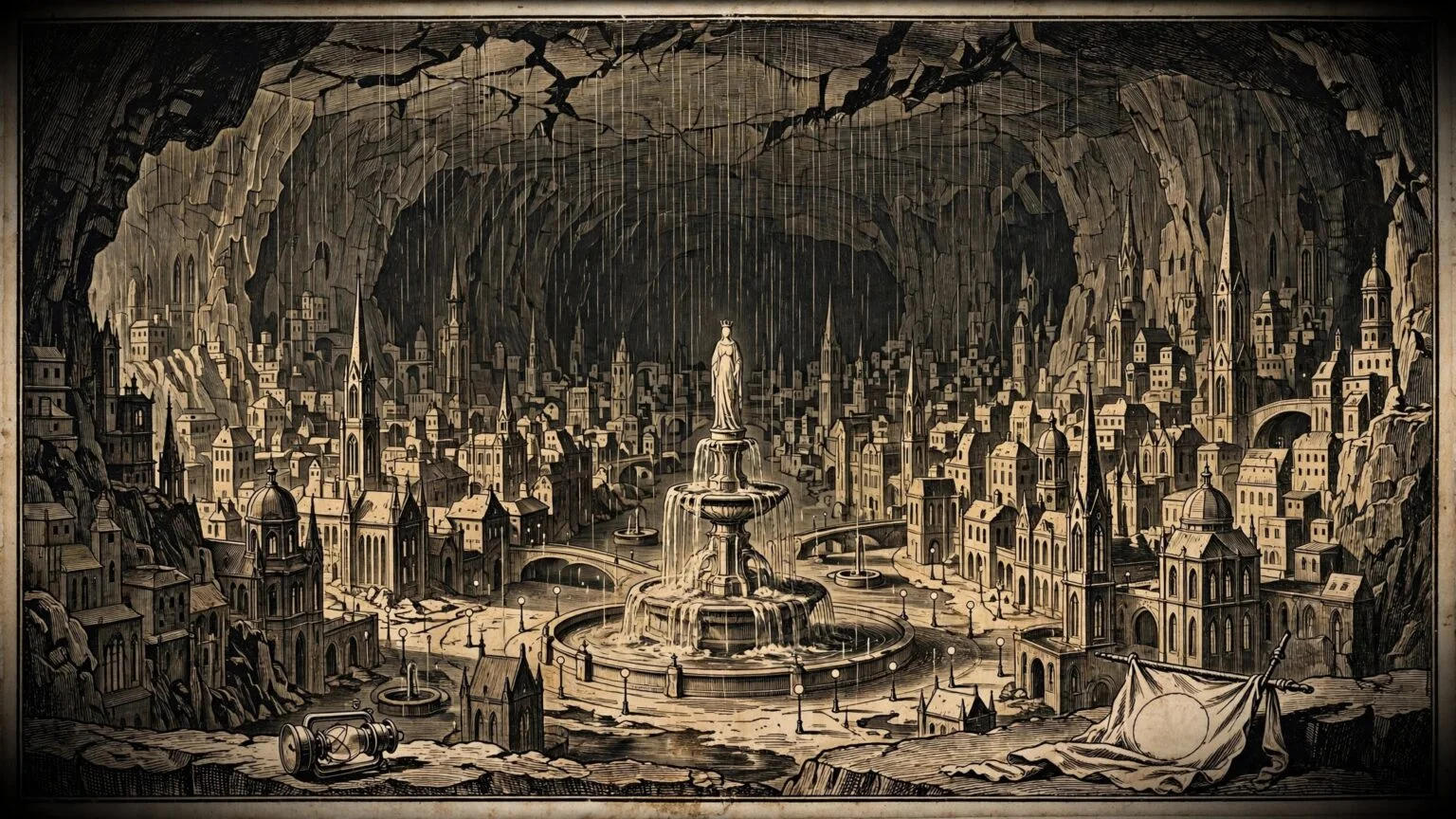
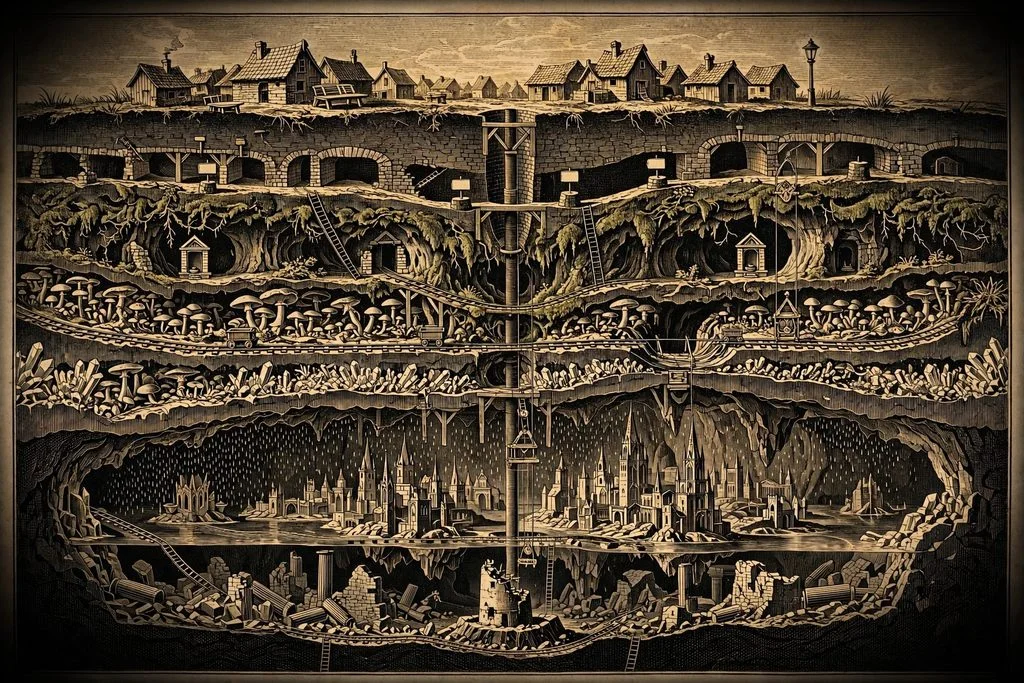
Beneath a small, half-empty town called Dirtmouth lies the corpse of a kingdom. Its roads still run for miles under the earth. Its capital still stands in a cavern where it has rained for longer than anyone remembers. Its statues still show a pale king with a crown of horns. And almost everyone who lived there is dead, mad or wandering the tunnels with orange light in their eyes.
This is Hallownest, the setting of Hollow Knight, released in 2017 by Team Cherry, a three-person studio in Adelaide, Australia. It is a world of insects, drawn like a children’s book and written like a tragedy, and it tells its history almost entirely through ruins. There are no history lessons. There are tablets, statues, scraps of journals and the memories of the few survivors, and the player pieces the story together the way an archaeologist would.
The Institute has studied faiths built around forgotten machines in The Tribe That Worshipped a Machine’s Door. Hallownest is the reverse case. It is a civilization that chose to forget a god, and the god did not accept it. This Excavation reconstructs how the kingdom was built, what it tried to bury and why the burial failed.
I. The Kingdom Beneath Dirtmouth
The game opens on the surface. A silent wanderer arrives in Dirtmouth, where an old bug called Elderbug sits alone by the road and almost every house is empty. Below the town, a well leads down into the Forgotten Crossroads, once the busiest junction of an underground empire. From there the kingdom unfolds in every direction. Greenpath with its overgrown shrines. The Fungal Wastes. The great mines of Crystal Peak. The spider nest of Deepnest. The City of Tears.
Each region was once a living province with its own people and purpose. Now each is a ruin, and the player’s map of it has to be bought from a wandering cartographer named Cornifer, who sketches the kingdom as he explores it. Even the map is an act of excavation.
What makes Hallownest unusual is its depth in time. The kingdom of the Pale King is only the most recent layer. Under it, in the darkest place in the world, lie the remains of an older civilization that worshipped the Void, the living darkness at the bottom of the earth. Hallownest was built on ruins, and it became a ruin itself.
II. The Pale King’s Gift
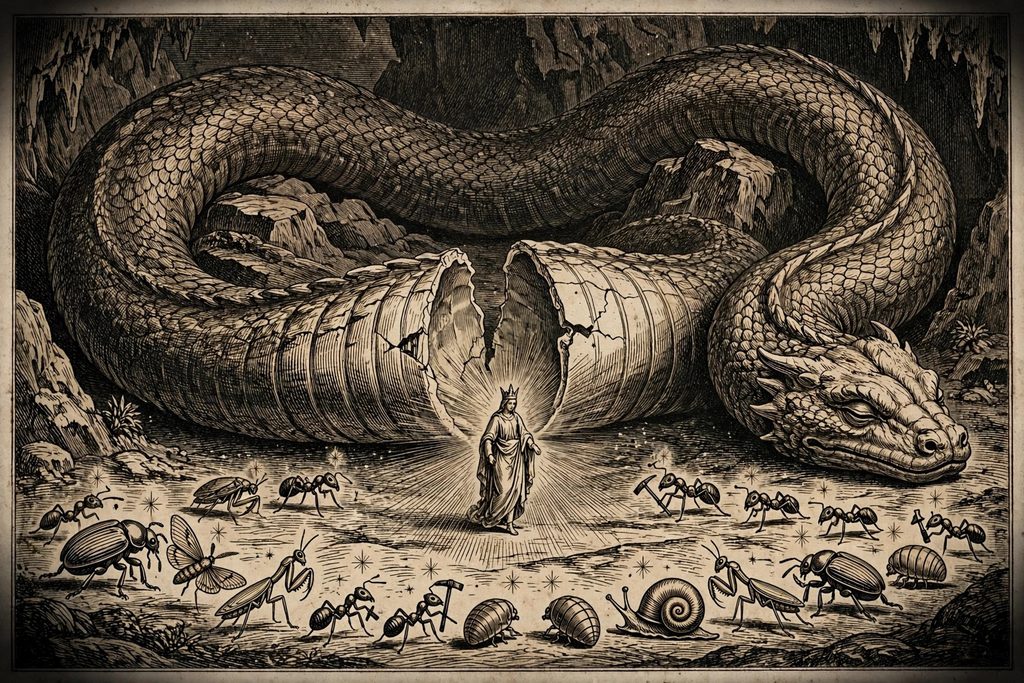
Hallownest began with a death and a birth. In the region now called Kingdom’s Edge, a colossal Wyrm, one of the higher beings of this world, came to the end of its life. From its body emerged a small pale figure who would become the Pale King. He did not conquer the bugs of the land with armies. He gave them minds. Species that had lived by instinct gained thought, language and self-awareness, and in return the Pale King asked for what gods usually ask for. He asked to be worshipped.
The kingdom that followed was a theocratic monarchy in the most literal sense. Its ruler was a god, and its order was his gift. He ruled alongside the White Lady, a being of great power rooted in the Queen’s Gardens, and his image was carved everywhere, on fountains, gates and the highest point of the kingdom. The tribes of the land accepted his rule in different ways. The Mushroom Clan joined the kingdom. The Mantis Tribe kept a truce and guarded its border against the beasts of Deepnest. The bees of the Hive and the spiders of Deepnest kept their distance.
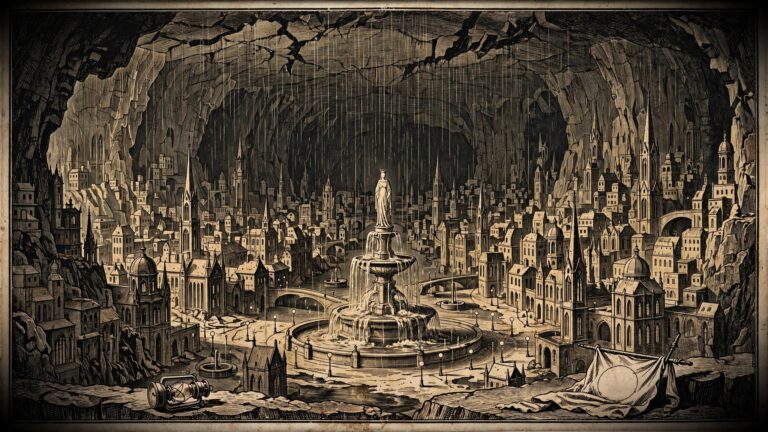
Its capital was the City of Tears, built in a vast cavern beneath a lake, where water pours endlessly through cracks in the roof. Everything about the city speaks of a confident civilization. There are grand halls, a tower for the Watcher who kept an eye on the city, archives, baths and stores. It was built by a society that believed its king had given it everything, and that the gift would last forever.
III. The God They Forgot
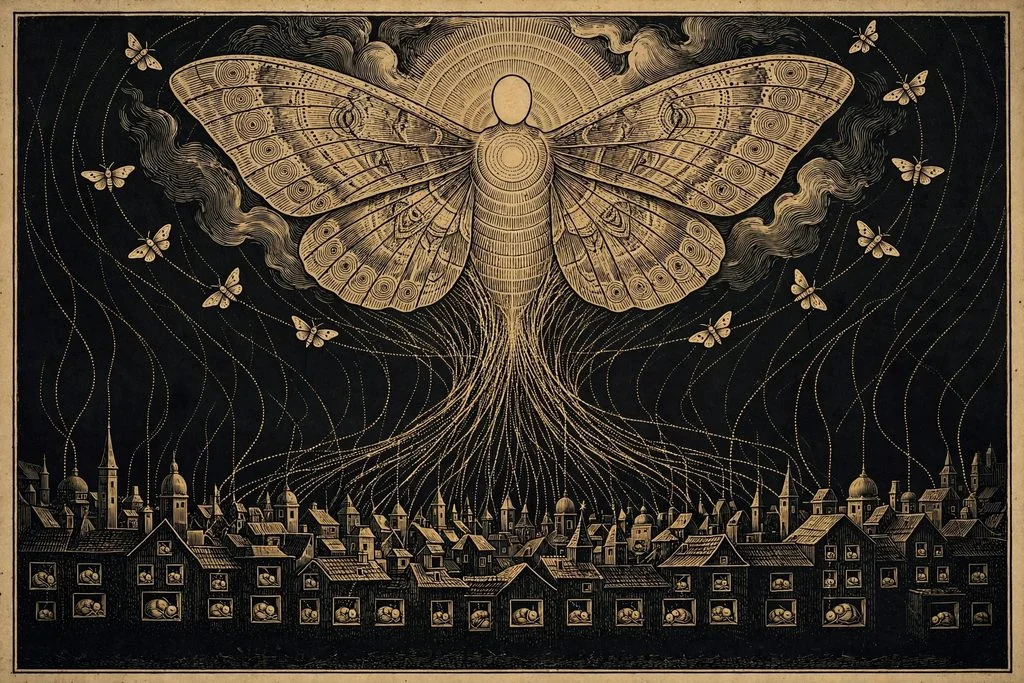
Before the Pale King, the land had another god. The Radiance was a higher being of light, worshipped by the moth tribe that she had made. When the Pale King came, the moths abandoned her and bowed to him. Over generations, the bugs of Hallownest forgot she had ever existed. Her memory survived only in fragments, in the old customs of the moths and in a statue on the summit of the kingdom.
But the Radiance was not dead. She lived on in dreams, the one realm the Pale King did not rule. She tried to return to the minds of the bugs that had forgotten her, and they resisted. Her return took the form of the Infection, a plague of orange light that spread through dreams. Infected bugs lost their minds and wills, their bodies filled with glowing orange matter, and they kept moving after death, walking the roads they had walked in life.
This is the darkest idea in Hallownest’s history. The Infection is not a disease in the ordinary sense. It is a god’s memory forcing its way back into minds that had been taught to forget it. The kingdom’s greatest gift, thought itself, became the channel through which it was destroyed. The last moth in the kingdom, an old seer living among the graves of the Resting Grounds, still remembers the light her people abandoned, and she is the only one who can teach the player to enter dreams.
IV. No Cost Too Great
The Pale King’s answer to the plague was as radical as anything a ruler has ever attempted in fiction. If the Radiance could enter any mind, she would have to be sealed inside a being with no mind at all. With the White Lady, he produced a generation of children called Vessels, filled with Void, the living darkness from the bottom of the world. They were born in the Abyss, and they were meant to be empty. “No mind to think. No will to break. No voice to cry suffering,” the king’s words declare over their birthplace.
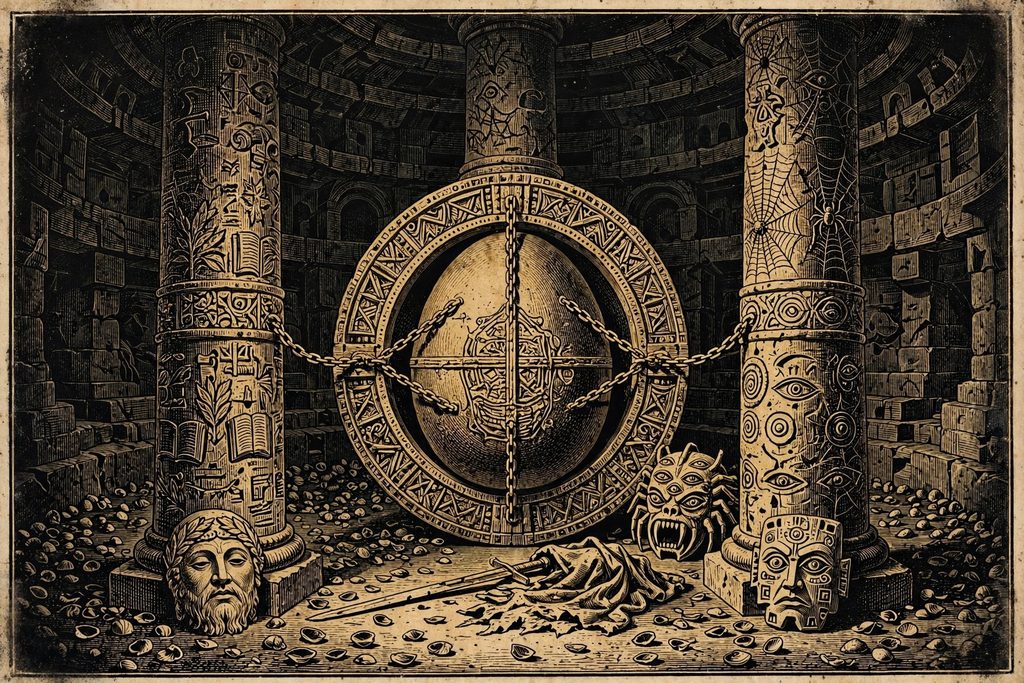
Most of them failed the test. Those that showed any trace of a self were abandoned in the Abyss, and their broken shells still cover its floor in uncountable numbers. One was judged pure. It was raised in the White Palace and became the Hollow Knight, and the Radiance was sealed inside it, in a chamber called the Temple of the Black Egg. To keep the seal closed, three great figures of the kingdom agreed to sleep forever as the Dreamers. Monomon the Teacher, the city’s great scholar. Lurien the Watcher, who kept the spire above the capital. And Herrah the Beast, the queen of Deepnest, who demanded a price for her sleep. She asked the king for a child, and that child was Hornet, who grew up to become the guardian of the ruined kingdom.
The seal held for a time, and then it did not. The Hollow Knight was not truly hollow. The Infection returned, and the Pale King, the god who had promised his people everything, vanished from his kingdom and hid his palace in the realm of dreams. Hallownest was left alone with its plague. The phrase most associated with his decision has become the epitaph of the whole kingdom. No cost too great.
V. The Relic Seekers
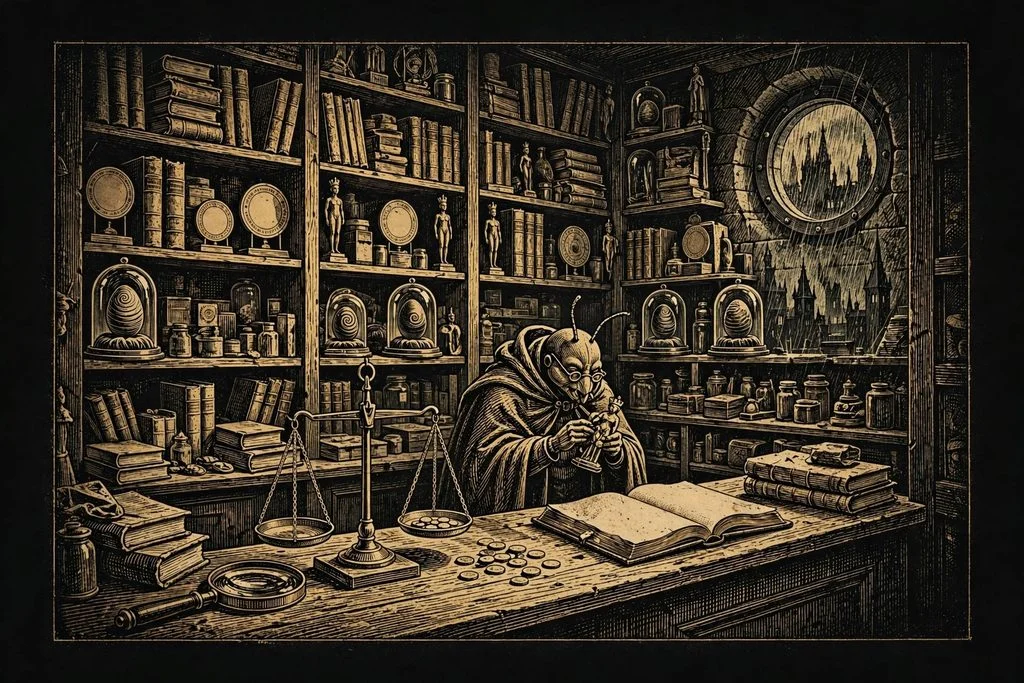
Hollow Knight contains its own archaeologists. In the City of Tears lives Relic Seeker Lemm, a collector devoted to the kingdom’s past, who buys the relics the player finds in the ruins. There are four kinds. Wanderer’s Journals, the scattered notes of travellers who came to Hallownest after the fall. Hallownest Seals, the official emblems of the old state. King’s Idols, small statues of the Pale King. And Arcane Eggs, strange objects from the age before the kingdom, relics of the civilization that came first. Lemm values them in that order, from the recent to the ancient, as a museum would.
The player’s whole journey works the same way. History is not told. It is found. Inscribed tablets along the roads record fragments of royal decrees and old warnings. A Hunter’s Journal turns every creature encountered into a field entry. The Dream Nail, the tool the old moth gives to the player, lets them read the last thoughts of the dead and the dreaming, which is the nearest thing in fiction to interviewing the past. The mapmaker sells maps of places he has only just seen. The kingdom has no historians left, so the player becomes one.
This design is one of the reasons Hollow Knight became a landmark. Its players have spent years reconstructing the order of events, the identity of the Void civilization and the meaning of each statue and tablet. Hallownest’s history now exists mostly in their wikis, essays and debates, the way the history of a real lost kingdom exists in the arguments of scholars.
VI. A Kingdom Beyond Saving
Hollow Knight offers several endings, and none of them restores Hallownest. In one, the wanderer takes the Hollow Knight’s place as the new vessel and seals the Radiance again, repeating the king’s solution for another generation. In another, Hornet joins the seal, and the cycle continues with one more sacrifice. In the hardest ending, the player calls up the Void itself, the darkness of the oldest civilization, and destroys the Radiance outright. The plague ends. The kingdom does not come back.
That is the quiet verdict of the game. Hallownest’s fate was decided long before the player arrived. The kingdom was built on a gift that came with a price, and it fell when it tried to pay that price with silence. Even the victory over the old god is won with the power of the civilization that came before Hallownest, as though the deep past had to return to end the conflict the kingdom created.
The story continued in 2025 with Hollow Knight Silksong, in which Hornet is taken to a new kingdom called Pharloom. Hallownest itself remains what it was at the end of the first game, a ruin full of statues to a king who abandoned it, guarded by survivors who remember fragments of what it used to be.
The ancestor of them all
The story of a king who replaced the old gods with a new one, built a shining capital for his faith and was then erased from memory has a real ancestor, and it lies on the banks of the Nile.
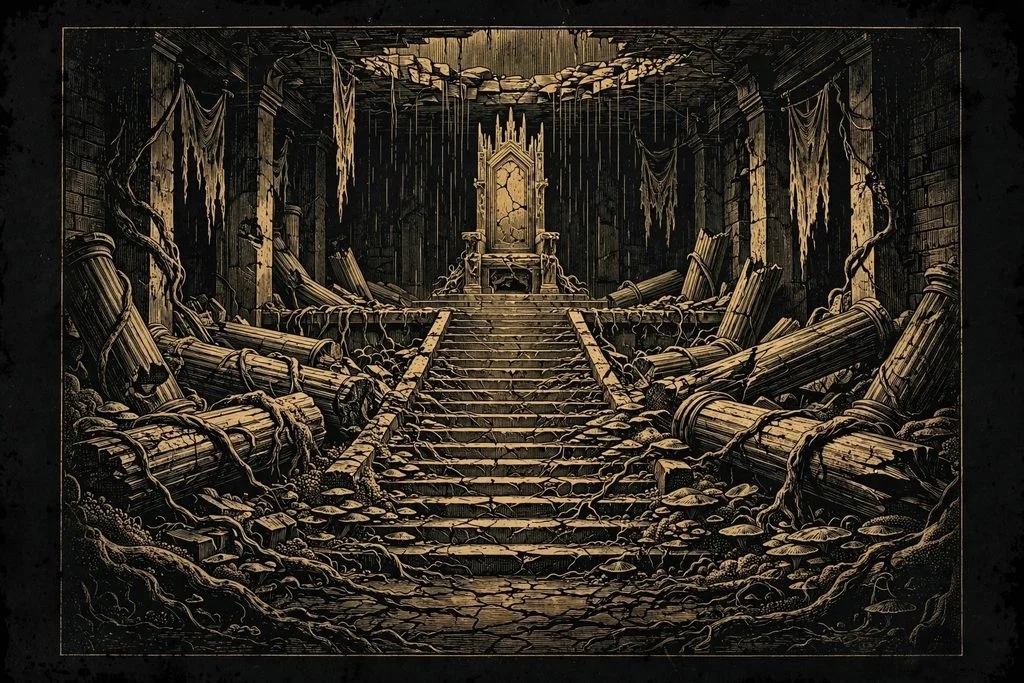
In the fourteenth century BCE, the Egyptian pharaoh Amenhotep IV changed his name to Akhenaten and turned the religion of his country upside down. He raised the Aten, the disc of the sun, above all other gods and pushed aside the great god Amun and his powerful priesthood. Akhenaten presented himself as the Aten’s son and the only true channel to it, a god-king in the full sense. He founded a new capital in the desert, Akhetaten, now known as Amarna, and filled it with open-air temples to the light.
It did not last. After his death, the court returned to the old capitals and the old gods. His successor Tutankhaten, probably his son, changed his name to Tutankhamun, honoring Amun again, and a decree from his reign known as the Restoration Stela describes a land in distress, its temples in ruin, its gods turned away from Egypt. Akhetaten was abandoned within a generation. Later kings dismantled its monuments and left Akhenaten out of the official lists of rulers. In later documents he was not named at all, only alluded to as the enemy of Akhetaten.
The parallel with Hallownest is close, though the roles are reversed in a revealing way. In Egypt, the new light failed and the old gods returned. In Hallownest, the old light returned and the new god-king fled. In both, a ruler tried to redirect the faith of an entire people toward himself, in both the older devotion did not die, and in both the result was an empty capital. Amarna was rediscovered in the nineteenth century, when the clay tablets of its diplomatic archive, the Amarna Letters, were found in 1887. Its history, like Hallownest’s, was reconstructed from what its people left behind.
The pattern
Hallownest belongs to a family of fictional civilizations the Institute calls ruin kingdoms, worlds that are already dead when the player arrives and that tell their history only through what remains. Their most influential ancestor in games is Dark Souls, released in 2011, whose Lord Gwyn sacrificed himself to prolong the Age of Fire rather than let it end. The Lands Between of Elden Ring, studied by the Institute in The Message Culture of the Lands Between, continue the same tradition.
Three features define these civilizations. The first is a ruler who refused the natural end of an age, whether by linking a dying fire or sealing away an inconvenient god. The second is a history told entirely in fragments, through item descriptions, tablets, statues and the confused memories of the last survivors. The third is a player who must act as an archaeologist, assembling the past from ruins, often without ever knowing for certain what happened.
What sets Hallownest apart is the nature of its mistake. Lordran tried to stop time. Hallownest tried to stop memory. Its king believed a people could be given new minds and made to forget what came before. The Institute has seen precursor civilizations survive in the ground, as in The Civilization Beneath Every Civilization. In Hallownest, the forgotten past survived in the one place the king could not reach, the dreams of his own people.
Findings
- Hallownest was a theocratic monarchy founded on a gift. The Pale King gave the bugs of the land minds and language, and in return he was worshipped as their god-king.
- Its fall was caused by forgetting. The bugs abandoned and forgot the Radiance, an older god of light, and her return through their dreams became the Infection that destroyed the kingdom.
- Its rulers paid any price to seal her away. The Pale King created Vessels of Void meant to have no mind, discarded those that did, and sealed the Radiance inside the Hollow Knight with three Dreamers sleeping forever to guard it.
- The game makes its players archaeologists. Relics, tablets, journals and the Dream Nail turn the history of Hallownest into an excavation, and Relic Seeker Lemm prices the past from the recent to the ancient.
- Its real ancestor is Akhenaten’s Amarna. A king who redirected his people’s faith toward himself and built a capital for the new light left behind an abandoned city once the older devotion returned.
This Excavation draws on Hollow Knight and its expansions, on Hollow Knight Silksong, on the history of Akhenaten and Amarna, and on the comparative study of fallen kingdoms in games.
The Institute collects field evidence from people who have explored these worlds. If you mapped Hallownest before reading a single guide, send us your account of what you found.
Sources
- Hollow Knight (2017), Team Cherry, with its free expansions Hidden Dreams, The Grimm Troupe, Lifeblood and Godmaster.
- Hollow Knight Silksong (2025), Team Cherry.
- Barry Kemp, The City of Akhenaten and Nefertiti, Amarna and Its People (2012), Thames & Hudson.
- Nicholas Reeves, Akhenaten, Egypt’s False Prophet (2001), Thames & Hudson.
- William L. Moran, The Amarna Letters (1992), Johns Hopkins University Press.
- Dark Souls (2011), FromSoftware.