

There is a moment in Frostpunk that every player remembers. The city is starving, the coal is running low, and the sick are filling the infirmary faster than they can be treated. A document opens on the screen, a heavy book with a ribbon marker, and it offers a solution. Children can be sent to work. It will only be in safe places, the law promises, and the city needs every pair of hands. The player signs it, or refuses, and the city remembers.
Frostpunk, released in 2018 by the Polish studio 11 bit studios, is usually described as a city builder. It is better understood as an experiment in political anthropology. It places a few dozen survivors around a single source of heat at the end of the world and asks the oldest question in the study of human societies. What will people accept from those who rule them, if the alternative is death?
The Institute has excavated societies made by catastrophe before, from the vault dwellers of The People Who Outlived the Bomb to the plague town of The Town That Bargained With the Plague. New London is the purest case of all. It has one fire, one ruler and one book of laws, and every page of that book is a negotiation between survival and conscience.
I. The Winter of 1886
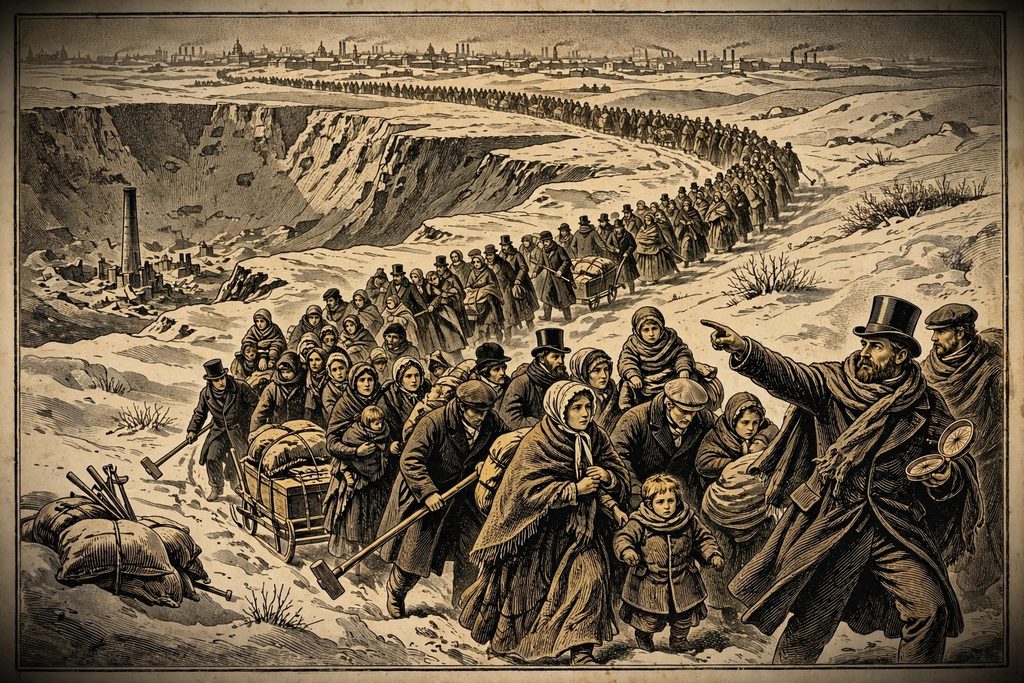
In Frostpunk’s history, the eruption of Krakatoa in 1883 and a chain of other events that nobody fully understands plunge the world into a volcanic winter. Snow falls in summer. Crops fail. The temperature does not recover. By 1886, the great cities of the British Empire are dying, and the survivors of London set out north on foot, toward a place the Empire prepared in secret before the cold arrived.
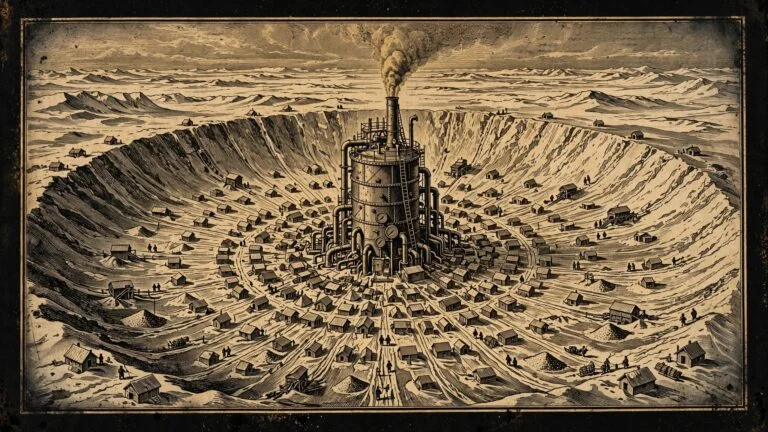
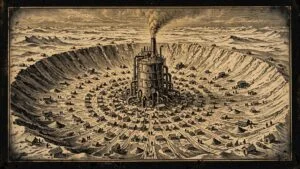
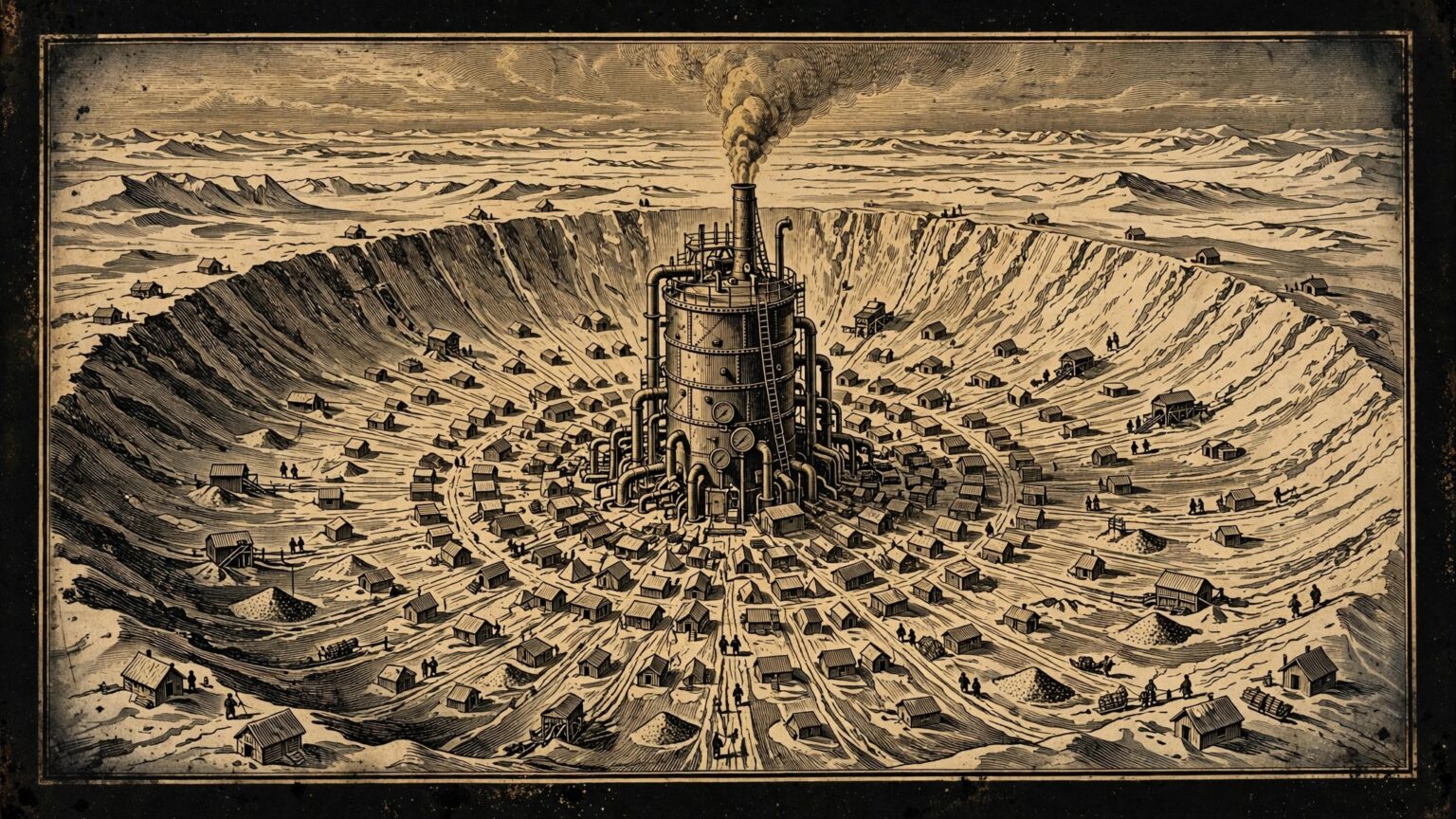
What they find, at the bottom of a vast crater, is a Generator. It is a colossal coal-fired furnace built by the engineers of an empire that saw the end coming and tried to plan for it. It produces heat in a circle, and outside that circle, nobody lives for long. The player is the Captain, the leader of the expedition, and the game begins with a few dozen people, a few tents, a pile of coal and a machine that must never go out.
The setting is fiction, but it is built on real fear. The studio drew on accounts of polar expeditions and on Jacek Dukaj’s novel Ice, an alternate history of a frozen Europe. The game’s motto, repeated through its loading screens and its laws, says everything about the civilization that grows in the crater. The city must survive.
II. The Generator as Sovereign
The true ruler of New London is not the Captain. It is the Generator. Every decision in the city flows from a single physical fact. Heat spreads from the center in rings, and the further a house stands from the furnace, the colder its people sleep. Geography becomes hierarchy. The first homes built close to the Generator become the most valuable places in the world, and those who live at the edge are always the first to fall ill.
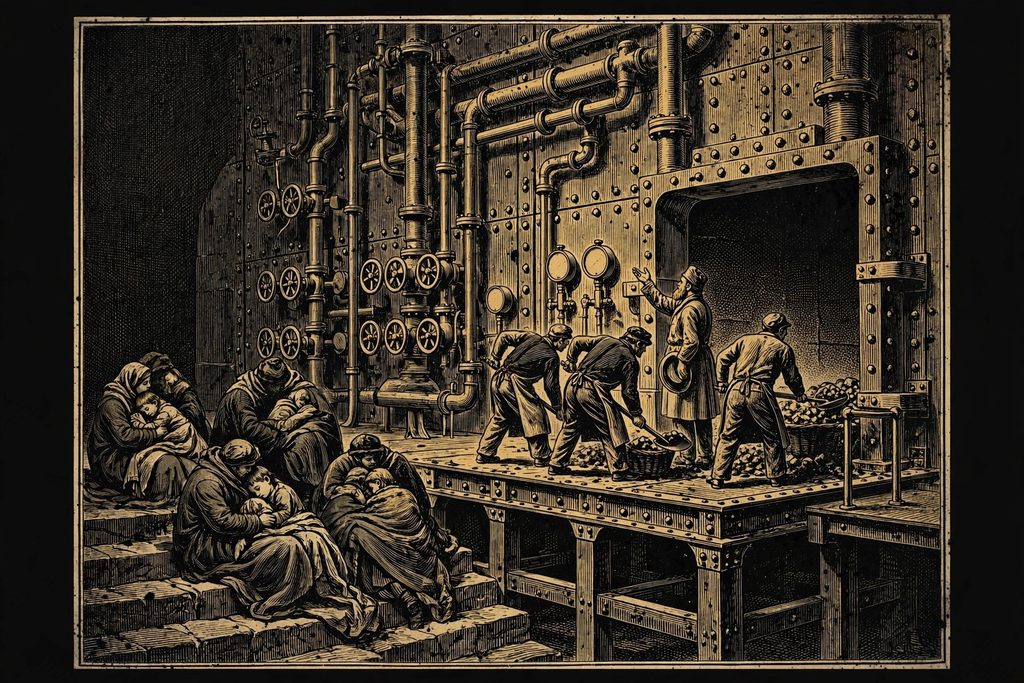
The machine also demands obedience of its own. It must be fed coal without pause, and when the cold deepens it can be pushed into overdrive, burning hotter at the risk of exploding. Workers are assigned to it like priests to an altar. The city’s whole economy, its mines, its sawmills, its hunters and its scouts, exists to keep one fire alive. Without it, there is no law, no hope and no city.
Anthropologists would recognize this structure at once. The ancient Greek city kept its own sacred fire on the common hearth of Hestia, in a building called the prytaneion, and that fire was never allowed to die. When Greeks sailed away to found a colony, they carried fire from the mother city’s hearth to light the hearth of the new one. The flame was the city. New London repeats the idea in iron and coal. A community of refugees from a dead capital gathers around a fire they did not light themselves, and that fire becomes the center of their political life.
III. The Book of Laws
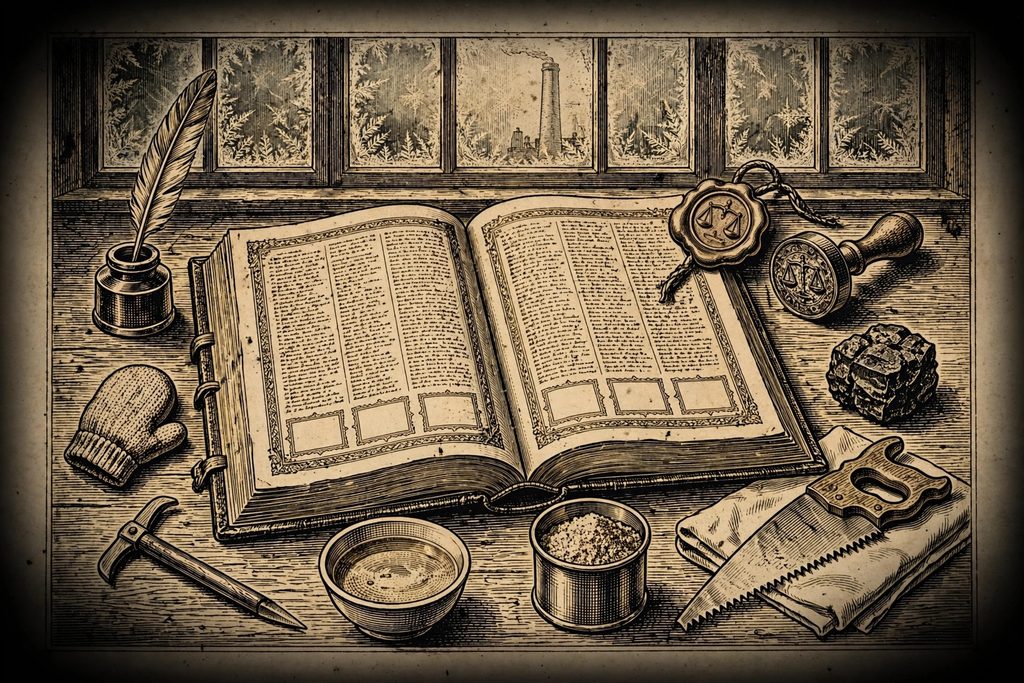
The heart of Frostpunk is a book. The Book of Laws is how the Captain governs, and every page is a choice with a cost. Some laws are merciful. The city can build a cemetery, fund prosthetics for the wounded or open a public house. Others are the laws of a society that has decided survival comes first. Children can be put to work. Workers can be forced into emergency shifts that last a full day. Food can be stretched with sawdust or thinned into soup. The dead can be thrown into a snow pit, and their organs can be harvested for the living. The gravely ill can be given radical treatment, which means amputation, so that more patients survive with fewer limbs.
None of these laws can be undone. The book records each decision permanently, and the people of New London react to every one. Two measures track their mood. Hope rises when the city feels it has a future. Discontent rises when people feel used, betrayed or cold. If Hope falls too far or Discontent climbs too high, the people overthrow the Captain and throw him out into the frost. The game ends there.
This is the Institute’s central observation about New London. Frostpunk does not measure legitimacy by consent. Nobody votes in the crater. It measures legitimacy by hope, the belief that suffering leads somewhere. A Captain can do terrible things as long as the people believe the city will survive, and the most modest act can provoke revolt if they stop believing. It is a harsh theory of politics, and an old one. Every ruler in a siege has governed by it.
IV. Order and Faith
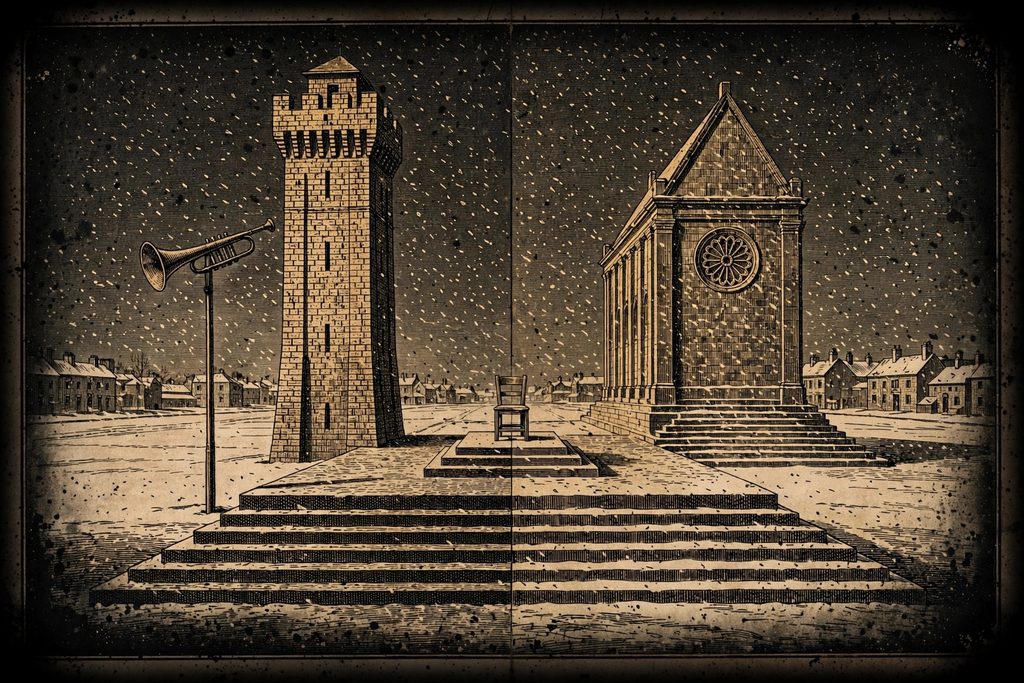
At a certain point in the main campaign, hope alone is no longer enough, and the Captain must give the city a purpose. Frostpunk offers two. The path of Order builds a society of discipline, with a neighbourhood watch, guard stations, propaganda and patrols. The path of Faith builds a society of devotion, with houses of worship, Faith Keepers who walk the streets and a great temple at the city’s heart.
Both paths begin gently and both can be followed to the end. At the end of Order lies the New Order, a police state in which the Captain rules without limits and dissent is crushed. At the end of Faith lies the New Faith, a theocracy in which the Captain is treated as a prophet and doubt itself becomes a crime. Each step down either path makes the city more stable and more frightening. The game never stops the player. It simply lets the consequences accumulate.
And then it delivers its verdict. A player who completes the campaign after crossing the final line hears that the city survived, followed by a single question. Was it worth it? It is one of the most famous endings in strategy games because it refuses to congratulate the winner. New London has survived the end of the world, and the game asks whether what survived still deserves to be called a civilization.
V. The Other Cities
New London is not the only city in the frost. Frostpunk’s other scenarios excavate different kinds of survival society, and together they read like a comparative study. In The Arks, a team of scientists from Oxford and Cambridge guards a vault of seeds and seedlings, the living archive of the world’s plants. Their own survival matters less than the survival of what they carry. In The Refugees, a community must absorb a flood of displaced people while a privileged class of Lords insists that the old hierarchy of Victorian England survive the end of the world. In The Fall of Winterhome, a once-promising city is collapsing around its failing Generator, and the task is to save as many people as possible before it dies.
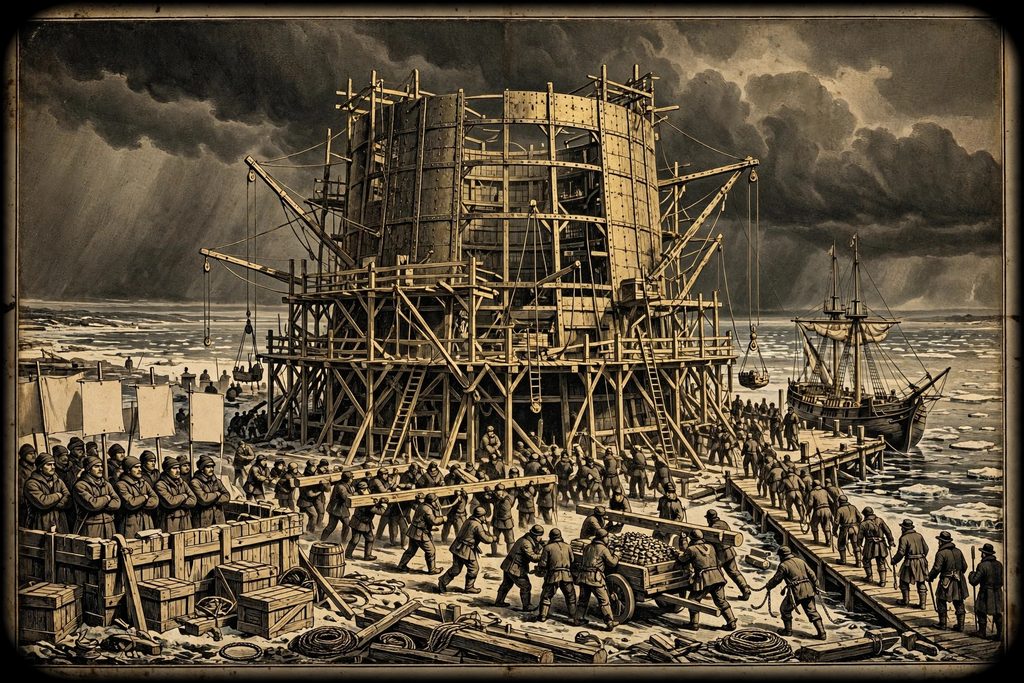
The most revealing scenario looks backward. The Last Autumn, released in 2020, takes place before the winter, at a construction site called Site 113, where the Generator itself is being built. It is a story about labour. Dock workers and engineers race against the coming cold, trade unions form, strikes halt construction, and the player can win cooperation through concessions or replace free workers with convicts. The machine that will later save the city is born from the same bargains between power and survival that will rule the city around it.
In A New Home, the main campaign, the city faces a final threat from within. A movement known as the Londoners spreads the belief that the expedition was a mistake and that the survivors should return to the capital. Their faith in the old world is a political force. The Captain must either persuade them, crush them or let them go into the snow. Every survival society, the game suggests, contains people who would rather die in the past than live in the present.
VI. Thirty Years Later
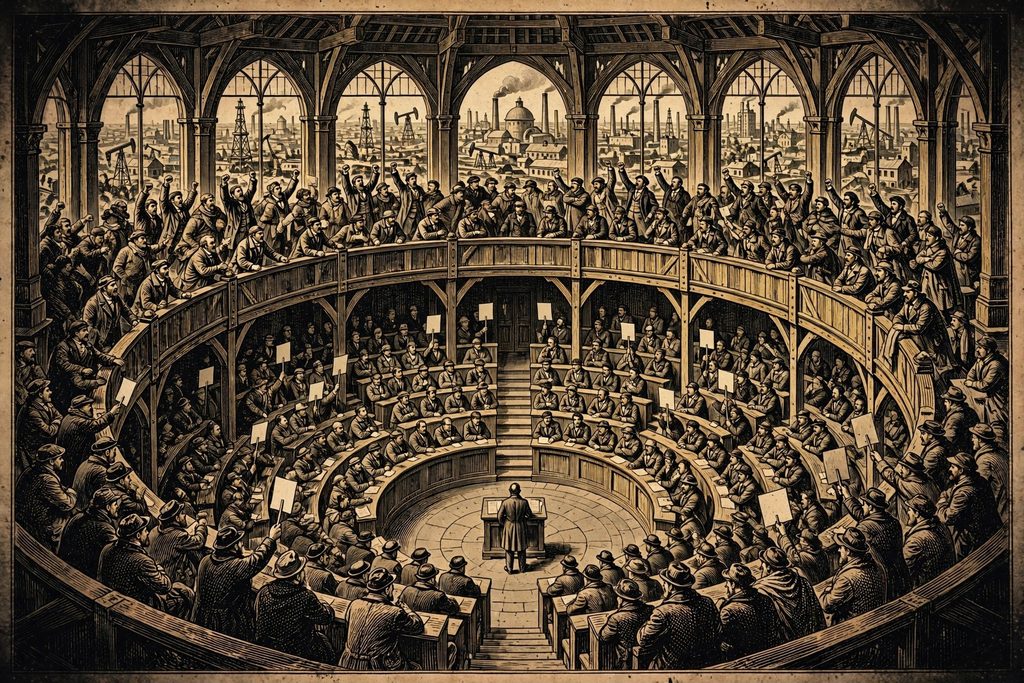
In 2024, Frostpunk 2 returned to New London thirty years after the Great Storm. The Captain is dead. The city has grown into a sprawling metropolis, coal is running out, and oil has become the new lifeblood. The player is no longer a Captain but a Steward, and the Steward does not rule alone. Laws now pass through a Council of a hundred delegates, and a simple majority is enough for most of them. Proposals that would give the Steward more power need two thirds of the votes.
The danger has changed shape. The old question was whether the city would survive the frost. The new question is what the city believes it is. Factions have formed around rival answers. The Stalwarts want to master the cold through discipline, merit and technology, while the Pilgrims want to learn to live with it. The Faithkeepers hold to tradition and the old devotion to the Generator, while the Evolvers would change the people themselves to endure the frost. Their quarrels can end in negotiation, in exile or in civil war.
For the Institute, this is the most interesting turn in the whole history of New London. A society born in emergency has outlived its emergency. The laws written to survive one winter have become a constitution, the Captain’s absolute power has become a contested inheritance, and the city must decide whether its harsh founding choices were a necessity or an identity. Many real states have faced the same question after the war that made them.
The ancestor of them all
The idea of a refuge built against a killing winter is one of the oldest stories in the world, and its earliest form comes from ancient Iran.
In the Vendidad, part of the Zoroastrian Avesta, the god Ahura Mazda warns Yima, the first king, of a catastrophe. In James Darmesteter’s 1880 translation, the warning is simple. Evil winters are about to fall upon the material world, bringing a fierce and deadly frost. Ahura Mazda tells Yima to build a Vara, an enclosure as long as a riding-ground on every side, and to bring into it the seeds of sheep and oxen, of men, of dogs, of birds and of red blazing fires. Inside the Vara, a year seems only as a day.
The Vara is New London’s ancestor in every detail. It is a refuge prepared before the cold, by a ruler warned in advance. It carries fire as a thing to be preserved, like seed. And it has a law of admission. The text lists who may not enter, the deformed, the impotent, the mad, the malicious and the liar. The first constitution of a survival society, in the oldest version of the story, is a list of who will be left outside. Frostpunk’s Book of Laws continues a tradition that began with Yima’s.
History added its own version. In 1815, the eruption of Mount Tambora in Indonesia filled the sky with ash, and 1816 became the Year Without a Summer. Crops failed across Europe and North America and snow fell in June. That summer, at a villa by Lake Geneva, Lord Byron wrote a poem called “Darkness”, in which the sun goes out and humanity burns its homes for warmth. In his words, all hearts “were chill’d into a selfish prayer for light.” Frostpunk’s eruption of Krakatoa is an echo of Tambora, and its city is Byron’s nightmare given a Generator.
The pattern
New London belongs to a family of fictional societies that the Institute calls lifeboat civilizations. Their most famous relative is Snowpiercer, born in the French graphic novel Le Transperceneige in 1982 and adapted for cinema by Bong Joon-ho in 2013. The earth is frozen, and the last humans circle it endlessly on a train whose engine is treated as sacred. The poor live at the back, the rich at the front, and the order of the carriages is the order of society.
Three features define these civilizations. The first is a single machine of life at their center, the Generator, the Engine or the vault reactor, whose survival matters more than any individual. The second is a law that ranks lives by their distance from that machine, in rings of heat, carriages of a train or levels of a shelter. The third is a politics measured in hope rather than consent, in which rulers are judged not by whether they are fair but by whether people believe tomorrow will come.
Such societies also share a destiny. Their founding emergency eventually ends or becomes normal, and then the people inherit the laws they accepted to survive. The vault dwellers of Fallout opened their doors into a world they had not prepared for. New London, thirty years after the storm, is still arguing about its own Book of Laws. A lifeboat can save a civilization, but it cannot tell it what to become once the water is calm.
Findings
- Frostpunk is a study in political anthropology. It reduces society to its foundations, a few survivors, one source of heat and one ruler, and asks what people will accept to stay alive.
- The Generator is the true sovereign of New London. Heat spreads in rings, distance from the furnace becomes social rank, and the whole economy exists to feed one fire, much like the sacred hearth of the ancient Greek city.
- Legitimacy in the crater is measured by hope. The Book of Laws can authorize child labour, sawdust in the food and amputation, but the Captain falls only when the people stop believing the city has a future.
- Survival can end in tyranny. The paths of Order and Faith lead to the New Order and the New Faith, and the game answers a player who crosses that line with a single question. Was it worth it?
- The oldest version of the story is Iranian. Yima’s Vara in the Vendidad is a refuge built against a deadly frost, carrying seeds and fire and governed by a law of who may enter, the first ancestor of New London.
This Excavation draws on Frostpunk, its scenarios and its sequel, on the Zoroastrian Vendidad, on the history of the Year Without a Summer, and on the comparative study of survival societies in fiction.
The Institute collects field evidence from people who governed these worlds. If you signed a law in the crater that you still remember, send us your account.
Sources
- Frostpunk (2018), 11 bit studios, with The Last Autumn (2020) and its other scenarios.
- Frostpunk 2 (2024), 11 bit studios.
- The Zend-Avesta, Part I, The Vendidad, translated by James Darmesteter, Sacred Books of the East, vol. 4 (1880), Fargard 2.
- Lord Byron, “Darkness” (1816).
- Gillen D’Arcy Wood, Tambora, The Eruption That Changed the World (2014), Princeton University Press.
- Jacek Dukaj, Ice (2007).
- Jacques Lob and Jean-Marc Rochette, Le Transperceneige (1982), and Bong Joon-ho, Snowpiercer (2013).
- Irad Malkin, Religion and Colonization in Ancient Greece (1987), Brill.