

EXCAVATION Nº 0024 · ANTHROPOLOGY
World: Revachol, Disco Elysium
Period: Spring ’51 (in-world)
Status: Contested
Medium: Game
Polity: Occupation, Commune
Origin: Rebellion, Conquest
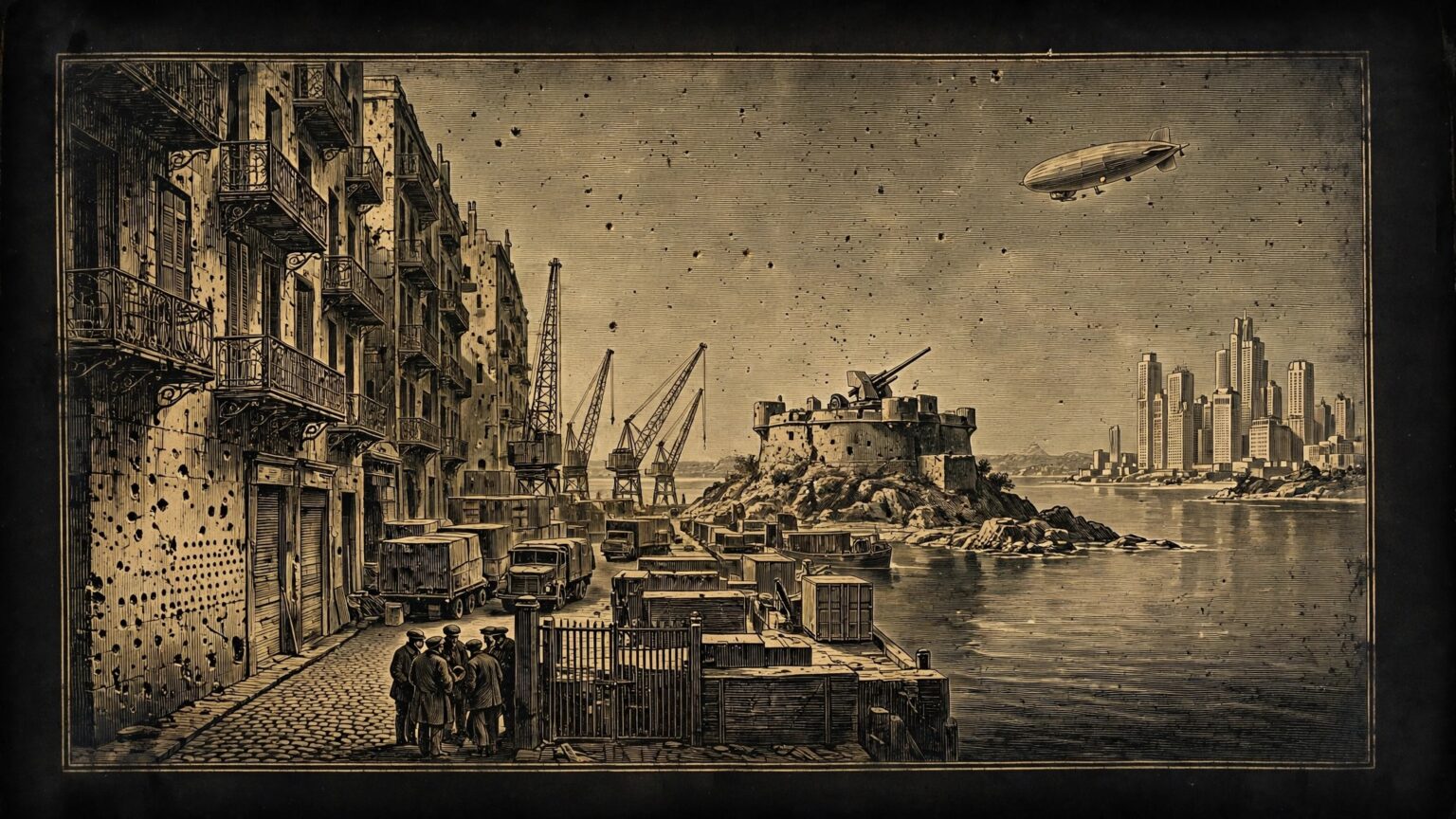
Somewhere in the harbor district of Martinaise there is a wall with bullet holes in it. Nobody has filled them. They were made in the spring of ’08, when the armies of five nations came down from the sky in airships and ended the Commune of Revachol, and in the forty-three years since, the city has been bombed, rebuilt, sold, boomed, crashed and forgotten by most of the world. The holes are still there. So is the argument that made them.
Disco Elysium, released in 2019 by the Estonian studio ZA/UM, is usually remembered as a detective game about a policeman who wakes up with no memory. It is also one of the most complete portraits of a defeated city in fiction. Revachol lost its revolution, lost its sovereignty and lost its place at the center of the world. What it never lost was its politics. Communists, royalists, moralists, ultraliberals and fascists still live on the same streets, drink in the same bars and argue as if the war were last week. This Excavation studies Revachol as what it has become, a city governed by people who are not there, policed by people nobody appointed, and haunted by an ideology that refuses to die.
I. The Capital of the World
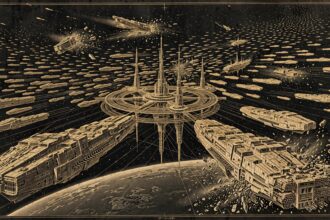
Revachol was not always a ruin. Founded nearly four centuries earlier as a colony, it grew into the seat of a constitutional monarchy, the Suzerainty, and for a time it was called the capital of the world. Its wealth came from an empire of colonies, and above all from a trade the game names without euphemism, the Regnum Cocainum. Revachol’s ships carried raw cocaine to a captive market of addicts across the known world, and the profits built the boulevards, palaces and royal zoo whose ruins still stand.
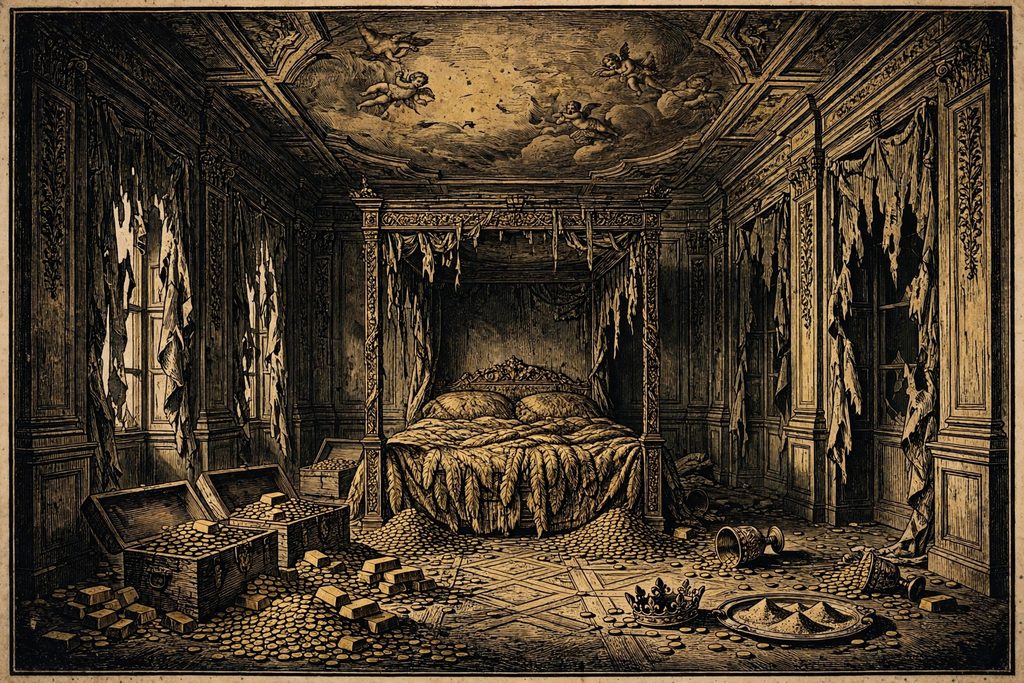
The dynasty that presided over this wealth rotted from the inside. One king turned his bedroom into the Sol Aurum, a treasure chamber said to hold heaps of gold and a bed of gold-dipped feathers. His addiction and his spending emptied the treasury, and the Suzerainty never recovered. By the time of the revolution, Revachol was a city with the architecture of an empire and the finances of a bankrupt.
That inheritance matters. Every faction in present-day Revachol is arguing, in part, about which past to mourn. The royalists remember the golden age and blame the revolution for everything since. The communists remember the revolution and blame the golden age. Nobody remembers a time when the city was simply ordinary.
II. The Six Years of the Commune
In the year ’02, a wave of communist revolution swept the region, fueled by war, poverty and plague. On the 7th of March, the Commune of Revachol announced its existence to the governments of the world in a document called the March Decree. The reigning monarch fled abroad and became a venture capitalist. His nephew stayed, took command and was killed. At Couron, a royal commander led his soldiers into battle in single file behind his own red stallion, dressed in purple velvet and cockatoo feathers, and the communards waited until they came close before opening fire.
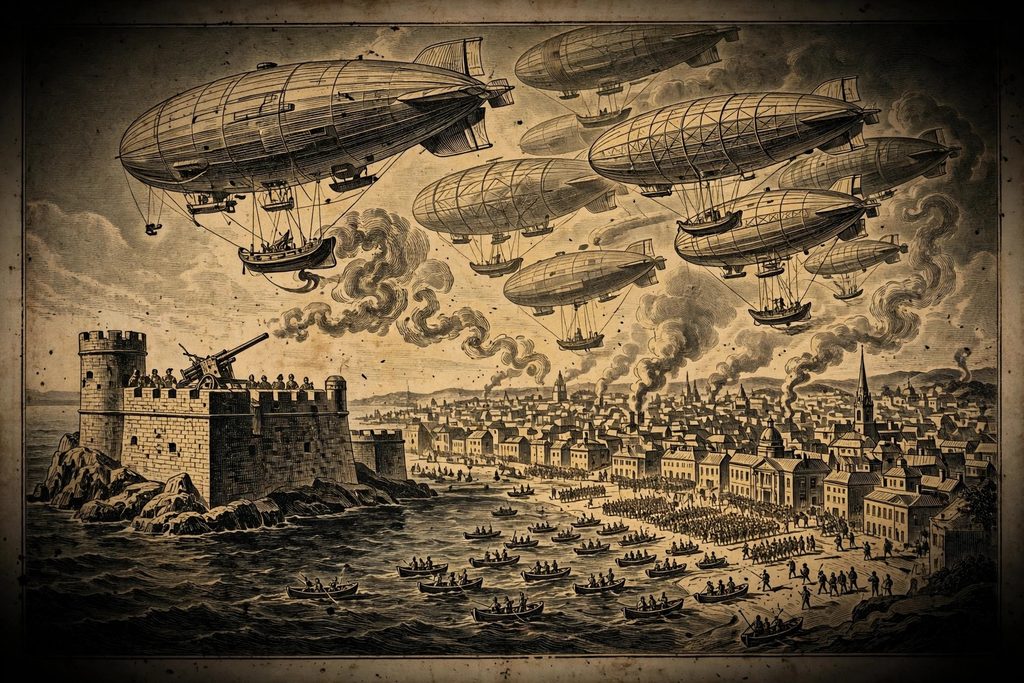
For six years Revachol was a workers’ republic. Its militia fortified an old sea fortress off Martinaise and mounted an anti-aircraft gun on it, to guard against an attack from the air. The attack came in ’08. A coalition of five nations, organized under a military command called INSURCOM, launched a coordinated aerial assault on the city. On the 13th of May, airships landed troops on the beach at Martinaise. The anti-aircraft gun failed to fire. Within days the city had fallen.
What followed was massacre. In the game’s history, at least two million people died across the region in the catastrophe known as the Insulindian Deluge, and the communists and anarchists of Revachol were buried in mass graves. Two years later, a group of liberal politicians signed the instrument of surrender that handed the city’s sovereignty to the Coalition. One detail is repeated often in Martinaise, because it explains so much. The Communist Party itself never surrendered.
III. An Occupation Nobody Sees
Most fictional occupations are visible. Soldiers on corners, flags on buildings, checkpoints at bridges. Revachol’s is almost invisible, and that is its genius.
After the war, the city became a zone under Coalition jurisdiction, divided into twenty-one cordons. The Coalition is the armed wing of the Moralintern, a supranational order whose ideology, moralism, presents itself as the reasonable center between extremes. It keeps warships and airships within reach, and it keeps the right to intervene. But in daily life it barely appears. It governs through law and money instead of soldiers. The emergency acts written after the war were designed to keep Revachol in a laissez-faire state that benefited foreign capital.
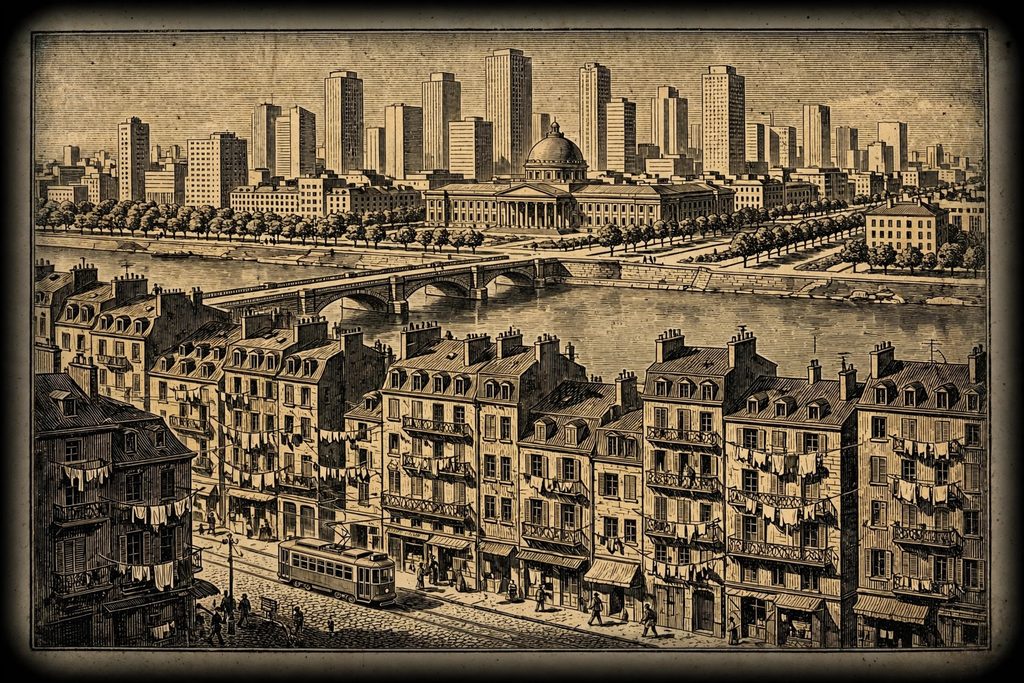
The results are written into the city’s map. In the Thirties, Revachol East became the world’s largest tax haven, and the flood of untaxed money produced a new culture of disco and ultraliberalism that the city still calls The New. The eastern districts were renovated into gleaming financial quarters, with the Bank of the World and the headquarters of global corporations. The western districts, including Martinaise, were left to decay through a decade of urban warfare, a measles epidemic and an industrial accident that poisoned a river. When the boom collapsed in the Forties, the West had nothing to lose and the East had nothing to give back. By the spring of ’51, when the game begins, Revachol is still in recession.
This is occupation as absence. The Coalition does not need to patrol Martinaise. It only needs to make sure that nobody there can ever build anything of their own. The Institute studied a related idea in The Civil War Over a Forbidden God, where a distant moral authority shapes a conquered land through a single treaty clause. In Revachol, the treaty clause is the whole economy.
IV. The Police Nobody Appointed
If the Coalition is absent, who keeps order? The answer is one of the strangest institutions in fiction, the Revachol Citizens Militia.
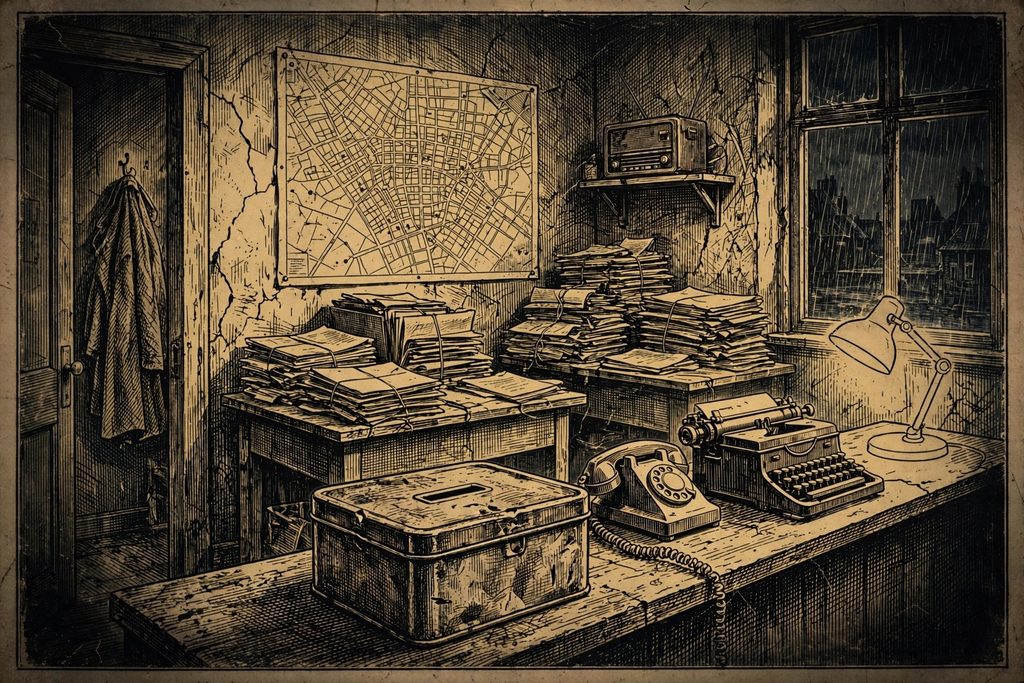
Even its origin is disputed. Some say the Coalition created it to restore order after the war. Others say the citizens organized it themselves. Either way, the RCM exists in a legal twilight. It is not an official police force. It runs on donations. Its officers earn a pittance, some take bribes to survive, and most of the city’s murders go unsolved. And yet its authority is rarely questioned, because there is nobody else.
Its internal structure tells its history. The RCM uses a system of dual leadership and ranks that descends from the revolutionary militia it replaced. The force that polices the occupied city is built on the organizational skeleton of the army that lost the war. The game’s two detectives embody that contradiction. Harry Du Bois, the amnesiac, can become a communist, a fascist, a moralist or an ultraliberal depending on the player’s choices. His partner, Lieutenant Kim Kitsuragi, is the most disciplined person in the game, a professional serving an institution that has no legal right to exist, because someone has to.
The Institute has followed other institutions that became governments by default, most dramatically the player corporations of The Corporations That Became States. The RCM is the opposite case. It is not power that filled a vacuum. It is duty that filled one.
V. The Union That Became a Government
Martinaise has another authority, and in daily life it matters more than the police. The Dockworkers’ Union controls the harbor, the jobs, the trucks that move in and out, and a great deal of what happens after dark. Its leader, Evrart Claire, is a genial, enormous, endlessly calculating man who greets every visitor as a friend and every friend as an investment. He and his twin brother have turned the Union into a family institution. It is at once a socialist faction and a corrupt mob, and nobody in Martinaise finds that contradictory.
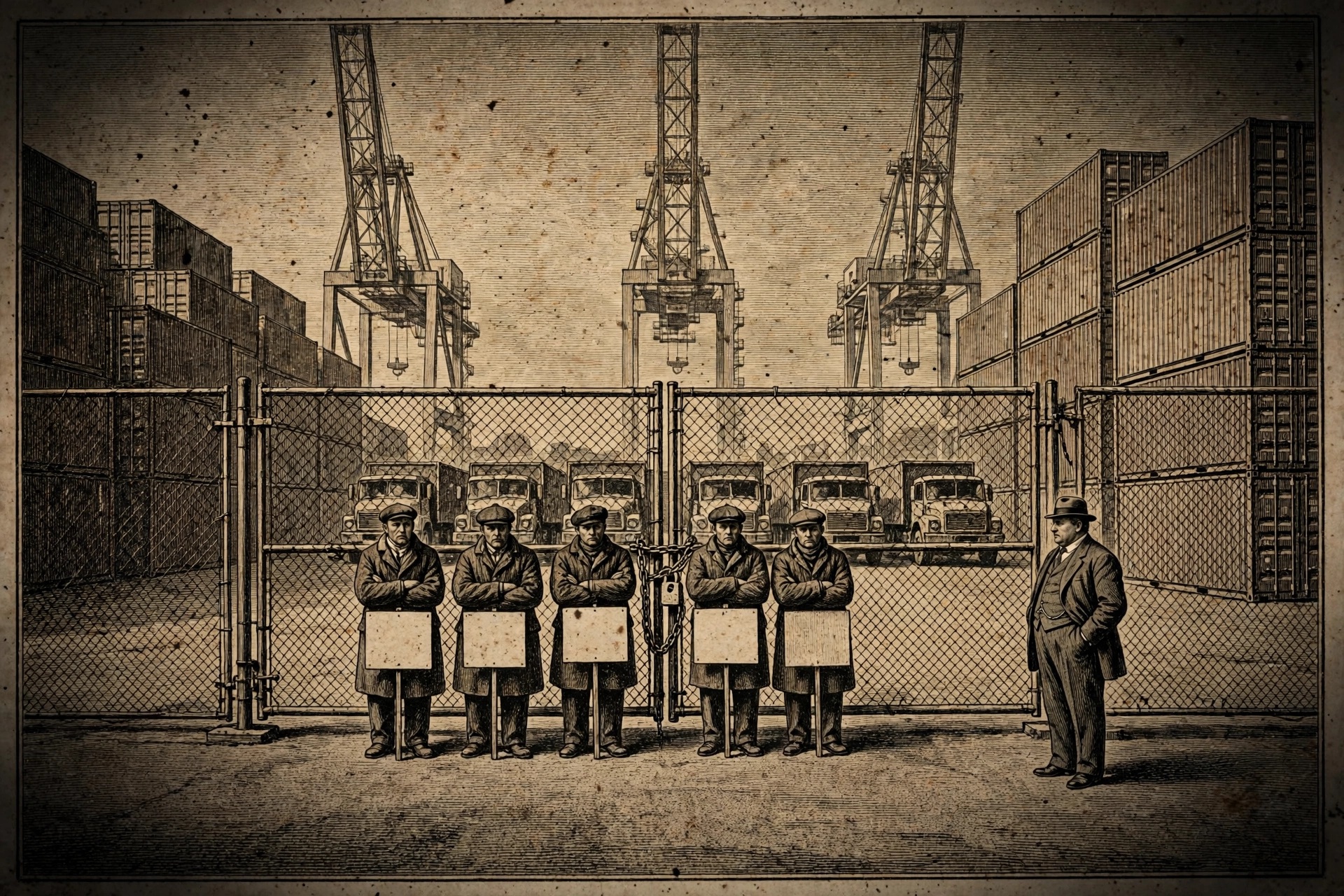
When the game opens, the Union has shut down the harbor in a strike against Wild Pines, the logistics company that owns the port. Wild Pines has sent a negotiator, Joyce Messier, who is courteous, intelligent and the best historian in the district, and it has also hired a squad of mercenaries. Between them hangs a corpse. A mercenary commander, Colonel Ellis Kortenaer, has been found hanging from a tree behind the local hostel. The investigation that follows is less a murder case than a tour of every power in Martinaise, the Union, the company, the mercenaries, the militia and the ghosts of the Commune, each with its own version of what the city is for.
The Union is the purest expression of Revachol’s condition. It speaks the language of the revolution, solidarity, labor, the workers against capital. It also runs the neighborhood like a private estate and dreams of developing it for profit. It is what a revolutionary movement becomes when it survives defeat but loses its purpose. It keeps the vocabulary and changes the job, much as the factions of the Wasteland keep the names of dead states in Why the Wasteland Keeps Rebuilding the Same Civilization.
VI. The Last Communist on the Island
The murderer, in the end, has not left the war at all.
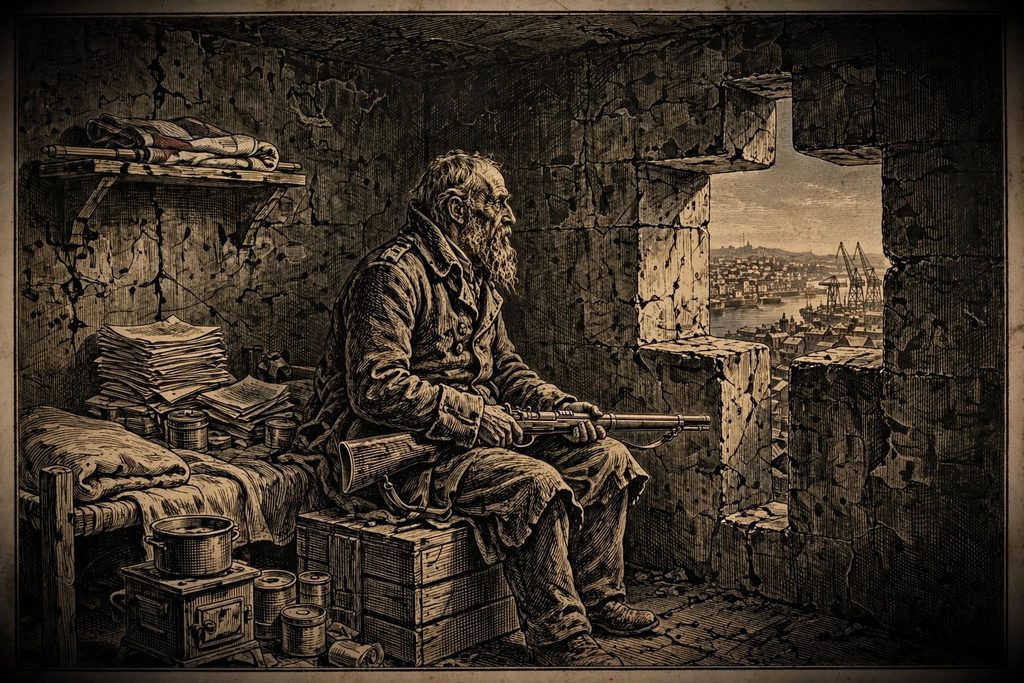
On a small island off Martinaise stands the old sea fortress where the Commune mounted its anti-aircraft gun. There, for forty-three years and ten months, a former political commissar of the Commune’s anti-aircraft division has been hiding. Iosef Lilianovich Dros was recruited as a teenager and trained as an ideological officer to keep the soldiers faithful to the revolution. He never surrendered, because nobody was left to surrender to. He lived from bunker to bunker, an old man with a rifle and a war that ended before most of the city was born, and it was his bullet, fired across the water, that killed the colonel. The hanging came later, staged by others.
When the detectives finally find him, his defense is the whole history of Revachol in one sentence. No superiors can relieve him of his duty, he tells them, because the Coalition bulldozed them all into a mass grave for trying to free humanity. Whether the player hears this as madness, tragedy or the last honest voice in the city is one of the choices the game refuses to make for you.
That refusal is the key to Revachol. The game lets the player become a communist, a fascist, a moralist or an ultraliberal, and in the Final Cut edition of 2021 each of those paths received its own political quest. Every one of them is treated as a real position held by real people in the city, and every one of them is shown failing in its own way. The ideologies did not die in ’08. They went underground, into bars, bookshops and bunkers, and they wait there for the next argument. Over all of it lies the game’s cosmology. The islands of the world are separated by the Pale, a grey void that erases memory and matter alike, and it is slowly spreading. A city that cannot stop remembering stands on a world that is slowly forgetting itself.
The ancestor of them all
Revachol’s revolution has an obvious ancestor, and the game wears it openly. On the 18th of March 1871, the people of Paris rose and declared the Paris Commune. It lasted seventy-two days. In the last week of May, the troops of the national government retook the city street by street in the Bloody Week, and thousands of Communards were killed, many of them executed. At the Père Lachaise cemetery, the wall where the last defenders were shot, the Mur des Fédérés, became a place of pilgrimage for the left that still draws crowds every year. Revachol’s French names, its March Decree, its Commune and its massacre all point to Paris.
Its occupation has a quieter ancestor. From the 1920s to 1956, the port of Tangier in Morocco was an International Zone, governed jointly by foreign powers. It became a haven for banks, smugglers, spies, tax exiles and writers, a city with enormous money passing through it and very little of it staying with the people who lived there. Revachol’s West is even called the International Zone in the game’s own history.
And behind both stands the experience of the people who made the game. ZA/UM was founded by Estonians, from a country that passed from Soviet occupation to independence and one of the most radical free-market transformations in Europe within a few years in the early 1990s. A city where the old ideology lingers in every conversation while foreign capital rebuilds half the streets and abandons the other half was not, for them, an abstraction.
There is one last irony. After the game’s success, its lead designer Robert Kurvitz, its art director Aleksander Rostov and its lead writer Helen Hindpere left ZA/UM in late 2021, saying they had been forced out after questioning a change of ownership, and years of legal disputes followed. A game about workers, owners and who controls what a community builds became, in the real world, a dispute over exactly that.
The pattern
Defeated cities in fiction are usually finished cities. Their politics die with their armies, and what remains is ruins and nostalgia. Revachol reverses the pattern. Military defeat ended its sovereignty, but not its political life. The ideologies that fought in ’08 survived as identities, subcultures, grievances and habits, passed down in bars and bookshops and acted out in every conversation.
Three features make it work. The first is occupation by absence. Because the Coalition rules through economics rather than soldiers, there is no visible enemy to unite against and no occupier to expel, so the city’s factions turn on one another instead. The second is institutions without legitimacy. The police, the union and the company each govern part of daily life, and none of them has a clear right to do so. The third is memory without resolution. The revolution was never formally ended. The party never surrendered, the dead were never properly buried, and the bullet holes were never filled.
Real history knows this condition well. The Paris Commune was crushed in a single week and has been argued over for a century and a half. Cities that lost civil wars, from Barcelona to Berlin, carried their old divisions in their streets for generations. Revachol is fiction’s most complete study of that afterlife, a place where losing the war did not end the politics. It only removed the possibility of winning.
Findings
- Revachol is a defeated city that never stopped arguing. Forty-three years after the Commune fell, communists, royalists, moralists, ultraliberals and fascists still share its streets, and the game treats each of them as a living position.
- Its occupation works by absence. The Coalition governs through law and capital, not soldiers, keeping the city open to foreign money and unable to build anything of its own. Revachol East became a tax haven, and Revachol West became a ruin.
- Its institutions govern without legitimacy. The Revachol Citizens Militia is an unofficial police force running on donations, built on the structure of the revolutionary army it replaced. The Dockworkers’ Union is a de facto government that is also a mob.
- Its revolution never formally ended. The Communist Party never surrendered, and its last soldier spent forty-three years in a sea fortress waiting for orders that could never come. His bullet sets the whole story in motion.
- Its ancestors are the Paris Commune and the International Zone of Tangier. Revachol joins the memory of a crushed revolution to the economics of a foreign-run free port, seen through the eyes of a studio from a country that lived both occupation and radical reform.
This Excavation draws on Disco Elysium and its Final Cut edition, on the history of the Paris Commune and the Tangier International Zone, and on the public record of ZA/UM’s founding and dispute.
The Institute collects field evidence from people who lived inside these worlds. If you walked the streets of Martinaise and chose a politics there, send us your account.
Sources
- Disco Elysium (2019) and Disco Elysium, The Final Cut (2021), ZA/UM.
- Robert Kurvitz, Püha ja õudne lõhn (Sacred and Terrible Air) (2013).
- The Game Awards 2019, winners for Best Narrative, Best Independent Game, Best Role Playing Game and Fresh Indie Game.
- John Merriman, Massacre, The Life and Death of the Paris Commune of 1871 (2014), Basic Books.
- Robert Tombs, The Paris Commune 1871 (1999), Longman.
- Graham H. Stuart, The International City of Tangier (1955), Stanford University Press.
- Mart Laar, The Power of Freedom, Central and Eastern Europe after 1945 (2010), Centre for European Studies.
- Reporting on the departure of Robert Kurvitz, Aleksander Rostov and Helen Hindpere from ZA/UM (2022 to 2024).