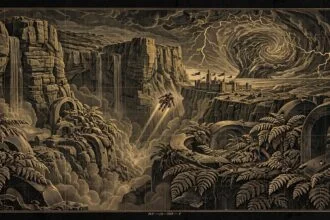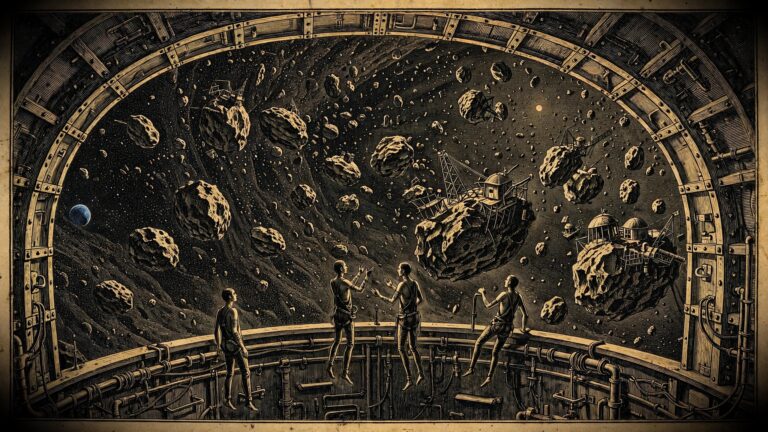


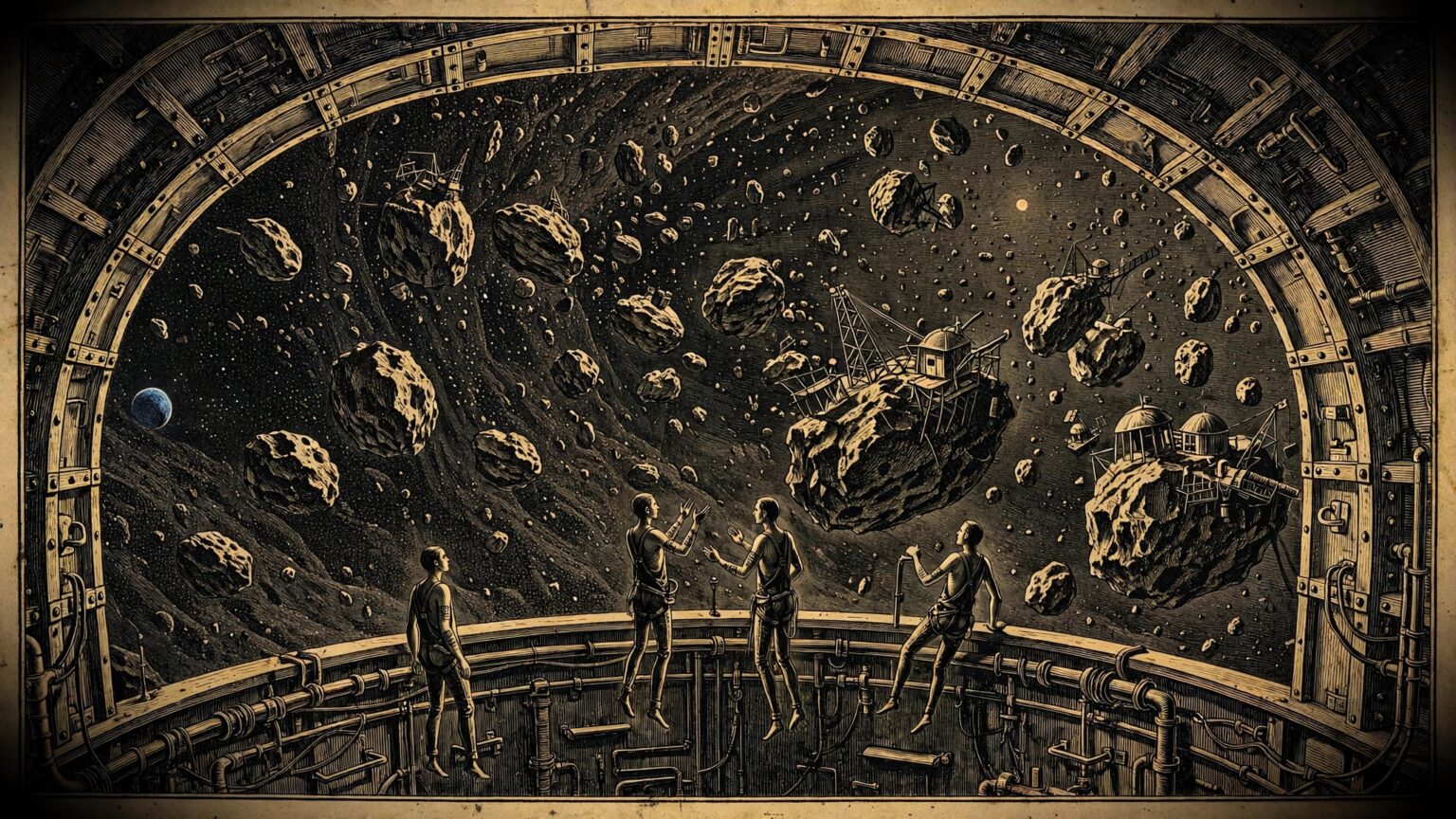
Every migration changes the people who make it, but most migrants can at least go home. The Belters of The Expanse cannot. Born and raised in the low gravity of the asteroid belt and the moons of the outer planets, they have grown tall, thin and fragile. Their bones and hearts are not built for Earth. Over a few generations of mining rock and hauling ice far from the sun, they have become something new, a people with its own bodies, its own language, its own gestures and its own politics.
The Expanse is a series of nine novels written by Daniel Abraham and Ty Franck under the pen name James S. A. Corey, from Leviathan Wakes in 2011 to Leviathan Falls in 2021, published by Orbit Books. It won the Hugo Award for Best Series in 2020. Its television adaptation ran for six seasons from 2015 to 2022, first on Syfy and then on Amazon Prime Video, which rescued it after cancellation. The series is admired for its hard science, but its deepest achievement is anthropological. It imagines how humanity might divide when it spreads into space.
The Institute has studied fictional corporations that became governments in The Corporations That Became States, and people who turned isolated shelters into nations in The Stations That Became Nations. The Belters belong to both stories. Their stations were built by companies, and their nation was built by the people the companies left behind.
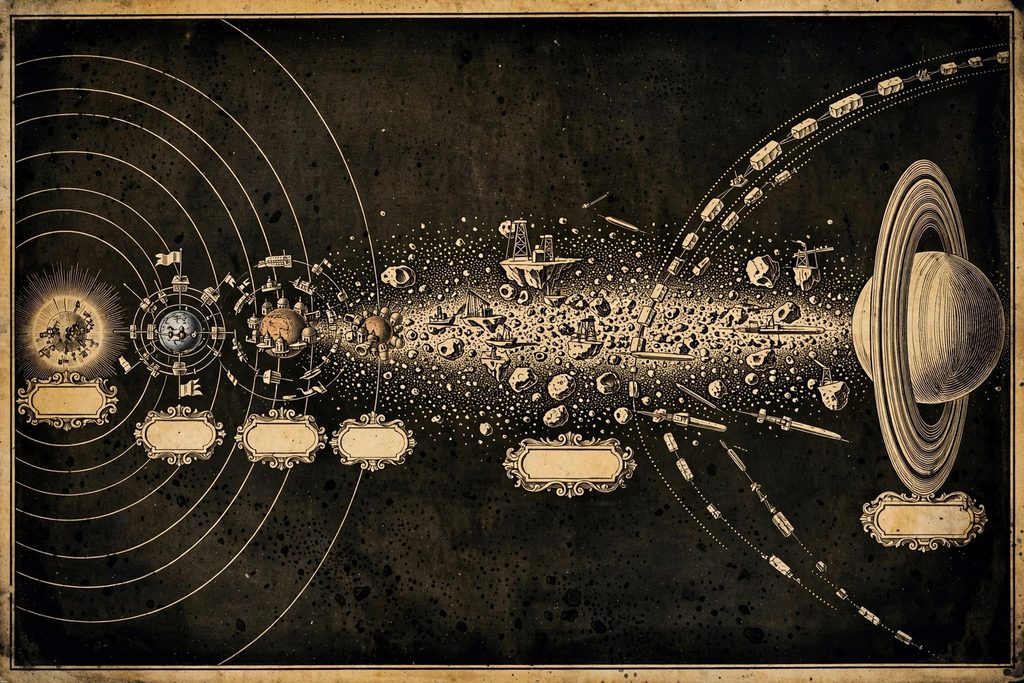
I. A Solar System Divided Into Three
The Expanse takes place centuries from now, in a solar system settled but not united. Earth is governed by the United Nations, a vast, overcrowded world where much of the population lives on government assistance. Mars is an independent republic, a militarized society whose citizens have spent generations working to terraform their planet. Together they are the Inners. Between them and the giant planets lie the Belt and the outer moons, where the people who do the hardest work live farthest from power.
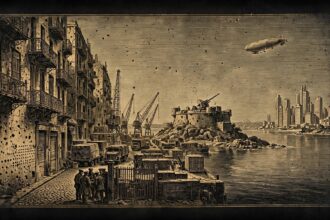
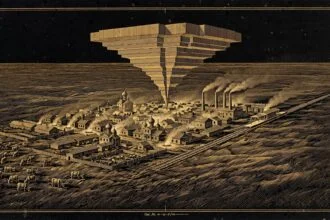
The Belters mine the asteroids for metals and haul ice from the rings of Saturn to supply water to the stations. They work for corporations owned by the inner planets, under contracts written on Earth and Mars. Their stations, hollowed out of asteroids and spun for gravity, have names like Ceres, Eros and Tycho. Their lives depend on supplies of air, water and food that are controlled, priced and shipped by people who have never visited them.
The novels and the series open in this tense balance. An ice hauler is destroyed, a girl goes missing, and an alien substance called the protomolecule is discovered. The story will eventually stretch across the galaxy. But from the first chapter, the political heart of The Expanse is the Belt, and the question of whether its people are workers, colonists or a nation in their own right.
II. Bodies Shaped by Low Gravity
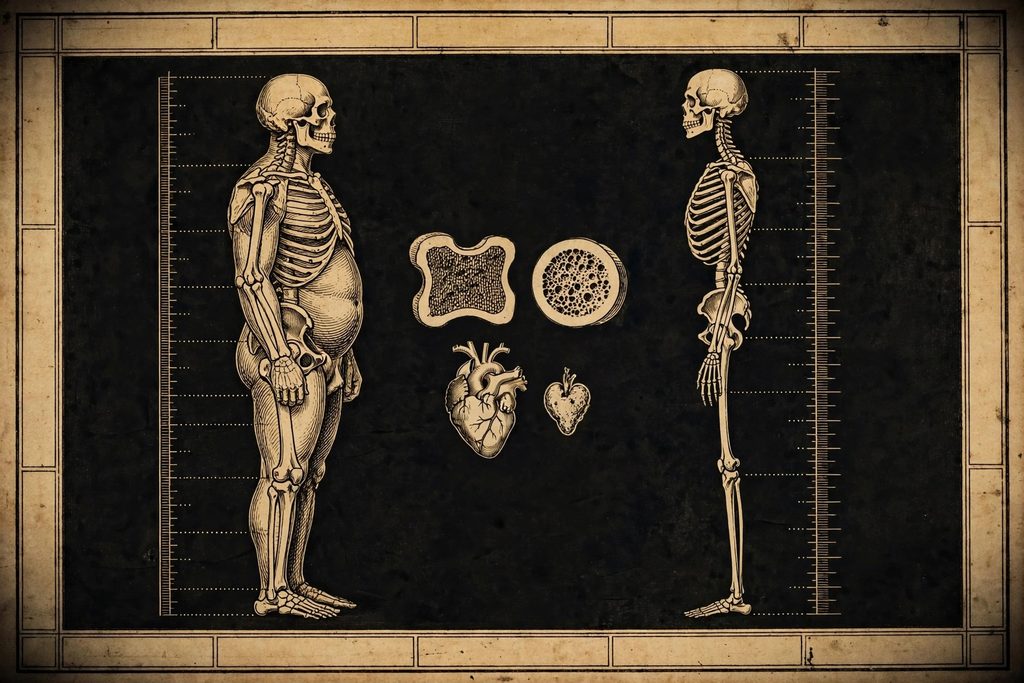
The first thing that makes a Belter different is the body. Children born in the weak gravity of a spinning station grow differently from children born on Earth. They become tall and thin, with long limbs and fragile bones. Their hearts and muscles never learn to fight a full gravity. A Belter visiting Earth would struggle to stand, and the strain could kill them. Most will never set foot on the planet their ancestors came from.
The Inners notice the difference at once, and so does everyone else. Belters can be recognized by their height, their slender build and the way they move. In the books and the series, Inners sometimes treat them as a lesser kind of human, labour adapted to its work. Belters, in turn, take pride in what space has made of them. Earthers seem soft, heavy and coddled, people who have never had to think about the air they breathe.
This is one of the boldest ideas in modern science fiction. Most space operas imagine humanity unchanged among the stars. The Expanse imagines that within a few generations, the environment itself begins to divide us. The Belters are not yet a separate species, but they have stopped being interchangeable with the people of Earth. Distance has written itself into their bodies.
III. A Creole Born in the Asteroids
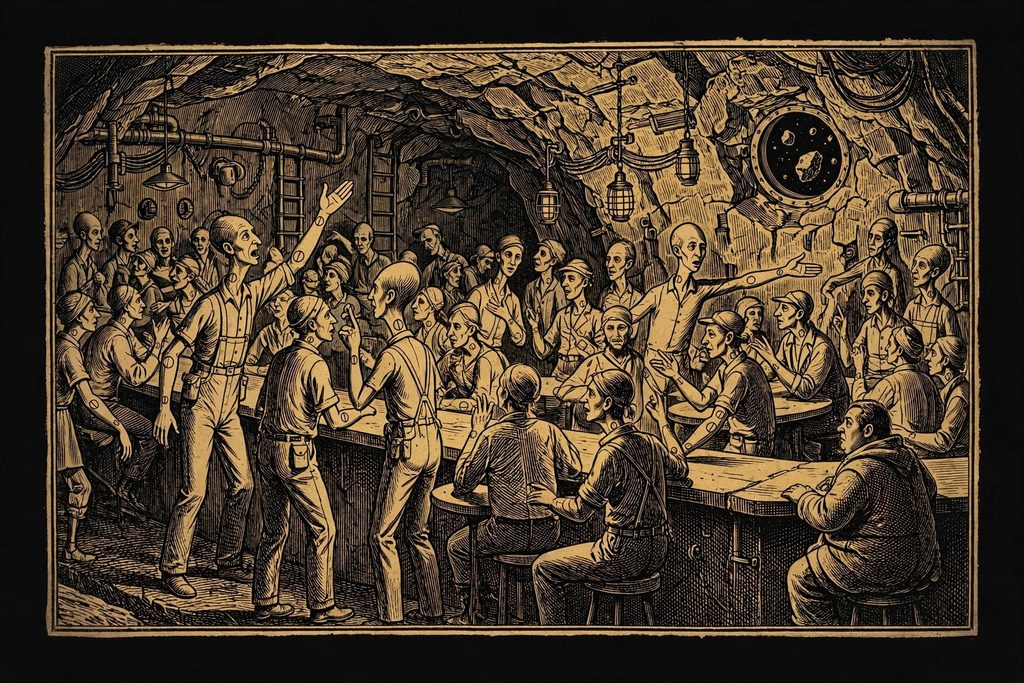
The second thing that makes a Belter different is language. In the stations and ships of the Belt, workers from every nation on Earth mixed for generations, and their speech mixed with them. The result is Belter Creole, a language built on English and woven with words from many others. In the novels, it appears as a rough dialect scattered through dialogue. For the television series, the linguist Nick Farmer developed it into a full language with over a thousand words, drawing on Romance, Germanic and Slavic languages, Japanese, Chinese, Persian, Arabic, Hebrew, Zulu and more.
Its vocabulary tells the story of its speakers. Belters call themselves Beltalowda and the people of the inner planets Inyalowda. A friend is a kopeng, a brother a beratna. Air is ereluf, water owkwa. The worst insult is welwala, a Belter who has sided with the Inners, a traitor to their own. The series deliberately avoided subtitles, so that viewers had to understand Belter the way an outsider would, through context and its echoes of English.
Belters also speak with their hands. Their gestures evolved in the era of space suits, when helmets hid the face and radios were unreliable, and a nod or a shrug had to be made with the hands to be seen. A Belter conversation is a performance of fingers, palms and arms. It is the kind of detail anthropologists treasure, a habit that makes sense only in a particular environment, and survives long after the people who invented it have taken off their suits.
IV. Air, Water and the Price of Breathing
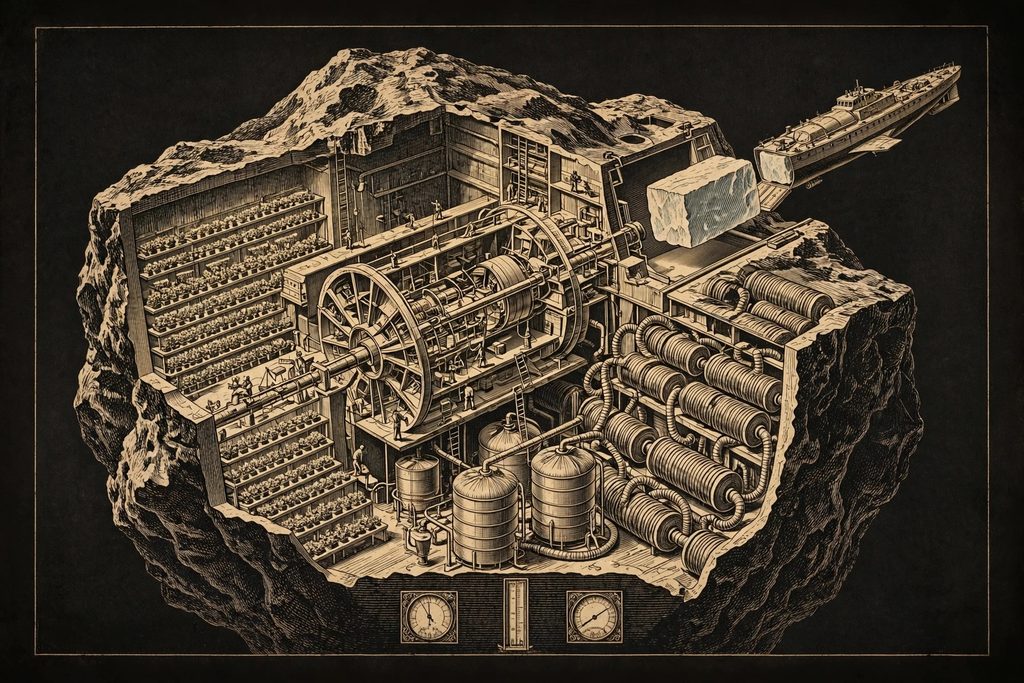
The third thing that makes a Belter different is scarcity. On a station inside a rock, nothing is free. Air must be made, scrubbed and recycled. Water must be hauled across the solar system as ice, melted and reused again and again. Food must be grown in tanks or imported. Every breath has a cost, and someone is charging it. The fact that the Inners control so much of the supply is the oldest Belter grievance.
Scarcity shapes Belter ethics. Wasting air or water is not careless. It is close to a crime, because it endangers everyone who shares the same sealed space. A broken seal, a faulty filter or a careless crew member can kill a whole station. Belters learn from childhood to check their environment constantly, to trust their crew and to fear the vacuum outside every wall. In The Expanse, a Belter’s first loyalty is not to a nation but to the people who share their air.
This is the root of the Belters’ anger toward the Inners, and the reason it runs so deep. Earth and Mars think of the Belt as a mining frontier. To the Belters, it is a place where life depends every moment on systems controlled from far away. When the prices of air and water are set on another planet, politics stops being abstract. It becomes a question of who is allowed to breathe.
V. The Outer Planets Alliance
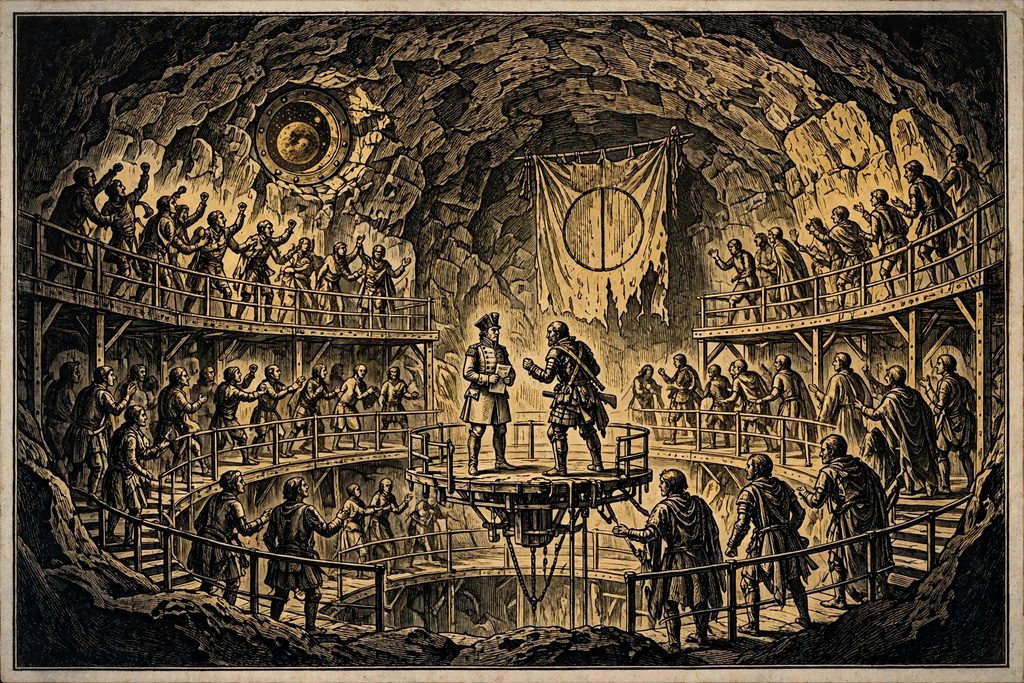
The political voice of the Belters is the Outer Planets Alliance, the OPA. To the Inners it is a terrorist organization. To many Belters it is the closest thing they have to a government. In practice it is neither. The OPA is a loose and quarrelsome network of factions, ranging from respectable station administrators and union organizers to smugglers, idealists and armed radicals. Its symbol, a circle split by a line, appears tattooed on arms and necks throughout the Belt.
Its leaders embody its contradictions. Some, like Fred Johnson, a former Earth soldier who changed sides, try to win the Belt a seat at the table through negotiation. Others, like Anderson Dawes on Ceres, are political operators who move between diplomacy and violence. The most extreme, Marco Inaros, forms the Free Navy and launches a campaign of terror against Earth itself, using stealth-coated asteroids as weapons of mass destruction. The Belt is torn between the desire for dignity and the temptation of revenge.
This is the classic shape of an emerging nation. A people becomes conscious of itself, gives itself a name and a symbol, and then fights over what that identity demands. The Belters agree that they are not Earthers or Martians. They do not agree on what to do about it. In The Expanse, the birth of a nation is not a single revolution but a long, violent argument among people who share the same grievance and very different hopes.
VI. The Gates and the Transport Union
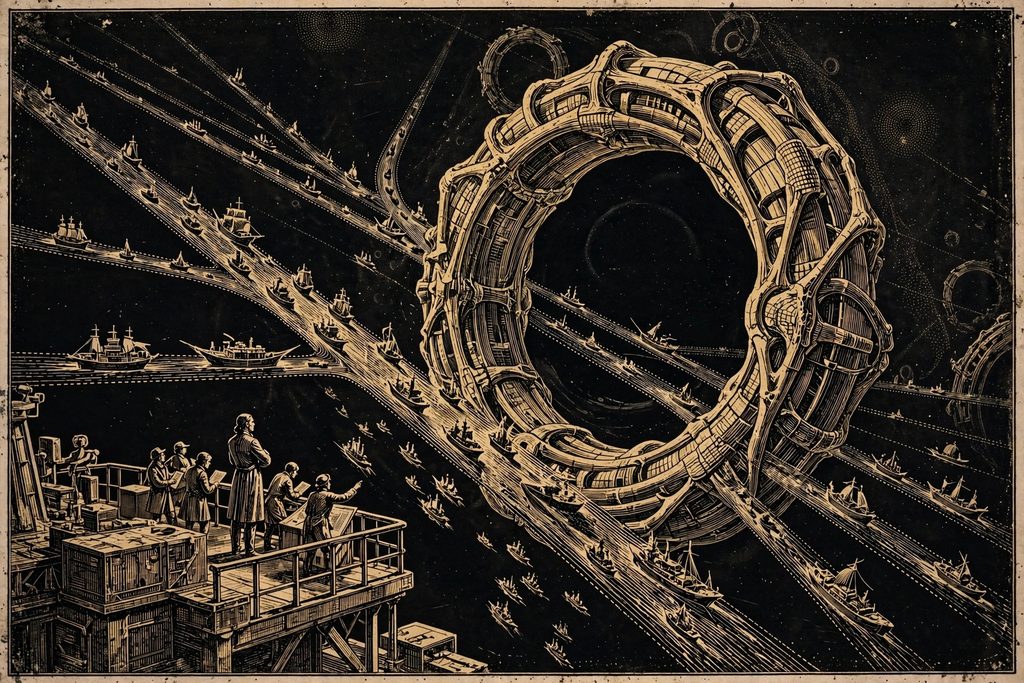
The story of the Belters takes a remarkable turn when humanity’s horizon suddenly expands. The protomolecule builds a ring beyond the orbit of Uranus, a gate leading to a hub that connects to more than thirteen hundred other star systems. Overnight, the solar system is no longer the edge of human space. Earth and Mars, which had controlled the Belt by controlling its supplies, find themselves facing a frontier too large for anyone to control.
The Belters are uniquely prepared for it. They have spent generations living on ships and stations, managing scarcity, working in microgravity and crossing vast distances. After the defeat of the Free Navy, the OPA is transformed into the Transport Union, a Belter organization that manages traffic through the gates. Its president, Camina Drummer, becomes one of the most powerful figures in human space. The people who were once the workers at the edge become the keepers of the doors to the galaxy.
It is a striking reversal. The qualities that made Belters marginal in a solar system centred on Earth, their adaptation to space, their mobility and their fierce cooperation, make them essential in a galaxy without a centre. The Expanse suggests that the future may belong not to the planets that send out colonists, but to the people the colonists become.
The ancestor of them all
History has seen peoples made by distance before, and both of the clearest examples are written in water.
On 22 March 1775, the Irish statesman Edmund Burke rose in the British House of Commons to warn that Britain could not govern its American colonies by force. His argument was geographical. “Three thousand miles of ocean lie between you and them,” he said. “No contrivance can prevent the effect of this distance in weakening government. Seas roll, and months pass, between the order and the execution.” Generations of life on another continent had made the colonists a different people, with their own habits, their own grievances about taxes and their own sense of who they were. Within a few weeks of the speech, the war had begun.
The Pacific tells the other half of the story. Over many centuries, the ancestors of the Polynesians sailed outward across thousands of kilometres of open ocean in double-hulled canoes, reaching islands from Hawaiʻi to Aotearoa and Rapa Nui. Distance did not divide them into subjects of a far-off empire. It made them a people of navigators, whose culture, language and knowledge were built around the sea. In 1976, the voyaging canoe Hōkūleʻa sailed from Hawaiʻi to Tahiti guided by the Micronesian navigator Mau Piailug without instruments, showing that this knowledge could carry a people across an ocean on purpose. The Belters inherit both stories. Like the American colonists, they are governed from far away. Like the Polynesians, they have made distance into a culture.
The pattern
The Expanse belongs to a family the Institute calls the frontier peoples, societies in which a new environment and a great distance from the centre produce a new identity. Its closest literary relative is Robert A. Heinlein’s The Moon Is a Harsh Mistress, published in 1966, in which the convicts and colonists of the Moon, exploited by an Earth that ships away their grain, revolt and declare independence, under a motto that every Belter would understand. There ain’t no such thing as a free lunch.
Three features define these peoples. The first is an environment that rewrites them, changing their bodies, habits, language and ethics. The second is dependence on a distant centre that extracts their labour and controls their survival. The third is a new identity that outgrows the empire, a people who stop thinking of themselves as colonists and start thinking of themselves as a nation.
The Institute found the same logic at a smaller scale in The City That Lived Around a Single Fire, where the rationing of heat shaped every law and loyalty. The Belt is that city scaled up to a solar system. When survival depends on shared air, water and warmth, the people who share them become a society of their own, and eventually they stop asking permission to be one.
Findings
- The Belters are a people made by environment. Born in the low gravity of the asteroid belt and the outer moons, they have grown tall, thin and fragile, and most can never live on the planet their ancestors came from.
- They have their own language and gestures. Belter Creole, developed for the series by the linguist Nick Farmer from English and many other languages, is spoken with a vocabulary of hand gestures that began in the era of space suits.
- Scarcity is the core of their ethics and their anger. On stations where air and water must be made, hauled and recycled, wasting them is close to a crime, and the control of those supplies by the inner planets is the Belt’s oldest grievance.
- Their nation was born in argument. The Outer Planets Alliance unites diplomats, unionists, smugglers and terrorists under one symbol, and its factions fight as fiercely over what the Belt should be as they fight the Inners.
- Distance turned from a weakness into a power. When the ring gates opened more than thirteen hundred star systems, the Belters’ life in space made them the keepers of the gates through the Transport Union.
This Excavation draws on the nine novels of The Expanse by James S. A. Corey, on the television series and its Belter Creole, on Edmund Burke’s speech on conciliation with America, on the history of Polynesian voyaging and the Hōkūleʻa, and on Robert A. Heinlein’s The Moon Is a Harsh Mistress.
The Institute collects field evidence from people who have lived inside these worlds. If you ever learned a word of Belter, or found yourself taking the Belt’s side against the planets, send us your account.
Sources
- James S. A. Corey, The Expanse, nine novels from Leviathan Wakes (2011) to Leviathan Falls (2021), Orbit Books.
- The Expanse (2015–2022), Syfy and Amazon Prime Video, developed by Mark Fergus and Hawk Ostby.
- Mike Wall, “Rejoice, ‘Copeng’! Belter Creole Returns on ‘The Expanse’ Season 4”, Space.com (2019).
- Edmund Burke, Speech on Conciliation with America, House of Commons, 22 March 1775.
- Ben Finney, Hokuleʻa, The Way to Tahiti (1979), Dodd, Mead.
- Robert A. Heinlein, The Moon Is a Harsh Mistress (1966), G. P. Putnam’s Sons.