

Most fictional religions grow out of revelation, fear or tradition. The church of Isaac Asimov’s Foundation was invented on purpose, by people who did not believe in it. As a galactic empire collapsed and its outer provinces forgot how to run their own machines, a colony of scholars on a remote planet offered the barbarian kingdoms nuclear power, and wrapped it in a religion. The kingdoms got light, heat and starships. The scholars got priests in every palace and power over every throne.
Foundation began as a series of stories in Astounding Science Fiction between 1942 and 1950, collected as Foundation (1951), Foundation and Empire (1952) and Second Foundation (1953). In 1966 the trilogy won a special Hugo Award for Best All-Time Series, beating The Lord of the Rings. Asimov later returned to it with sequels and prequels, and since 2021 it has been adapted by Apple TV+ as a lavish television series. The religion of science appears in only a few of its chapters. It remains one of the most cynical and influential ideas in all of science fiction.
The Institute has studied faiths engineered by outsiders in The Religion Planted on Arrakis, and an empire that turned its founder into a god in The Empire That Prays to a Corpse. Foundation sits between them. Its church is not built around a god or a corpse but around a reactor, and its founders always knew exactly what was inside.
I. The Mathematics of the Fall
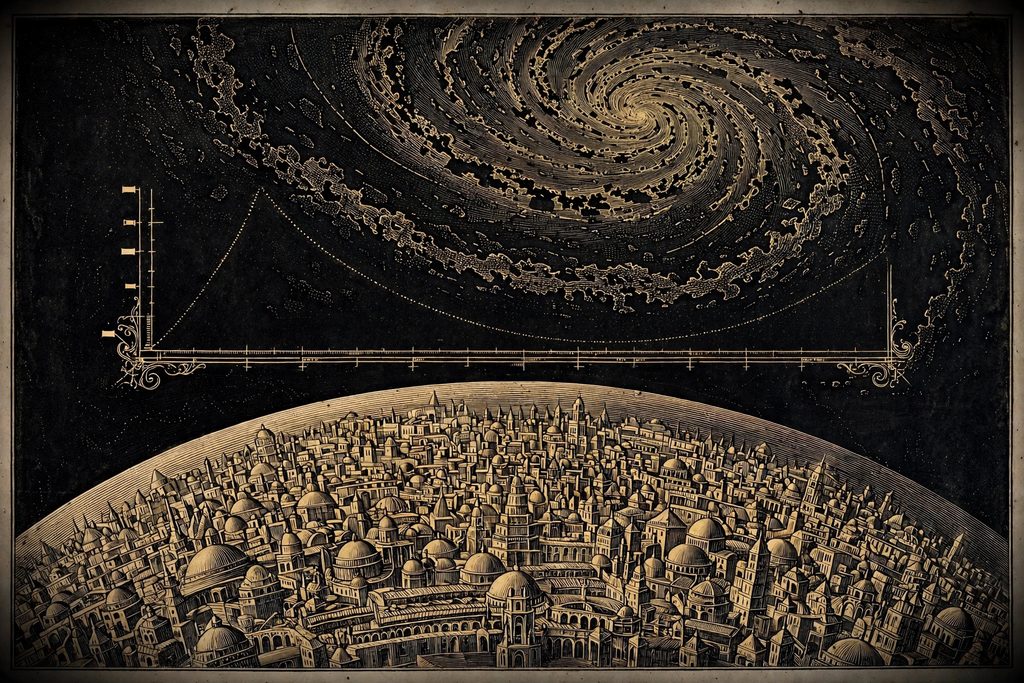
The story begins with the end of an empire. The Galactic Empire has ruled millions of worlds for twelve thousand years from its capital, Trantor, a planet covered entirely by a single city. A mathematician named Hari Seldon has developed psychohistory, a science that predicts the behaviour of vast populations the way physics predicts the behaviour of gases. His equations show that the Empire will fall, and that the dark age that follows will last thirty thousand years.
The fall cannot be stopped. But it can be shortened. Seldon proposes to gather the Empire’s best scholars on Terminus, a poor planet at the very edge of the galaxy, to compile an Encyclopedia Galactica preserving all human knowledge. The Imperial authorities, irritated by his predictions, exile him and his followers there. This, it turns out, is exactly what Seldon intended. The Encyclopedia is a cover. The real purpose of the colony is to become the seed of a second empire, guided by his plan, in only a thousand years.
Asimov said that he built the premise on Edward Gibbon’s History of the Decline and Fall of the Roman Empire, transposed to the stars. The Galactic Empire is Rome, Trantor its eternal city, and the dark age the long night after the fall. And like the real Rome, Asimov’s empire does not collapse all at once. It retreats from its borders first, leaving the provinces at its edge to fend for themselves.
II. Four Kingdoms Without Atoms
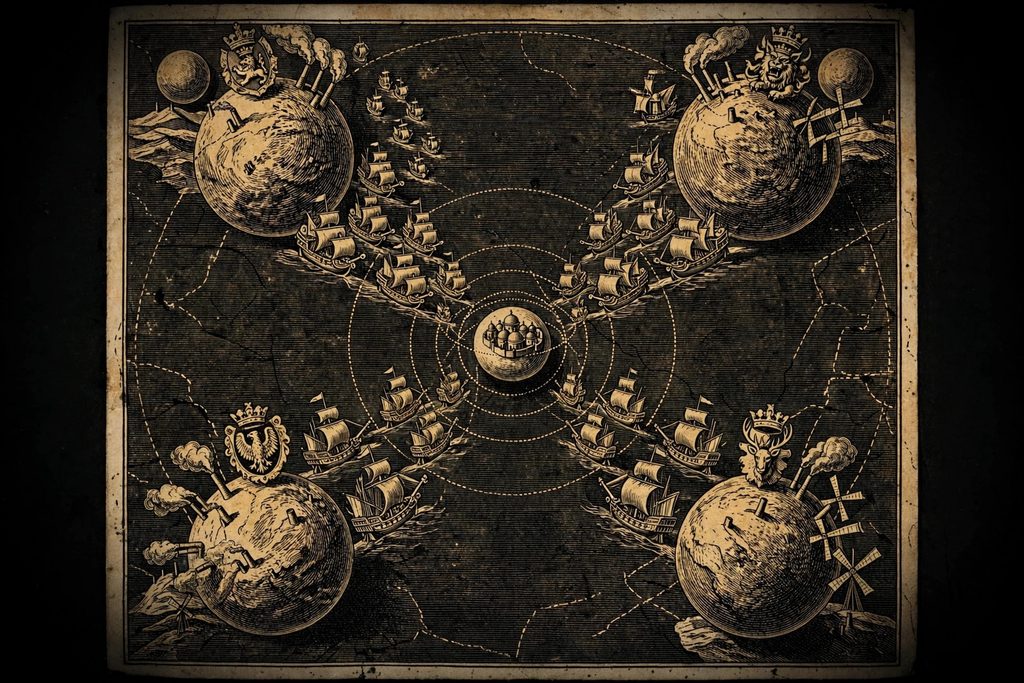
Fifty years after the founding of Terminus, the Empire has withdrawn from the Periphery. The prefects of its former provinces have crowned themselves kings. Four new kingdoms surround Terminus, Anacreon, Smyrno, Konom and Daribow, and the strongest of them, Anacreon, wants the Foundation’s planet for itself. The kingdoms have warships and soldiers. What they no longer have is nuclear power. The knowledge has been lost, and their worlds are sliding back toward coal and oil.
The scholars of the Foundation are useless in a crisis. They care only about the Encyclopedia and assume the Empire will protect them. It is the mayor of the town of Terminus City, Salvor Hardin, who sees the danger and seizes power from them. Hardin is a politician, not a scientist, and his motto has become one of the most quoted lines in science fiction. “Violence is the last refuge of the incompetent.”
Hardin’s first solution is diplomatic. He persuades the three weaker kingdoms that none of them can allow Anacreon alone to take the Foundation’s knowledge. Together they force a balance, in which every kingdom will receive nuclear technology and none may seize Terminus. Then, as the crisis peaks, a recording of Hari Seldon appears in a vault on Terminus and reveals that the whole sequence had been predicted. The Foundation was never meant to compile an encyclopedia. It was meant to survive among barbarians, and Hardin had just found the way.
III. The Religion of Science
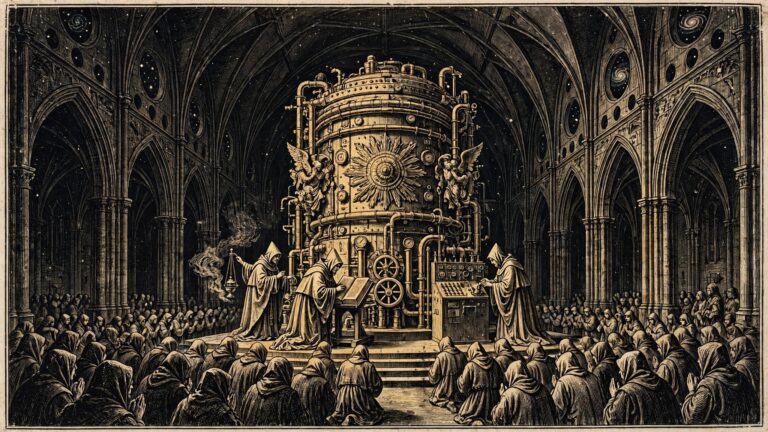
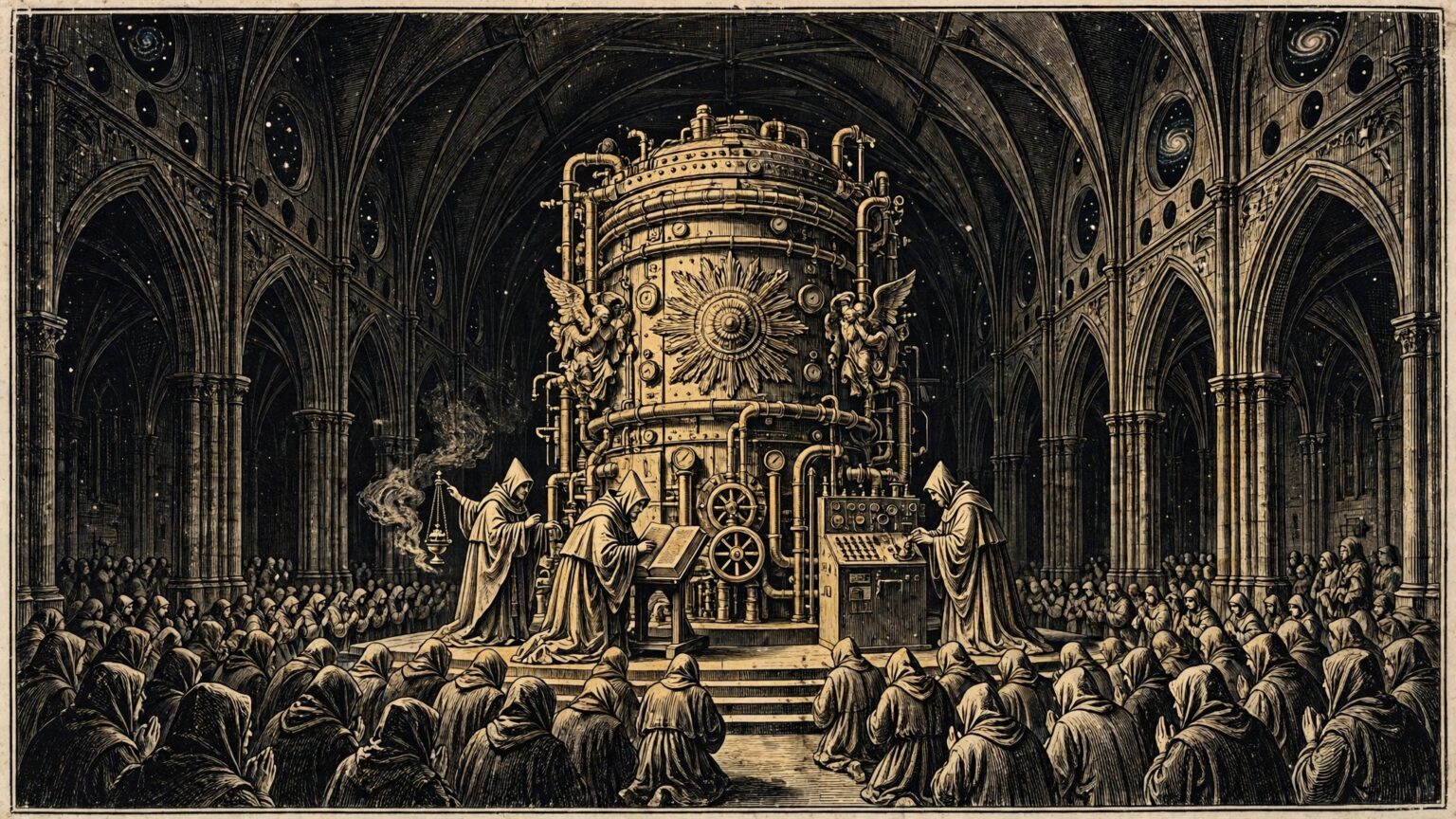
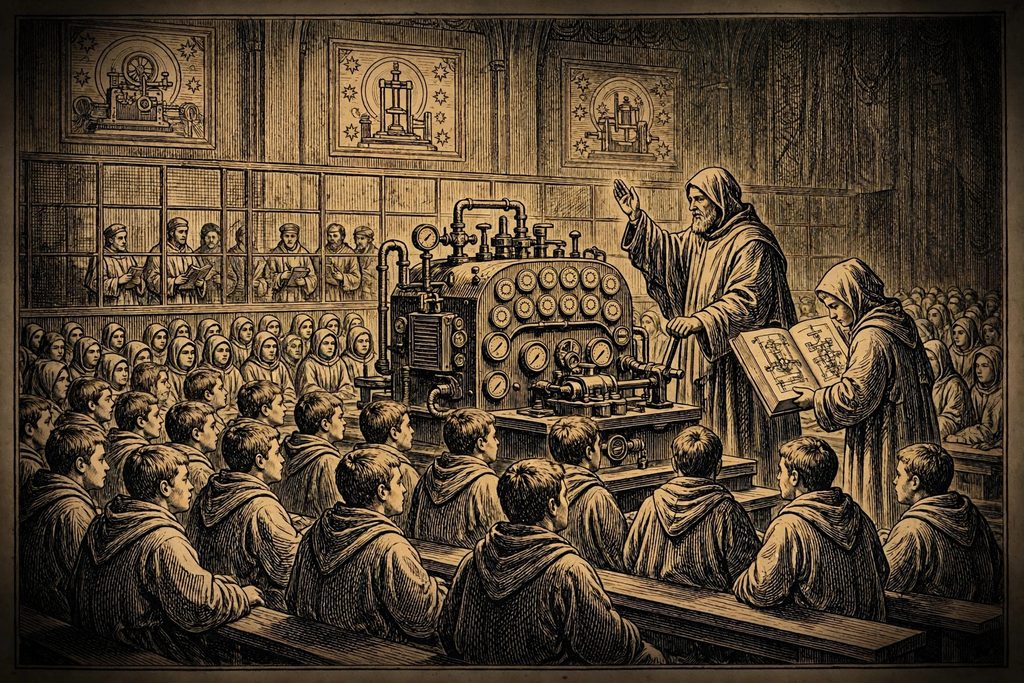
Thirty years later, the Foundation rules the four kingdoms without an army. It supplies them with nuclear power plants, starships, medicine and machines, but it never hands over the knowledge behind them. Instead, it sends priests. The technology is presented as holy, the gift of the Galactic Spirit, and its maintenance as sacred ritual. Power plants stand in temples. Engines are blessed. Only ordained priests may touch the machines, and only the Foundation may ordain priests.
The priests themselves are trained on Terminus, and most of them believe. They learn which switches to throw, which valves to turn and which prayers to say while doing it, in a sacred language and a sacred procedure, without learning the physics underneath. They become sincere, devoted and indispensable. The people of the kingdoms come to the temples for healing and for light. Even the kings depend on the priests for the power that runs their palaces, their cities and their fleets.
It is a theocracy of the most unusual kind. Its gods are fictions, and its rulers know they are fictions. Its miracles are real, because they are engineering. For Hardin, it is a tool as precise as any machine. A kingdom that worships the source of its power cannot turn that power against the church that controls it. Or so the Foundation believes, until a king tries.
IV. The Interdict
The test comes in Anacreon. Its Prince Regent, Wienis, rules on behalf of his young nephew, King Lepold I, and resents the Foundation’s priests. When the Foundation repairs an ancient Imperial battlecruiser found drifting in space and hands it over to Anacreon, Wienis sees his chance. He renames it after himself, places his son Prince Lefkin in command and sends it against Terminus, while Salvor Hardin is a guest at his court.
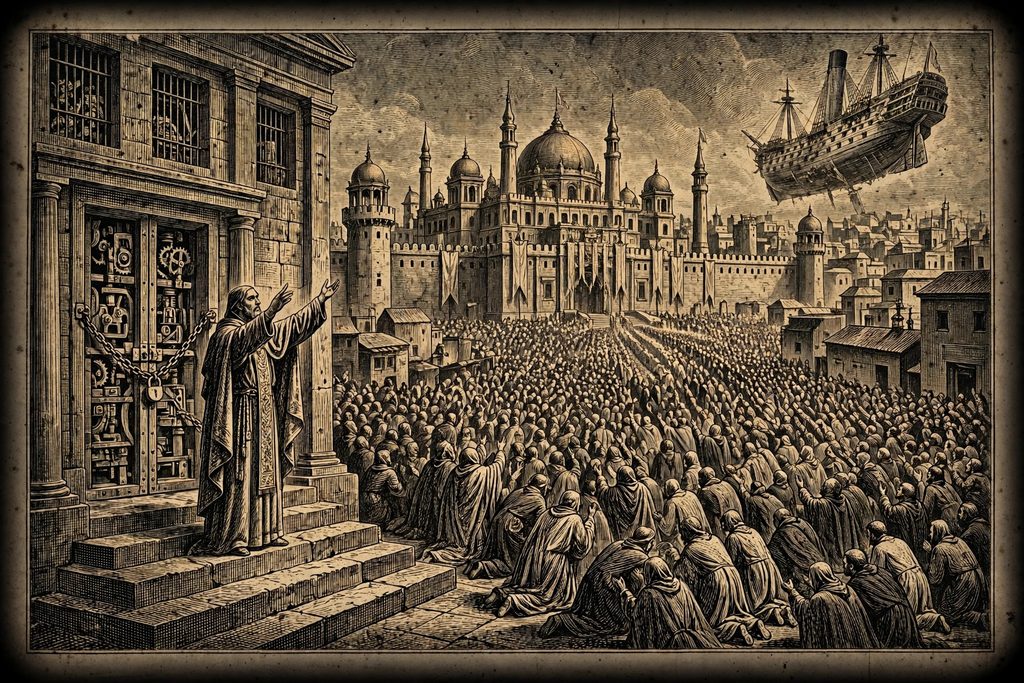
Hardin has prepared for this. On the flagship, the high priest Theo Aporat declares the expedition a sacrilege, and the ship, fitted by Foundation engineers with controls only the priesthood can command, stops obeying its officers. The crew, faithful to the church, mutinies. On Anacreon, the Foundation’s high priest Poly Verisof pronounces an interdict. The temples close. Power fails across the planet. Lights go out, machines stop, and crowds surround the royal palace demanding that the king make peace with the Spirit.
Wienis, cornered, fires a blaster at Hardin, who is protected by a personal force field. The regent then turns the weapon on himself. The crisis ends without a single Foundation soldier. Lefkin broadcasts the surrender, the power returns and the kingdom returns to the church. It is the high point of the religion of science, a church that won a war by switching off the lights.
V. When Faith Became a Liability
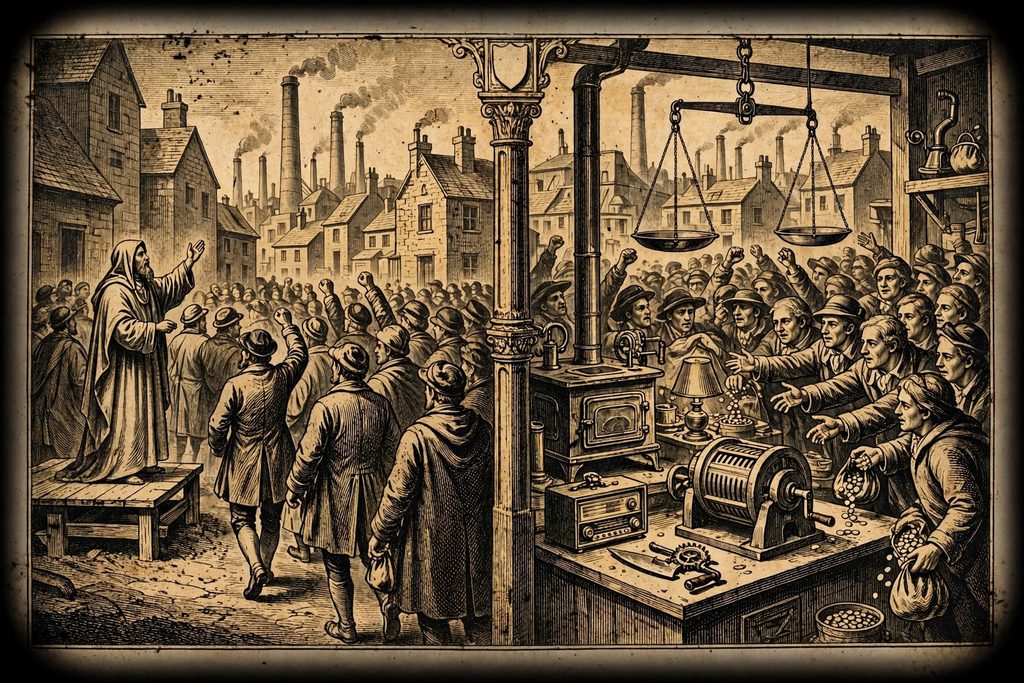
The church worked only where it had been planted early. Beyond the four kingdoms, the Foundation’s traders found worlds that wanted nothing to do with it. On Askone, the Elders kept an ancestral religion that forbade advanced technology altogether, and sentenced a Foundation trader to death for trying to sell it. The trader Limmar Ponyets freed him not with priests but with greed. He built a crude machine that turned iron into gold, sold it to an ambitious councillor, recorded him using it and blackmailed him. Gold, it turned out, converted people faster than faith.
A generation later, the Master Trader Hober Mallow drew the lesson. On the Republic of Korell, Foundation missionaries were hated, and a man posing as one was used as bait to provoke a war. Mallow refused to protect him, and was put on trial for it at home. He won, became mayor and changed the Foundation’s strategy. Korell would be conquered not by religion but by trade, with household appliances its people could not live without. When the war came, Korell surrendered because its factories and kitchens stopped working.
Mallow also saw the Empire’s own version of the problem. On Siwenna, a former Imperial province, he found nuclear power plants maintained by hereditary technicians who no longer understood them, repairing machines by rote. The Empire had turned its own science into ritual without meaning to. The Foundation had done it deliberately, and now it abandoned the method. The Religious Power, as Mallow called it, had served its purpose. The age of the priests gave way to the age of the Merchant Princes.
VI. The Gospel of Hari Seldon
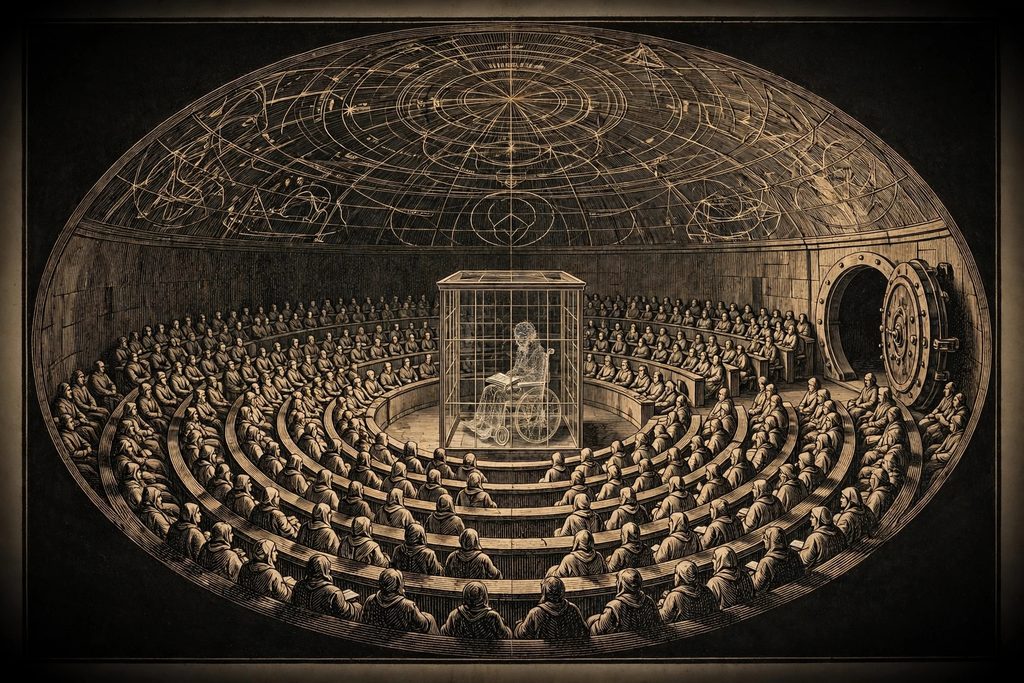
The church of the Galactic Spirit faded, but the Foundation never stopped having a faith. Its real object was Hari Seldon. At every great crisis, his recorded image appeared in the Time Vault on Terminus to explain what had just happened and why. The citizens of Terminus gathered to hear him like a congregation awaiting a prophet. Belief in the Seldon Plan, the certainty that history was on their side, became the Foundation’s true religion, and when the Mule, a mutant the Plan had not foreseen, broke that certainty, the Foundation collapsed almost overnight.
The Apple TV+ series, created by David S. Goyer and Josh Friedman, made this hidden religion explicit. Its Foundation sends clerics into the Periphery to spread what the series calls the gospel of Hari Seldon, among them Brother Constant, a novice and travelling magician, and the High Claric Poly Verisof. Its Empire has its own state faith, Luminism, and its own sacred ruler, a dynasty of cloned emperors. In the third season, released in 2025, the Emperor declares the Church of Seldon an armoury and orders its priests executed.
Between the book and the series lies a single insight. Societies do not need to believe a religion is true to be ruled by it. They need to depend on it. Asimov’s priests kept the lights on, and the people worshipped the light. Seldon’s followers trusted the Plan, and the Plan carried them, until the moment it failed. In Foundation, every faith is a technology, and every technology, sooner or later, becomes a faith.
The ancestor of them all
The idea of science dressed as religion did not begin with Asimov. Its history runs from the temples of ancient Alexandria to the court of the Chinese emperors.
In the first century CE, the Greek engineer Hero of Alexandria described in his Pneumatica a series of devices that look very much like temple miracles. One was a vessel that dispensed a measured amount of holy water when a coin was dropped into it, the first known vending machine. Another opened a temple’s doors by itself when a fire was lit on the altar, as heated air pushed water into a vessel whose weight swung the doors open, and closed them again when the fire went out. To the worshipper, the god had answered. To the engineer, it was pneumatics.
Sixteen centuries later, Jesuit missionaries in Beijing used science to win the ear of an emperor. In 1664, during a bitter dispute over the calendar, the Jesuit astronomer Johann Adam Schall von Bell was imprisoned and sentenced to death, and only an earthquake, read as an omen, saved him. In 1669, the young Kangxi Emperor held a public contest of predictions, the length of a noon shadow, the positions of the planets and the timing of an eclipse. The Flemish Jesuit Ferdinand Verbiest won all three tests and was made head of the imperial astronomical bureau. The Jesuits had hoped to bring the faith through the observatory. Like Hardin’s priests, they found that whoever controls the calendar of heaven is welcome in the palace.
The pattern
Foundation belongs to a family the Institute calls the engineered faiths, religions built deliberately by people who understand what lies behind the miracles. Its closest literary relative is Roger Zelazny’s Lord of Light, published in 1967, in which the crew of a colony ship uses advanced technology to rule a new world as the gods of the Hindu pantheon, while keeping the knowledge from everyone else.
Three features define these faiths. The first is a knowledge gap, a world where one group can do what others can no longer understand. The second is a sincere priesthood, believers who maintain the machines devoutly without knowing how they work, so that the deception never has to be spoken. The third is an exit, the moment when the founders discover that the faith they built has become harder to control than the people it was meant to control.
The contrast with the cargo-cult societies is instructive. In The Tribe That Worshipped a Machine’s Door, the Institute studied people who came to worship technology they did not understand, by accident, after the knowledge was lost. Foundation imagines the same worship produced on purpose, by the very people who kept the knowledge. Both arrive at the same temple. Only one of them knows the god is a reactor.
Findings
- The Foundation’s church was invented by unbelievers. Salvor Hardin and the scholars of Terminus wrapped nuclear power in the worship of the Galactic Spirit to control four barbarian kingdoms that had lost the knowledge of atoms.
- Its power was dependence, not belief. Priests trained on Terminus ran the kingdoms’ power plants, ships and machines as sacred rites, so no king could turn that technology against the church that controlled it.
- It won a war by switching off the lights. When Anacreon attacked Terminus, a priest stopped its flagship, an interdict darkened the planet, and the crisis ended without a Foundation soldier.
- It was abandoned when it stopped working. Beyond the four kingdoms, gold and trade proved stronger than faith, and Hober Mallow replaced the Religious Power with the commerce of the Merchant Princes.
- Its ancestors are real temples and observatories. Hero of Alexandria’s self-opening temple doors and holy water machine, and the Jesuit astronomers who won the Chinese imperial court through predictions, used science to inspire devotion long before Asimov.
This Excavation draws on Isaac Asimov’s Foundation trilogy and his autobiography, on the Apple TV+ series Foundation, on Edward Gibbon’s Decline and Fall of the Roman Empire, on Hero of Alexandria’s Pneumatica, on the history of the Jesuit astronomers in Beijing and on Roger Zelazny’s Lord of Light.
The Institute collects field evidence from people who have lived inside these worlds. If Foundation changed the way you think about faith, history or power, send us your account.
Sources
- Isaac Asimov, Foundation (1951), Foundation and Empire (1952) and Second Foundation (1953), Gnome Press.
- Isaac Asimov, “Bridle and Saddle”, Astounding Science Fiction, June 1942.
- Isaac Asimov, In Memory Yet Green, The Autobiography of Isaac Asimov, 1920–1954 (1979), Doubleday.
- Foundation (2021–), Apple TV+, created by David S. Goyer and Josh Friedman.
- Edward Gibbon, The History of the Decline and Fall of the Roman Empire (1776–1789).
- Hero of Alexandria, Pneumatica, translated by Bennet Woodcroft as The Pneumatics of Hero of Alexandria (1851), Taylor Walton and Maberly.
- Catherine Jami, The Emperor’s New Mathematics, Western Learning and Imperial Authority During the Kangxi Reign (1662–1722) (2012), Oxford University Press.
- Roger Zelazny, Lord of Light (1967), Doubleday.