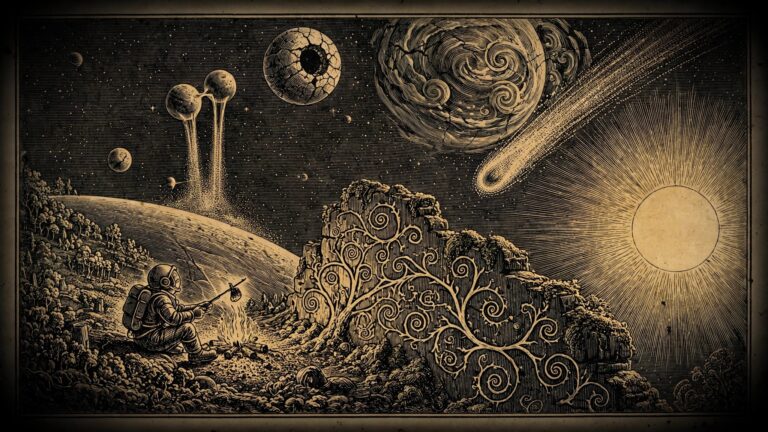


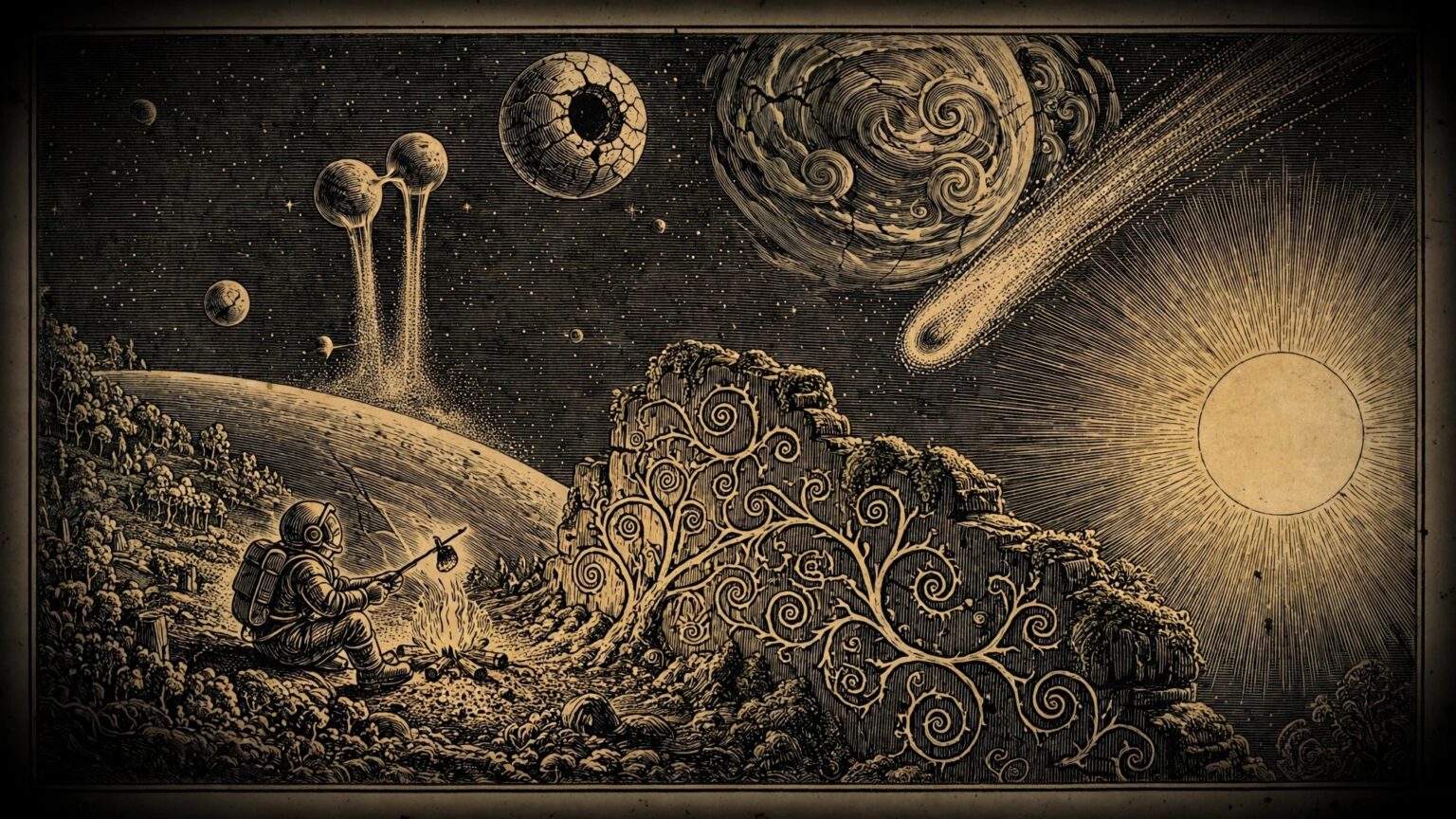
Most extinct civilizations in fiction leave behind weapons, treasure or warnings. The Nomai of Outer Wilds left behind questions. They came to a small solar system following a signal from something older than the universe, built cities on comets and in the hearts of planets, and died in an instant before they could finish what they came to do. What survives of them is their writing, thousands of spiralling conversations on walls across the system, in which they argue, joke, plan and wonder.
Outer Wilds was developed by Mobius Digital and published by Annapurna Interactive in 2019. It began in 2012 as the master’s thesis of Alex Beachum at the University of Southern California, won the Seumas McNally Grand Prize at the Independent Games Festival in 2015, and in 2020 won Best Game at the British Academy Games Awards. An expansion, Echoes of the Eye, followed in 2021. The game contains no weapons, no experience points and no upgrades. The only thing a player gains is knowledge, and almost all of it comes from reading the words of the dead.
The Institute has studied the ancient races that fiction places beneath its worlds in The Civilization Beneath Every Civilization, and the messages players leave for one another in The Message Culture of the Lands Between. The Nomai belong to both studies, but they ask a different question. Not who came before, but what a civilization owes to the people who will read it afterwards. This Excavation reveals the game’s secrets. If you have not played Outer Wilds, the Institute recommends playing it first, because it can only be discovered once.
I. The Sun That Explodes Every Twenty-Two Minutes
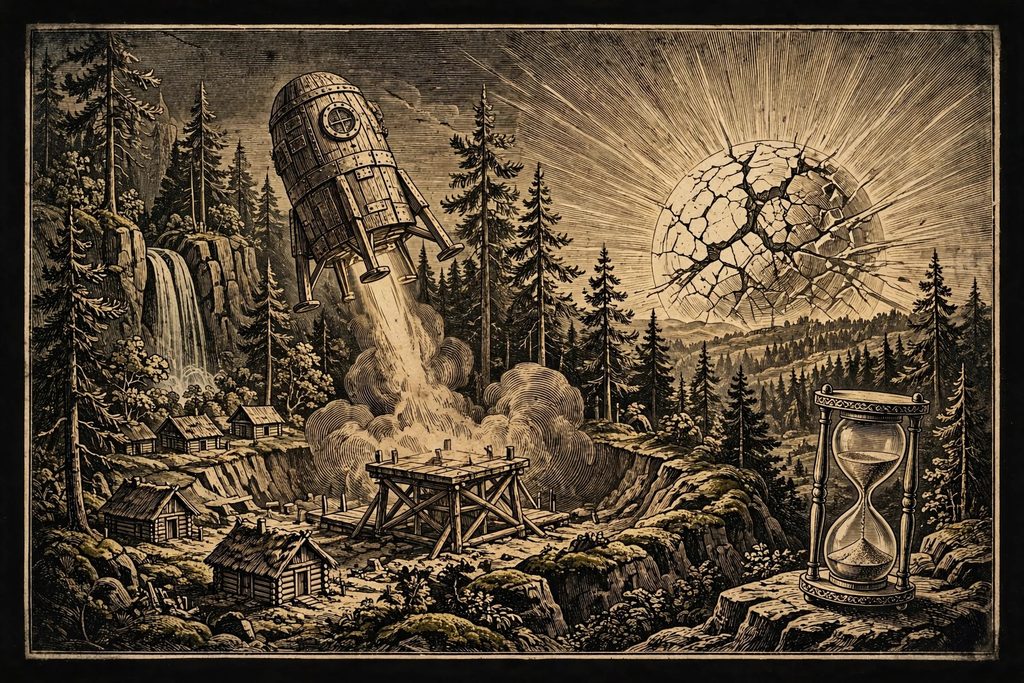
The player is a young astronaut of the Hearthians, a small, gentle species living on the forested planet Timber Hearth. Their space program, Outer Wilds Ventures, flies ships built of wood and held together with patience. On the morning of the player’s first launch, everything seems ordinary. The other astronauts are already out among the planets, camping, exploring and playing music by their campfires.
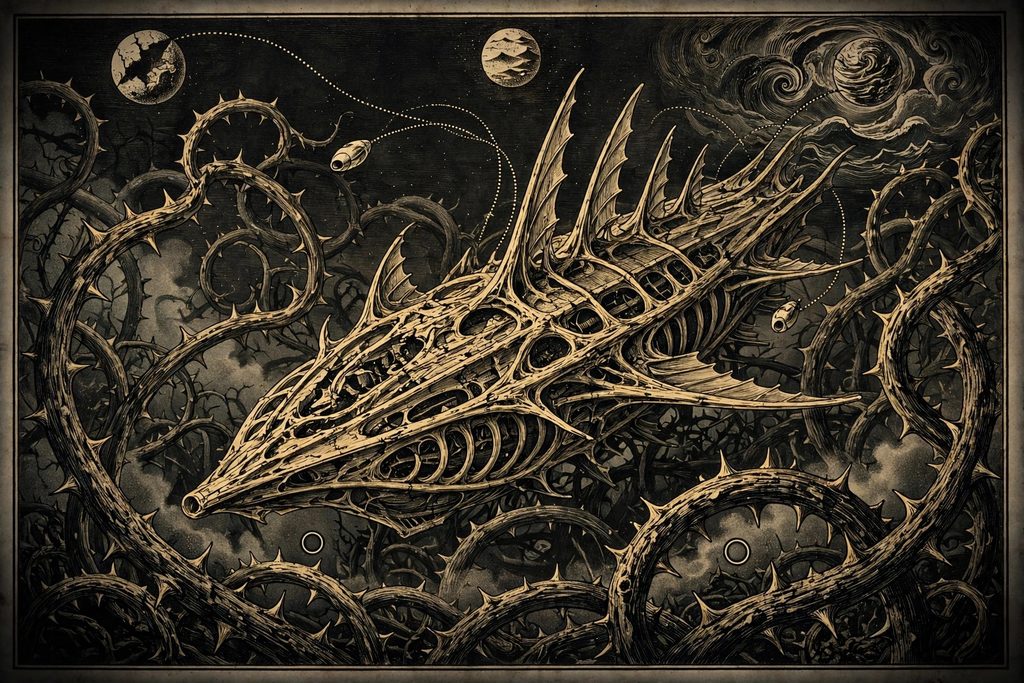
Twenty-two minutes later, the sun explodes. The supernova sweeps across the system and destroys everything. Then the player wakes again by the same campfire on Timber Hearth, on the same morning, with every memory intact. The loop repeats forever. No one else remembers. Dying resets it too, and dying is easy in a solar system where planets crumble, tornadoes hurl islands into space and an anglerfish the size of a ship hunts inside a seed of brambles.
The loop is the game’s great teacher. Because nothing the player builds or takes survives the reset, the only thing that carries forward is understanding. A door that seems impossible in the first hour becomes simple once the player knows when a column of sand will fall. Outer Wilds turns curiosity into the only form of progress, and the source of nearly everything worth knowing is a species that died long before the Hearthians learned to walk.
II. The Wanderers Who Followed a Signal
The Nomai were a nomadic people who travelled between the stars in clans. Their purpose was a search. Long before they reached the Hearthians’ system, they detected a signal from something they called the Eye of the Universe, an object that seemed to be older than the universe itself. The Nomai had no army to send and no empire to expand. They simply went to look.
Their great ship, the Vessel, reached the system and was caught inside Dark Bramble, a planet of vast thorny vines that is larger on the inside than on the outside. The survivors escaped in pods that landed on three different worlds. Unable to leave, they made the system their home. They built a city hanging beneath the crust of Brittle Hollow, a planet slowly collapsing into the black hole at its center. They built another city underground in Ember Twin, observatories, laboratories and mining outposts across the planets and moons.
When they found native life on Timber Hearth, they moved their mining elsewhere so as not to disturb it. They had no idea the small aquatic creatures they observed would one day evolve into the Hearthians. Their whole culture remained oriented toward the Eye. The cities, the science and even their rituals existed to answer one question, what was the thing that had called them across the stars?
III. A Civilization Written in Conversation
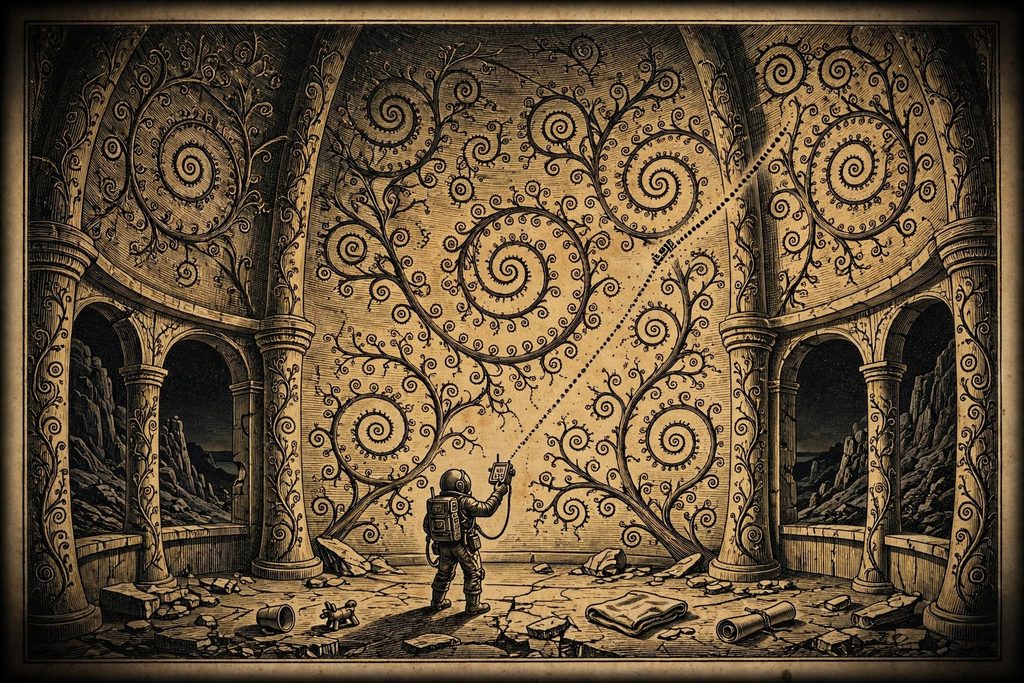
The Nomai wrote on walls in spirals. A single spiral holds one person’s thought, and when someone answers, a new spiral branches from the old one, and another from that. Their texts are not proclamations or scriptures but conversations, with several voices arguing over a single idea. The Hearthians have built a translator tool to read them, and the player spends much of the game holding it up to walls, following the branches from one voice to the next.
What those conversations reveal is a culture of friendly argument. Nomai scientists disagree with one another openly, praise each other’s work and admit their mistakes. Parents leave notes for their children, children play games in the ruins, and colleagues tease each other about lost equipment and bad ideas. There is no record of a king, a war or a god demanding obedience. Their leaders are coordinators of research, and their great debates are about ethics and evidence.
For a student of civilizations, this is rare. Most fictional ancient races are known through monuments, the voice of power speaking down to the future. The Nomai are known through the voices of ordinary people speaking to one another. The Hearthians do not meet a lost empire. They meet a lost community of colleagues, and through their writing come to feel that they would have been friends.
IV. Science Compels Us to Blow Up the Sun
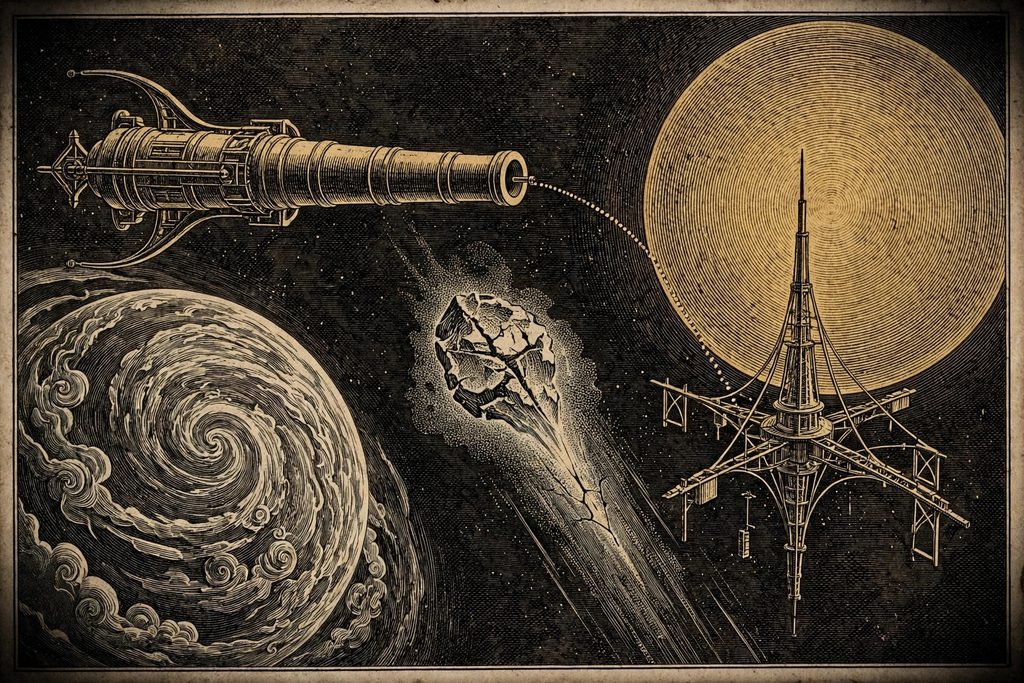
The Eye could not be found by ordinary searching. The Nomai built the Orbital Probe Cannon above the ocean planet Giant’s Deep, a great machine that fired probes in random directions in the hope that one would find it. But the chance of success with any single probe was impossibly small. They needed to fire again and again, and to remember the results of every attempt.
Their solution was the Ash Twin Project, a machine hidden inside a sandy planet that could send information twenty-two minutes back in time. If the cannon fired and missed, the project would send the result back, and the next attempt could fire in a different direction. It needed an enormous amount of energy, so the Nomai designed the Sun Station, a structure meant to make their star explode. One Nomai wrote, cheerfully, “Science compels us to blow up the sun!” Others objected that the plan betrayed everything they believed in. The debate is preserved on the walls.
The Sun Station failed. The sun did not explode. And while the Nomai were still considering what to do, a comet called the Interloper entered the system. Some of them went to study it. Inside its icy core was ghost matter, an invisible substance lethal to living things, under enormous pressure. When the core ruptured, a wave of ghost matter spread across the system, and every Nomai died in an instant. Their machines remained, waiting.
V. The Heirs
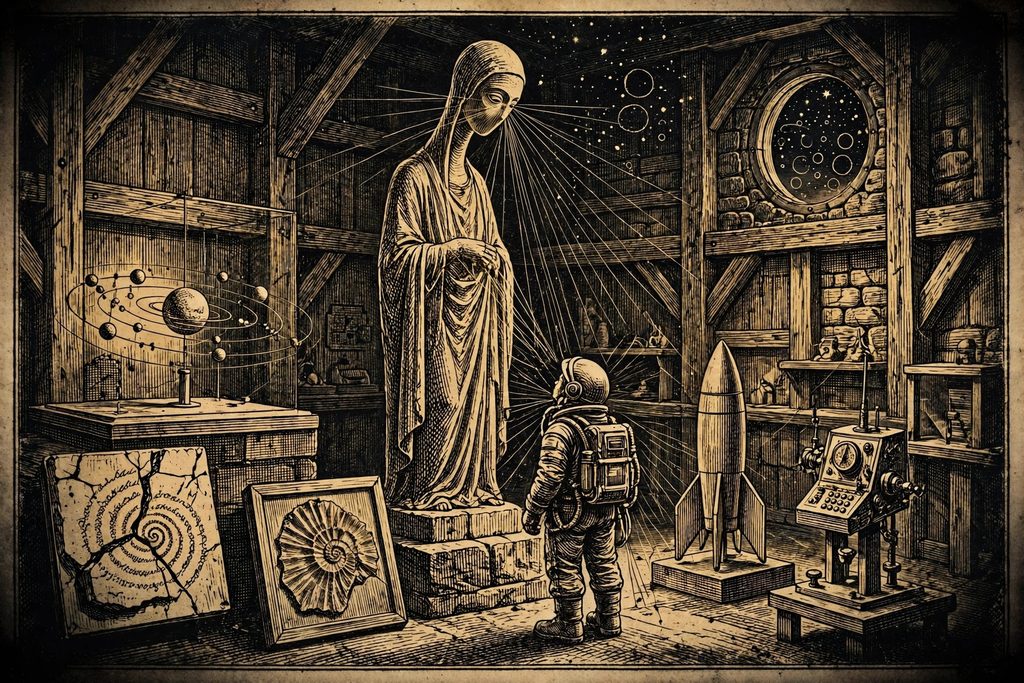
Hundreds of thousands of years later, the sun is dying of old age. Stars across the universe are going out. When the Hearthians’ sun finally explodes, naturally, the Ash Twin Project detects the energy and switches on. A dead civilization’s machine finally works. It sends information twenty-two minutes back in time, and the player, whose mind was linked to it through a Nomai statue in a Hearthian museum, is carried back with it. The loop is not a curse. It is the Nomai experiment, running at last, with a Hearthian as its subject.
The Hearthians were already the Nomai’s heirs before they knew it. Their archaeologist Riebeck studies Nomai ruins on Brittle Hollow despite a deep fear of space. Their translator tool exists because Hearthians wanted to read Nomai words. Now one of them inherits the whole project. Loop by loop, the player finds the coordinates of the Eye in the Nomai records, repairs their ancient Vessel and sets course for the place they had spent their lives trying to reach.
On the Quantum Moon, a place that exists in different locations depending on who is watching, the player meets a single Nomai named Solanum, in circumstances the game leaves mysterious. She has waited, alone, to learn what became of her people’s search. At the Eye itself, the universe ends, and from the Eye a new universe is born. The Nomai never reached it. But they left everything a stranger would need to finish the journey for them.
VI. The Strangers Who Chose Not to Know
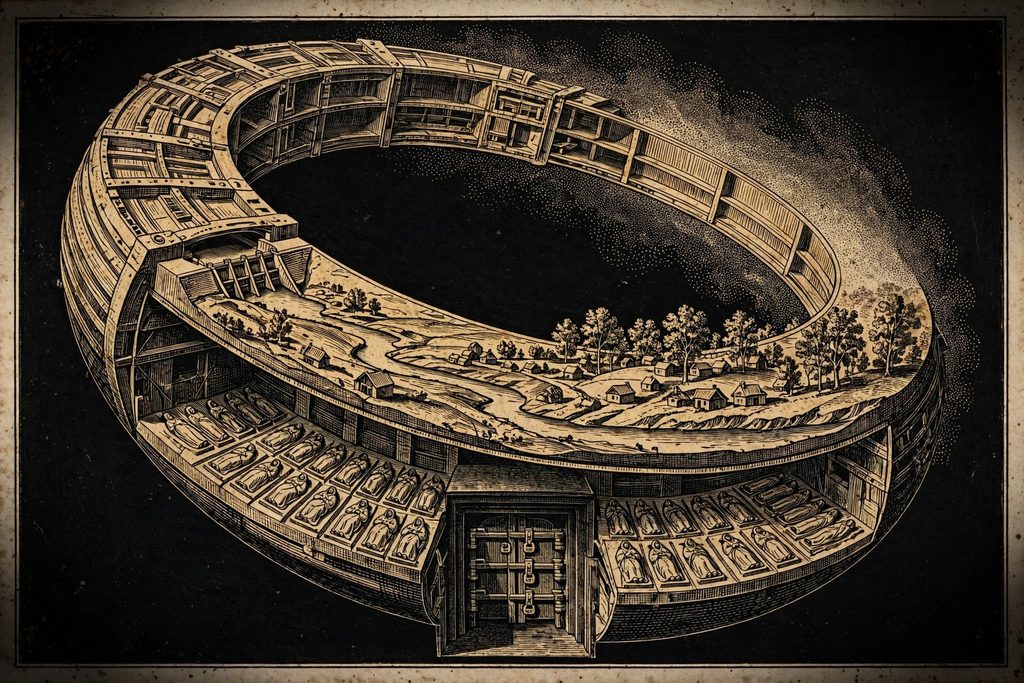
Echoes of the Eye, released in 2021, revealed that the Nomai were not the first to come. Hidden in the system, wrapped in a cloaking field, is the Stranger, an enormous rotating ring-shaped ship. Its builders, a people the game never names, also heard the signal of the Eye and travelled to reach it. They arrived long before the Nomai. And when they finally understood what the Eye was, they were filled with dread.
Their answer was the opposite of the Nomai’s. They blocked the signal so that no one else would follow it. They burned the records of their own history, the slide reels in which their story is told. Then they withdrew into a simulation of their lost home, a dream world entered through sleep, while their real bodies lay still and slowly died. Inside the dream, they live on, in a beautiful copy of a world that no longer exists, refusing to look outward.
One of them disagreed. Known to players as the Prisoner, they still believed the Eye might be good, and they briefly switched off the signal blocker. For this they were sealed in a vault, alone, for an age. But in that brief window, the signal escaped, and far across the galaxy, the Nomai heard it. When the player finally opens the vault and shows the Prisoner what followed, the Nomai search and the Hearthian journey, the Prisoner learns that their act of defiance set the whole story in motion.
The ancestor of them all
The relationship between the Hearthians and the Nomai is one that real archaeology has lived through many times. A later people finds the instruments of an earlier one and slowly works out what questions they were built to answer.
In 1900, sponge divers working off the small Greek island of Antikythera discovered a Roman-era shipwreck full of statues and treasure. Among the finds was a corroded lump of bronze, noticed in 1902 by the archaeologist Valerios Stais to contain a gear wheel. It took more than a century to understand it. Derek de Solla Price studied it with X-rays in the 1970s, and in 2005 the Antikythera Mechanism Research Project scanned it with high-resolution computed tomography, revealing dozens of gears and thousands of hidden inscriptions. The mechanism, built in the second or first century BCE, modelled the movements of the sun and moon, the phases of the moon, the cycle of eclipses and even the calendar of the Olympic Games. It was a machine for asking the sky questions, and its makers were gone long before anyone could read it again.
The other half of the story points forward. In 1977, NASA launched the two Voyager probes, each carrying a golden record with sounds, music, greetings and images of Earth, prepared by a committee chaired by Carl Sagan. Its makers knew that anyone who found it might do so long after humanity had changed or vanished. The Antikythera mechanism is a question found by heirs. The Voyager record is a question sent to them. The Nomai did both. They built instruments to question the universe, and left their notes on the walls for whoever came next.
The pattern
Outer Wilds belongs to a family the Institute calls the seeker civilizations, societies organized around a single question larger than themselves. Its closest literary relative is Arthur C. Clarke’s short story The Star, published in 1955, in which a Jesuit astronomer finds a vault on the outermost planet of a star that exploded, left by a civilization that knew it was doomed and chose to preserve a record of itself for whoever came after.
Three features define these civilizations. The first is a question that matters more than power, a search that gives the whole society its purpose. The second is an archive left in good faith, knowledge recorded not to command the future but to help it. The third is an heir, a later people who complete the search because the dead made it possible. The Nomai have all three. Their question was the Eye, their archive was every wall in the system, and their heir is a young Hearthian with a translator and a wooden ship.
What makes Outer Wilds unique in this family is that Echoes of the Eye shows the road not taken. The builders of the Stranger faced the same question and chose to hide from it, much like the kingdom the Institute studied in The Kingdom That Tried to Forget Its God, which sealed away the light it could not bear to face. Side by side, the two peoples form a single argument. A civilization that hides from its question ends in a dream of its own past. A civilization that pursues it may die, but leaves the future its curiosity.
Findings
- The Nomai are known through their questions, not their power. Their surviving record is a vast body of spiralling conversations, in which scientists, parents and children argue, joke and wonder, with no trace of a king, a war or a god.
- Their whole civilization served a single search. Drawn across the stars by the signal of the Eye of the Universe, they built cannons, laboratories and a machine to send information back in time, all to find one object.
- They died before they could finish. The Sun Station failed, and ghost matter released from the core of the Interloper comet killed every Nomai in an instant, leaving their machines waiting for hundreds of thousands of years.
- The Hearthians became their heirs. When the sun finally exploded on its own, the Ash Twin Project carried a Hearthian astronaut through the time loop the Nomai had designed, and their records guided the journey to the Eye.
- Echoes of the Eye shows the opposite choice. The builders of the Stranger blocked the signal, burned their history and retreated into a simulation, and only the defiance of the Prisoner let the Nomai hear the call at all.
This Excavation draws on Outer Wilds and its expansion Echoes of the Eye, on interviews with Alex Beachum and Mobius Digital, on the history of the Antikythera mechanism and its modern study, on the Voyager Golden Record and on Arthur C. Clarke’s The Star.
The Institute collects field evidence from people who have lived inside these worlds. If you remember the loop when everything finally made sense, or the moment you read the last words of the Nomai, send us your account.
Sources
- Outer Wilds (2019) and Outer Wilds, Echoes of the Eye (2021), Mobius Digital, published by Annapurna Interactive.
- Phill Cameron, “Road to the IGF, Alex Beachum’s Outer Wilds”, Gamasutra (now Game Developer), 27 January 2015.
- Chris Wallace, “We didn’t think it would have tremendously broad appeal, Mobius Digital on the multi-BAFTA award-winning Outer Wilds”, MCV/Develop, 3 April 2020.
- Derek de Solla Price, “Gears from the Greeks. The Antikythera Mechanism, a Calendar Computer from ca. 80 B.C.”, Transactions of the American Philosophical Society 64, no. 7 (1974).
- Tony Freeth et al., “Decoding the ancient Greek astronomical calculator known as the Antikythera Mechanism”, Nature 444 (2006), 587–591.
- Tony Freeth et al., “A Model of the Cosmos in the ancient Greek Antikythera Mechanism”, Scientific Reports 11 (2021), 5821.
- Carl Sagan et al., Murmurs of Earth, The Voyager Interstellar Record (1978), Random House.
- Arthur C. Clarke, “The Star”, Infinity Science Fiction, November 1955.