





EXCAVATION Nº 0014 · RELIGIONS
World: Arrakis, Dune
Period: 10,191 AG onward (in-world)
Status: Active
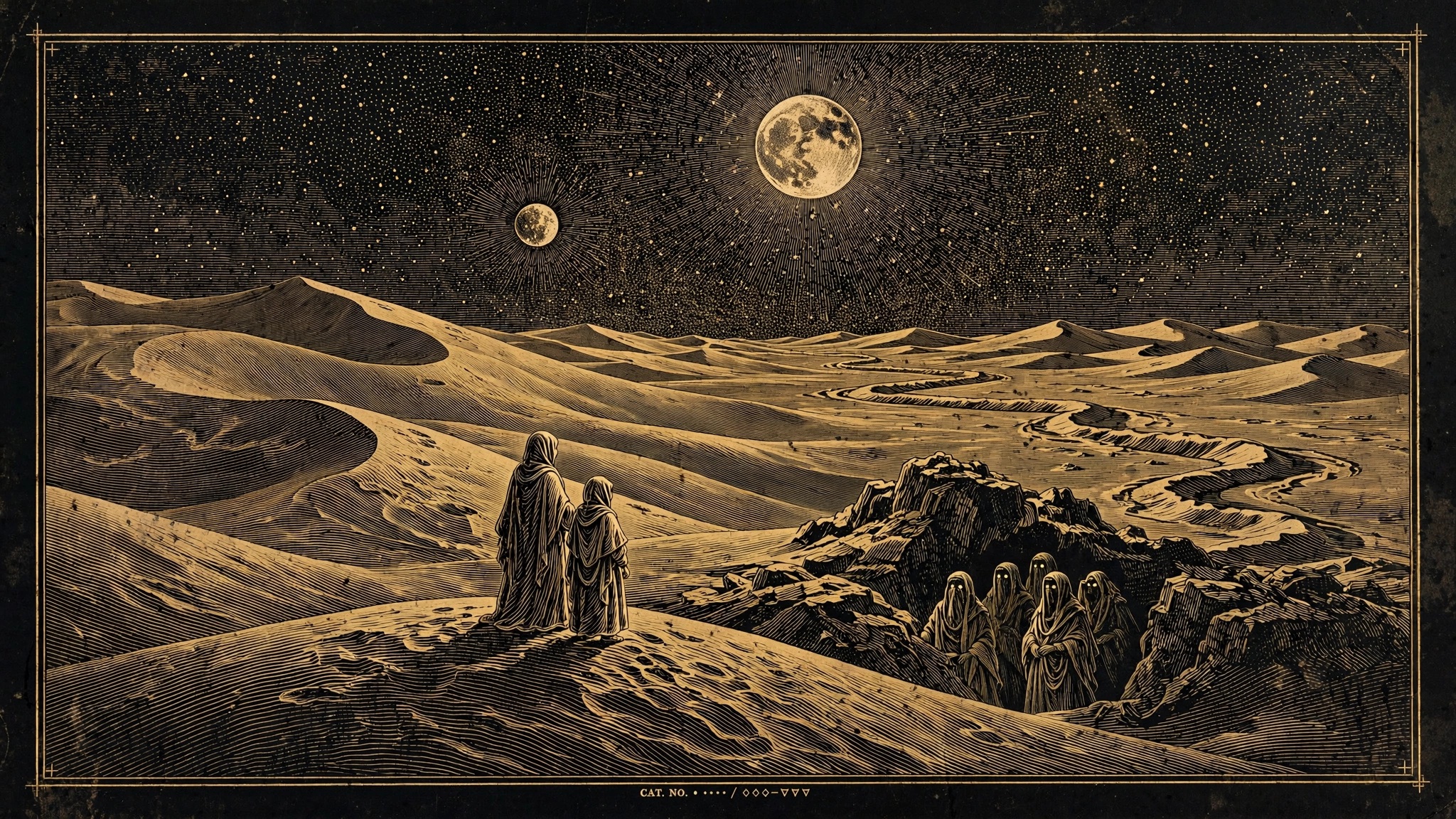
A woman and her son flee into the deep desert of Arrakis after the destruction of their house. They are captured by a band of Fremen, the hardened people of the open sand. To survive, the woman must win their trust, and as the Fremen speak, she begins to hear something she recognises. The phrases, the expectations, and the legend of a mother and a son who will come from another world are fragments of a prophecy written by her own order. Her sisters planted it on this planet centuries ago, for exactly this kind of emergency. Lady Jessica realises that her life, and her son’s, depends on playing roles that were scripted before either of them was born.
This is one of the central situations of Dune, the novel Frank Herbert published in 1965, and it is one of the most original ideas about religion in all of fiction. The faith that will carry Paul Atreides to power and set a galaxy on fire was not revealed, inherited or invented by its believers. It was engineered in advance by an outside organisation, as a protective device, and left to grow on its own.
The Religions department studies how fictional faiths are born, practised and transformed. Dune asks a question no other work of fiction asks so directly. What happens to a religion that was designed as a tool, when it works?
I. The Planters
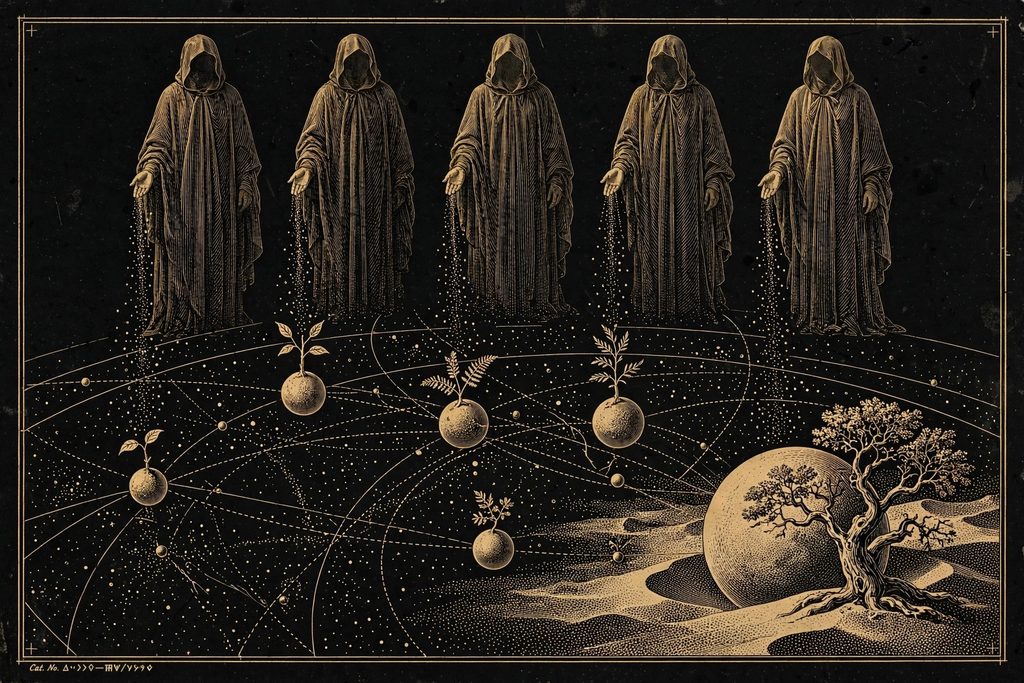
The Bene Gesserit are an ancient sisterhood of women trained in extraordinary physical and mental disciplines. Over many centuries they have been pursuing a long breeding programme across the noble houses of the Imperium, aiming to produce a man with powers no human has possessed. They call him the Kwisatz Haderach. To protect their members as they travel the galaxy, the sisterhood maintains a division called the Missionaria Protectiva.
According to the glossary Herbert attached to the novel, the Missionaria Protectiva is the arm of the order charged with sowing infectious superstitions on primitive worlds, so that those regions are opened to the Bene Gesserit. Its tool is a body of prepared prophecies and legends known as the Panoplia Propheticus. These include stories of saviours, signs, wise women and chosen children, written so that any future Sister who arrives in trouble will find a people already primed to recognise and protect her.
It is an extraordinary institution to imagine. It is a religious organisation whose members do not believe in the religions they spread. The Missionaria works like a gardener planting seeds whose harvest no one alive will see. It does not need anyone to believe its stories now. It only needs them to be believed when they are needed.
II. The Soil
A planted religion still needs soil, and the Fremen were fertile ground for reasons that had nothing to do with the Bene Gesserit.
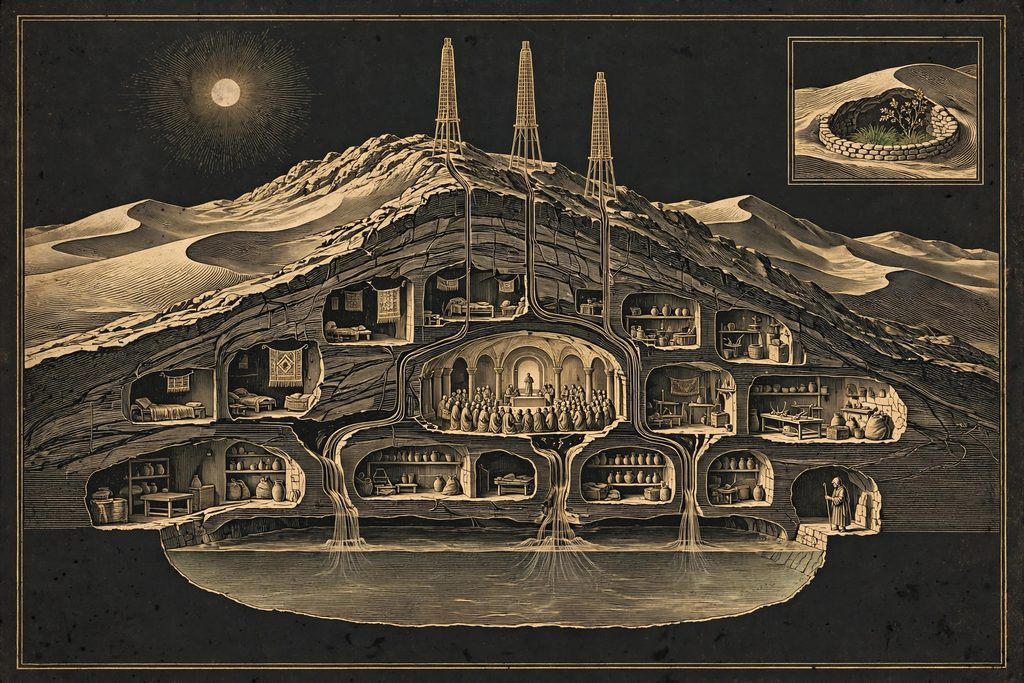
The Fremen descend from the Zensunni wanderers, peoples who were persecuted and driven from world to world over thousands of years before they settled on Arrakis. There they built a culture of survival around the planet’s defining fact, its lack of water. They live in sealed communities called sietches, wear stillsuits that recycle every drop of the body’s moisture, and reclaim the water of their dead for the tribe. A tear shed for the dead is a gift of water, and among the Fremen there is no greater honour. Their scripture, the Kitab al-Ibar, combines survival instruction with religious teaching, because on Arrakis the two cannot be separated. The great sandworms that rule the desert they call Shai-Hulud, the Old Man of the Desert, and they treat the worm as a manifestation of the divine.
A second, newer faith had also taken root among them, and it was ecological. Pardot Kynes, an Imperial planetologist sent to Arrakis, went to live among the Fremen and gave them a vision. Through centuries of patient work, catching dew, planting grasses to hold the dunes, and storing water in hidden cisterns, Arrakis could be transformed into a green world. His son, Liet-Kynes, carried on the work. Among the Fremen, the dream of a green Arrakis became a sacred goal, pursued with religious discipline across generations. The appendix to the novel, “The Ecology of Dune”, makes clear how deliberately Herbert built this. Herbert’s interest began in 1957, when he travelled to Florence, Oregon, to research a government project that used grasses to stop sand dunes moving.
The Fremen, then, were a people already shaped by persecution, hardship and long-term hope. They were waiting for a deliverance they had every reason to believe in. The Missionaria’s legends did not create their longing. They gave it a name and a shape.
III. The Harvest
When Jessica and Paul fall into the hands of the Fremen, the harvest begins.
The Fremen have a legend of the Lisan al-Gaib, the Voice from the Outer World, an off-world prophet who will lead them to paradise. They also expect a wise woman who will come with him. Jessica, trained by the Bene Gesserit, recognises the shape of her order’s work at once and chooses her words and actions to match the expectations planted long before. Paul, who has begun to develop prescient visions, sees further still. He understands that the legend is a tool, that it will work, and what it will cost.
Paul takes a Fremen name, Muad’Dib. He learns their ways, rides the great worms, and survives the Water of Life, a poison only a Reverend Mother is supposed to survive. With each step he fulfils more of the prophecy. The Fremen come to see him as their Mahdi, the one who will lead them to paradise, a term taken from Islamic eschatology. Some of those closest to him, most memorably Chani in Denis Villeneuve’s 2024 film Dune Part Two, see the danger clearly. But the legend does not need everyone to believe it. It needs enough people to believe it at the right time.
The Institute notes the uncomfortable precision of Herbert’s design. The prophecy was false in its origin and true in its effects. Paul really does have extraordinary powers, he really does lead the Fremen to victory, and he really does transform Arrakis. The Missionaria wrote a story, and then a man was born who could make it true.

IV. The Jihad
The tragedy of Dune is that a religion built as a shield becomes a weapon that no one can control.
Paul’s prescience shows him a terrible future. In it, a holy war is fought in his name across the galaxy by fanatical Fremen legions. He struggles to avoid it and fails. By the time of Dune Messiah (1969), the sequel, the jihad has swept through the Imperium, and Paul himself reckons the dead in tens of billions. He has become emperor and god, and he cannot stop what he has become a symbol of. The religion has outgrown both the Bene Gesserit who planted it and the man who harvested it. The sisterhood’s breeding plan has failed too. Jessica, defying her orders, bore a son instead of a daughter, and the Kwisatz Haderach arrived a generation early and outside their control.
Herbert was explicit about what he meant. In his 1980 essay “Dune Genesis”, written for Omni magazine, he described the dangers of the messianic figure: “Heroes are painful, superheroes are a catastrophe. The mistakes of superheroes involve too many of us in disaster.” He also urged readers not to give up their critical judgement to people in power, however admirable they seem. Dune was misread for years as the triumphant story of a hero who becomes a god. It is better read as a careful description of how a population can be led into catastrophe by a story that was designed to manipulate it.
Villeneuve’s second film placed this warning at its centre, and his third, an adaptation of Dune Messiah scheduled for release in December 2026, is expected to carry it to its conclusion.
V. The God Who Swallowed the Religion
Herbert took the idea further than almost any other writer has taken a fictional faith. In God Emperor of Dune (1981), Paul’s son Leto II has fused his body with the sandworm and rules the Imperium as a living god for more than three thousand years. The religion born of the Missionaria’s prophecy has become a single, total state church centred on one immortal being.
Leto’s purpose is deliberate. He imposes a long, crushing peace, which he calls the Golden Path, to teach humanity a lesson so deep it will never again submit to a single ruler or a single story. Religion here reaches the end of its arc as an instrument. It began as a protective legend planted by a sisterhood, became a holy war in Paul’s name, and ends as a god-emperor using his own worship to cure humanity of the need for gods.
Few real or fictional religions have been examined across such a span of time. Herbert gave the planted faith a complete life cycle. It is seeded, it takes root, it is harvested, it explodes, it is institutionalised, and it is finally turned against itself.
VI. The World Without a Messiah
The idea has proved durable beyond the novels. Dune: Awakening, a survival game released by the Norwegian studio Funcom in June 2025, is set in an alternate history. In its timeline, Jessica obeys the Bene Gesserit and bears a daughter, and Paul is never born. The Fremen have mysteriously vanished, and players take the role of an agent working to find them.
For a student of the Missionaria Protectiva, it is a fascinating thought experiment. In this version, the legends are still in place, but the messiah they were waiting for never comes. Every prophecy still waits for someone to fulfil it. The game asks, in effect, what happens to a planted religion when the harvest never arrives.
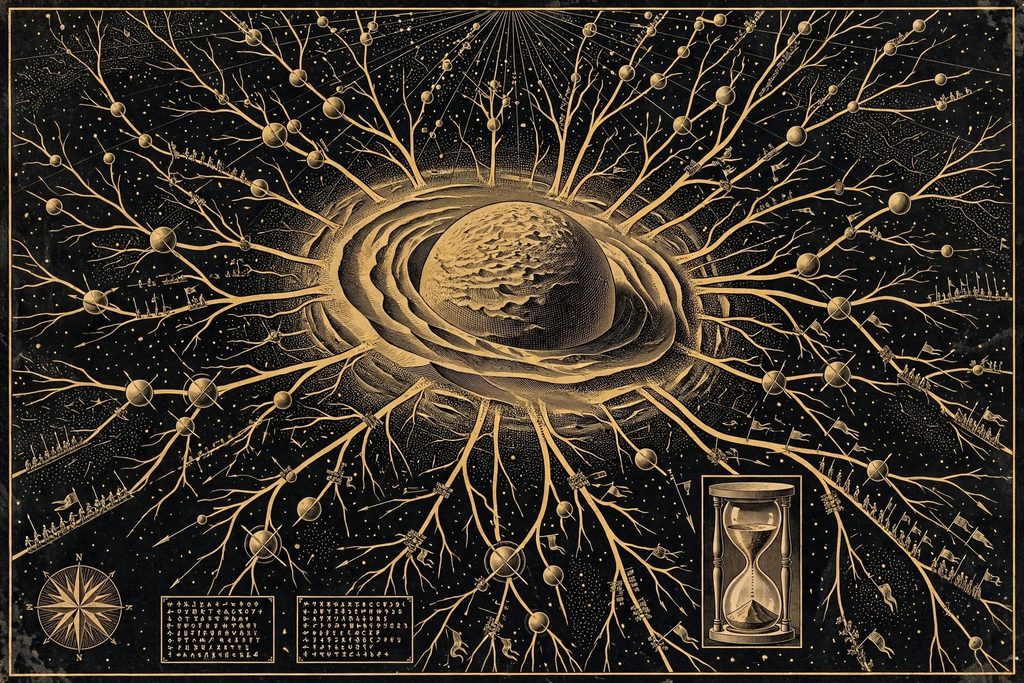
The ancestor of them all
The idea that religion can be deliberately used to govern people is ancient. According to Livy and Plutarch, Numa Pompilius, the legendary second king of Rome, gave his laws authority by claiming that he received them in secret meetings with a divine nymph, Egeria. In the sixteenth century, Niccolò Machiavelli praised Numa for exactly this in his Discourses on Livy. He argued that a ruler who wished to introduce new laws would find no surer foundation than religion. Plato’s Republic describes a “noble lie”, a founding myth told to citizens so that they will accept their places in the city.
Herbert drew on real history as well as political theory. He was influenced by Lesley Blanch’s The Sabres of Paradise (1960), a history of the nineteenth-century resistance of the peoples of the Caucasus, led by the religious leader Imam Shamil, against the Russian Empire. He is widely recognised to have borrowed language and atmosphere from it. Historians have also compared Paul’s story to messianic movements such as the uprising led by Muhammad Ahmad, who declared himself the Mahdi in Sudan in 1881.
What Herbert added was the idea of a religion planted in advance, by people who did not believe it, for a purpose that might not arrive for centuries. Real religions arise from the experience of their communities. In Melanesia, the cargo movements of the twentieth century grew spontaneously out of contact with colonial wealth. The Missionaria Protectiva is the reverse of that, contact deliberately preceded by belief. No real institution has ever done this at such scale, and that is precisely why Dune’s version is so unsettling.
The pattern
The religion of Arrakis follows a sequence the Institute has seen in other fictional faiths, made explicit:
- A planted story needs prepared soil. The Missionaria’s legends worked because the Fremen were a persecuted people already living in hope.
- A false origin can produce true effects. The prophecy was invented, but the man who fulfilled it had real power, and his victories were real.
- Tools escape their makers. The Bene Gesserit lost control of their legend, and Paul lost control of his jihad.
- Religion moves from shield to sword to state. A protective device became a holy war, then the institution of a god-emperor.
- The deepest warning is about belief itself. Herbert’s lesson is not that the Fremen were foolish, but that any people can be led into disaster by a story told well enough.
For other studies of fictional religions, see The Cults of the Wasteland and The Civil War Over a Forbidden God. For another living world shaped by ecology and faith, see Eywa.
Findings
- The religion of Arrakis was engineered in advance. The Bene Gesserit’s Missionaria Protectiva planted prophecies on Arrakis so that a future Sister in danger would find a people ready to protect her.
- It grew because the soil was ready. The Fremen’s history of persecution, their water-centred faith and Kynes’s ecological dream gave the planted legends deep roots.
- The prophecy was false in origin and true in effect. Paul Atreides fulfilled a story written by others, and his power and victories were real.
- The tool escaped its makers. The jihad fought in Paul’s name killed billions and could not be stopped by the sisterhood that planted the legend or the man who used it.
- Herbert wrote a warning, not a celebration. In “Dune Genesis” he called superheroes a catastrophe, and the saga traces a planted faith through its whole life cycle, from legend to holy war to god-emperor.
This Excavation draws on Frank Herbert’s Dune novels, their adaptations, and Herbert’s own writing about them. Read more about how the Institute works.
The Institute collects field evidence from people who lived inside these worlds. If Dune changed how you think about belief and power, send us your account.
Sources
- Frank Herbert, Dune (1965), including its appendices “The Ecology of Dune” and “Terminology of the Imperium”. Also Dune Messiah (1969) and God Emperor of Dune (1981).
- Frank Herbert, “Dune Genesis”, Omni (July 1980). Quotations via Wikiquote.
- Dune Part Two (Denis Villeneuve, 2024) and Dune Part Three, scheduled for 18 December 2026.
- Dune: Awakening (Funcom, 2025).
- Lesley Blanch, The Sabres of Paradise (1960).
- Livy, History of Rome, Book 1, and Plutarch, Life of Numa, on Numa and Egeria.
- Niccolò Machiavelli, Discourses on Livy, Book 1, chapters 11 to 15.
- Plato, Republic, Book 3, on the “noble lie”.