





EXCAVATION Nº 0010 · RELIGIONS
World: Faerûn, Baldur’s Gate
Period: 1358 DR to 1492 DR (in-world)
Status: Active
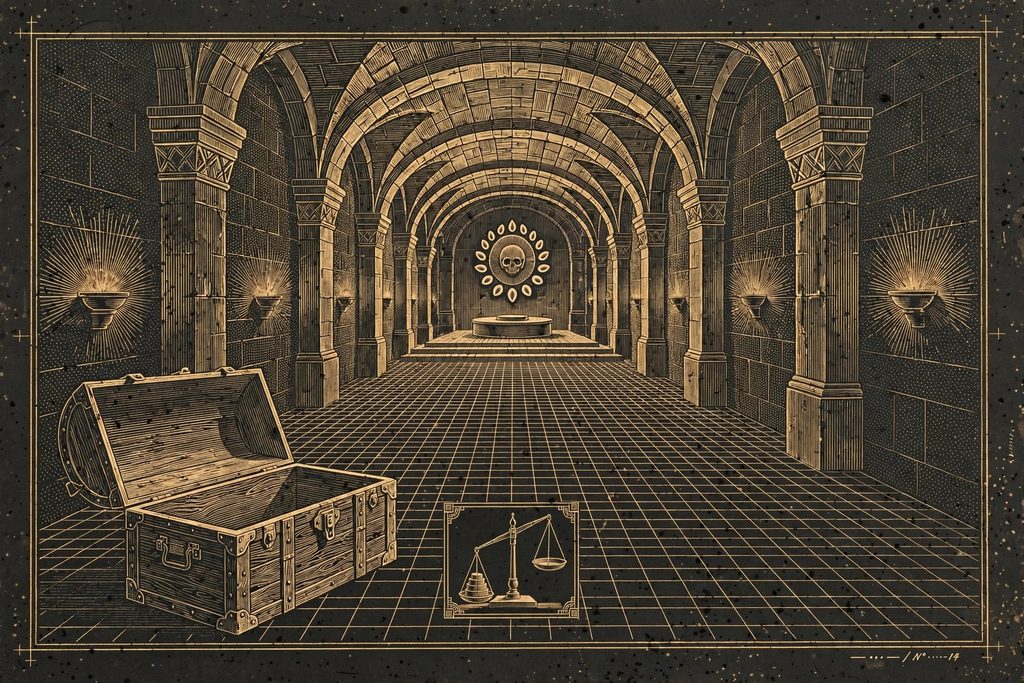
At the end of 2025, a Baldur’s Gate 3 player posting on Reddit as Longwinter1641 finished a project that had taken an entire playthrough. Across all three acts of the game, they had collected the body of nearly every unique character who died, including villains, bystanders, heroes and even the parents of one of their own companions. They carried the bodies in their inventory with the help of a mod for unlimited carrying capacity. The collection reportedly weighed more than forty-five tons. Then they carried all of it to the Temple of Bhaal, far beneath the city of Baldur’s Gate, and laid some 850 bodies out on the floor of the sanctuary. The game’s frame rate reportedly dropped into single digits under the weight of the dead.
The community laughed, and so did the player. But in the language of the setting, what they had done had a name. It was an offering. For thousands of years the fictional followers of Bhaal, the Lord of Murder, have brought the dead to his temples in exactly this spirit, and a real person had just done the same in a spirit of play. It is a fitting tribute to one of the strangest gods in fantasy, a god of murder who began as a mortal, died, and has come back again and again through the people who carry his blood.
The Religions department studies the faiths of imagined worlds. Bhaal’s religion is unusual in almost every respect, and it is one of the few fictional faiths that players have lived inside for more than twenty-five years, across four decades of games.
I. Three Adventurers and a Game of Bones
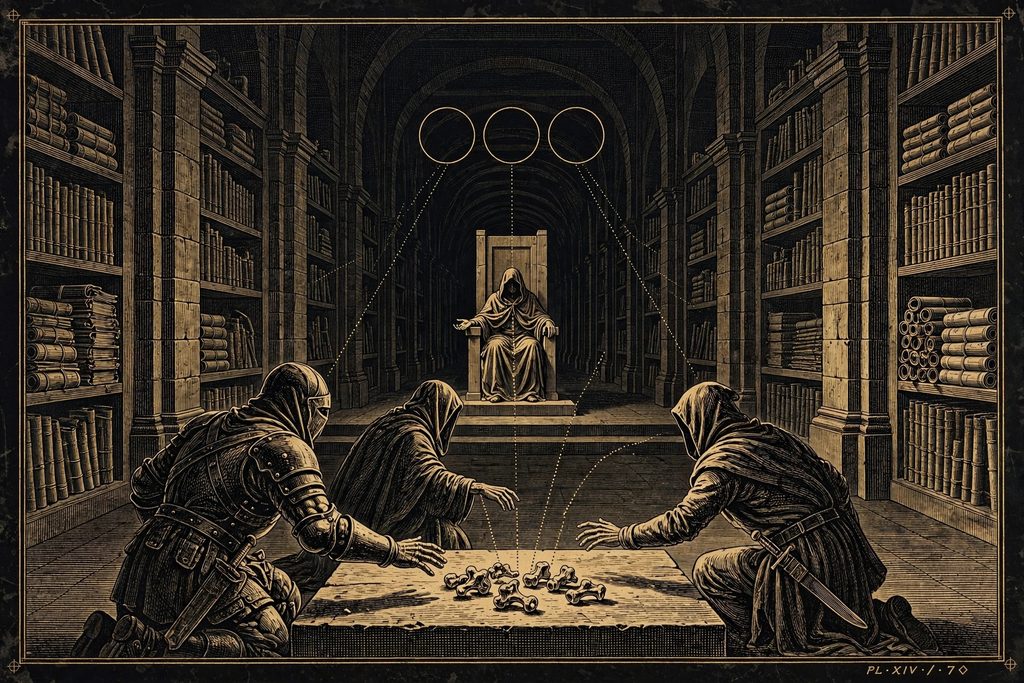
In the lore of the Forgotten Realms, the world in which the Baldur’s Gate games are set, Bhaal was not born a god. He was a mortal adventurer, ambitious and ruthless, who travelled with two companions, Bane and Myrkul. Together they sought out Jergal, the ancient god of the dead, intending to take his power.
What they found was a god who was tired of it. Jergal offered them his realm willingly. The three divided his domains between them in a game of knucklebones, the ancestor of dice, played with the small bones of an animal’s ankle. Bane won tyranny, hatred and strife. Myrkul won dominion over the dead. Bhaal won violent death itself, the act of killing. Jergal stayed on as a humble scribe of the dead, and in Baldur’s Gate 3 he appears as the enigmatic Withers.
The three became known as the Dead Three. The Institute notes how precisely this myth defines the god. Bhaal’s divinity was not revealed, inherited or earned by virtue. It was won by chance in a game played by three killers, and it has the character of its origin. Murder is violence without justification, and Bhaal holds it because he happened to throw the right bones.
II. The Death at Boareskyr Bridge
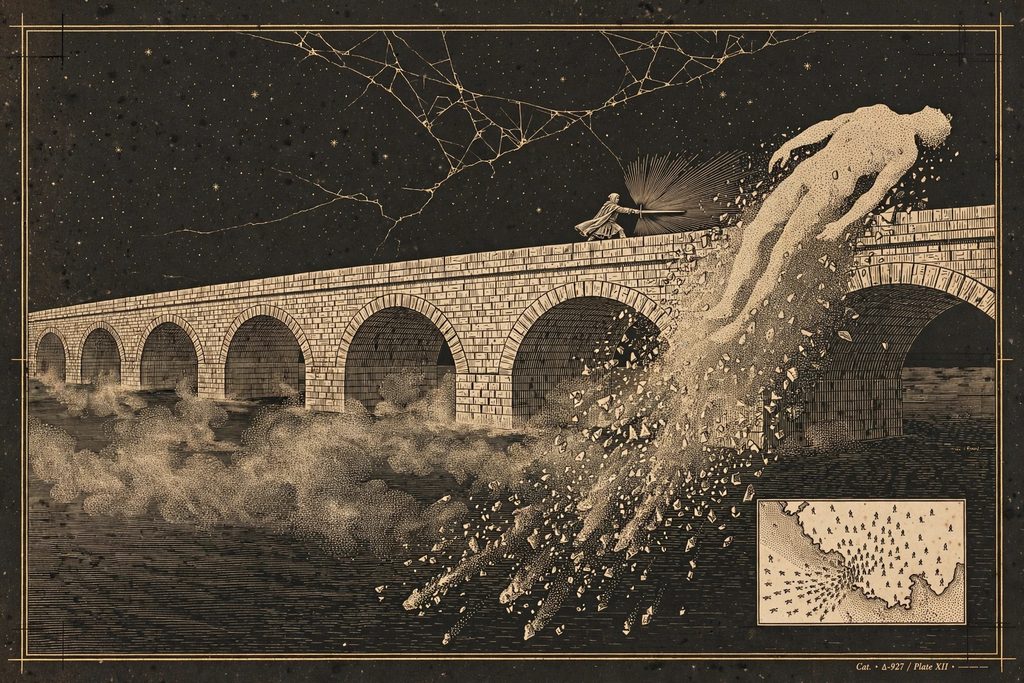
In the year 1358 by the Realms’ calendar (Dalereckoning, written DR), the gods of Faerûn were punished. Two of the Dead Three had stolen the Tablets of Fate, and the overgod Ao cast the entire pantheon down into mortal bodies to walk the world until the tablets were returned. The period became known as the Time of Troubles. Gods could be wounded in it, and they could die.
Bhaal died. At Boareskyr Bridge, a mortal thief named Cyric killed him with a sword called Godsbane, which was secretly another god, Mask, in the form of a blade. Cyric took Bhaal’s divine power for himself and rose to become a god of murder, strife and lies.
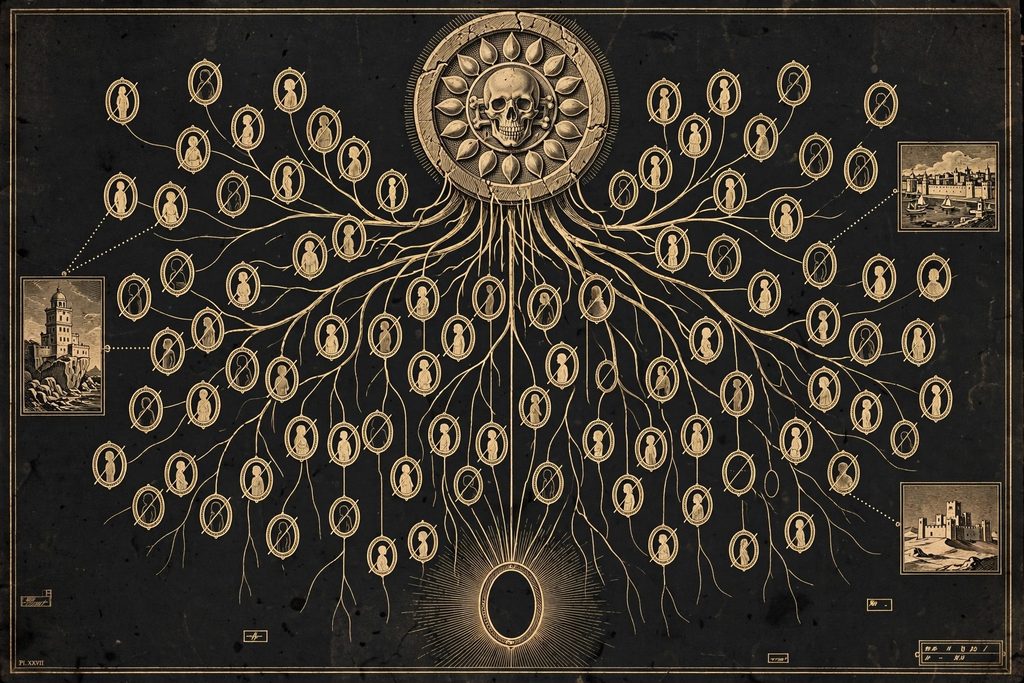
But Bhaal had foreseen his death. Before it came, he fathered children with mortal women across the Sword Coast, planting his divine essence in their blood. When he died, that essence remained scattered through his offspring. If they killed each other, the surviving essence would gather in fewer and fewer of them, until it could be reunited and he could live again. His death was therefore not an ending but the start of a long, deliberate plan. The opening of the first Baldur’s Gate game, in 1998, quotes the prophecy of the seer Alaundo, which foretold that the Lord of Murder would perish but leave behind “a score of mortal progeny” whose passage would sow chaos.
This is the heart of Bhaal’s theology, and the Institute finds it remarkable. He is a god whose resurrection depends on murder among his own children. His faith does not promise that the god will return through prayer or sacrifice alone. It promises that he will return through fratricide.
III. The Children of Murder
The children of Bhaal, the Bhaalspawn, drive the original Baldur’s Gate saga. In Baldur’s Gate, released by BioWare in 1998, the player is one of them without knowing it. They are an orphan raised as the ward of the sage Gorion in Candlekeep, a fortress-library on the Sword Coast. Their half-brother Sarevok, another Bhaalspawn, is manipulating the region toward war. He plans to become the new Lord of Murder through the bloodshed it would bring. The final confrontation takes place in the ruins of an old Temple of Bhaal hidden beneath the city of Baldur’s Gate.
In Baldur’s Gate II Shadows of Amn (2000), a mage named Jon Irenicus steals the player’s soul and discovers what the divine essence inside them can do. In the expansion Throne of Bhaal (2001), the war among the children reaches its end. A group of powerful Bhaalspawn known as the Five hunt their siblings. Behind them stands Amelyssan the Blackhearted, a high priestess of Bhaal, who plans to gather the essence and become a goddess herself. When she is defeated, the player faces a choice the series had been building towards for three games. They can accept the divine essence and ascend as a god, or reject it and remain mortal.
This gives the Bhaalspawn saga its moral structure. Every child of Bhaal carries the same inheritance, and the question is what each does with it. Sarevok and the Five embraced it. Some of the player’s companions feared it. The player defines their own nature through choices, against a bloodline that demands murder. It is a story about predestination, and about how much of a person their parentage can decide.
IV. The Return
The Bhaalspawn saga seemed to end with Throne of Bhaal, but gods of the Realms do not stay dead, especially profitable ones. In the novels, the canonical hero of the first games was named Abdel Adrian. He became a celebrated figure in Baldur’s Gate, the last known living Bhaalspawn and a symbol of the city’s survival.
In 1482 DR, in the Dungeons and Dragons adventure Murder in Baldur’s Gate, published in 2013, Abdel Adrian was attacked in a public square by another Bhaalspawn. Both died, and through their deaths Bhaal was revived and reclaimed the domain of murder from Cyric. The plan he had set in motion over a century earlier had worked. His children had killed each other until the essence found its way home.
Baldur’s Gate 3, developed by Larian Studios and released in 2023, takes place in 1492 DR, a decade after Bhaal’s return. His cult is active again beneath the city. Its leader is Orin the Red, a shapeshifting assassin and Bhaal’s Chosen, one of three Chosen of the Dead Three who together drive the game’s central conspiracy. Players can also choose to be the Dark Urge, a character who wakes with no memory and a compulsion to kill. They slowly discover that they are a child of Bhaal and were once his favoured servant. A courtly, grotesque little servant named Sceleritas Fel appears at their camp to deliver the god’s instructions. The player can obey or refuse. Refusing Bhaal is fatal. A Dark Urge who defies their father is struck down, and only returns to life through the intervention of Withers, the old god of the dead, who was there at the very beginning.
The game won Game of the Year at all five of the major ceremonies, a first, and has sold more than twenty million copies. The Lord of Murder has never had so many followers, voluntary or otherwise.
V. The Liturgy
What does it mean to worship murder? The lore of the Realms is specific. Bhaal’s priests, known as Bhaalists, are organised in loose local hierarchies rather than one central church. They believe that murder is both a duty to their god and a pleasure to be enjoyed. Each cleric is expected to kill at least once every tenday, the Realms’ ten-day week, in the darkest hour of the night. Bhaal’s symbol is a skull surrounded by a ring of blood drops, the image of a life taken and the blood it leaves behind.
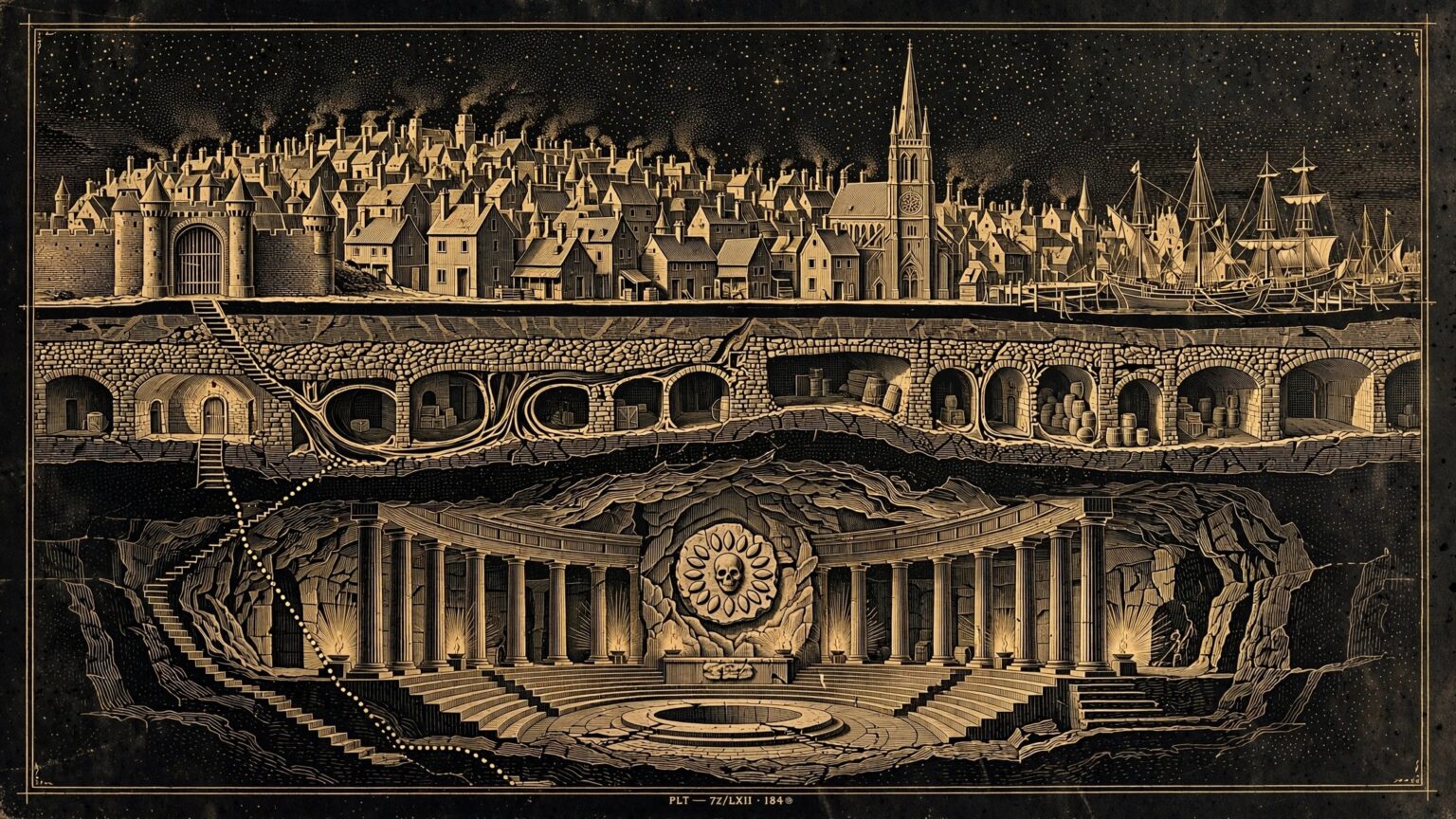
Two features of this faith deserve attention. The first is its location. In both the first Baldur’s Gate and Baldur’s Gate 3, the Temple of Bhaal lies beneath the city, carved into the foundations. Baldur’s Gate is a prosperous trading city of guilds, dukes and a busy harbour, and it keeps its god of murder underground. The architecture states the theology. Murder is always present in the city, hidden under its daily life, and it periodically rises to the surface.
The second is its paradox. A religion requires continuity, organisation and a future, and Bhaal’s is built on an act that ends futures. His faith survives because it is not really a faith of individuals. It is a faith of inheritance. It persists through blood, through prophecy, and through the children who carry it whether they believe or not.
Real history offers fewer parallels than one might expect. Many human religions have had gods of death, war or destruction, but a god whose sacrament is murder itself is rare. The best known historical case was the Thuggee, a network of robbers and killers described by British colonial officials in India in the 1830s as devotees of the goddess Kali. Modern historians regard those accounts as heavily exaggerated, shaped as much by colonial fears as by evidence. The Institute’s finding is that a true religion of murder is almost entirely a product of fiction. Bhaal fills a space that real pantheons largely left empty.
VI. The Offering
Which brings us back to the forty-five tons of bodies. In Baldur’s Gate 3, players do not only read about Bhaal’s religion. They can take part in it. The Dark Urge origin puts a player inside the compulsion itself. The game offers sudden temptations, murders that happen before the player can intervene, and a divine father who speaks in dreams. Many players choose it precisely for the experience of resisting, and many choose it to give in.
Longwinter1641’s collection belongs to another tradition, the player as curator. Hauling 850 bodies across a continent, sorting the villains from the victims and laying them out in a god’s sanctuary is a ritual without belief. It has the forms of devotion, including effort, sacrifice, procession and arrangement, without the faith. The Institute has seen this pattern before, in the way the players of Helldivers 2 perform loyalty to Super Earth while mocking it. Players are often most devout to the gods they find most absurd.
There is also a technical truth behind the ritual. Baldur’s Gate 3 keeps the bodies. Most games quietly remove the dead to save memory. Larian’s world remembers every corpse and lets the player move it. A game that preserves the dead turns out to be a very good home for a god who collects them.
The ancestor of them all
Bhaal’s death has an unusual origin outside the fiction. The Forgotten Realms began as the private creation of the Canadian writer Ed Greenwood, and was published by TSR as a setting for Dungeons and Dragons in 1987. Two years later, TSR released the second edition of the Advanced Dungeons and Dragons rules. The new rules changed how magic and the gods worked, so the setting needed a reason for its world to change too.
The answer was the Time of Troubles, told in the Avatar novels of 1989. The gods were cast down to earth so that some could die and others could change. Bhaal, Bane and Myrkul all died as part of that event. The death of the Lord of Murder, which drives the entire Baldur’s Gate saga, began as a way to explain a revision to a rulebook.
It is one of the clearest examples of a pattern the Institute tracks across fictional religions. The gods of commercial worlds live and die by the needs of their publishers. Bhaal was killed to make way for new rules, revived by his children to create a video game saga, and revived again for a new adventure and a new game. His followers believe he cannot be permanently destroyed. On the evidence of the last thirty-seven years, they are right.
The pattern
Bhaal’s religion shows how a fictional faith can outlive the death of its god:
- The god is made by chance. Bhaal’s divinity came from a game of bones, and it carries the arbitrariness of its origin.
- Death becomes a strategy. Bhaal planned for his own death and hid his essence in his children, turning mortality into a path back to power.
- Faith becomes inheritance. The religion survives in bloodlines as much as believers, so even children who reject it carry it.
- The sacred is buried beneath the ordinary. Every era places the Temple of Bhaal under the city of Baldur’s Gate, hidden in its foundations.
- The real world keeps the god alive. Rule changes killed Bhaal, and new games and adventures resurrected him. Players now carry out his rituals for fun.
For another study of fictional faiths and what keeps them alive, see The Cults of the Wasteland.
Findings
- Bhaal is a mortal who won a god’s power by chance. In Realms lore he gained the domain of murder from Jergal, the god of the dead, in a game of knucklebones with Bane and Myrkul.
- His death was part of his plan. Killed by Cyric at Boareskyr Bridge in 1358 DR, he had already scattered his essence among mortal children, the Bhaalspawn.
- His faith survives by inheritance. Across four decades of games, the drama of Bhaal is the drama of his children, who must decide what to do with a bloodline that demands murder.
- A true religion of murder is almost purely fictional. Real history offers few genuine parallels, and the best known, the Thuggee, was largely shaped by colonial exaggeration.
- Players have become his worshippers in play. From the Dark Urge to a forty-five-ton offering in his temple, Baldur’s Gate 3 lets players perform the rituals of a god they do not believe in.
This Excavation draws on the Baldur’s Gate games, published Forgotten Realms lore, and documented player activity. Read more about how the Institute works.
The Institute collects field evidence from people who lived inside these worlds. If you played the Dark Urge and resisted, or did not, send us your account.
Sources
- Baldur’s Gate (BioWare, 1998), Baldur’s Gate II Shadows of Amn (BioWare, 2000) and Throne of Bhaal (BioWare, 2001).
- Baldur’s Gate 3 (Larian Studios, 2023).
- Murder in Baldur’s Gate (Wizards of the Coast, 2013).
- Richard Awlinson, the Avatar trilogy (TSR, 1989).
- Bhaal, Forgotten Realms Wiki, for his origin, death, return and dogma.
- Baldur’s Gate 3, Wikipedia, for release history, awards and sales.
- Longwinter1641, report of the Temple of Bhaal corpse collection, r/BaldursGate3 (December 2025).
- Kim A. Wagner, Thuggee (Palgrave Macmillan, 2007), on the historical reality behind colonial accounts.