





EXCAVATION Nº 0012 · ANTHROPOLOGY
World: The Town on the Steppe, Pathologic
Period: Twelve days (in-world)
Status: Partially documented
A train stops at a small town at the edge of the steppe, and a doctor steps onto the platform. Within a day, people in one district begin to die of a disease that turns the body to sand from within. The authorities seal the town. No trains leave. The doctor has twelve days to understand the disease, find a cure and decide who deserves it, and the game makes one thing clear very early. You will not save everyone.
This is Pathologic, a game by the Moscow studio Ice-Pick Lodge, first released in Russia in 2005. Its Russian title, Мор. Утопия, joins the Russian word for pestilence to the name of Thomas More’s Utopia. It has been remade and extended twice, as Pathologic 2 in 2019 and Pathologic 3 in January 2026, and it has a reputation as one of the most demanding and least forgiving games ever made. It is also one of the most complete portraits of a society under catastrophe that any medium has produced.
The Anthropology department studies how imagined societies govern, divide and hold together. Pathologic asks a harsher version of that question. What happens to a society’s laws, faiths, economy and loyalties when it has twelve days to live, and everyone knows it?
I. Three Towns in One
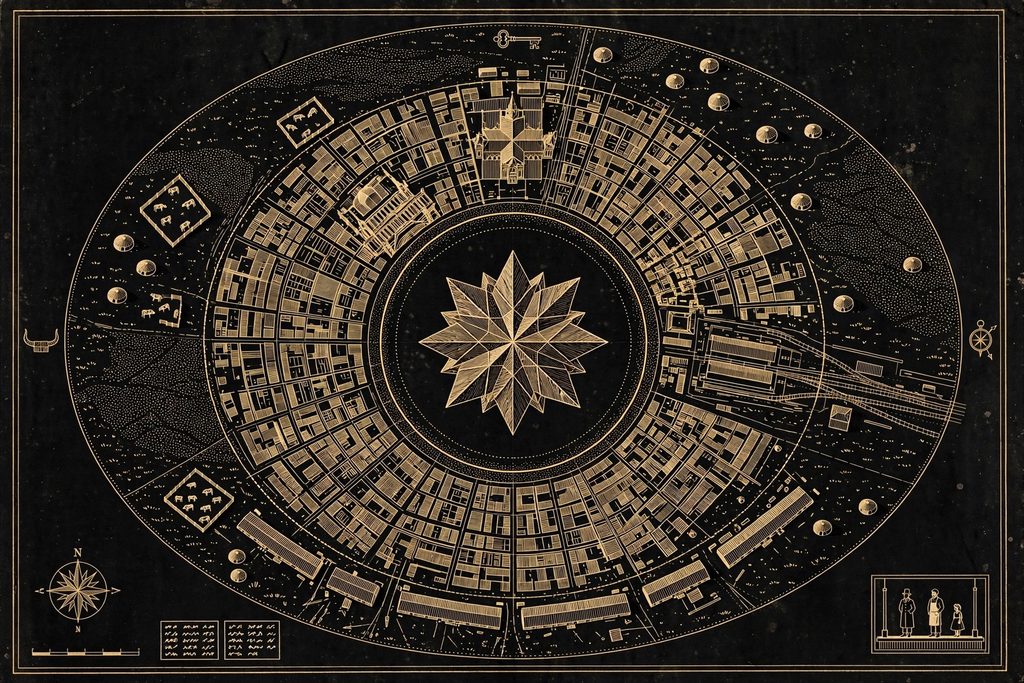
The Town has no name. It sits on the steppe, far from the Capital, and it is not one society but three, layered on top of each other.
The oldest layer is the Kin, the indigenous people of the steppe, who call themselves the Khatanghe. They herd the great cattle, gather the steppe’s sacred herbs, and keep a religion in which the land itself is the body of a living mother. The Kin live in and around the Town but by their own law, in their own districts, and in the enormous slaughterhouse on its edge, the Abattoir.
The middle layer is the Town itself, a provincial settlement of merchants, workers, officials and children, governed by three powerful families who divide its authority between them.
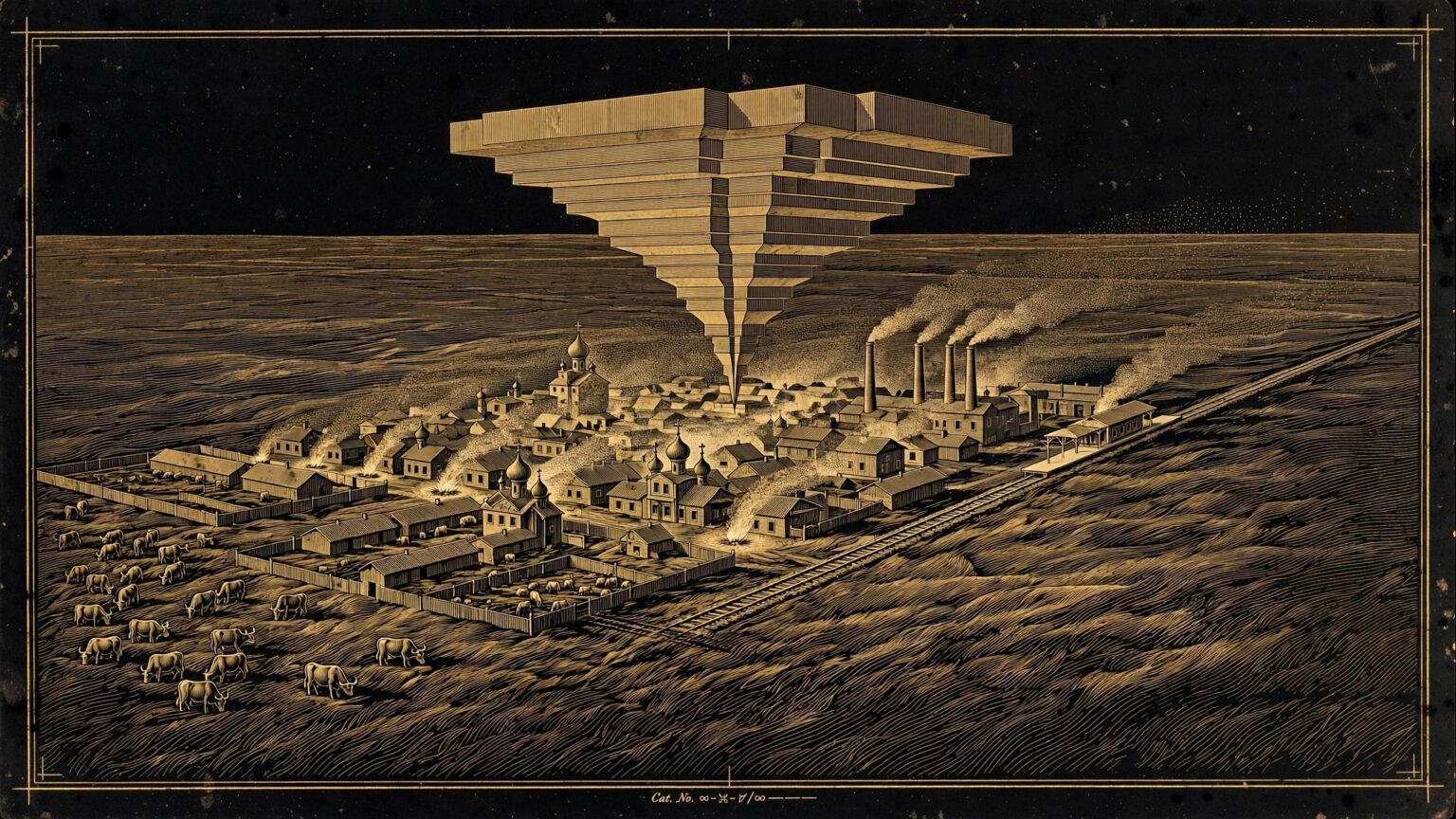
The newest layer is an idea, and it belongs to the Capital. At the Town’s centre stands the Polyhedron, an impossible tower that widens as it rises and balances on a single point. It was designed by two architects, the Stamatin brothers, and built at the direction of the Kain family. It is the Town’s utopia, a monument to the belief that human will can defy nature. Children have made it their fortress and their dream.
When the plague arrives, it strikes a society already under tension between these three layers. The healers who come to fight it each belong to one of them. There is the Bachelor, Daniil Dankovsky, a scientist from the Capital devoted to defeating death itself. There is the Haruspex, Artemy Burakh, a surgeon who is the son of the Town’s healer and was raised in the traditions of the Kin. And there is the Changeling, a mysterious girl who seems to belong to no one. Each sees a different Town, and each is trying to save a different one.
II. The Law of the Earth
To understand the Town, begin with the Kin, because their law explains almost everything the plague reveals.
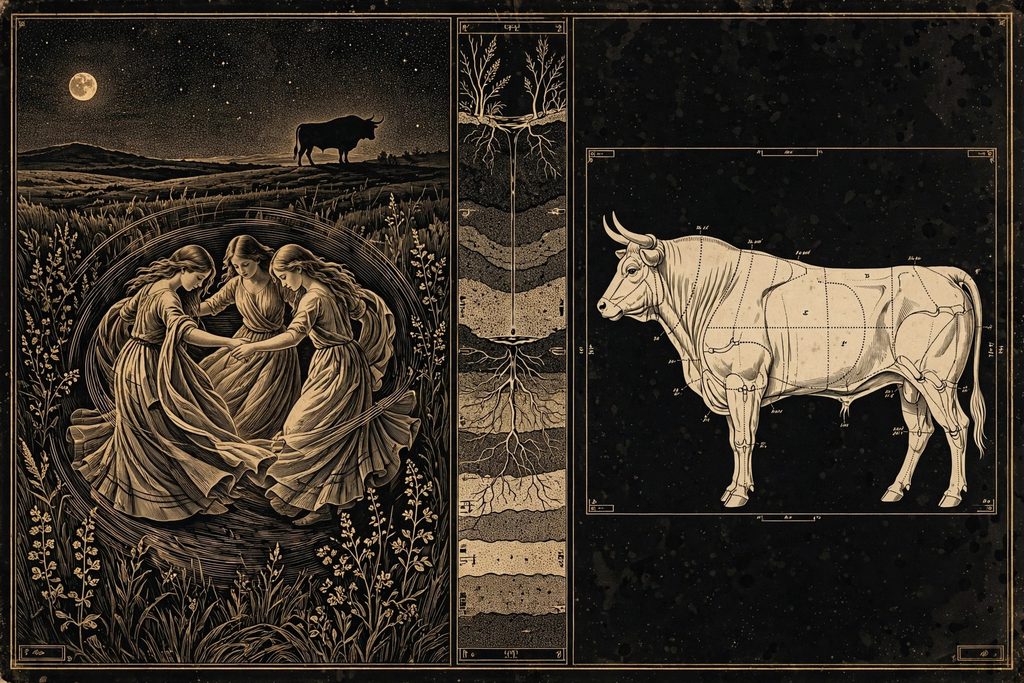
The Kin believe that the earth is the body of Mother Boddho, the creator of all living things. Because the land is her body, it must not be dug into or cut open. Blood offered to the ground is part of an exchange. The earth receives it and gives back life in the form of the sacred herbs, twyre, which grow across the steppe. Young women called Herb Brides dance on the steppe at night to encourage the herbs to grow. Beside the mother stands Bos Turokh, the World Bull, who created the universe by devouring the void. His living form is the aurochs, the great cattle the Kin herd and revere.
The Kin’s most sacred knowledge concerns the Lines, the hidden structure of bodies and joints. Only a caste of sacred butchers called the menkhu may open a body, human or animal, because only they know how to part the joints in a way that pleases the earth. The Abattoir, which looks from the outside like an industrial slaughterhouse, is in fact the Kin’s holiest site, the one place where cutting into flesh and earth is permitted.
The British anthropologist Mary Douglas argued in Purity and Danger, published in 1966, that ideas of pollution are ideas about boundaries. Dirt, she wrote, is matter out of place. A society’s taboos show where it draws the line between order and disorder. The Kin’s law draws that line at the surface of the earth. From their perspective, the Polyhedron is the greatest pollution imaginable. It is a building driven deep into the mother’s body, standing on a single point in defiance of every natural rule. The Kin regard it as the clearest example of the breaking of the Law. When the plague rises out of the ground, many of them believe they know why.
III. The Families and the Broken Balance
The Town is governed by three families, each holding one branch of power:
- The Kains hold judicial and spiritual authority. They built the Polyhedron, the Cathedral and the Town’s other extraordinary buildings, and they are fascinated by the idea that architecture can contain and capture souls.
- The Olgimskys hold economic power through the Bull Enterprise, which controls the Abattoir, the cattle and the Town’s production and trade.
- The Saburovs hold executive power. The head of the family serves as the Town’s governor and is responsible for order.
Each family is led by powerful men, and each is paired with a Mistress, a woman of the family believed to possess mystical abilities.
For years the balance held because of one man. Simon Kain, the ancient patriarch of the Kains, was said to be nearly immortal, and he kept the three families in equilibrium. His death at the start of the outbreak removed the keystone. Within days, the families begin to act against each other, each trying to use the catastrophe to secure its own future.
Anthropologists call this kind of arrangement a balance of power, and its lesson is familiar from human history. Systems that depend on a single person to hold rivals together rarely survive that person’s death. The plague did not create the divisions in the Town. It arrived at the precise moment the structure holding them together gave way.
IV. The Price of Bread
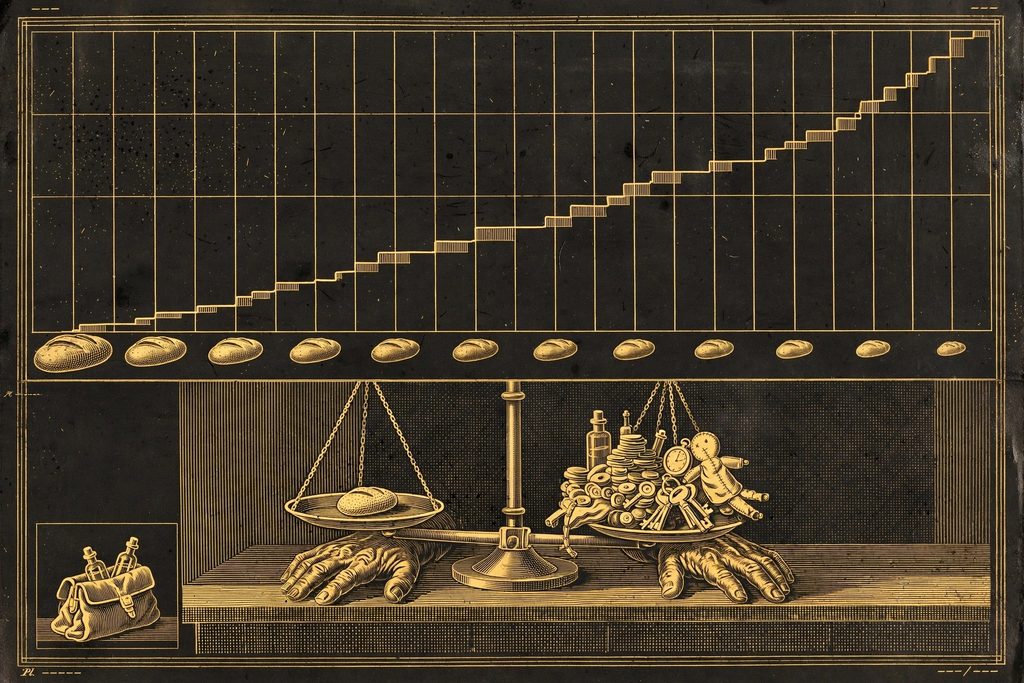
Pathologic is famous, even notorious, for the way it makes the player feel an economy collapse. The healer must eat, drink and sleep, and every day the plague spreads, food becomes scarcer and prices rise. By the second week, a loaf of bread can cost what a week’s food cost at the start. Money loses its meaning, and the Town turns to barter. Trade happens with scavengers, with desperate neighbours and, most strikingly, with children, who have their own economy of trinkets, favours and secrets.
The game’s cruelty is deliberate. Medicine is so scarce that the healer cannot treat everyone. Every antibiotic or dose of the rare cure given to one person is taken from another. Every hour spent helping someone in one district is an hour not spent in another. A player who tries to save the whole Town will fail. A player who wants to save anyone must choose. Pathologic turns triage, the hardest decision in real medicine, into the central act of play.
Human history has recorded this pattern in every major epidemic. The writer Daniel Defoe described it in A Journal of the Plague Year (1722), his account of London in 1665. Trade collapsed, prices rose, the wealthy fled, the poor were left behind, and every act of charity had to be weighed against the survival of the giver. Pathologic does not describe this economy. It makes the player live inside it for twelve days.
V. The Search for a Culprit
Every society under plague looks for someone to blame, and the Town is no exception. Artemy Burakh arrives to find that his father, the Town’s healer, has been murdered, and that he himself is accused of the crime. The townspeople suspect the Kin and their rituals. The Kin blame the Polyhedron and the Town’s violations of the earth. Mobs form and denounce strangers. Suspicion falls on the healers themselves, whose failures look like proof of guilt.
The French thinker René Girard argued that plague narratives, from ancient myth to modern literature, share a common structure. When a crisis dissolves the ordinary distinctions that keep a society stable, the community restores order by uniting against a scapegoat. History bears him out with grim regularity. During the plague of Athens in 430 BC, the historian Thucydides recorded how the epidemic destroyed respect for law and custom, and people gave up burying their dead properly. In September 1771, during an outbreak of plague in Moscow, the city’s archbishop, Ambrosius, ordered a venerated icon removed from public view to stop crowds from gathering around it and spreading the disease. A mob killed him for it.
Pathologic reproduces the whole pattern. It shows the collapse of distinctions, the search for a culprit, the violence against outsiders, and the way a public health measure can itself become the provocation. The game’s genius is that it makes the player one of the suspects.
VI. The Tower or the Town
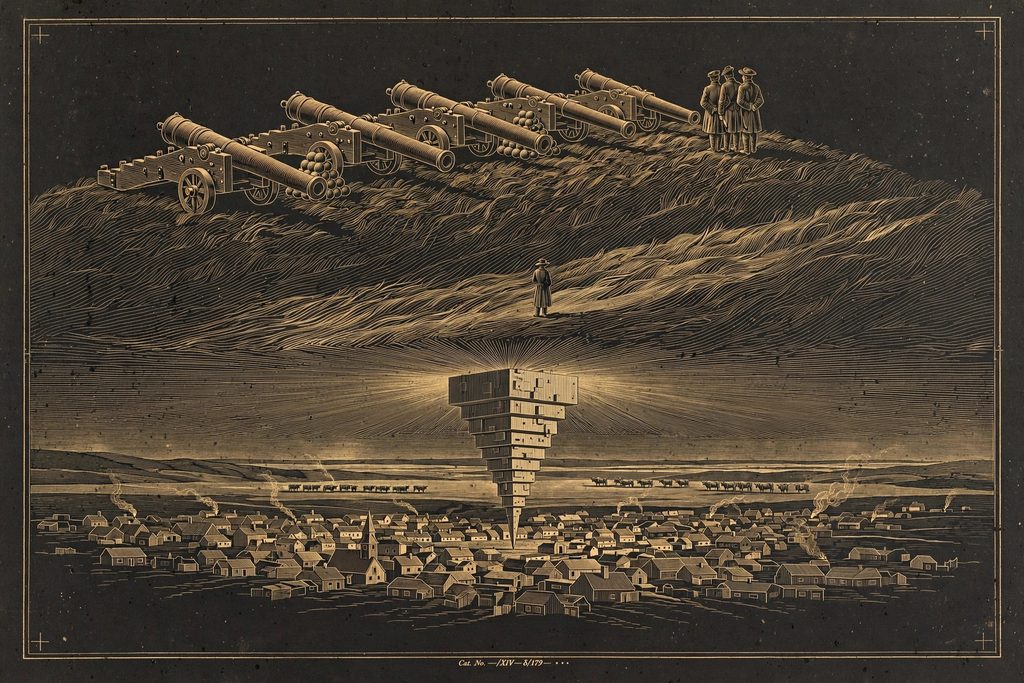
As the days pass, outside powers arrive. An Inquisitor is sent from the Capital with the authority to judge the Town and everyone in it. An army follows under a general, with artillery positioned on the hills. The Capital’s patience is limited. If the disease cannot be stopped, the Town can be destroyed.
The final choice in Pathologic is between the Town and its utopia. In the original game’s endings, the Bachelor’s path saves the Polyhedron but lets the Town be destroyed. The Haruspex’s path destroys the Polyhedron to save the Town, because healing the earth requires ending the wound that the tower represents. The Changeling’s path preserves both at a heavy human cost. In each case, the plague forces the society to decide what it values most. It can keep its tradition, rooted in the earth and the Kin’s law. It can keep its dream, the tower of human will. Or it can keep its people, whatever becomes of either.
This is the anthropological heart of the game. Most societies never have to choose explicitly between their past, their future and their present, because the choice is spread across generations. Pathologic compresses it into twelve days and places it in the hands of one person.
VII. The Stage
One more feature makes Pathologic unlike almost any other game. It openly presents itself as a play. The Town has a theatre, and in it a troupe of masked players called the Tragedians perform scenes that comment on the events outside and seem to foretell them. Two mysterious masked figures, who appear to direct the performance, address the healers as actors in a production. At the end of the original game, the fiction steps back entirely and the player is invited to see what they have been part of.
For the Institute, this framing is not a trick but a key. Anthropologists have long studied ritual as a kind of performance, in which a society acts out its own conflicts in order to understand them. By presenting the Town as a stage, Pathologic tells the player that the society they have lived in was built to be examined. The Town is a model of a civilization in crisis, performed so that its audience can learn what it would do in the same place.
The ancestor of them all
Pathologic belongs to one of the oldest traditions in literature, the plague narrative. Thucydides recorded the plague of Athens as an eyewitness. Boccaccio framed the Decameron around young people who flee Florence during the Black Death of 1348. Defoe reconstructed plague-year London. Albert Camus, in La Peste (1947), used an epidemic in the Algerian city of Oran as a study of how people behave when catastrophe removes every excuse. Pathologic takes its place in this line, with one crucial difference. The reader of Camus watches the citizens of Oran. The player of Pathologic has to decide.
The game’s own history has become part of its story. Its first English release in 2006 was hampered by a poor translation, and it remained an obscure cult work for years. A Kickstarter campaign in 2014 raised more than $333,000 to rebuild it, leading to Pathologic 2 in 2019, which told the Haruspex’s story. A nearly four-hour video essay by the YouTuber Hbomberguy, “Pathologic is Genius, And Here’s Why”, brought the game to a large new audience. When the COVID-19 pandemic arrived in 2020, many players found that a game about a town sealed by an epidemic had become uncomfortably familiar. Pathologic 3, released in January 2026, returns to the Bachelor’s story and adds the ability to move through the twelve days out of order, a scientist’s attempt to master time itself.
The pattern
The Town follows a sequence that plague-stricken societies have repeated throughout history:
- Catastrophe exposes existing fault lines. The Kin, the Town and the Capital were already in tension. The plague made the tension lethal.
- Balance depends on keystones. When Simon Kain died, the three families’ equilibrium collapsed.
- Scarcity turns ethics into arithmetic. With medicine and bread running out, every act of care becomes a choice about who will be left without.
- Crisis demands a culprit. Suspicion falls on outsiders, rival faiths and healers alike, as it did in Athens and in Moscow.
- Societies must finally choose what they are. The Town must decide between its tradition, its utopia and its people.
For another study of how a society is tested to its limits, see Why the Wasteland Keeps Rebuilding the Same Civilization.
Findings
- The Town is three societies in one. The Kin of the steppe, the provincial Town and the utopian ambition of the Capital share one place and one catastrophe.
- The Kin’s law explains the plague’s meaning. In a culture that forbids cutting into the earth, the Polyhedron is the ultimate pollution, exactly as Mary Douglas described the logic of taboo.
- The plague struck a broken balance. The death of Simon Kain left the three ruling families without the figure who held them together.
- Pathologic makes triage the central act of play. Rising prices, barter and scarce medicine force the player to decide who will be saved.
- The final choice is between past, future and present. The Town must choose its tradition, its utopia or its people, a decision most societies spread across generations.
This Excavation draws on the Pathologic games, their published lore, and the history and anthropology of epidemics. Read more about how the Institute works.
The Institute collects field evidence from people who lived inside these worlds. If you survived all twelve days, or failed trying, send us your account.
Sources
- Pathologic (Ice-Pick Lodge, 2005, English release 2006), Pathologic Classic HD (2015), Pathologic 2 (Ice-Pick Lodge and tinyBuild, 2019) and Pathologic 3 (2026).
- Pathologic and Pathologic 2, Wikipedia.
- The Ruling Families and The Kin, Pathologic Wiki.
- Hbomberguy, Pathologic is Genius, And Here’s Why, video essay.
- Mary Douglas, Purity and Danger (1966).
- René Girard, “The Plague in Literature and Myth” (1974), and The Scapegoat (1982).
- Thucydides, History of the Peloponnesian War, Book 2.
- Daniel Defoe, A Journal of the Plague Year (1722).
- Albert Camus, La Peste (1947).
- John T. Alexander, Bubonic Plague in Early Modern Russia (1980), on the Moscow plague riot of 1771.