





EXCAVATION Nº 0016 · ANTHROPOLOGY
World: New Eden, EVE Online
Period: 2003 onward (real world)
Status: Active
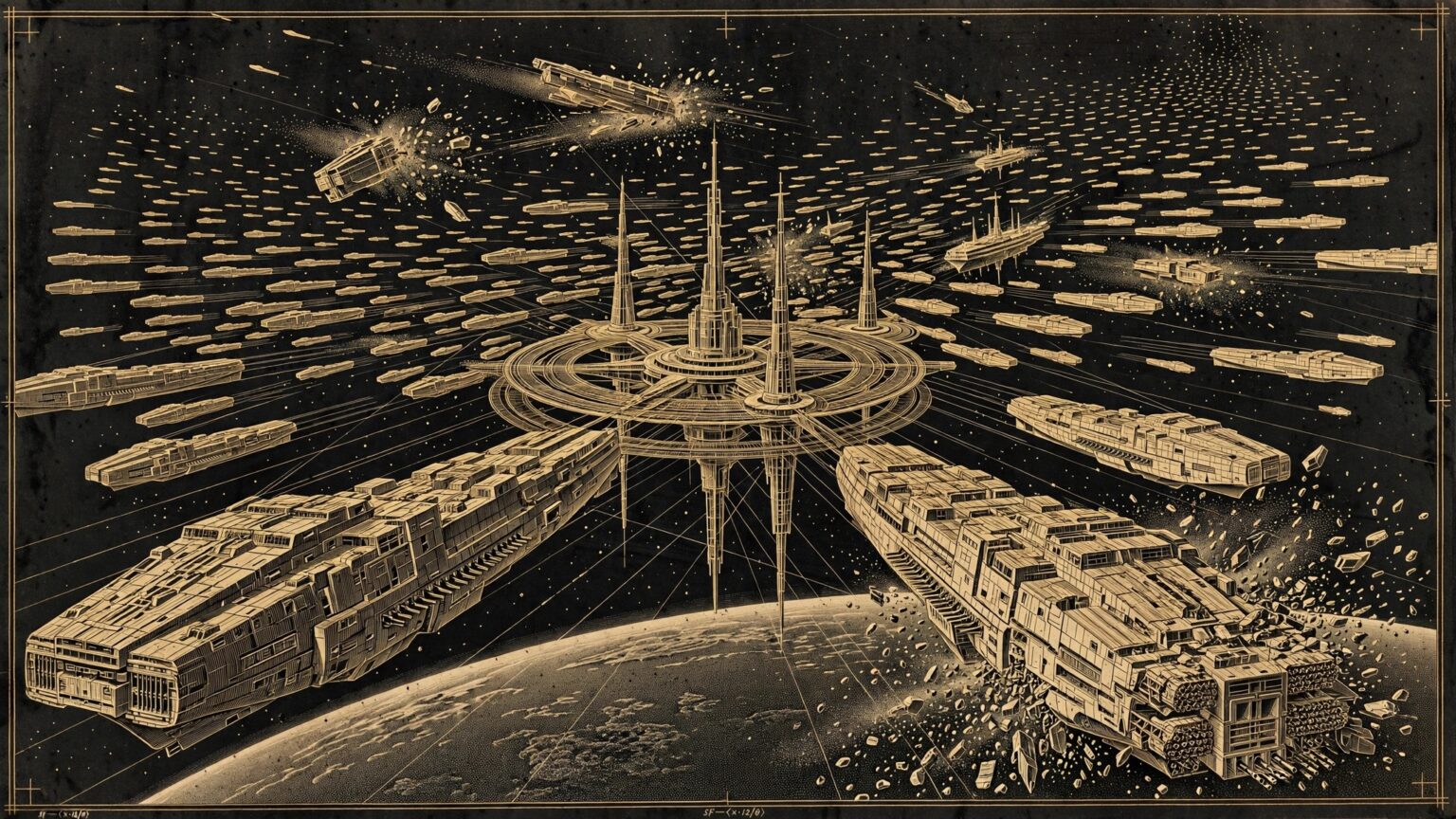
In January 2014, a corporation in EVE Online forgot to pay a bill. The fee kept a remote star system called B-R5RB under the control of its alliance. Without it, the system’s defences lapsed, and a rival coalition saw the opening. Within hours, thousands of players on both sides had logged in. The battle that followed lasted about twenty-one hours. More than 7,500 player characters took part, from 717 corporations organised into 55 alliances. When it ended, 75 of the game’s largest warships, called Titans, had been destroyed, along with hundreds of other capital ships. The losses were estimated at around 11 trillion units of the game’s currency, worth about $300,000 in real money. CCP Games, the game’s developer, left the wrecks in place as a permanent monument.
A missed payment, a power vacuum, an opportunistic invasion, a catastrophic war and a memorial are not the typical events of a video game. They are the events of political history. EVE Online, launched by the Icelandic studio CCP Games in May 2003, is the place where they happen most clearly.
The Anthropology department studies how imagined societies govern, divide and hold together. EVE Online is the most extensive experiment ever run on that question. The developers provide a lawless universe and a set of rules, and its players build the states.
I. The State of Nature
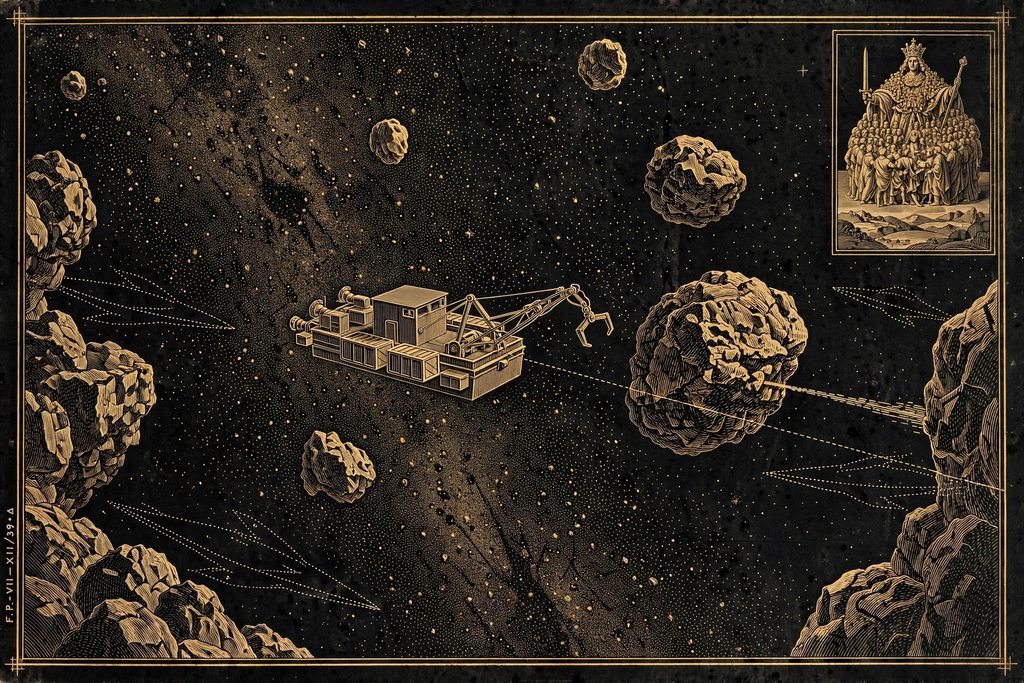
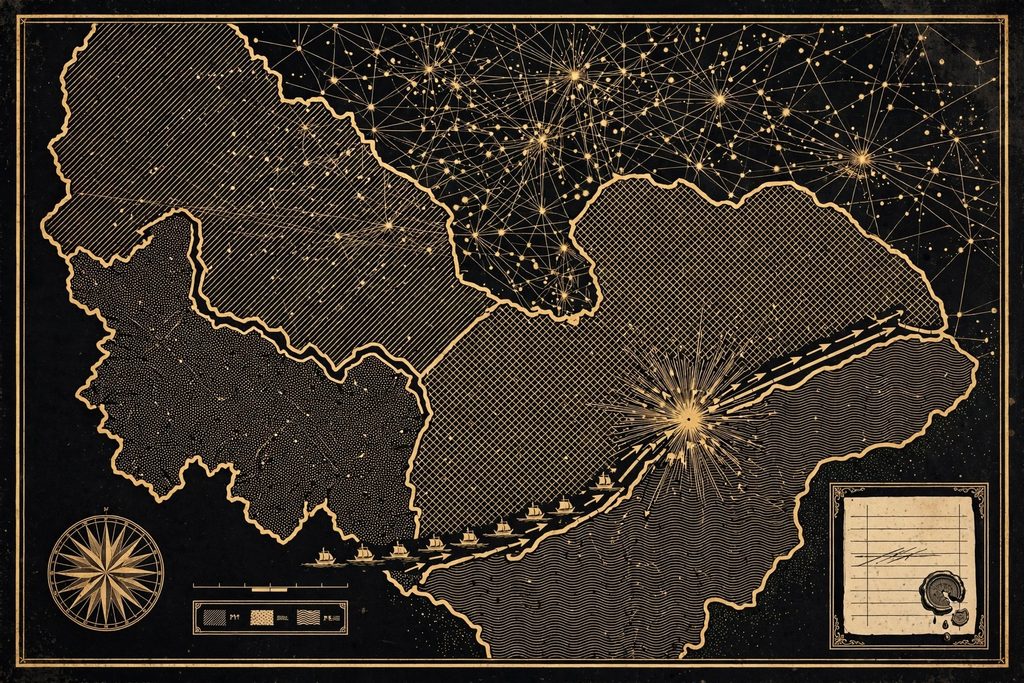
EVE Online takes place in New Eden, a galaxy of thousands of star systems, all on a single server shared by every player in the world. Its geography is divided by law and lawlessness. In the systems at the galaxy’s core, an automated police force called CONCORD punishes attacks on other players, although it cannot prevent them. In the outer regions, called null security space or nullsec, there is no police at all. Anyone may attack anyone, take anything and hold anything they are strong enough to defend.
The philosopher Thomas Hobbes described this condition in Leviathan (1651). He imagined a state of nature without government, in which life would be “solitary, poor, nasty, brutish, and short”. In such a world, people would be driven to surrender some of their freedom to a sovereign power in exchange for security. Nullsec is Hobbes’s state of nature, built in software. A lone player who mines there is defenceless. A lone player who builds something valuable there will lose it.
So the players did what Hobbes predicted. They organised. They joined corporations, groups that pool resources, share defence and divide labour. The corporations joined alliances, and the alliances joined coalitions. Out of a lawless galaxy, sovereigns emerged.
II. From Corporations to Coalitions
The organisations that grew out of nullsec look less like gaming guilds every year and more like governments.
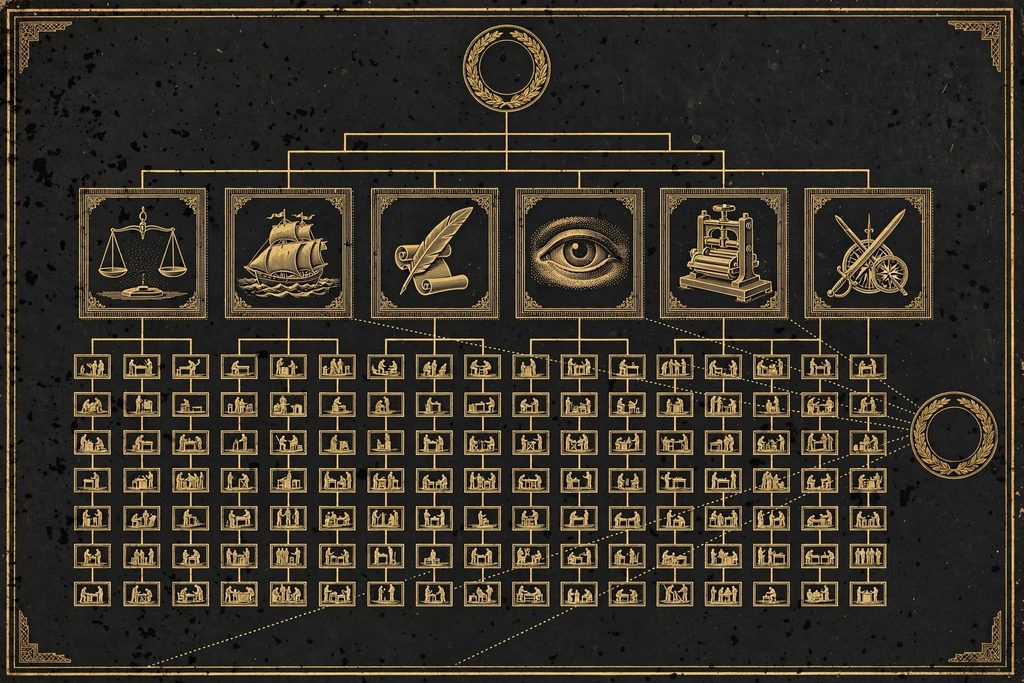
A large alliance in EVE Online has a leadership hierarchy, a treasury and a tax system. Members pay a share of their income to their corporation, and corporations pay a share to the alliance. It runs a logistics service that moves goods across hundreds of star systems, and a diplomatic corps that negotiates treaties with neighbours. It has an intelligence service, and a propaganda operation that publishes news, speeches and recruitment material. It holds territory through the game’s sovereignty system, which requires owners to maintain and pay for their claim to each system, the bill that was missed at B-R5RB. It also has military doctrine, standardised fleets of particular ship types flown together under trained commanders.
The sociologist Charles Tilly argued that real European states grew in exactly this way. In his essay “War Making and State Making as Organized Crime” (1985), he described early states as protection rackets that succeeded. Armed groups offered protection from threats, often threats they themselves posed, and taxed the protected in return. Over centuries, the rackets with the most effective armies and tax systems became kingdoms. Tilly summed up the process elsewhere in a famous line: war made the state, and the state made war.
EVE’s alliances follow Tilly’s sequence almost step by step. They offer protection, they collect tax, they fight wars to expand, and the ones that do this best become the great powers of the galaxy.
III. The Instruments of State
Every state needs an economy, and New Eden’s is unusually real. Nearly everything in the game is made by players. Raw materials are mined by players, refined by players, built into ships and modules by players, hauled across space by players and sold in markets run by players. Ships destroyed in battle are gone for good, so war creates constant demand. In 2007, CCP hired an economist, Eyjólfur Guðmundsson, to study and report on the game’s economy, which made it the first game developer known to employ one. His economic reports read like those of a central bank.
Every state also needs intelligence, and EVE is famous for its spies. In 2005, a mercenary corporation called the Guiding Hand Social Club spent about a year infiltrating a rival corporation, Ubiqua Seraph. Its agents worked their way into positions of trust. On a single coordinated day, they ambushed and destroyed the ship of the corporation’s leader and emptied its hangars. They stole assets worth around 30 billion units of currency, estimated at the time at about $16,000 in real money. In 2009, one of the most powerful alliances in the game, Band of Brothers, was destroyed from within. One of its own directors defected to its enemies, took the alliance’s assets and disbanded it.
States also need trust in their institutions, and EVE has shown how fragile that can be. Player-run banks and investment schemes have repeatedly collapsed when their founders vanished with the deposits. The game’s rules allow theft and fraud, so the players’ institutions have had to develop their own safeguards: reputation, vetting, contracts and counter-intelligence.
IV. The Wars
The wars of New Eden have become some of the largest coordinated human activities ever recorded in a game.
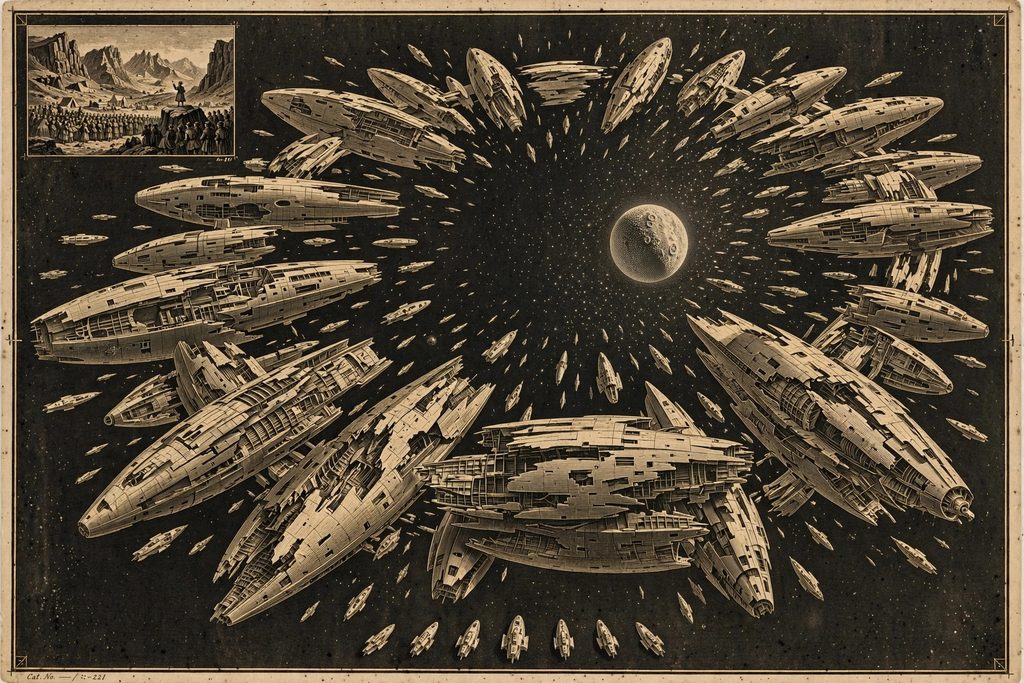
The Bloodbath of B-R5RB in 2014 was surpassed in the conflict that players called World War Bee. From mid 2020, around 130,000 players took part in a struggle between two great coalitions, the Imperium and an alliance of its enemies known as PAPI. On 30 and 31 December 2020, a battle in the system M2-XFE lasted fourteen hours. More than 5,000 players fought, and over a thousand Titans were brought to the field. 3,404 ships were destroyed, including 257 Titans, and the losses were valued at about 29 trillion units of currency, or roughly $378,000. The battle set two Guinness World Records, for the most costly video game battle and the most Titans lost in a single engagement.
What makes these wars historical rather than merely large is how they are remembered. Players write accounts of them, analysts publish maps and statistics, and veterans tell stories of particular fleets and commanders. CCP Games marks the greatest battles with permanent monuments in the game world itself. The wrecks at B-R5RB became a memorial called the Titanomachy, and a monument was placed for the participants at M2-XFE. These wars have causes, turning points and consequences, and they are remembered by those who fought in them.
V. The Parliament
The most remarkable institution in EVE Online is not a player creation but a political one. In 2008, CCP Games created the Council of Stellar Management, an elected body of players who represent the community to the developer. Its first election, in March 2008, drew 66 candidates for nine seats. Since then, players have voted every year for representatives who campaign on platforms, form blocs and travel to meet the developers. The game’s great alliances quickly learned to mobilise their members to elect their own candidates, so the council became a reflection of the galaxy’s political power.
The relationship between the players and CCP has also had its revolutions. In 2011, CCP introduced an in-game store selling virtual items for real money, including a cosmetic monocle priced at about $70. Shortly afterwards, an internal company newsletter leaked that appeared to discuss expanding paid items. The players treated it as a betrayal of the game’s principles. Thousands protested inside the game, gathering at the busiest trade hub, Jita, and firing on its monument, and many cancelled their subscriptions. CCP’s chief executive publicly apologised, the company changed course, and it laid off staff as it reorganised. As in the case of Helldivers 2, players of a game about power turned out to be very good at exercising it against real authority.
The Institute notes one more detail. CCP Games is based in Reykjavík, in a country whose parliament, the Althing, traces its origins to 930 and is often counted among the oldest in the world. The players of EVE Online elect their council and send it to meet in the same country.
The ancestor of them all
The idea of a company becoming a state is not a fantasy of science fiction. The English East India Company was founded by royal charter in 1600 as a trading venture. Over the following two centuries it acquired armies, minted currency, collected taxes, administered territories and made war. By the early nineteenth century it governed much of the Indian subcontinent and commanded a private army larger than the British Army. The historian William Dalrymple has described its rise in The Anarchy (2019) as the story of a corporation that became an empire.
EVE Online reproduces that transformation with remarkable fidelity. Its corporations begin as groups formed to make money and protect their members. Under the pressure of a lawless environment, they acquire the instruments of government one by one: defence, taxation, intelligence, diplomacy, territory and memory. The players did not set out to recreate Tilly’s history of the state or the history of the East India Company. The conditions of the game led them there.
The pattern
New Eden follows the sequence that political scientists have traced in the formation of real states:
- Insecurity produces organisation. In a galaxy without police, individuals join corporations for protection.
- Protection produces taxation. Alliances defend their members and collect a share of their income, as Tilly described the early state.
- War builds the state. The need to fight and to defend territory drives alliances to develop logistics, doctrine, intelligence and propaganda.
- Institutions require trust, and trust can be betrayed. Heists, defections and collapsed banks show how much a society depends on its members’ good faith.
- Even players govern their gods. Through an elected council and organised protest, the population of New Eden holds its developer to account.
For another world that keeps rebuilding the same institutions, see Why the Wasteland Keeps Rebuilding the Same Civilization.
Findings
- Nullsec is a state of nature. Without police, EVE Online’s outer regions reproduce the conditions Hobbes described, and players respond by forming sovereign organisations.
- Player alliances follow the path of real states. Protection, taxation, war and expansion turn corporations into territorial powers, as Charles Tilly argued for early modern Europe.
- New Eden has the instruments of government. Its alliances run treasuries, logistics, diplomacy, intelligence and propaganda, and its economy is studied like a nation’s.
- Its wars are historical events. B-R5RB in 2014 and M2-XFE in 2020 involved thousands of players, were commemorated with monuments, and set world records.
- Its players hold their creators to account. An elected council since 2008 and the protests of 2011 show a population acting as a political constituency.
This Excavation draws on the history of EVE Online, the documented actions of its players, and published records of its wars and institutions. Read more about how the Institute works.
The Institute collects field evidence from people who lived inside these worlds. If you flew in one of the great wars, or served as a spy, a diplomat or a quartermaster, send us your account.
Sources
- EVE Online (CCP Games, 2003 onward).
- EVE Online and Bloodbath of B-R5RB, Wikipedia.
- The Most Expensive Video Game Battle Ever Earns Two Guinness World Records Titles, CCP Games (2021).
- Most costly videogame battle, Guinness World Records.
- “The Deadly Dollar of Eve Online”, Slashdot (2005), on the Guiding Hand Social Club heist.
- Thomas Hobbes, Leviathan (1651).
- Charles Tilly, “War Making and State Making as Organized Crime”, in Bringing the State Back In (1985).
- William Dalrymple, The Anarchy: The Relentless Rise of the East India Company (2019).