

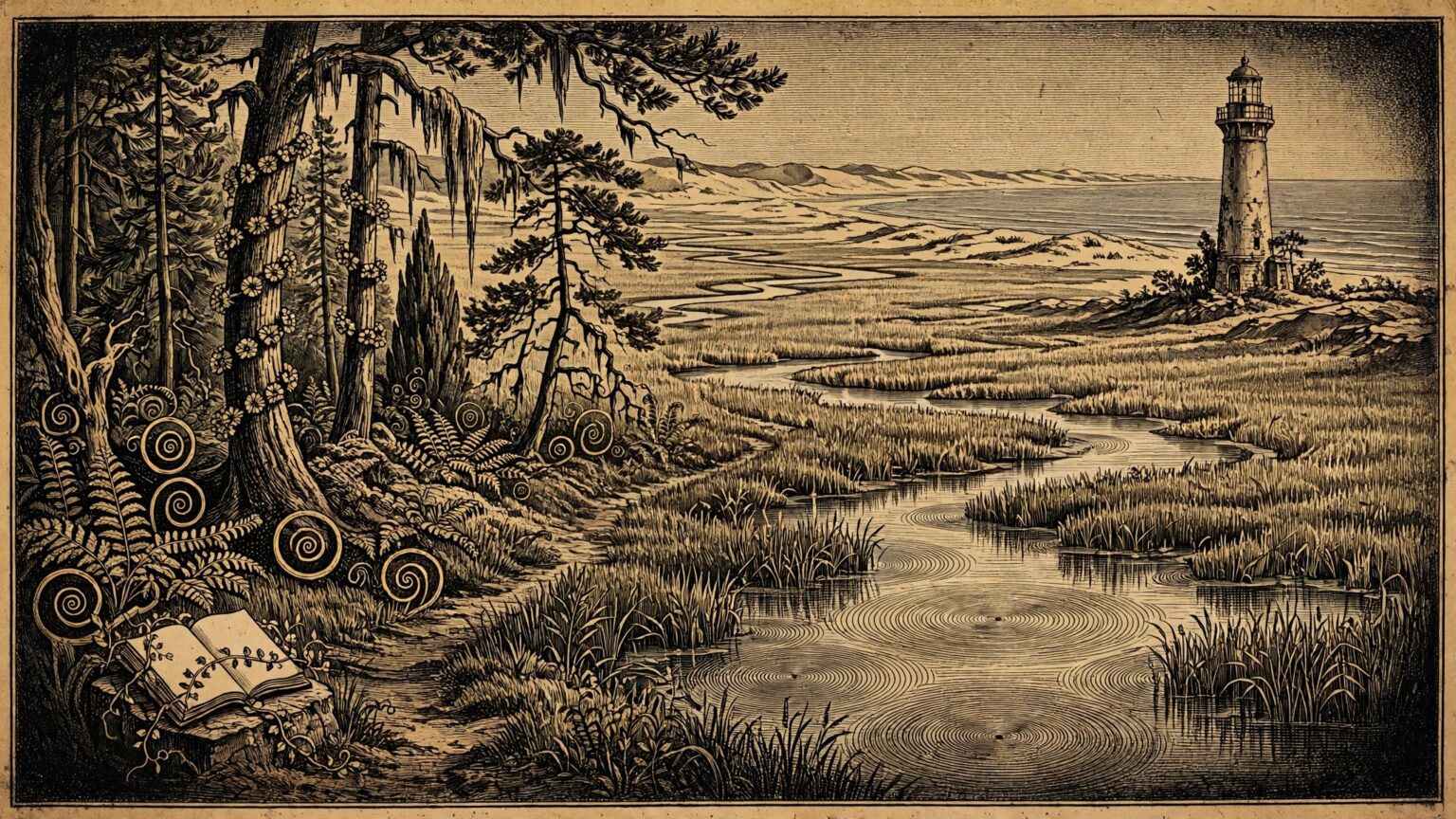
There is a stretch of coastline in the American South that nobody may enter without permission. It has been closed for about thirty years, and from the outside it looks like the most beautiful wilderness in the country. Its marshes are clean. Its forests are untouched. Its animals are thriving. Every few years, a government agency sends a small team across its invisible border, and the teams come back changed, or they come back as something that only looks like them, or they do not come back at all.
This is Area X, the setting of Jeff VanderMeer’s Annihilation, published in 2014 and adapted for cinema by Alex Garland in 2018. The novel won the Nebula Award, and together with its sequels Authority and Acceptance, and a fourth book, Absolution, in 2024, it became one of the defining works of what critics call the New Weird. VanderMeer has said the setting grew from a long hike through the St. Marks National Wildlife Refuge in Florida, and from his horror at the Deepwater Horizon oil disaster of 2010.
The Institute has studied living worlds before, a planet that thinks in Eywa, Anatomy of a Planetary Organism and a poisonous forest that was secretly healing the earth in The Toxic Jungle That Was Healing the World. Area X asks a stranger question. What if an ecosystem did not want to kill us or save us, but simply to rewrite us, as it rewrites everything else it touches?
I. The Border
Area X began with an event that nobody fully witnessed. Some three decades before the novel opens, a stretch of coast known as the Forgotten Coast, home to a lighthouse, a small village and a few scattered homes, was enclosed by an invisible border. The official story released to the public was an environmental catastrophe. The truth, as far as anyone knew it, was that something had arrived, and that the world inside the border was no longer following the same rules as the world outside.
The border is the first great mystery of the zone. It cannot be seen, only passed through at a single known point, and crossing it is an experience that expedition members do not remember. In the later books, experiments show what happens to living things that try to cross elsewhere. They vanish. The border behaves less like a wall than like a membrane, the boundary of a single organism that decides what may pass.
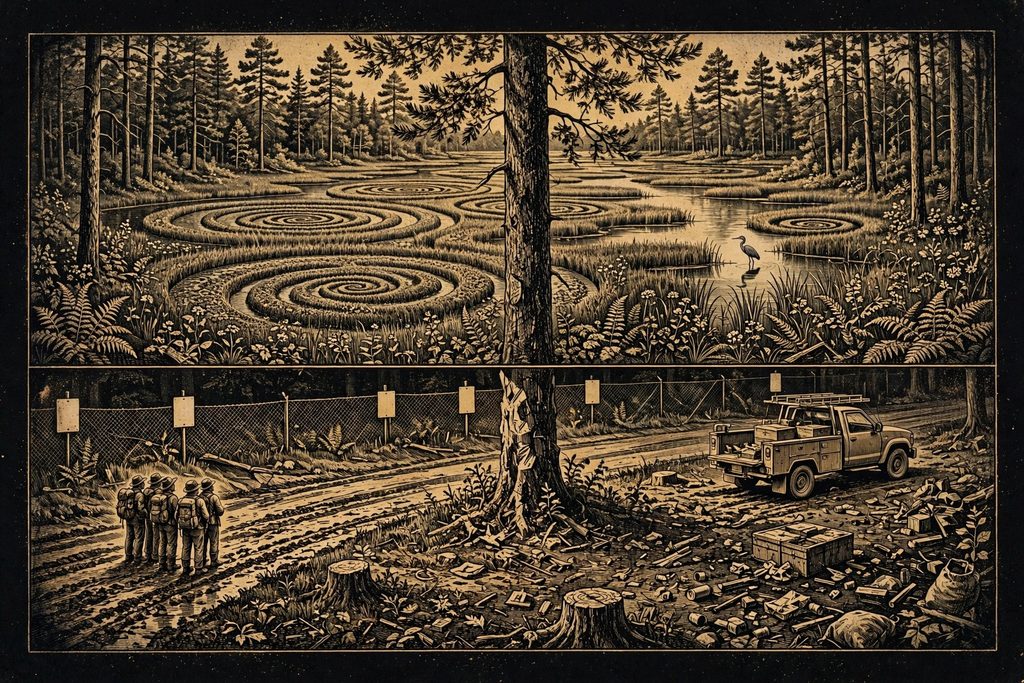
What lies inside is not a wasteland. It is the opposite. Free of people, roads and industry, Area X has become a wilderness of extraordinary richness, the kind of untouched landscape that conservationists dream of. That is the first unsettling lesson of the zone. A place can be ecologically perfect and still be utterly hostile to us.
II. The Twelfth Expedition
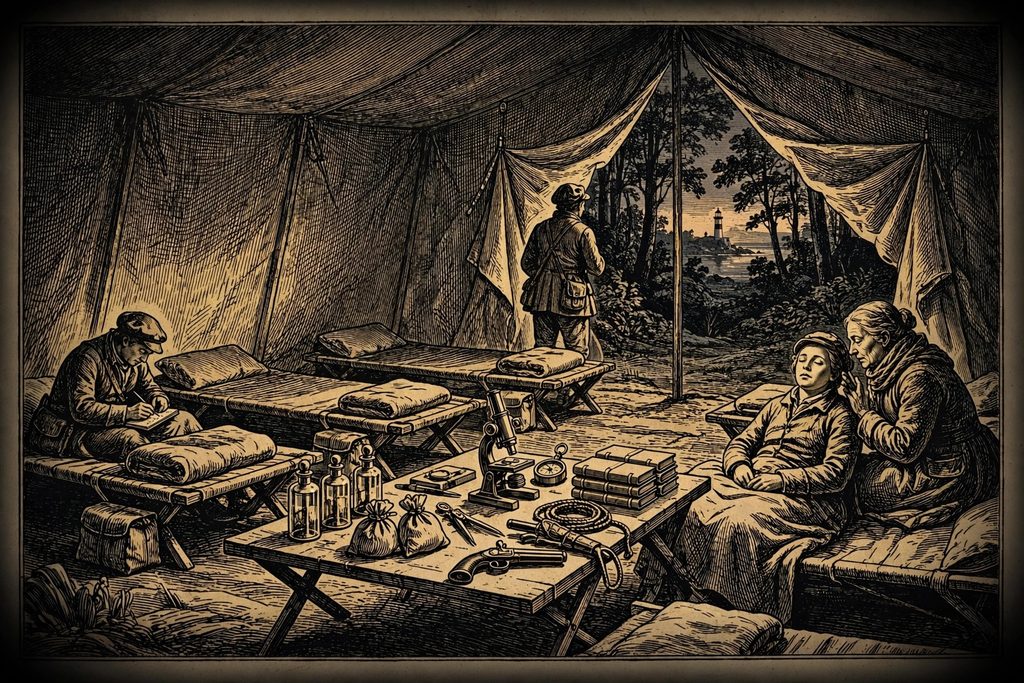
Annihilation is told through the field journal of a biologist, one of four women sent into Area X as the twelfth expedition. The others are an anthropologist, a surveyor and a psychologist who leads the group. None of them is named. The Southern Reach, the agency that manages the zone, removes names as a matter of procedure, as though identity itself were a contaminant. The expedition carries no modern technology beyond what is strictly necessary. Its members are told that earlier expeditions ended in suicide, in violence or in cancers that killed the survivors months after their return.
The biologist has a private reason for going. Her husband was a member of the eleventh expedition. He came home without explanation, without memory of how he had returned, and quiet in a way she did not recognize. Within months, he and his teammates were dead of cancer. What came back from Area X looked like him. Whether it was him is a question the novel never quite answers.
The expedition soon learns that it is not only exploring the zone but being managed by its own leader. The psychologist uses hypnotic suggestion to keep the others calm and obedient, with trigger words planted before the mission. The word that gives the novel its title is one of them. The first human institution inside Area X, in other words, is a small hierarchy of control, and the first thing that breaks down is trust.
III. The Words on the Wall
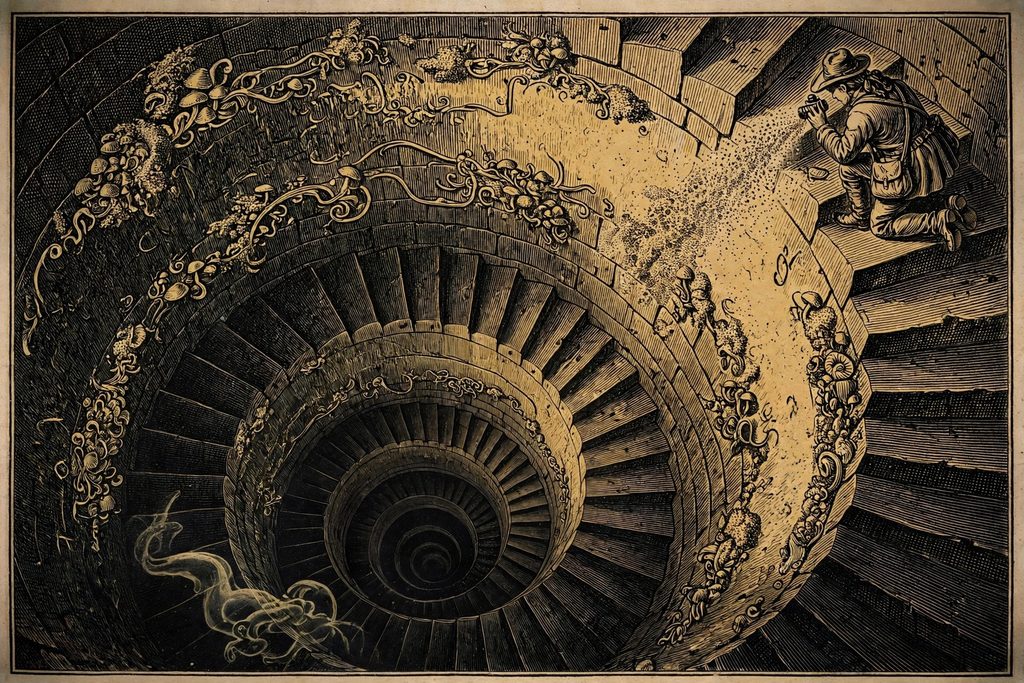
The heart of Area X, at least as far as the expedition can reach, is a structure that does not appear on any map. The biologist insists on calling it a tower, even though it descends into the ground, a spiral staircase sinking into the earth. The others call it a tunnel. The disagreement matters. In Area X, even the basic categories of up and down, structure and creature, are open to argument.
On the curving walls of the tower runs a line of text, written not in ink but in living organisms, fungal growths and tiny creatures arranged into words. The sentences read like scripture from a feverish sermon. “Where lies the strangling fruit that came from the hand of the sinner,” the first line begins, and it continues downward for hundreds of steps. Somewhere deeper in the tower, something is still writing it. The expedition calls it the Crawler.
When the biologist leans close to the words, she inhales spores, and the zone begins to change her. She becomes immune to the psychologist’s hypnosis. She feels what she calls a brightness growing inside her, a light that heals her wounds and sharpens her senses. Area X has a language, and it writes that language not only on walls but into the bodies of those who read it.
IV. The Lighthouse Archive
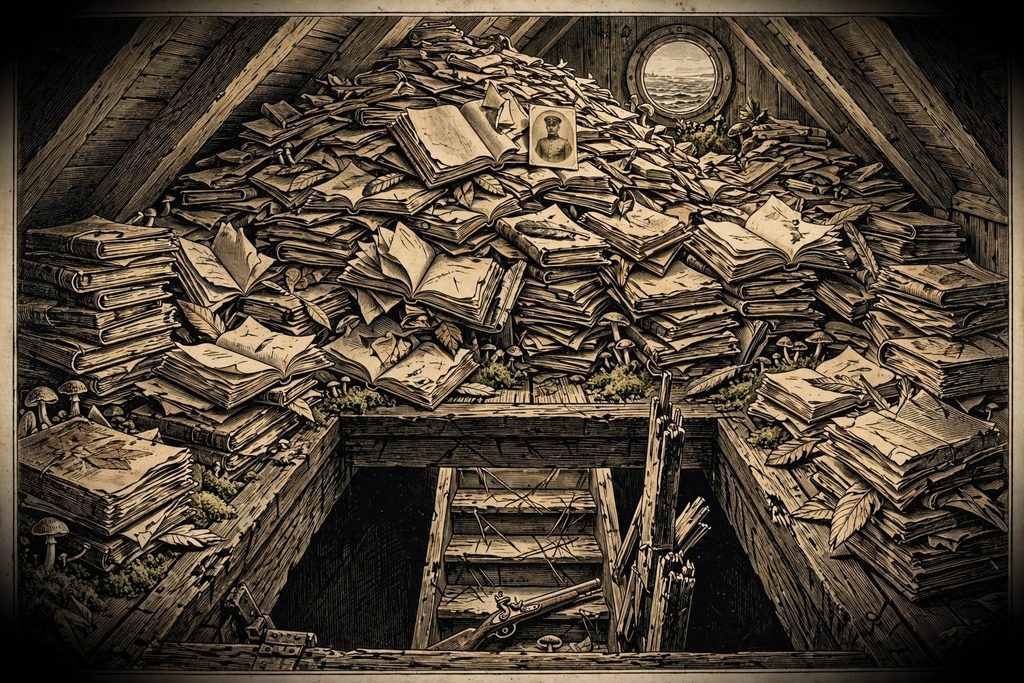
The other landmark of Area X is the lighthouse that once guided ships along the Forgotten Coast. When the biologist climbs it, she finds the signs of a desperate battle on the stairs and, at the top, a discovery that changes everything she thought she knew. A trapdoor opens onto a hidden room piled almost to the ceiling with journals. There are hundreds of them, far more than eleven expeditions could ever have written.
The Southern Reach has been lying, even to its own people. There have been many more expeditions than the agency admits, perhaps sent in under different numbers, perhaps erased from the official record. The lighthouse has become an archive of the zone’s victims, a mound of field notes left by people who were meant to study Area X and were instead absorbed by it. Among the journals, the biologist finds her husband’s.
For an archaeologist, this is the most haunting image in the trilogy. The lighthouse was built to keep travellers safe, and it has become a tomb of observations. In the third book, Acceptance, the reader learns that its last keeper, Saul Evans, was standing at the point where Area X began. The Crawler writing scripture in the tower is what remains of him, still repeating the words of a sermon he once gave, transformed by the zone into its scribe.
V. The Agency That Studied Itself to Pieces
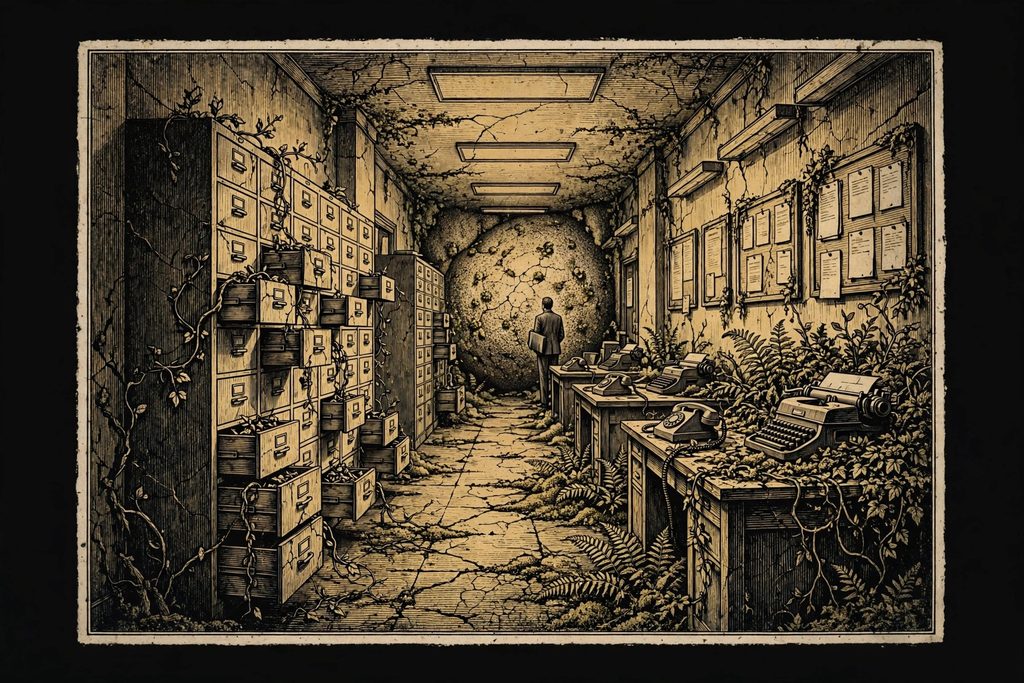
The second book, Authority, leaves the zone and enters the Southern Reach itself. Its new director, a man known only by the name Control, inherits an agency in decay. Its scientists repeat the same experiments for decades. Its files contradict one another. Its building is quietly being changed from within. A plant on a desk has not wilted in years. A wall seems to breathe. A room is full of strange words written by a researcher who has spent too long on the problem.
The Southern Reach is a remarkable piece of institutional fiction. It is a bureaucracy built to contain something it cannot understand, and over thirty years it has become a mirror of its subject. Its secrecy has spread like a fungus. Its leaders conceal information from one another. Its staff are, in small ways, already part of Area X. The agency that studies the zone has been colonized by it, the way the zone colonizes everything.
Behind it all stands Central, a higher authority that wants the zone used rather than understood. In the end, none of the structures built to manage Area X can hold. The border begins to move. The ecosystem that the institutions were meant to study has been studying them, and it is expanding.
VI. Copies and Brightness
Area X does not destroy what it absorbs. It copies it. The biologist’s husband returned as a double. In Acceptance, the biologist herself is copied, and her double, who calls herself Ghost Bird, walks out of the zone with her memories but not her history. The dolphins in the channels have eyes that look disturbingly human. A creature moaning in the reeds may once have been a member of an expedition. Nothing in Area X is wasted, and nothing remains entirely itself.
Alex Garland’s film turns this idea into an image. In his version, the zone is the Shimmer, a wall of rainbow light expanding from the lighthouse, and inside it every living thing is refracted like light through a prism. DNA mixes between species. Flowers of different kinds grow from a single stem. Trees take human form. The film’s biologist comes to understand that it is not destroying anything. It is making something new. The film ends with its protagonist face to face with a perfect copy of herself, and then with a quiet doubt about who walked out.
That is why the trilogy belongs in the Institute’s department of ecologies. Area X is not a monster. It is an ecosystem with a single principle, transformation, applied without exception to plants, animals, buildings, words and people. Its terror is not that it kills, but that it treats a human being as one more organism to be read and rewritten.
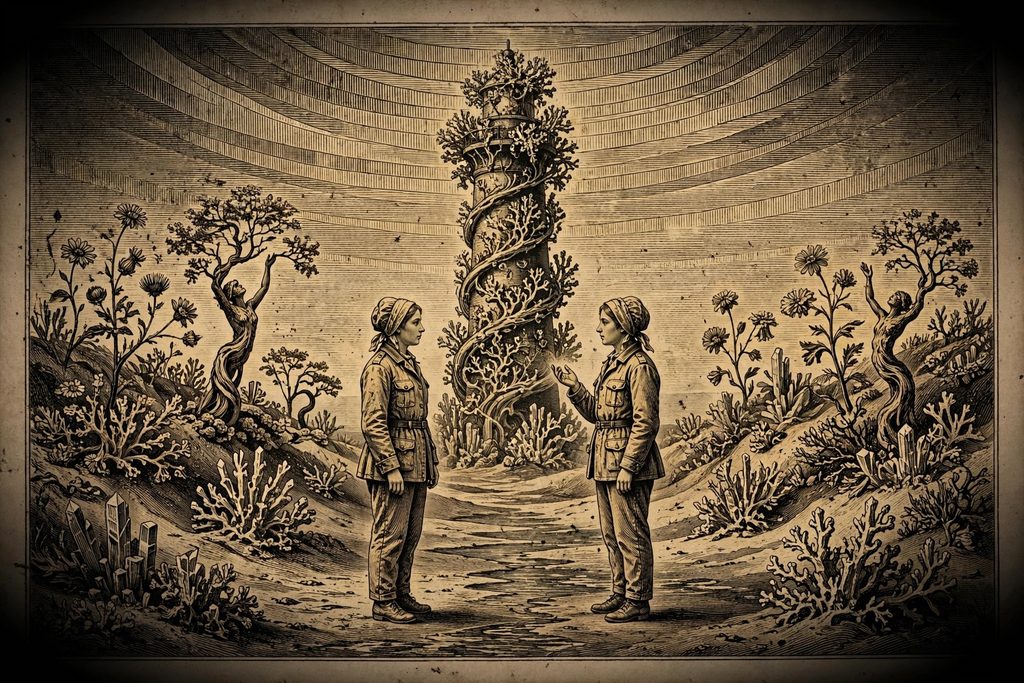
The ancestor of them all
The idea of a wild place where human laws stop working, where nature becomes sacred and dangerous at once, is far older than science fiction. The ancient world called such places groves.
The Roman poet Lucan, writing in the first century, described a sacred grove near Massilia, the Greek colony that is now Marseille, which Julius Caesar’s army found during the civil war. No one had cut it since the beginning of time. Its shade was cold and dark. Birds would not perch in its branches and beasts would not make their lairs there. Its trees trembled when there was no wind, and the images of its gods were rough, shapeless logs. Even its priest, Lucan writes, feared to approach it at certain hours. When Caesar ordered the grove cut down for siege timber, his soldiers hesitated, afraid of what the axe would bring. Caesar took up an axe and struck the first blow himself.
The historian Tacitus records a grove of the Germanic Semnones that could be entered only by those bound in chains, as a sign of their humility before the god who lived there. Whoever fell inside was not allowed to stand up again, but had to roll out along the ground.
Area X inherits both traditions. Like the Semnones’ grove, it can be entered only on its own terms, through a single doorway, by people who must surrender something of themselves to pass. Like the grove at Massilia, it is a wilderness where nature behaves wrongly and the gods have no faces. And the Southern Reach is Caesar’s army without Caesar’s certainty, an institution that has stood at the edge of the sacred wood for thirty years, axe in hand, unable to decide whether to strike.
The pattern
Area X belongs to a family of fictional places the Institute calls the Zones. Their ancestor is the Zone of Arkady and Boris Strugatsky’s novel Roadside Picnic, published in 1972, where an alien visitation has left behind territories full of strange artifacts and lethal anomalies, and Andrei Tarkovsky’s film Stalker of 1979, which turned the Zone into a landscape of faith and doubt. Real history added its own example after 1986, when the exclusion zone around Chernobyl emptied of people and slowly filled with wolves, deer and forests.
Three features define the Zones. The first is a border, a line that separates the familiar world from a place where its rules no longer hold. The second is nature behaving in a way that is neither friendly nor simply hostile, but indifferent to human meaning. The third is an institution, a military, an agency or a scientific team, that tries to study, contain or exploit the Zone and is gradually changed by it.
The Institute has documented ecologies that think, heal and evolve, from Pandora to the Machine Ecology of Regis III. Area X is the one that refuses every human story told about it. It is not Eywa, guarding a sacred balance, and it is not the Sea of Corruption, quietly cleansing the earth. It is life itself, freed from human purpose, writing its own text on whatever surface it finds.
Findings
- Area X is an ecosystem, not a monster. Behind its invisible border, the Forgotten Coast has become a flawless wilderness that transforms plants, animals, buildings and people by a single principle, rewriting.
- Its institutions erase identity before the zone does. The Southern Reach strips expedition members of their names, manages them through hypnosis and hides the true number of expeditions, even from its own staff.
- Its archive is a tomb. The hidden room at the top of the lighthouse holds hundreds of journals from expeditions the agency never acknowledged, the field notes of people absorbed by what they came to study.
- Its language is alive. The words in the tower are written in fungi and living creatures by the Crawler, once the lighthouse keeper Saul Evans, and those who read them are changed by the spores they release.
- Its ancestors are the sacred groves. Like the grove at Massilia described by Lucan and the chained entry to the grove of the Semnones in Tacitus, Area X is wild nature that must be entered on its own terms.
This Excavation draws on Jeff VanderMeer’s Southern Reach series, on Alex Garland’s film Annihilation, on Lucan’s Pharsalia and Tacitus’ Germania, and on the comparative study of zones in science fiction.
The Institute collects field evidence from those who have crossed into these worlds. If Area X changed the way you see a marsh, a forest or a lighthouse, send us your account.
Sources
- Jeff VanderMeer, Annihilation (2014), Authority (2014) and Acceptance (2014), Farrar, Straus and Giroux.
- Jeff VanderMeer, Absolution (2024), MCD.
- Annihilation (2018), written and directed by Alex Garland, Paramount Pictures.
- Lucan, Pharsalia, book 3, on the sacred grove of Massilia (first century CE).
- Tacitus, Germania 39, on the sacred grove of the Semnones (98 CE).
- Arkady and Boris Strugatsky, Roadside Picnic (1972), and Andrei Tarkovsky, Stalker (1979).