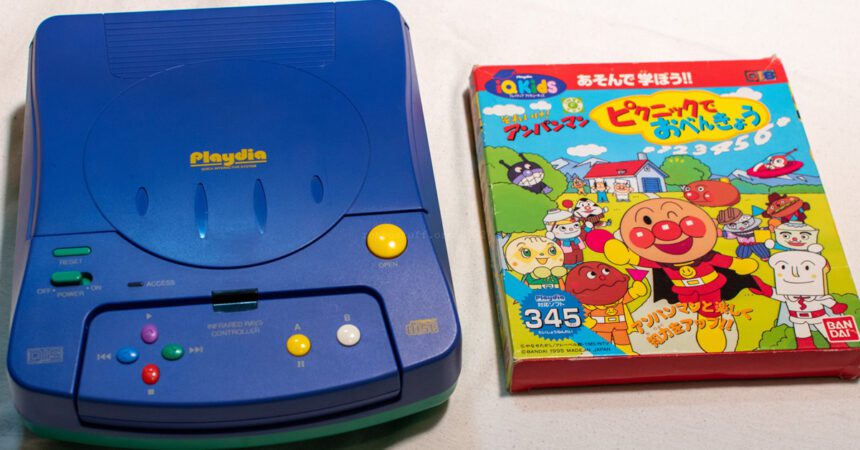
The 1980s ignited a wildfire of optimism, a belief that dreaming big could turn any vision into reality. Bandai, a titan in Japan’s toy and gaming empire, rode this wave of ambition straight into the console wars with the Playdia—a bold, anime-fueled experiment launched in 1994.
While it flickered brightly for a moment, this quirky console couldn’t outshine the giants of its era. Yet, its story is a hidden gem worth rediscovering, blending nostalgia with lessons from a bygone gaming age.
Bandai’s Big Bet on Anime Power
By the mid-’90s, Bandai wasn’t just a name—it was a cultural force, synonymous with Japanese animation thanks to its dominance in toys, games, and accessories. As the console industry roared into a new era with Sony’s PlayStation, Sega’s Saturn, and NEC’s PC-FX battling for supremacy (and Nintendo prepping its Nintendo 64), Bandai saw an opening. Enter Playdia—a home gaming system banking on the irresistible pull of anime.

The pitch was irresistible | a console loaded with games from blockbuster franchises like Dragon Ball, Sailor Moon, Ultraman, and Hello Kitty. For kids and anime fans, it sounded like a dream machine. But a quick glance at its candy-colored buttons and Playmobil-esque logo revealed Bandai’s target | young children. That choice, while bold, proved to be its Achilles’ heel as teens flocked to the cutting-edge graphics of rival systems.
Not Bandai’s First Rodeo
Bandai wasn’t some wide-eyed rookie in the hardware game. Flash back to the late ’70s—long before Playdia’s debut—and you’d find the TV Jack, a humble Pong-style console with four built-in games. Later came the Bandai SuperVision 8000, boasting swappable cartridges and a modest library of seven titles. These early ventures showed Bandai’s knack for innovation, but Playdia was a different beast. Launching in 1994 with an 8-bit processor in a world racing toward 32-bit 3D graphics, it was like bringing a slingshot to a rocket fight.
Where Playdia Stumbled
The 8-bit era birthed legends—think NES and Sega Master System—but Playdia didn’t chase that legacy. Instead, it leaned hard into interactive video games, a niche popularized by titles like Dragon’s Lair. With its CD drive (a rarity for the time), it delivered animated stories where players made occasional choices, not fast-paced action. Bandai churned out most of the catalog itself, with only one third-party title, Ie Naki Ko – Suzu no Sentaku, from VAP, tied to a Japanese TV series.
The result? A library that felt more like a Saturday morning cartoon than a gaming revolution. Teens craving immersive worlds and dazzling visuals shrugged and moved on.
Hidden Strengths That Shined
Playdia wasn’t all missteps. It boasted a wireless controller baked right into the system—a groundbreaking feature in an era when Atari’s infrared pads and Sega’s add-on wireless options were the norm. And the price? At 24,800 yen, it undercut the Sega Saturn (44,800 yen) and PlayStation (39,800 yen) by a wide margin, making it an affordable entry for families.

But that controller came with a catch | no multiplayer. Playdia was a solo adventure, a deliberate design for its kid-centric vision. While smart on paper, it boxed out the social gaming boom that competitors embraced.
A Quick Rise, a Faster Fall
Playdia hit Japanese shelves with promise but fizzled fast. Weak hardware, a narrow game lineup, and zero third-party support left it choking in the dust of its rivals. Estimates peg sales at around 120,000 units in 1994, but by 1996, production was kaput. It never ventured beyond Japan, fading into obscurity—until retro collectors and gaming historians gave it a second look.
The Echoes of Playdia
Flawed? Sure. Forgotten? Not quite. Playdia’s tale paved the way for Bandai’s next swing, the ill-fated Pippin console with Apple—a flop so rare it’s now a collector’s holy grail. Today, Playdia lives on as a quirky footnote, a snapshot of a company daring to dream big in an industry that didn’t blink.

Boost Your Visit | Dive into Playdia’s World
Curious about this anime-powered relic? Hunt down gameplay clips online, scour retro forums, or snag a unit from a collector’s stash. Share this story with fellow gaming buffs—Playdia’s mix of ambition and misadventure deserves a spotlight in 2025’s retro renaissance!