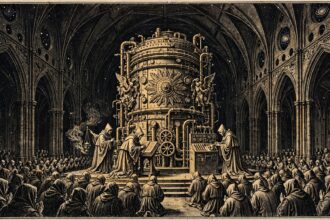


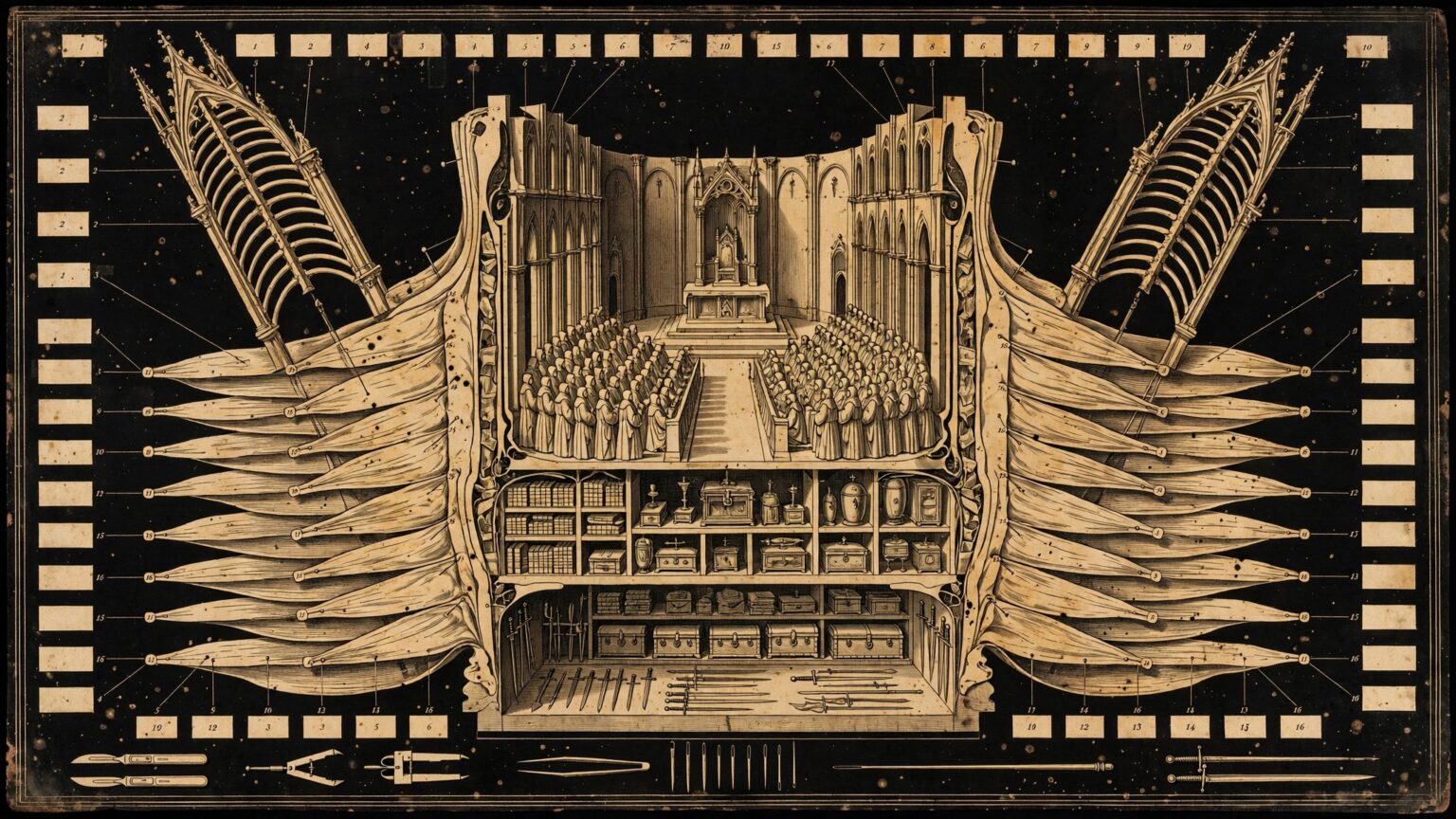
Fiction loves a holy state. From the deserts of Arrakis to the cathedral-worlds of the Imperium of Man, from the living gods of Morrowind to the blood-soaked Healing Church of Yharnam, writers and game designers return again and again to societies ruled in the name of the divine. In just over a year of excavations, the Institute has catalogued more theocracies than monarchies, republics or empires. They are not all alike. But placed side by side, they share an anatomy.
This is the Institute’s first comparative study. Instead of excavating a single world, it dissects a form of government across many. It draws on Excavations already in the register, among them The Religion Planted on Arrakis, The Living Gods of Morrowind, The Church That Healed Its City With the Blood of Gods, The Empire That Prays to a Corpse and The Church That Turned Science Into Scripture.
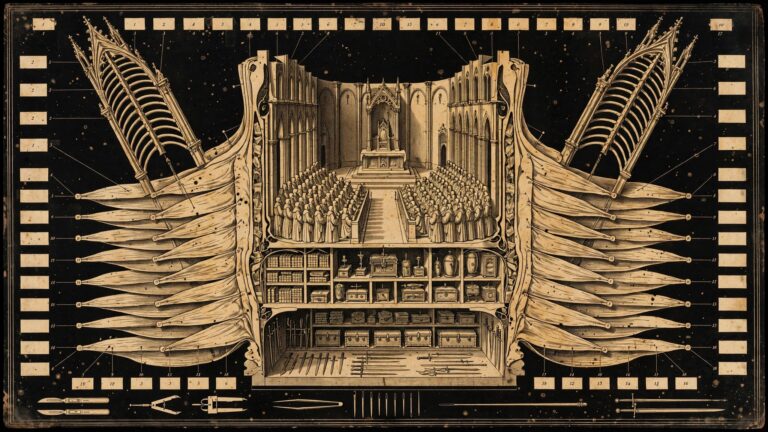
Every theocracy, real or imagined, must answer the same six questions. What is its god? Who speaks for it? What is written? What proves it? Who is its enemy? And how does it end? The sections that follow take each question in turn, and show how fiction has answered them.
I. The God
Every theocracy begins with a claim about the divine, and fiction has imagined that claim in strikingly different forms. Some fictional gods are alive and present. In Morrowind, the three members of the Tribunal, Almalexia, Sotha Sil and Vivec, were once mortals who made themselves divine by tapping the power of the Heart of Lorkhan, and they walked among their worshippers as living gods for thousands of years.
Others are dead or silent. The God-Emperor of the Imperium of Man in Warhammer 40,000 forbade religion in life, and has sat for ten thousand years as a withered body on the Golden Throne, unable to object as a galaxy prays to him. Still others are invented. The church of Isaac Asimov’s Foundation worships the Galactic Spirit, a deity designed by scholars who knew it did not exist, while the prophecies Paul Atreides fulfils in Dune were planted on Arrakis centuries earlier by the Bene Gesserit.
The nature of the god shapes the whole state. A living god can intervene, judge and punish in person. A dead or silent god must be interpreted, which gives enormous power to whoever speaks for it. An invented god belongs to its inventors. Across fiction, the most dangerous theocracies are rarely those with a present god. They are those in which the god is absent, and someone else has taken its voice.
II. The Priesthood
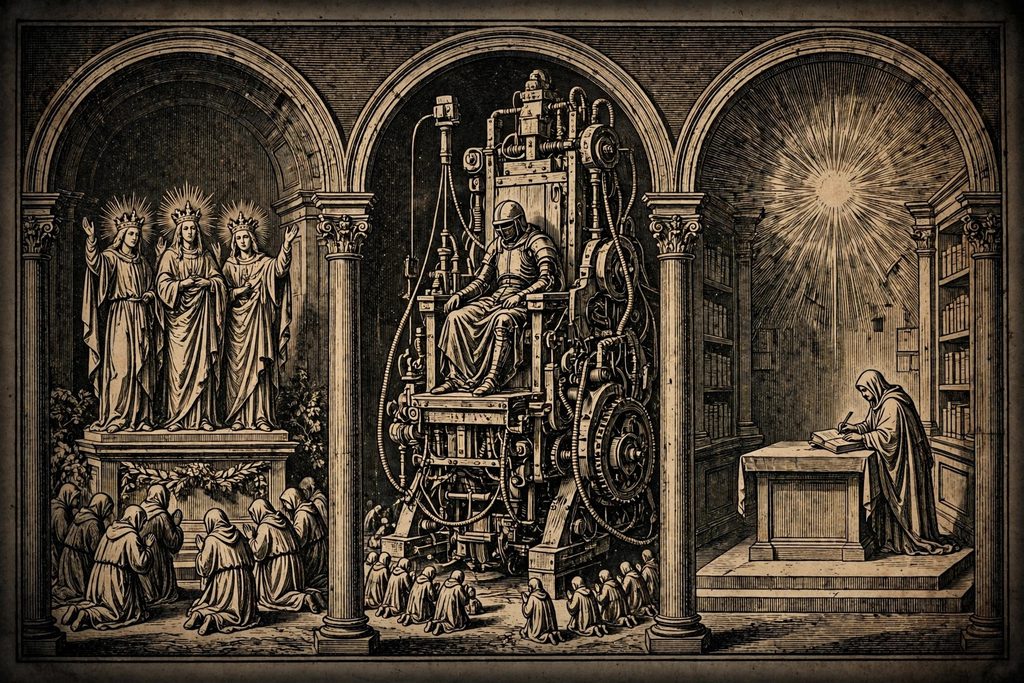
Between the god and the people stands the priesthood, and in fiction it is almost always where power really lies. The Ecclesiarchy of Warhammer 40,000, the Adeptus Ministorum, controls the worship of the Emperor across a million worlds. In the Age of Apostasy, one of its leaders, Goge Vandire, seized the highest offices of the Imperium and ruled through a reign of terror, until he was overthrown and the church was restrained by law.
Some priesthoods do not even understand their own faith. The priests of Foundation’s church are trained on Terminus to operate nuclear plants as sacred rituals, and most sincerely believe in the Galactic Spirit. The Healing Church of Bloodborne began as scholars who discovered the old blood of the Great Ones and turned it into a sacrament, offering healing to a whole city through blood ministration. Its priests knew more than their congregations, but not enough to control what they had found.
The pattern repeats across worlds. A fictional priesthood is a class of interpreters with a monopoly on access to the sacred, and that monopoly can be turned into political power, economic power or simple survival. The more absent the god, the stronger the priests. The more secret the knowledge, the greater the danger when it fails.
III. The Word
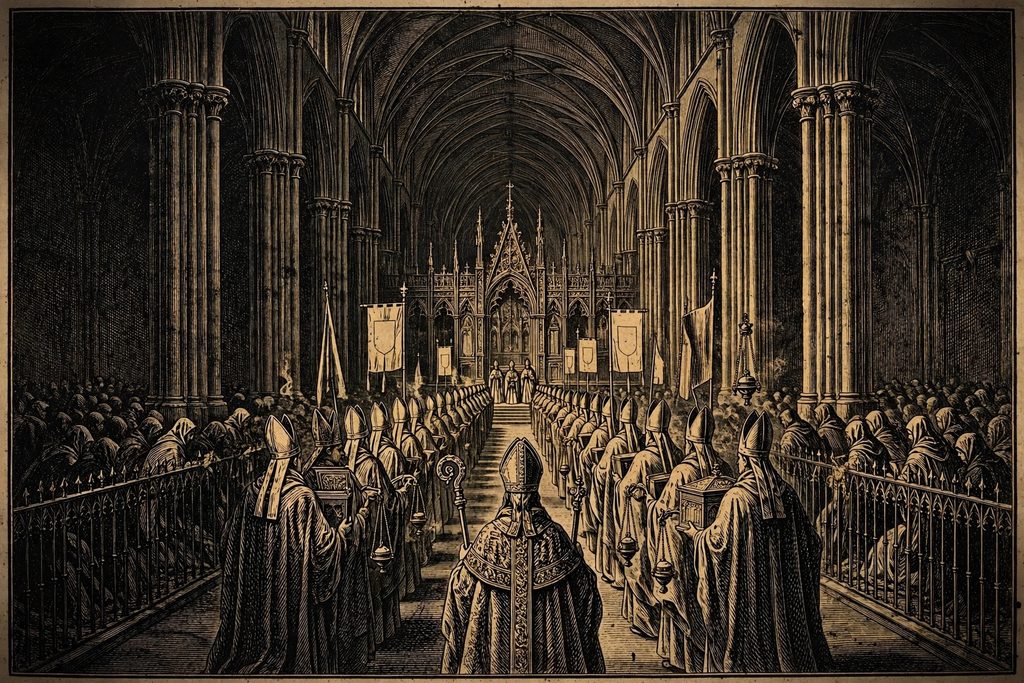
Theocracies govern through texts. A sacred book turns the will of a god into rules, and whoever controls its interpretation controls the law. In Dune, the Orange Catholic Bible stands as the shared scripture of the empire, while the Fremen live by prophecies that the Bene Gesserit’s Missionaria Protectiva planted among them generations earlier, so that the arrival of a messiah would follow a script.
Fictional scripture is often a tool in someone’s hands. The Missionaria Protectiva seeds legends across many worlds as protection for any Bene Gesserit who might one day need them, and Paul Atreides survives the desert by stepping into one of those legends. The doctrine of the Imperial Cult in Warhammer 40,000 grew from texts that declared the Emperor divine against his own wishes. The rituals of Foundation’s church were written by scholars to keep technicians obedient without understanding.
The lesson is consistent and unsettling. In fictional theocracies, the sacred text is rarely revealed and then interpreted. It is more often written by people with a purpose, and then believed by people who never knew there was one. The word of the god becomes the word of the author, and the author is usually hidden.
IV. The Miracle
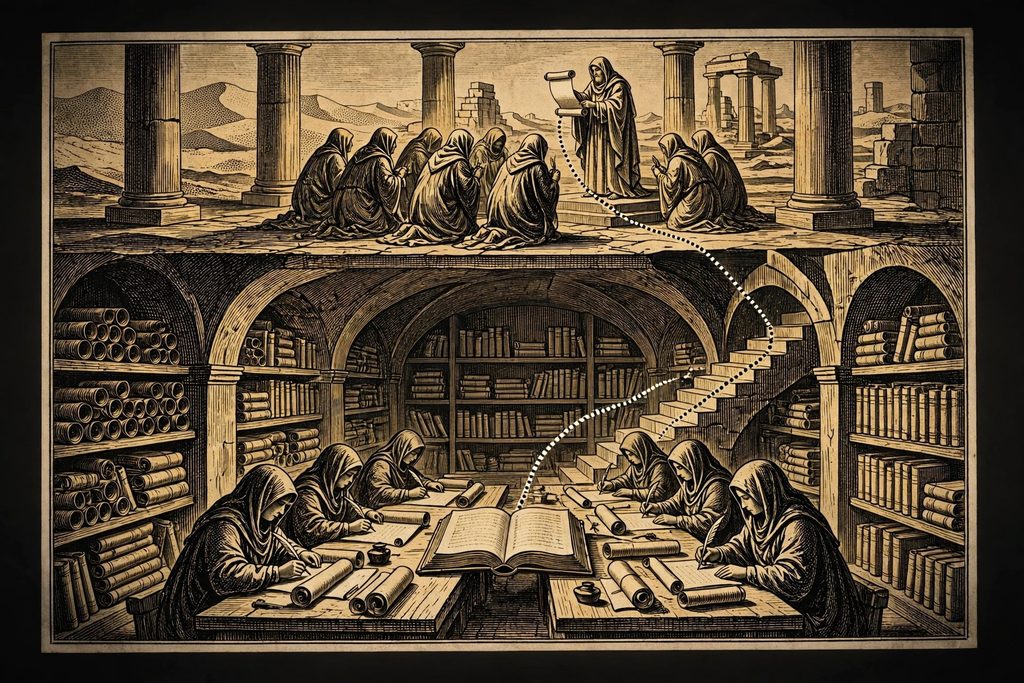
A theocracy needs proof. Faith may sustain a believer, but a state built on faith needs regular, visible evidence that its god is real and on its side. Fiction is unusually honest about where those miracles come from. In Foundation, the miracles are nuclear power plants and starships, technology presented as grace. In Morrowind, the Tribunal’s divinity was real enough, but it was drawn from the Heart of Lorkhan through tools made by the Dwemer, a power source rather than a revelation.
The Healing Church of Bloodborne built its authority on the most tangible miracle of all. Its blood healed the sick, and the city of Yharnam came to depend on it. The same blood that proved the church’s power also spread the beast plague that destroyed the city. Its miracle and its catastrophe were the same substance. In Dune, the miracle is Paul himself, whose survival among the Fremen and whose prescient powers seem to fulfil every planted prophecy.
What these worlds share is a dangerous dependency. A theocracy that rests on a miracle is only as stable as the miracle. Switch off the reactor, sever the Heart, poison the blood, and the god disappears with it. Fictional theocracies often fall not because people stop believing, but because the evidence that sustained their belief turns out to have a mechanism, and the mechanism breaks.
V. The Heretic
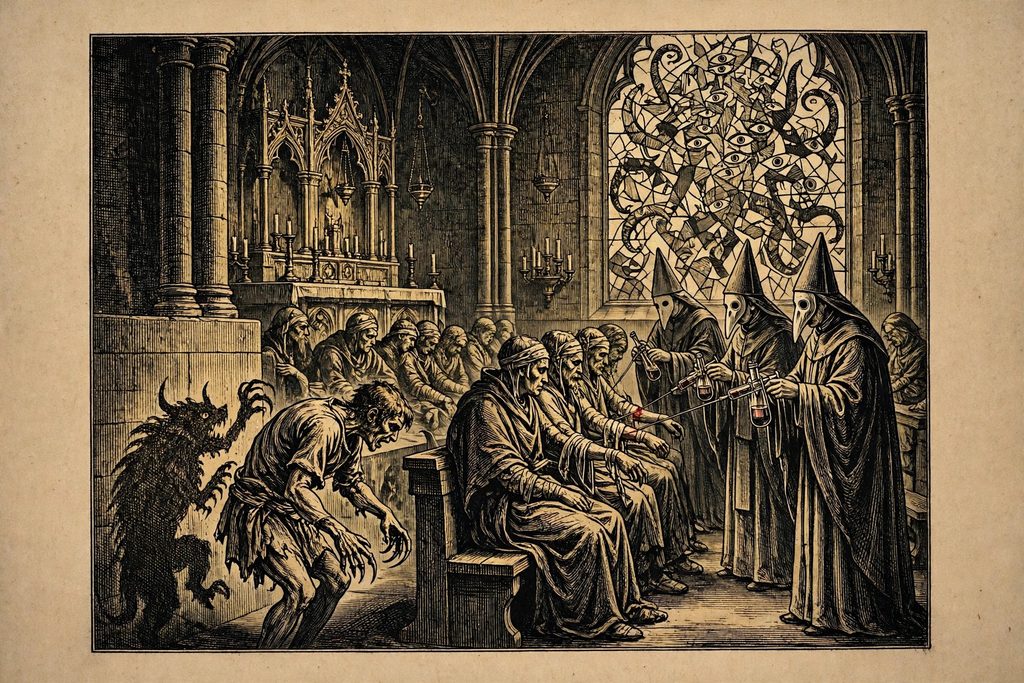
Every theocracy defines itself against an enemy, and fiction shows how quickly the definition expands. In Warhammer 40,000, the Inquisition hunts heresy across the galaxy with almost unlimited authority, and whole planets can be destroyed for the wrong belief. In Skyrim, the situation is inverted. The White-Gold Concordat, imposed by the Aldmeri Dominion, outlawed the worship of Talos, and agents of the Dominion’s Thalmor hunt his followers, turning a whole province’s faith into a crime.
Some theocracies make their own god the heresy. In Hollow Knight, the kingdom of Hallownest was built by a king who tried to erase the memory of an older god, the Radiance, whose followers had worshipped her before he arrived. Forgetting became state policy. The suppressed god returned as a plague that infected the dreams of the kingdom and destroyed it. A holy state that forbids one faith to protect another gives the forbidden faith a power it might never have had.
The heretic is necessary to the theocracy because it makes the boundaries of the faith visible. But fiction repeatedly shows the cost. The hunt for heresy becomes an engine of fear, and fear needs more heretics. The Institute studied this dynamic in The Civil War Over a Forbidden God and The Kingdom That Tried to Forget Its God. In both, suppressing a god did not end its worship. It turned that worship into a cause.
VI. The Fall
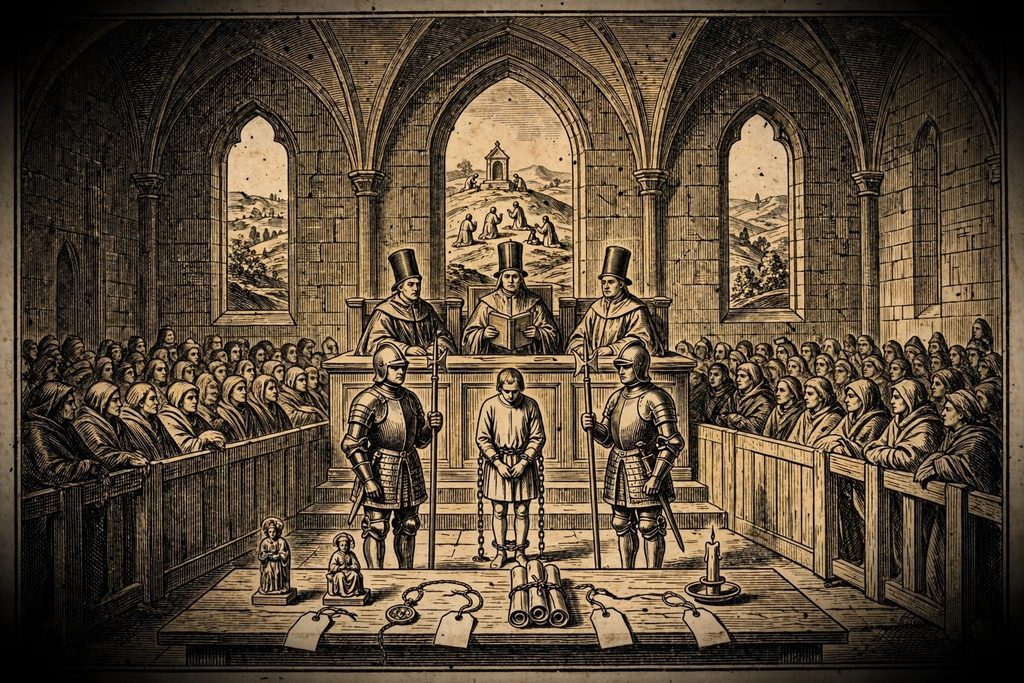
How do fictional theocracies end? Rarely in the way they expect. The Tribunal of Morrowind lost its divinity when the Heart of Lorkhan was severed, and by the time of Skyrim, two centuries later in the setting, its temple has been replaced by a New Temple that worships the daedric princes Azura, Boethiah and Mephala. The living gods became history. The church of Foundation was abandoned by its own founders when trade proved a more reliable instrument of control than faith.
Some theocracies collapse under their own miracles. The Healing Church of Bloodborne destroyed Yharnam with the very blood it used to save it. Others become something worse than they were. Paul Atreides foresees the jihad that will be fought in his name, tries to prevent it, and fails. The holy war he could not stop spreads across the known universe, and in Dune Messiah its death toll is counted in billions. A religion engineered to protect a few Bene Gesserit becomes a force no one can control.
The Imperium of Man is the exception that proves the rule. It has not fallen. It has simply never stopped declining. Across fiction, the theocracy is a form of government that carries the mechanism of its own fall inside it, whether that is a miracle that fails, a priesthood that overreaches, a heresy that becomes a cause or a faith that escapes its makers. Fiction’s holy states are rarely destroyed from outside. They are undone by the very thing that made them holy.
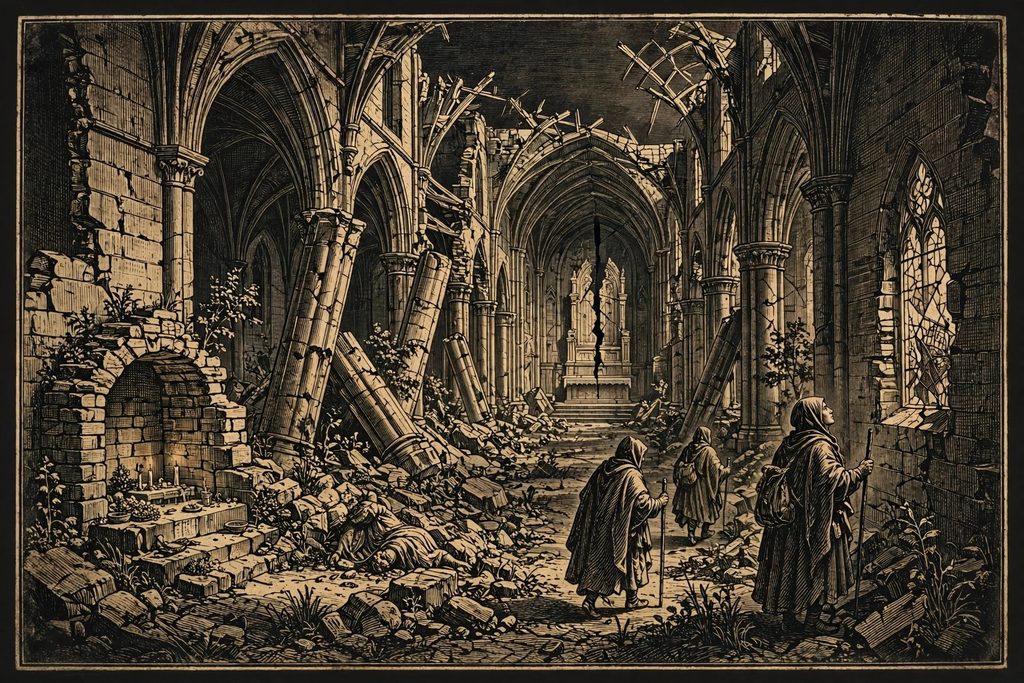
The ancestor of them all
The word itself has a history. It was coined in the first century CE by the Jewish historian Flavius Josephus, in his treatise Against Apion. Comparing the constitutions of the world, he observed that some peoples entrusted power to monarchies, others to oligarchies and others to the multitude, but that the lawgiver of the Jews had chosen none of these. He had made the government what Josephus called, by a strained expression, a theocracy, ascribing all authority and power to God. The word was an apology and a description at once, and from its first use it carried a question. If God governs, who governs in God’s name?
The longest-lived Christian answer was the Papal States. From the eighth century, when the Frankish king Pepin granted territories in central Italy to the pope, the bishops of Rome ruled a temporal kingdom as well as a church. For more than a thousand years, the papacy collected taxes, raised armies, ran courts and fought wars. The state ended on 20 September 1870, when the troops of the Kingdom of Italy entered Rome, and the pope withdrew into the Vatican, refusing to recognize the new order. The dispute was resolved only in 1929, when the Lateran Treaty created Vatican City, the smallest state in the world and the last of the old theocratic kingdoms of Europe.
The pattern
Why does fiction return so often to the theocracy? The Institute’s excavations suggest three reasons. The first is that a theocracy makes ideas into a political force, so that a story about belief can also be a story about armies, laws and borders. The second is that it turns the question of truth into a question of power, because whoever speaks for the god decides what is real. The third is that it carries its own downfall inside it, giving writers a society whose collapse can grow from its foundations.
Its closest literary relative is Margaret Atwood’s The Handmaid’s Tale, published in 1985, in which a theocratic regime called Gilead overthrows the government of the United States and governs through a selective reading of scripture. Atwood said she included nothing that humans had not already done somewhere in history. Gilead is the theocracy without the fantastic disguise, which is why it remains the reference point for every holy state that fiction has imagined since.
The Institute has also studied the opposite case, in The Tribe That Worshipped a Machine’s Door, where a faith grew around a machine no one understood, with no priesthood planning it. Between the accidental cult and the engineered church lies the whole spectrum of fictional theocracy. At one end, belief creates power. At the other, power creates belief. Most of fiction’s holy states live somewhere in between.
Findings
- Fictional theocracies share an anatomy. Each must answer six questions, about its god, its priesthood, its scripture, its miracles, its heretics and its end, and the answers shape the whole society.
- The absent god is the most dangerous. Living gods like the Tribunal can rule in person, but dead, silent or invented gods like the God-Emperor or the Galactic Spirit leave their voice to priesthoods, who hold the real power.
- Fictional scripture is usually written with a purpose. From the prophecies of the Missionaria Protectiva to the rituals of Foundation’s church, sacred texts in fiction are more often engineered than revealed.
- Miracles are the weak point of holy states. Theocracies that rest on visible proofs, like nuclear power, the Heart of Lorkhan or the healing blood of Yharnam, fall when the mechanism behind the miracle fails.
- Theocracies are undone by what made them holy. The fall of Morrowind’s Tribunal, the ruin of Yharnam, Paul Atreides’ uncontrollable jihad and the abandonment of Foundation’s church all grew from the foundations of each faith.
This comparative study draws on the Institute’s earlier Excavations of Dune, The Elder Scrolls, Bloodborne, Warhammer 40,000, Foundation, Skyrim and Hollow Knight, on Josephus’ Against Apion, on the history of the Papal States and on Margaret Atwood’s The Handmaid’s Tale.
The Institute collects field evidence from people who have lived inside these worlds. If there is a fictional theocracy you think belongs in this study, or one that frightened you more than any other, send us your account.
Sources
- Frank Herbert, Dune (1965) and Dune Messiah (1969), Chilton Books and G. P. Putnam’s Sons.
- The Elder Scrolls III, Morrowind (2002) and The Elder Scrolls V, Skyrim (2011), Bethesda Game Studios.
- Bloodborne (2015), FromSoftware.
- Hollow Knight (2017), Team Cherry.
- Isaac Asimov, Foundation (1951), Gnome Press.
- Flavius Josephus, Against Apion, Book 2, translated by William Whiston (1737).
- David I. Kertzer, The Pope Who Would Be King (2018), Random House.
- Margaret Atwood, The Handmaid’s Tale (1985), McClelland and Stewart.