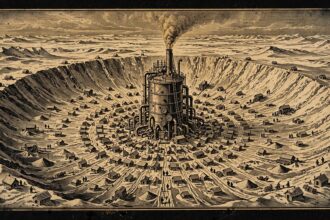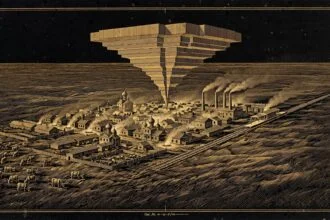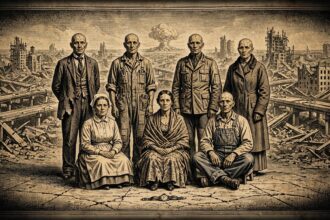


In 2013, the world ends in a nuclear war, and the surface of Moscow becomes uninhabitable. Tens of thousands of survivors flee into the city’s metro, the deepest and most ornate underground railway in the world, and there, in the dark, they rebuild everything humanity has ever built. Stations become villages. Lines become empires. Old ideologies come back to life between the tracks. Twenty years later, the metro is not a shelter anymore. It is a civilization.
This is the world of Metro 2033, the novel by the Russian writer Dmitry Glukhovsky, first published online in 2002 and in print in 2005, and of the video game series that followed it, beginning with Metro 2033 in 2010 and continuing through Last Light and Exodus. It has become one of the most widely read works of post-apocalyptic fiction to come out of Russia, and one of the most anthropologically detailed.
The Institute has studied the vault dwellers of The People Who Outlived the Bomb and the frozen city of The City That Lived Around a Single Fire. The Metro is a different kind of survival society. It is not one shelter but dozens, each with its own government, its own economy and its own idea of what humanity should become.
I. A Palace Built for Shelter
The Moscow Metro was always more than a railway. When its first line opened in 1935, it was presented as a gift of the Soviet state to its people, with stations designed as underground palaces of marble, mosaic, bronze and chandeliers. It was also built deep, much deeper than most subway systems, because its planners expected that one day it might have to shelter the city.
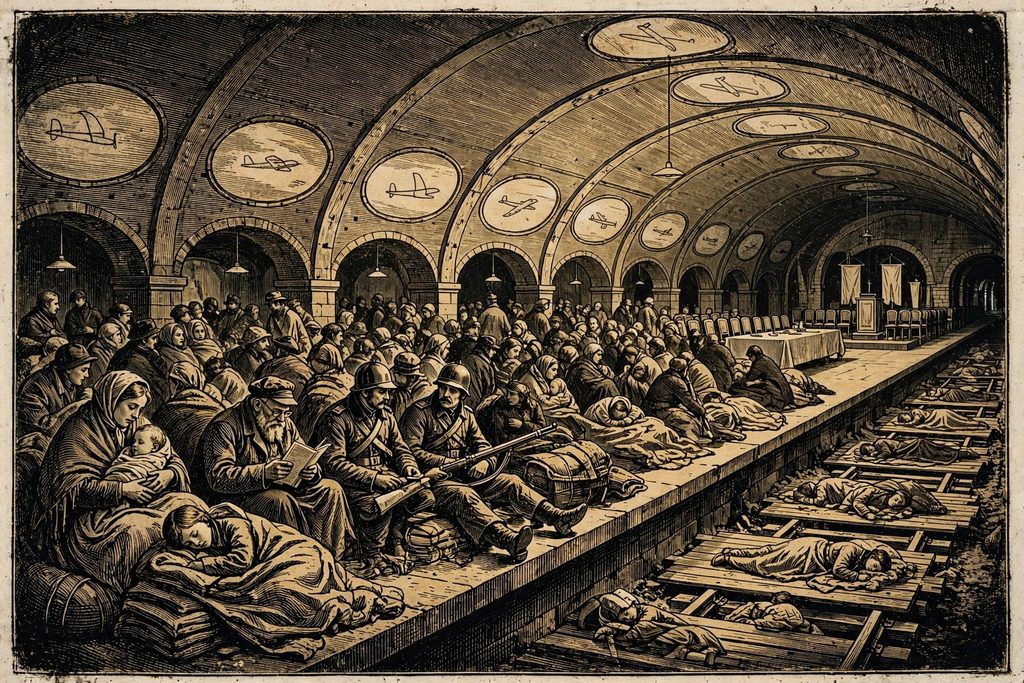
That expectation came true long before the novel. During the Second World War, the metro became Moscow’s refuge from German air raids. Thousands of people slept on its platforms and in its tunnels, and children were born there. In November 1941, with the enemy close to the city, the Soviet leadership held the anniversary meeting of the Revolution inside Mayakovskaya station, under its mosaic ceiling, where Stalin addressed the assembly underground.
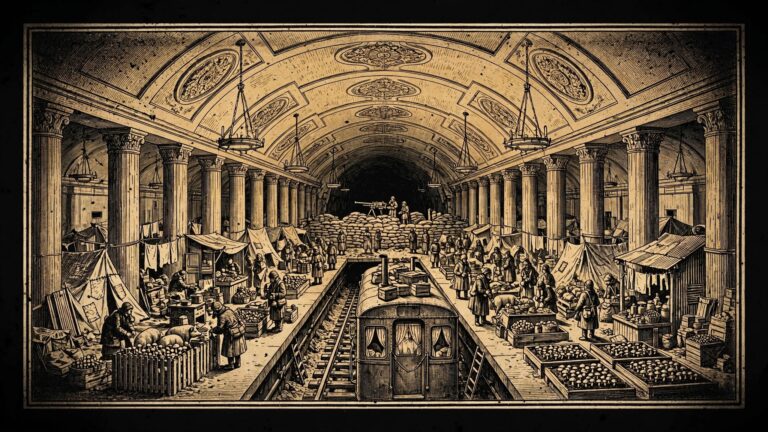
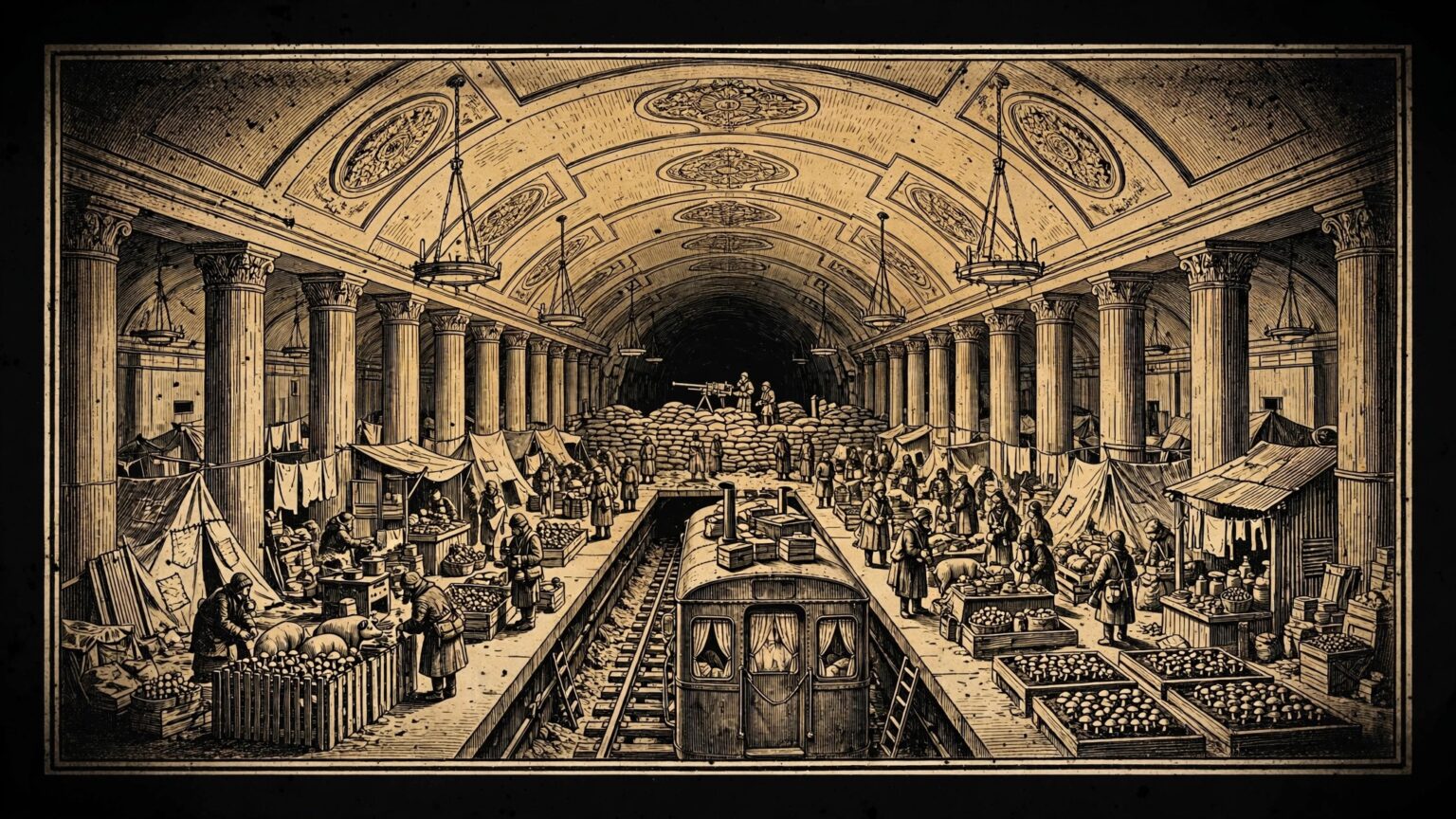
Glukhovsky’s novel takes this real history to its logical end. The underground palaces become the last homes of a civilization. The marble halls fill with tents and pig pens, the ceilings with soot, and the escalators that once carried commuters to the light now lead only to a poisoned surface, guarded by blast doors that are rarely opened.
II. The Map Is a Political Map
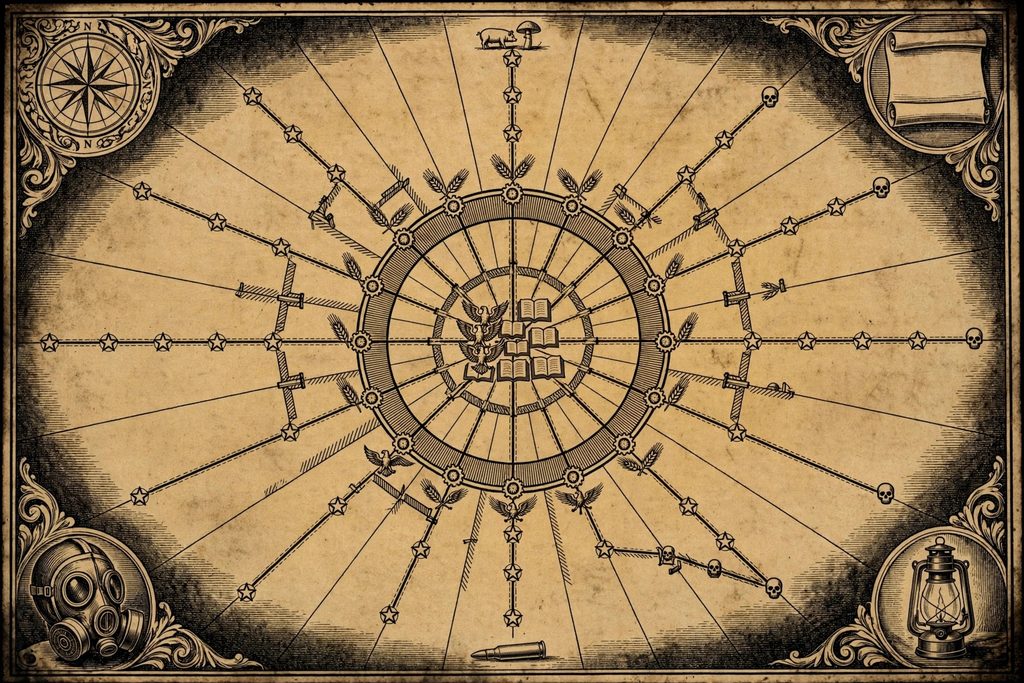
In the Metro, the subway map has become a map of nations. Each station is a settlement, and each settlement has made its own choices about how to live. Exhibition, known as VDNKh, where the hero Artyom grew up, is a modest farming community at the edge of the system, growing mushrooms, raising pigs and brewing tea from fungus. Other stations are trading posts, fortresses, slums or ruins abandoned to the tunnels.
The great powers of the Metro are federations of stations. The Ring Line, which circles the centre of the system and connects to every other line, has become the Hansa, a commercial confederation named after the merchant league of medieval northern Europe. It is the richest state underground, issuing passports and controlling trade with border posts and customs. Along the old red line on the map, a neo-Soviet Red Line has revived communism with its own leaders, propaganda and secret police. At three central stations, a neo-Nazi Fourth Reich has taken power and persecutes anyone it does not consider pure.
At the heart of the system, four connected stations form Polis, the last centre of learning in the world. It is governed jointly by a military caste and by the Brahmins, scholars who preserve the knowledge of the old world and send armed stalkers to the surface to bring back books from the great library above. The Metro, in other words, has rebuilt the full range of twentieth century politics within a few kilometres of tunnel, and placed them side by side as rival states.
III. An Economy of Bullets
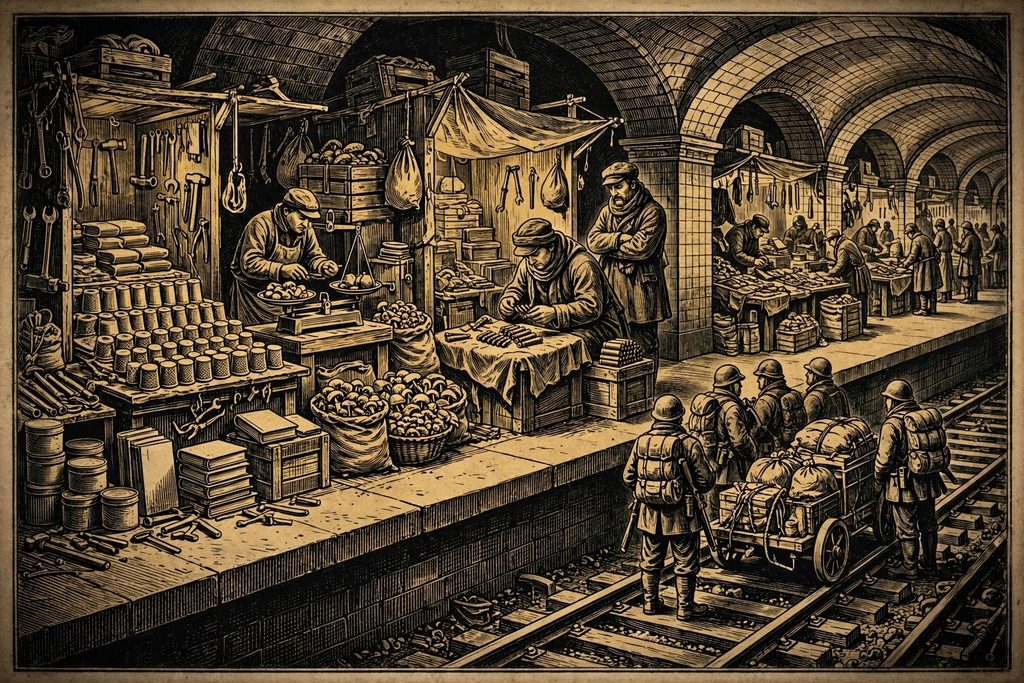
Every civilization needs a currency, and the Metro chose the one thing that is both valuable and impossible to manufacture underground. Its money is military-grade ammunition, cartridges made before the war. They can be spent in a market, or loaded into a rifle in an emergency, and everyone knows that the supply will never grow. Each purchase in the Metro is, in a small way, a decision about whether to trade safety for comfort.
Around this currency a whole economy has grown. Stations trade mushrooms, pork, tea, filters for gas masks, salvaged tools and medicines. Caravans travel the tunnels between stations with armed escorts. The Hansa grows rich by taxing the flow of goods around the Ring. Stalkers, the professionals who go up to the surface in protective suits, are the Metro’s explorers and its most valuable workers, because they bring back what the underground cannot produce, from medicine to books.
Life itself is organized around scarcity. Light comes from rationed electricity, lamps and fires. Air depends on ventilation systems and filters. The surface is a source of everything and a place of death. The tunnels between stations are the most dangerous places of all, home to mutated creatures, bandits, anomalies and silence. A station is a civilization. A tunnel is a frontier.
IV. Faiths of the Tunnels
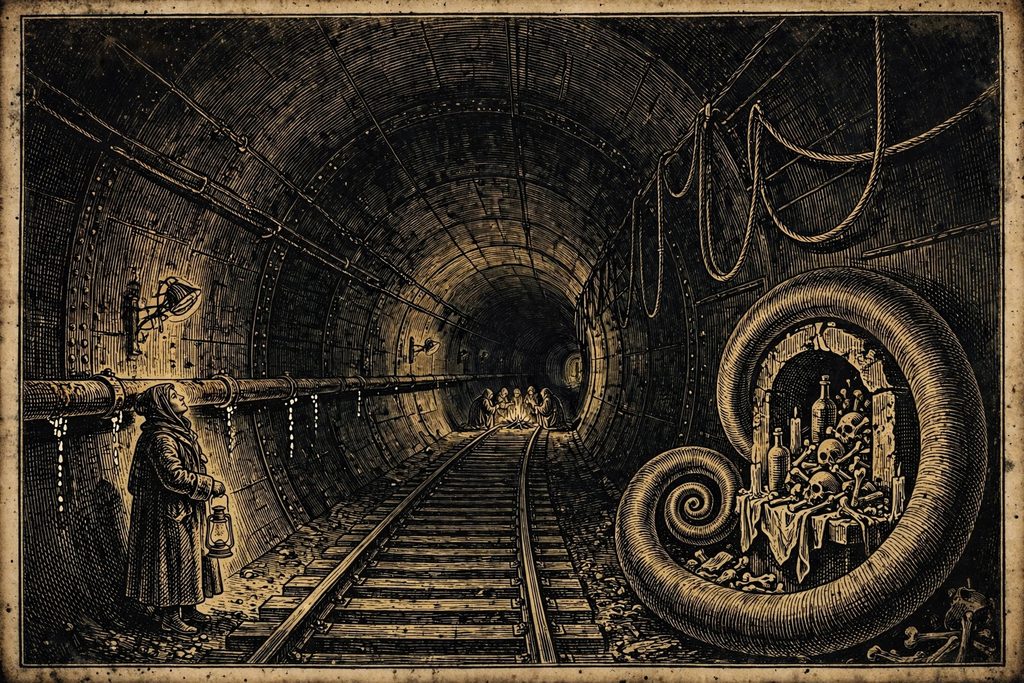
Where there is darkness, there are religions. The Metro has many. In the deepest and most abandoned tunnels live cults that worship whatever they fear. The most memorable in the novel is a cannibal tribe devoted to the Great Worm, a god they believe dug the tunnels themselves, and who, they teach, should be fed. Other stations harbour sectarians, mystics, Satanists and believers in a hidden second metro.
That last belief has a real basis. Muscovites have long told stories of Metro-2, a secret parallel railway said to have been built for the government and the military, linking the Kremlin to bunkers outside the city. Its existence has never been officially confirmed. In the Metro games, it becomes D6, a hidden military complex with weapons and secrets from before the war, and a kind of holy grail for those who know of it.
Among the Metro’s spiritual figures, the most important is Khan, a wanderer and mystic who guides Artyom through the tunnels and speaks of the dead, of voices and of the spirits that move in the dark. In a world without a sky, the tunnels themselves have become sacred space. People listen to pipes for messages from the dead. Some stations have fallen into madness for reasons nobody understands. The Metro is a rational civilization of trade and politics, built on top of a layer of myth that grows thicker the further one goes from the light.
V. The Dark Ones
The novel’s central threat comes from the surface. At the edge of the system, near the Botanical Garden, strange creatures called the Dark Ones have begun to attack Exhibition. They are tall, pale, humanoid beings, and their presence brings terror, visions and madness. Artyom is sent on a journey across the whole Metro to warn Polis, and the journey becomes a tour of every state, faith and ruin underground.
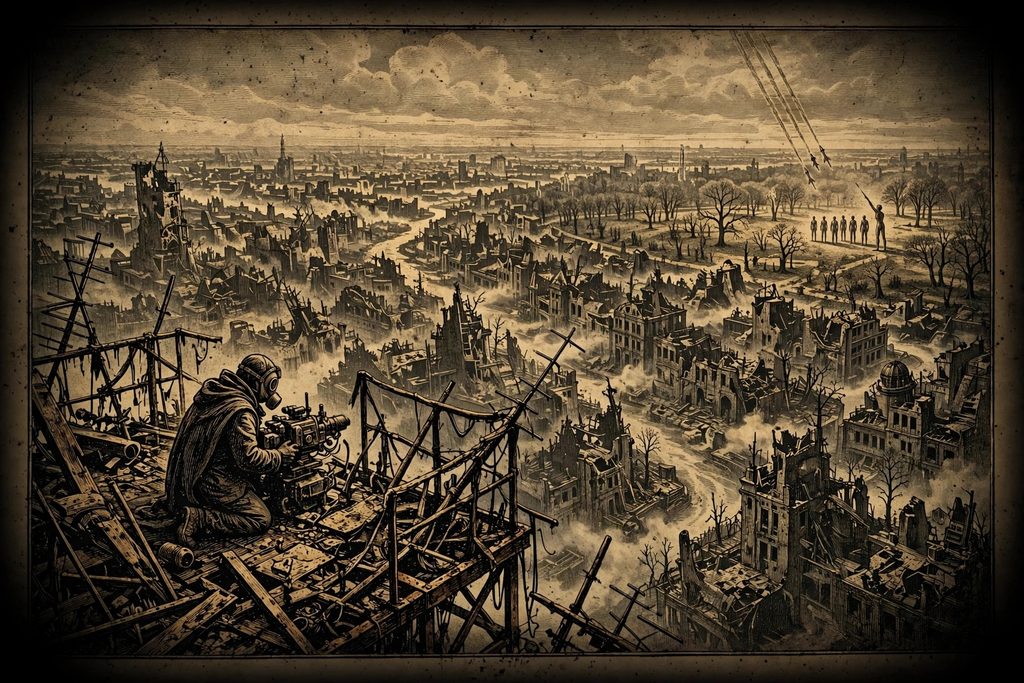
At the end of the novel, Artyom finds a way to destroy the Dark Ones. A working missile system survives from before the war, and he climbs the ruined Ostankino television tower to guide the strike. At the very last moment, he understands what the Dark Ones have been doing all along. They were not attacking. They were trying to communicate, reaching out to the only survivors of humanity with minds that humans experienced as horror. The missiles fall anyway. The only other intelligent species on earth is destroyed by the people it was trying to help.
It is one of the bleakest endings in modern science fiction, and the most anthropological. The Metro has rebuilt markets, governments, ideologies and religions. What it has not rebuilt is the capacity to meet a stranger without fear. The games return to this question again and again. In Last Light, a surviving Dark One child reaches out to Artyom once more, and this time, at least in part, humanity listens.
VI. The Lie Above Ground
The deepest secret of the Metro is about the surface. In the later novels and in the game Exodus, Artyom keeps climbing to the poisoned city to search the radio waves for other survivors, and everyone tells him he is wasting his time. They are wrong. The radio signals from the outside world exist. They have been jammed, deliberately, by powers inside Moscow, so that the people of the Metro would go on believing they were the last humans alive.
The revelation changes the meaning of the whole civilization. The Metro was not only a refuge. It was also a prison, held together by a lie that kept its people underground and its rulers in power. In Exodus, released in 2019, Artyom and a band of Rangers steal a locomotive and leave Moscow, crossing a ruined but not empty Russia in search of a place to live in the open air. The Metro’s people have been told for twenty years that there is no outside. The final journey of the series is the discovery that there always was.
The story is not over. A new game, Metro 2039, is announced for release this winter, returning to the tunnels to find the Metro’s factions united under a single new power. Twenty-six years after the war, the civilization of the stations is still writing its history.
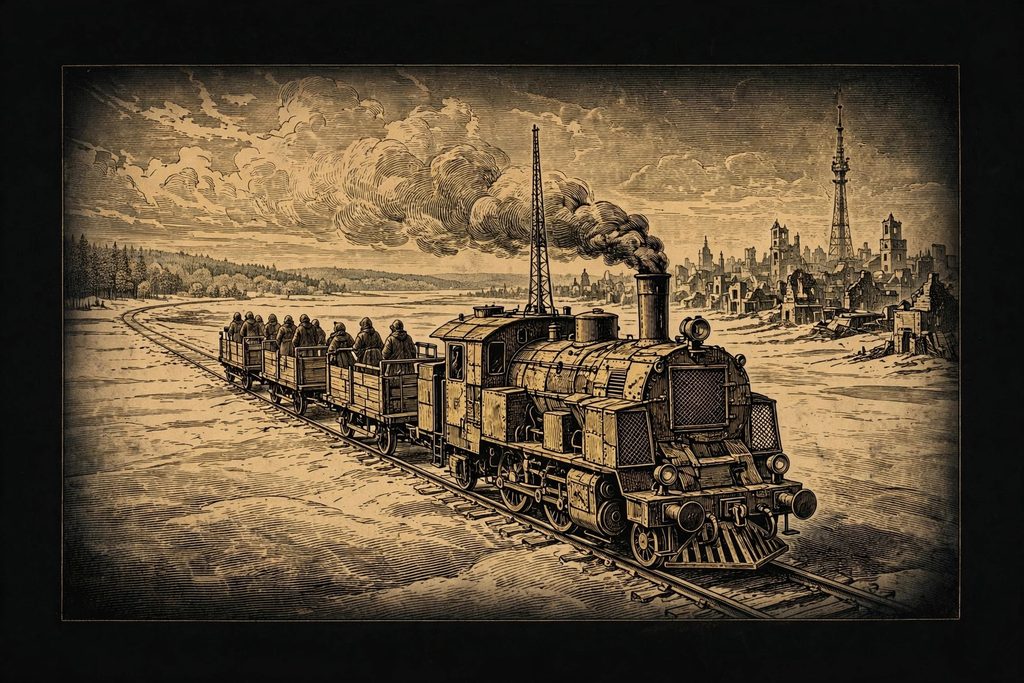
The ancestor of them all
Humans went underground to survive long before the Moscow Metro was dug, and the most spectacular example lies in Cappadocia, in the heart of Anatolia.
Beneath the town of Derinkuyu, in what is now Turkey, lies an underground city carved into the soft volcanic rock, descending around eighty-five metres through at least five levels. It had ventilation shafts, wells, stables, wine and oil presses, storerooms, kitchens and chapels, and its corridors could be sealed with great rolling stone doors. Estimates suggest it could shelter thousands of people, perhaps as many as twenty thousand, together with their animals and food. Its earliest tunnels may be very old, but it was greatly enlarged in the Byzantine period, when the Christian communities of Cappadocia retreated underground during the long Arab raids of the eighth to twelfth centuries.
Derinkuyu was used as a refuge into modern times. The Cappadocian Greeks and Armenians of the region sheltered in the underground cities during the persecutions of the early twentieth century, and only abandoned them when the Greek population was expelled in the exchange of populations of 1923. The city was then forgotten, until 1963, when a resident renovating his house knocked through a wall and found a passage leading down into the dark.
Even older is the testimony of Xenophon, the Athenian soldier and historian, who marched through Armenia around 400 BCE and described villages whose houses were dug underground, entered through a mouth like a well, with people and animals living together below the surface through the winter. The Metro’s stations, with their pigs and mushrooms and fortified tunnels, would have looked familiar to him.
The pattern
The Metro belongs to a family the Institute calls the underground polities, civilizations rebuilt beneath a surface that has become forbidden. Their relatives include the vaults of Fallout, the subterranean city of Jeanne DuPrau’s novel The City of Ember, published in 2003, and the Silo of Hugh Howey’s Wool, first published in 2011, in which thousands of people live in a vast buried tower and are told that the outside world is deadly.
Three features define these polities. The first is enclosure, a society whose entire territory is a shelter and whose borders are walls of rock. The second is scarcity of the elements, light, air and space, which becomes the basis of politics, economy and law. The third is the lie of the dead surface, the belief, sometimes true and sometimes manufactured, that there is nowhere else to go. In Wool, in the Metro and in many vaults, the most dangerous secret is not what lives outside but whether the outside is as dead as the rulers say.
The Metro adds one more element that makes it unique. Its people carried all of history down with them. Capitalism, communism, fascism, theocracy and scholarship were rebuilt at neighbouring stations, as in a museum of twentieth century ideas, and the Institute has seen the same refusal to let old politics die in The City That Lost the War and Kept Its Politics. The bombs ended a world. They did not end its arguments.
Findings
- The Metro is a civilization of city-states. After the war of 2013, Moscow’s survivors turned each subway station into a settlement with its own government, economy and culture.
- Its map is a political map. The Hansa of the Ring Line, the Red Line, the Fourth Reich and the scholarly Polis rebuilt the full range of twentieth century politics as rival states a few stations apart.
- Its money is its last ammunition. Pre-war military cartridges serve as currency, so every purchase is a choice between comfort and safety, in an economy defined by what can never be made again.
- Its tragedy is fear of the stranger. The Dark Ones, the only other intelligent species left, were trying to communicate when humanity destroyed them, and the series keeps returning to that failure.
- Its ancestors are the underground cities of Anatolia. Derinkuyu in Cappadocia sheltered thousands beneath the earth with their animals and chapels, and Xenophon described underground villages in Armenia around 400 BCE.
This Excavation draws on Dmitry Glukhovsky’s Metro novels, on the Metro video games, on the history of the Moscow Metro, on the underground cities of Cappadocia and on Xenophon’s Anabasis.
The Institute collects field evidence from people who have walked these tunnels. If you remember the first time you reached Polis, send us your account.
Sources
- Dmitry Glukhovsky, Metro 2033 (2005), Metro 2034 (2009) and Metro 2035 (2015).
- Metro 2033 (2010), Metro Last Light (2013) and Metro Exodus (2019), 4A Games.
- Andrew Jenks, “A Metro on the Mount, The Underground as a Church of Soviet Civilization”, Technology and Culture 41 (2000).
- Xenophon, Anabasis, book 4 (fourth century BCE).
- Hugh Howey, Wool (2011), and Jeanne DuPrau, The City of Ember (2003).