





EXCAVATION Nº 0018 · RELIGIONS
World: Vvardenfell, Morrowind
Period: 1E 700 to 3E 427 (in-world)
Status: Extinct
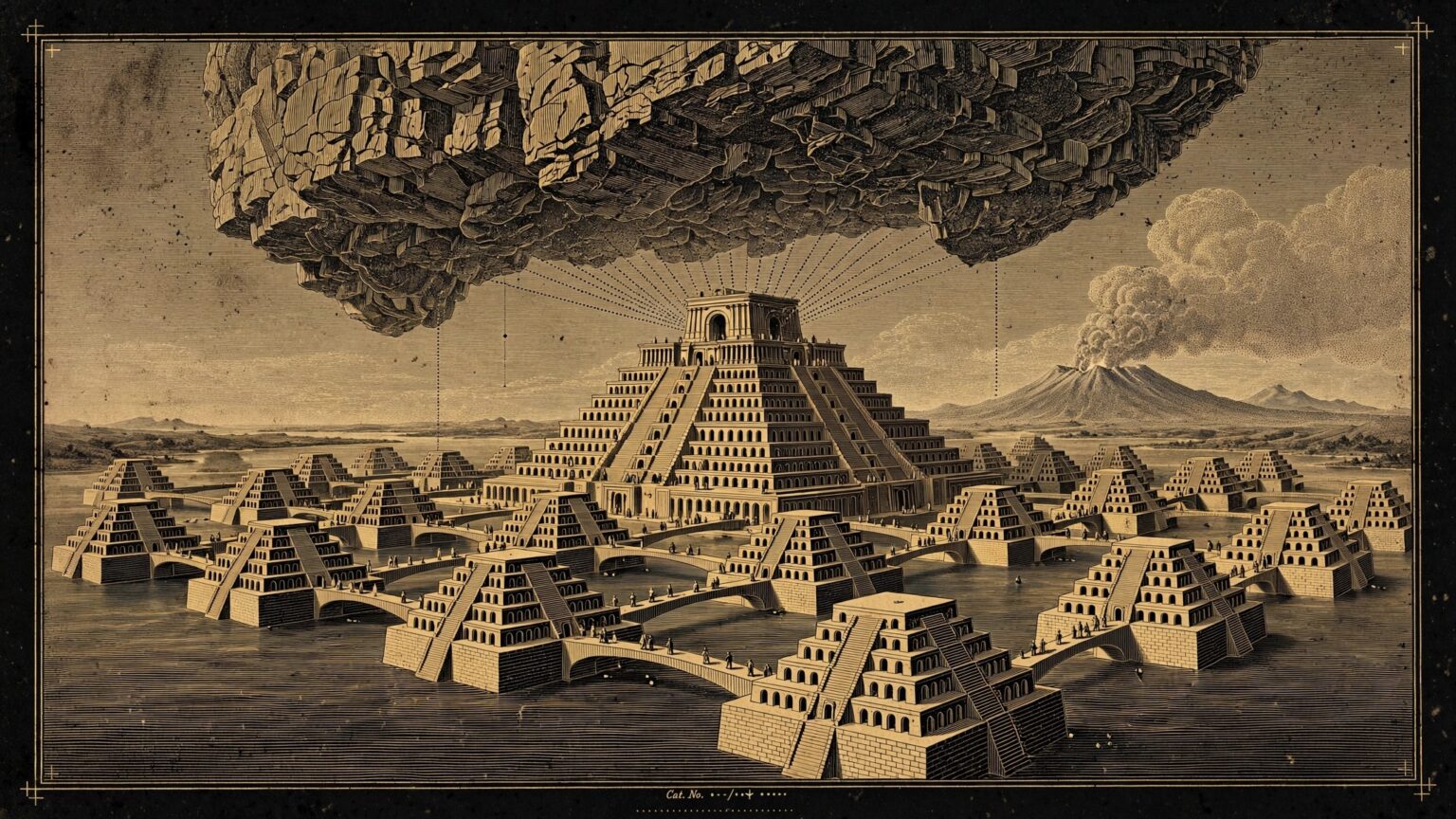
Above the city of Vivec, in the province of Morrowind, a mountain of rock hangs in the sky. It does not fall because a god is holding it up. The god is Vivec himself, warrior, poet and one of the three living deities who have ruled the Dunmer, the dark elves, for nearly four thousand years. Pilgrims come from across the island to see him and to walk the shrines of his city, and the evidence of his divinity is literally overhead. In most religions faith means believing in what cannot be seen. In Morrowind, the gods walk the streets, answer prayers and hold the sky in place.
This is the setting of The Elder Scrolls III Morrowind, released by Bethesda in May 2002. It is one of the most admired role-playing games ever made, and the Tribunal at its centre is one of the most sophisticated religions in fiction. Its three gods were once mortal. They became divine by stealing the power of a dead god, betraying their king and breaking an oath. Their Temple has spent four thousand years making sure no one finds out. The player arrives as the one person who might.
The Religions department studies how fictional faiths are born, practised and transformed. The Tribunal is a rare and complete case. It is a religion whose gods are real, present and verifiable, which makes its fall all the more instructive.
I. The Mortals Who Stole Godhood
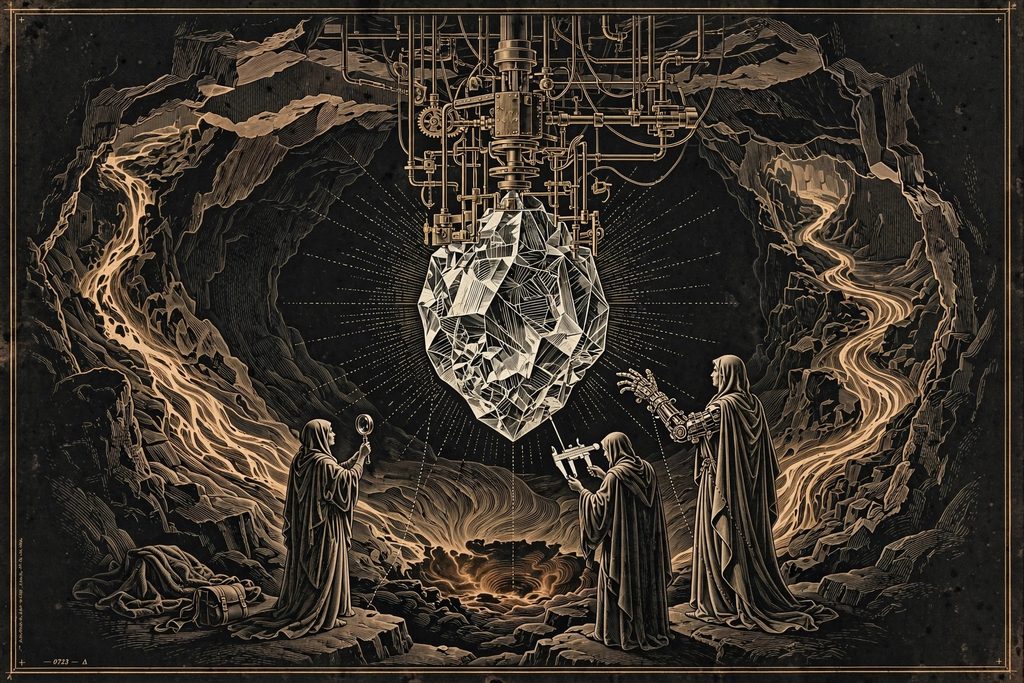
The Tribunal’s story begins in war. Long ago, the Chimer, the ancestors of the Dunmer, fought alongside and then against the Dwemer, a technologically brilliant elven people. Beneath Red Mountain, the great volcano of Vvardenfell, the Dwemer had found the Heart of Lorkhan. In Elder Scrolls cosmology, Lorkhan is the dead god whose sacrifice made the mortal world possible. The Dwemer’s chief engineer, Kagrenac, built three tools to tap the Heart’s power, a hammer, a blade and a gauntlet.
At the Battle of Red Mountain, the Chimer’s leader, Nerevar, confronted the Dwemer. The Dwemer vanished from the world in an instant, every one of them, for reasons no one has ever fully explained. Nerevar’s retainer, Dagoth Ur, was left guarding the Heart. Nerevar and his three closest counsellors, Almalexia, Sotha Sil and Vivec, had sworn to the Daedric Prince Azura never to use Kagrenac’s tools. Soon afterwards Nerevar was dead.
Then the three counsellors broke the oath. Sotha Sil worked out how the tools functioned, and the three used them on the Heart to make themselves gods. Azura’s response was a curse. She turned the Chimer’s golden skin to ash grey and their eyes to red, and they became the Dunmer. The Tribunal began their four-thousand-year reign over a people who carried, in their own faces, the mark of their rulers’ crime.
II. The Temple of the Living Gods
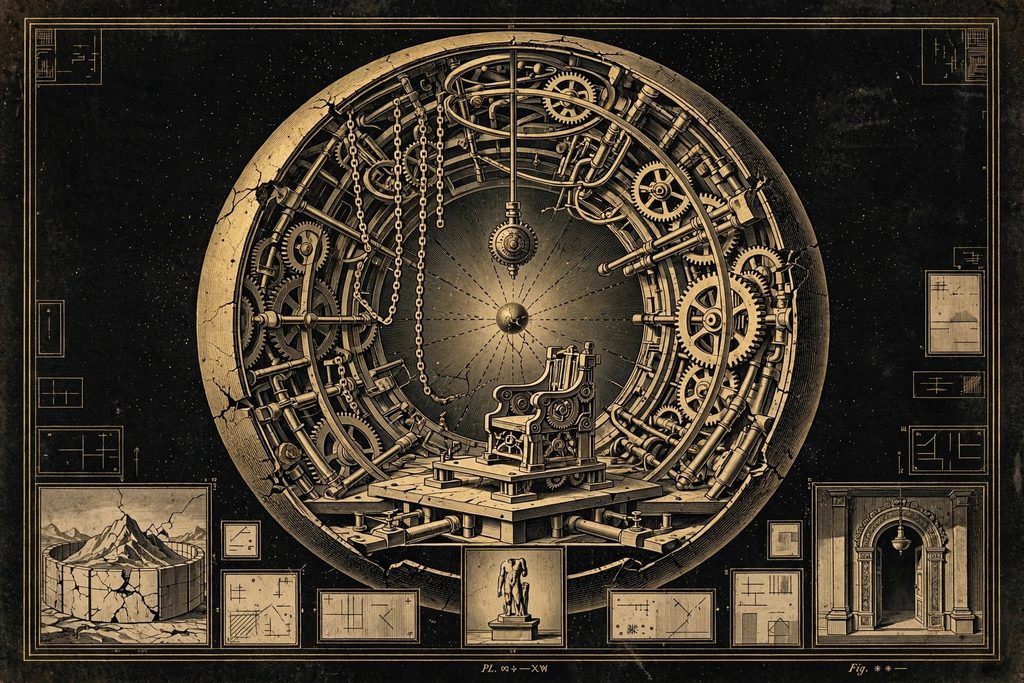
From the crime grew a church. The Tribunal Temple worshipped the three as ALMSIVI, a name formed from Almalexia, Sotha Sil and Vivec. Almalexia ruled from Mournhold as the mother of the people. Sotha Sil worked in seclusion on his mechanical Clockwork City. Vivec, poet and warrior, lived in his city on Vvardenfell. The Temple had priests, pilgrimages, shrines and saints. It also had an armed order of guards, the Ordinators, who enforced its laws in the cities and hunted down its enemies.
The Temple also rewrote the older faith of the Dunmer. Before the Tribunal, the Chimer had revered certain Daedric Princes, among them Azura, Boethiah and Mephala, as their spiritual guides. The Temple did not abolish them. It reclassified them as lesser powers whose teachings the Tribunal had fulfilled and replaced. More dangerous Daedra were grouped together as the House of Troubles, adversaries to be resisted. Like many reforming religions in human history, the Temple absorbed its predecessor’s gods and gave them a subordinate place in its own story.
What made this faith unique was its evidence. The Tribunal performed visible miracles. Vivec held the rock called Baar Dau above his city to prevent it from falling. Together the three maintained the Ghostfence, a vast barrier of magical power around Red Mountain that held back the blight-spreading forces of Dagoth Ur, who had survived beneath the mountain, bonded to the Heart. The Dunmer did not have to take their gods’ power on trust. They could see it.
III. The Forbidden Prophecy
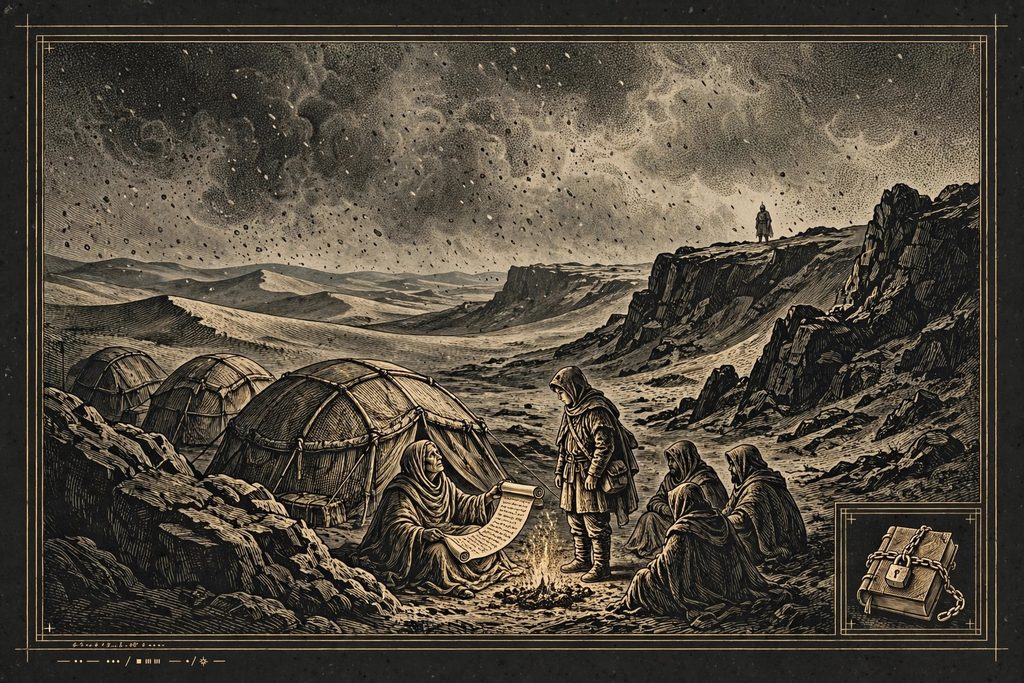
Not everyone accepted the Temple’s account. Out in the ash wastes of Vvardenfell live the Ashlanders, nomadic Dunmer tribes who still honour their ancestors and the older Daedric faith. They keep a prophecy that the Temple has declared heresy. Nerevar, the betrayed king, will return as the Nerevarine. He will be an outsider born under particular signs, who will unite the peoples of Morrowind and drive out the corruption at Red Mountain. The Temple persecuted those who believed it, because the prophecy contained an accusation. If Nerevar returned, so might the truth about how he died.
That truth was disputed even inside the Temple. The Tribunal’s own accounts say Nerevar died of wounds after Red Mountain. Dagoth Ur claims the three murdered him to take the Heart’s power. In the game, a faction of Dissident Priests inside the Temple circulates forbidden texts that challenge the official history and the Tribunal’s divinity. Vivec himself, in a series of in-game books of sermons known as the 36 Lessons of Vivec, offers a strange, poetic and contradictory account of his own nature. It reads less like scripture than like a riddle.
The player arrives in Morrowind as a prisoner with no past and is gradually revealed to fit the prophecy. The game never fully settles whether the player is truly Nerevar reborn. It is enough that they fulfil the signs. The returning ghost of the founder, the one figure the Temple most feared, becomes the person who decides the fate of its gods.
IV. The Failing Divine
By the time the game begins, in 3E 427, the living gods are weakening. Their power had always come from the Heart of Lorkhan, and Dagoth Ur, bonded to the Heart beneath Red Mountain, had long cut them off from it. Without new access to its power, the Tribunal could only spend what they had already taken. The Ghostfence held, but at enormous cost. Sotha Sil had withdrawn into his Clockwork City. Almalexia was growing unstable. Vivec continued to hold up the sky, but even he could not do it forever.
In the main story, the Nerevarine gathers Kagrenac’s tools, enters Red Mountain, defeats Dagoth Ur and destroys the Heart’s connection to the world. In doing so, they end the source of the Tribunal’s divinity. In the expansion Tribunal, released in November 2002, the consequences arrive. Almalexia, losing her power and her sanity, murders Sotha Sil in his Clockwork City and turns on the Nerevarine. She is killed. Of the three gods, only Vivec remains, and his power is fading.
The Institute notes how precisely this follows the theology Morrowind built. The Tribunal’s divinity was stolen, so it was finite. It was sustained, so it could be cut off. And because the gods were visible, their decline was visible too. A religion that had relied on evidence lost its believers as soon as the evidence began to fail.
V. The Gods Who Became Mortal
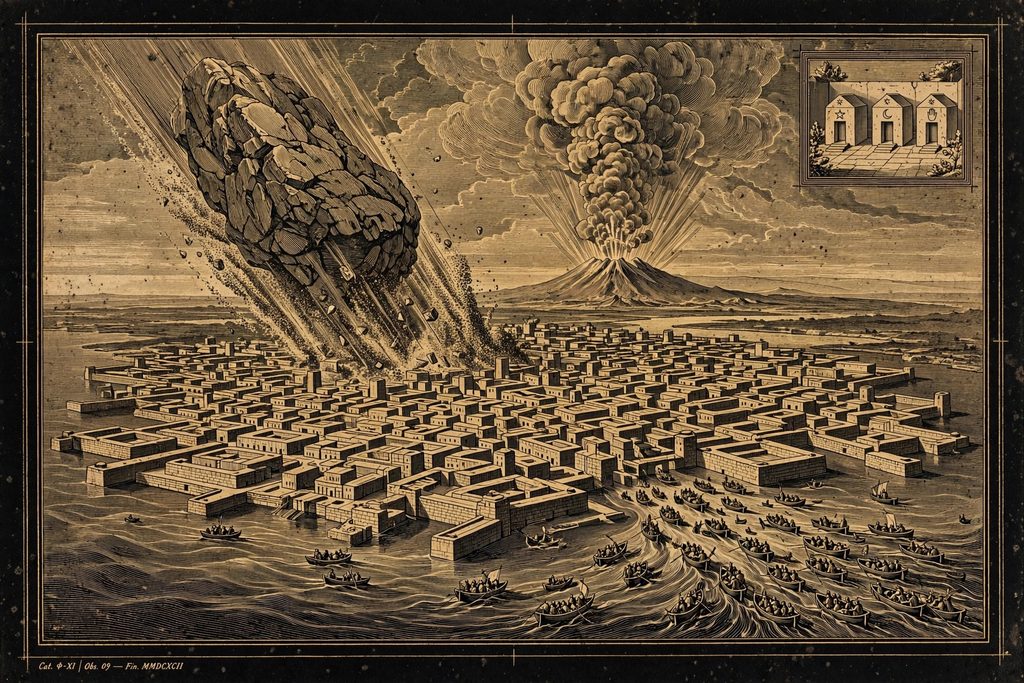
What happened next is told across later Elder Scrolls games. Vivec disappeared during the crisis that ended the Third Era. Without him, nothing held up Baar Dau. In 4E 5, the year the Dunmer remember as the Red Year, the great rock fell on Vivec City, and Red Mountain erupted. Much of Vvardenfell was devastated. Huge numbers of Dunmer fled, many of them to Skyrim, where two centuries later the player of Skyrim finds their descendants living as refugees. They are confined to the Gray Quarter of Windhelm, as the Institute described in The Civil War Over a Forbidden God.
The Temple did not simply disappear. It reformed. The New Temple turned away from the fallen Tribunal and back toward the older powers the Tribunal had displaced. Azura, Boethiah and Mephala were restored as the true objects of reverence, sometimes described as the True Tribunal. A religion that had begun by demoting the old gods ended by returning to them.
The Institute regards this as the most complete life cycle of any religion in its archive. The Tribunal was founded on a crime, sustained by visible miracles and protected by suppressing history. It was challenged by a forbidden prophecy, undone when its source of power was cut off, and finally replaced by the faith it had once replaced.
The ancestor of them all
The Tribunal draws on a very human idea, that rulers can be gods. In ancient Egypt, the pharaoh was regarded as divine. In Rome, Julius Caesar was officially deified after his death, and later emperors were honoured in cults throughout the empire. In Japan, the emperor was treated under State Shinto as a living god until 1 January 1946. On that day, under the American occupation after the Second World War, Emperor Hirohito issued a rescript that came to be known as the Humanity Declaration, renouncing the idea of his own divinity. A living god became a man by announcement.
The sociologist Max Weber gave the clearest account of what happens to authority of this kind. In Economy and Society (published in 1922), he described charismatic authority, power based on the extraordinary personal qualities of a leader, and argued that it cannot last in pure form. To survive, it must be routinised, turned into institutions, offices, rules and doctrines that can outlive the original figure. The Tribunal Temple is routinised charisma made literal. Its gods were present, but its priests, Ordinators, laws and official histories did the daily work of holding power. When the gods’ charisma failed, the institution could not save them.
Morrowind’s makers built this world deliberately. The game was directed by Todd Howard, with Ken Rolston as lead designer. Its developers avoided conventional European fantasy, drawing instead on African, Ancient Egyptian, Japanese and Middle Eastern influences. They filled the world with more than three hundred in-game books, the equivalent of about six novels. The 36 Lessons of Vivec, widely attributed to the writer and artist Michael Kirkbride, remain among the most discussed texts in game lore. In a game full of books, the history of the gods could be read, and much of it had been deliberately falsified.
The pattern
The Tribunal follows the life cycle of a religion founded on stolen power:
- Divinity taken by force is finite. The Tribunal’s power came from the Heart of Lorkhan, and it ended when access to the Heart ended.
- Visible miracles create visible decline. Gods whose power can be seen lose believers as soon as that power is seen to fail.
- Founding crimes require suppressed histories. The Temple’s control of the story of Nerevar’s death was essential to its legitimacy.
- Suppressed histories survive at the margins. The Ashlanders’ prophecy and the Dissident Priests’ texts preserved the truth the Temple tried to bury.
- Fallen faiths return to what came before. The New Temple restored the older Daedric powers that the Tribunal had replaced.
For other gods who began as mortals, see The Lord of Murder Will Not Stay Dead. For a religion deliberately engineered by its makers, see The Religion Planted on Arrakis.
Findings
- The Tribunal were mortals who stole divinity. Almalexia, Sotha Sil and Vivec used Kagrenac’s tools on the Heart of Lorkhan, breaking their oath to Azura after the death of Nerevar.
- Their Temple was a religion with evidence. Visible miracles, from the floating rock above Vivec City to the Ghostfence around Red Mountain, made the gods’ power undeniable for four thousand years.
- Their legitimacy depended on a suppressed history. The Temple declared the Nerevarine prophecy heretical and persecuted those who questioned how Nerevar died.
- Their power failed when its source was cut off. Dagoth Ur denied them the Heart, and when the Nerevarine destroyed its link to the world, the Tribunal’s divinity ended.
- Their faith returned to its origins. After the Red Year of 4E 5, the New Temple restored the older Daedric powers the Tribunal had displaced.
This Excavation draws on The Elder Scrolls III Morrowind and its expansions, later Elder Scrolls games, and the published lore of the series. Read more about how the Institute works.
The Institute collects field evidence from people who lived inside these worlds. If you were the Nerevarine and remember the moment the gods fell, send us your account.
Sources
- The Elder Scrolls III Morrowind (Bethesda Game Studios, 2002), and its expansions Tribunal (2002) and Bloodmoon (2003).
- The Elder Scrolls III: Morrowind and The Elder Scrolls III: Tribunal, Wikipedia.
- Tribunal, The Elder Scrolls Wiki, and Tribunal Temple, UESP.
- Max Weber, Economy and Society (1922).
- Emperor Hirohito, Imperial Rescript of 1 January 1946 (the “Humanity Declaration”).