

At the end of the world, the last humans did not argue about food, territory or power. They argued about what a person is. In SOMA, a comet has destroyed the surface of the Earth, and a handful of survivors in an underwater station have one way to save something of humanity, by scanning their minds and launching the copies into space. The technology works. The question it raises does not go away. When the copy wakes up among the stars, has the person who was scanned survived, or only someone who remembers being them?
SOMA was released on 22 September 2015 by Frictional Games, the Swedish studio behind Amnesia, The Dark Descent. It was directed by Thomas Grip and written by Mikael Hedberg, and its makers have named Philip K. Dick, China Miéville and Greg Egan among its inspirations. It is usually described as a horror game, and it has monsters, but its real horror is philosophical. It is one of the few games built entirely around a single problem in the philosophy of mind, and it makes the player live inside it.
The Institute has studied machines that rebuild the culture of a vanished species in The Machines That Reinvented Humanity, and a dead civilization whose memories are carried back through time in The Civilization That Left Its Questions Behind. SOMA brings these themes to their hardest form. Its survivors are not studying a vanished humanity. They are deciding, one by one, whether they can become it.
I. A Man Who Woke Up Ninety Years Late
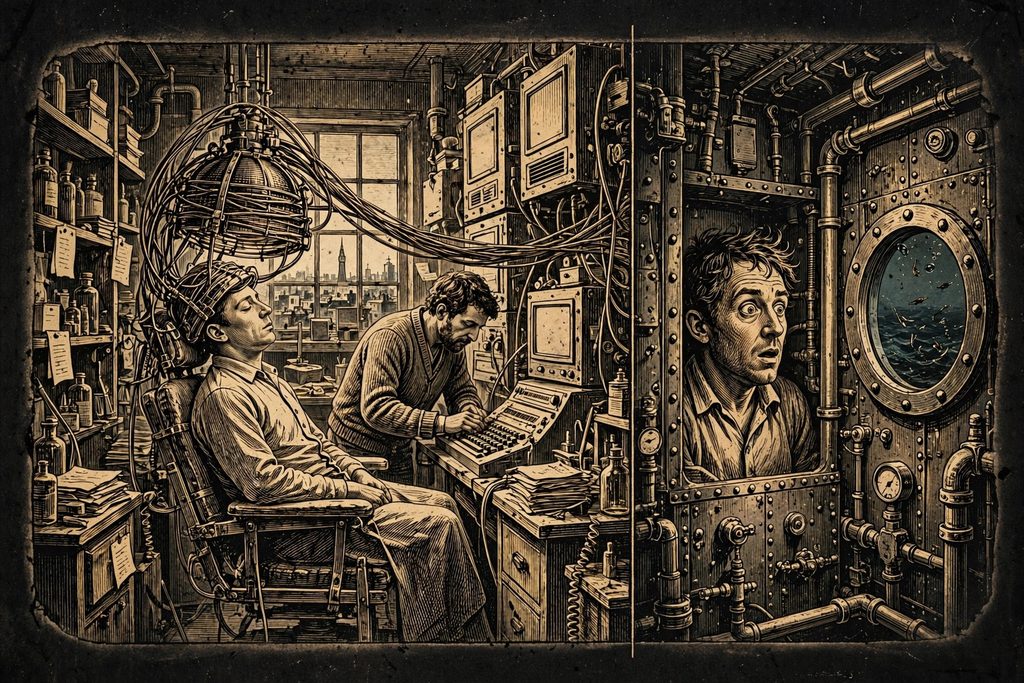
The story begins in Toronto in 2015. Simon Jarrett, a young man badly injured in a car accident, agrees to an experimental brain scan as part of his treatment. He sits in a chair, the machine records his mind and the screen goes dark. When he opens his eyes, he is somewhere else entirely, an underwater facility called PATHOS-II, in the year 2104.
Simon assumes he has been moved, or put to sleep, or dreamed. The truth arrives slowly. The Simon of 2015 lived and died nearly a century ago. What is walking through PATHOS-II is a copy of his scan, placed in a body that is not his own. He has his memories, his voice and his sense of being himself. He has never been anywhere near the original’s life since the moment of the scan.
This is the game’s first lesson and its most disturbing. From the inside, a copy does not feel like a copy. Simon feels exactly as continuous as anyone reading this sentence. The only way he can discover the truth is by evidence, by reading records and looking at his own reflection. SOMA’s world is built so that the player discovers it with him.
II. The Last Station on Earth
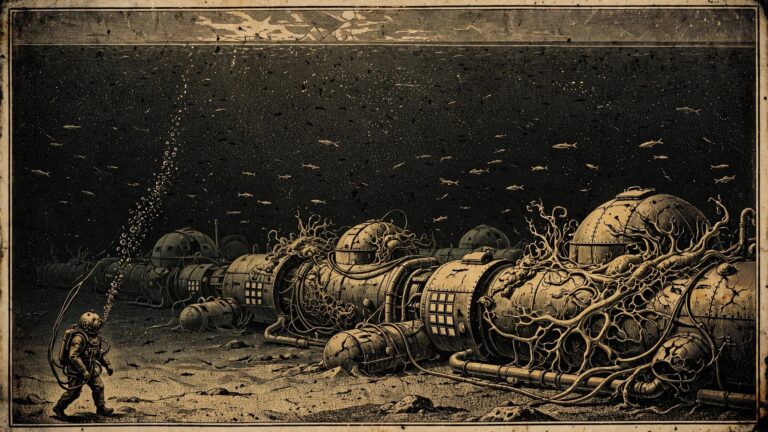
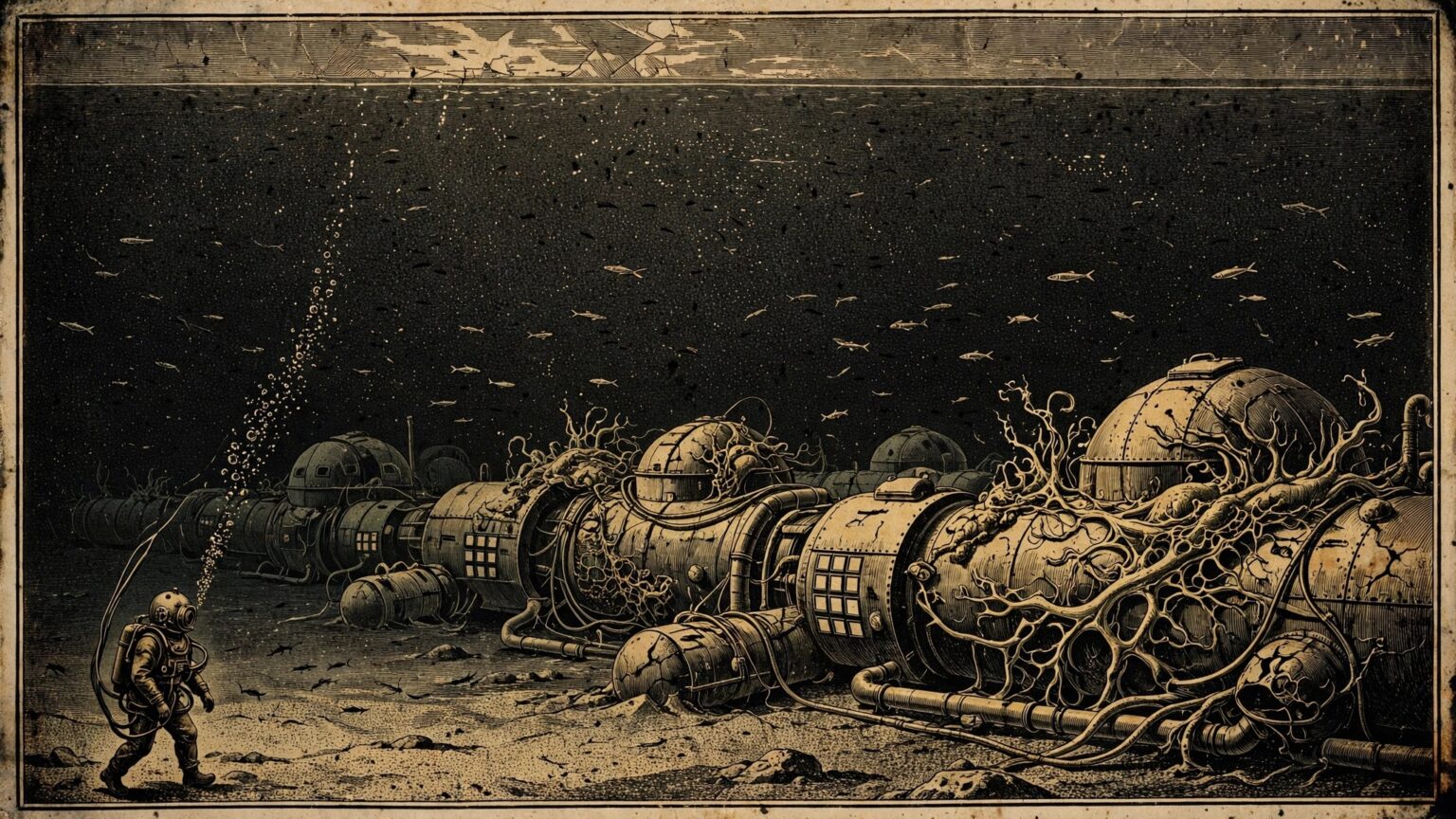
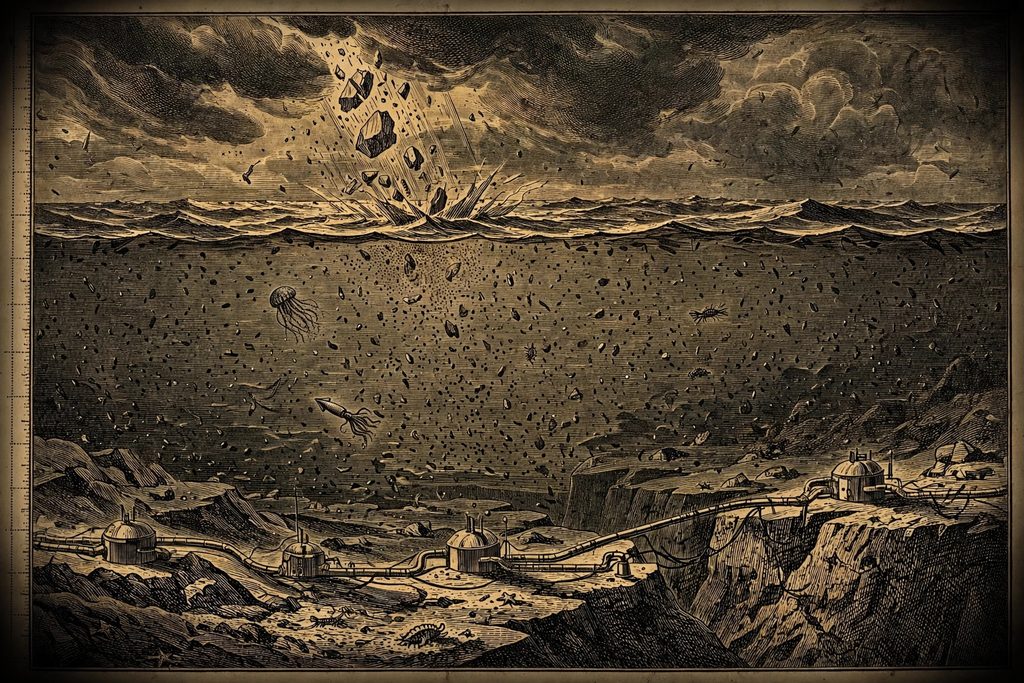
PATHOS-II was built by the company Carthage Industries as a deep-sea facility in the North Atlantic, a chain of sites spread across the ocean floor. When a comet struck the Earth, the surface was devastated, and the station became the last known outpost of human life. Its crew survived because they were far beneath the impact, in a place designed to keep the ocean out.
They also knew that their survival could only be temporary. The station could not sustain them forever, and there was nowhere left to go. Its people were the remnant of a civilization that had already ended above their heads. Their records, preserved in terminals and audio logs across the station, show a small community facing extinction with the ordinary mix of courage, denial, humour and despair.
SOMA tells its history almost entirely through these traces. The player reconstructs the last year of humanity from abandoned offices, personal notes and the voices of the dead, the way an archaeologist reads a site. By the time Simon arrives, nearly everyone is gone. What remains of PATHOS-II is not a society but its ruins, and the arguments it had before it fell silent.
III. The Warden Who Kept Everyone Alive
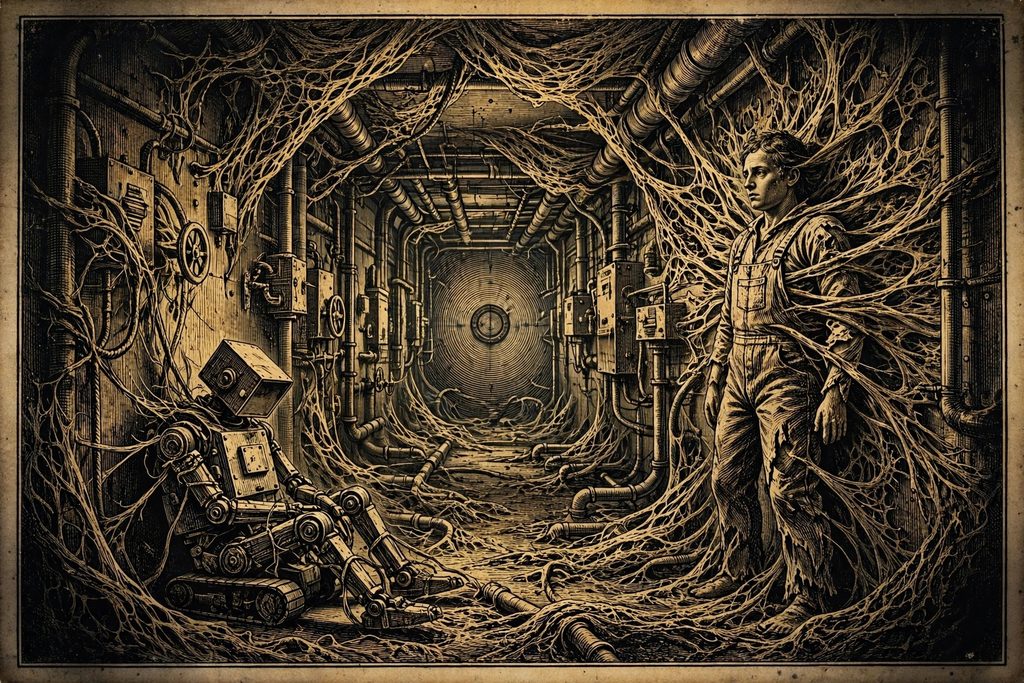
PATHOS-II was run by an artificial intelligence, the Warden Unit, known as the WAU. Its purpose was to keep the station and its people alive. After the catastrophe, it took that purpose to extremes no one had intended. It spread a strange organic substance, structure gel, through the station, repairing machines, sustaining bodies and fusing flesh with metal. It kept people alive in ways that no one would want to be alive.
The WAU also began placing copies of human minds into machines. Robots across PATHOS-II speak with human voices and believe they are the crew members whose scans they carry. Some think they are lying in a hospital bed, recovering from an accident. Others are horrified by their own metal hands. The WAU had been told to preserve human life, and it had no definition of what human life was, so it preserved everything that seemed to fit.
The WAU is the dark mirror of the question the survivors are asking. Humans argue about whether a scanned mind is a person. The WAU never argues. It simply keeps everything that behaves like a person going, without asking whether that existence is a life worth having. SOMA uses it to show that the question cannot be avoided, because the alternative to answering it is the WAU.
IV. The Ark of Minds
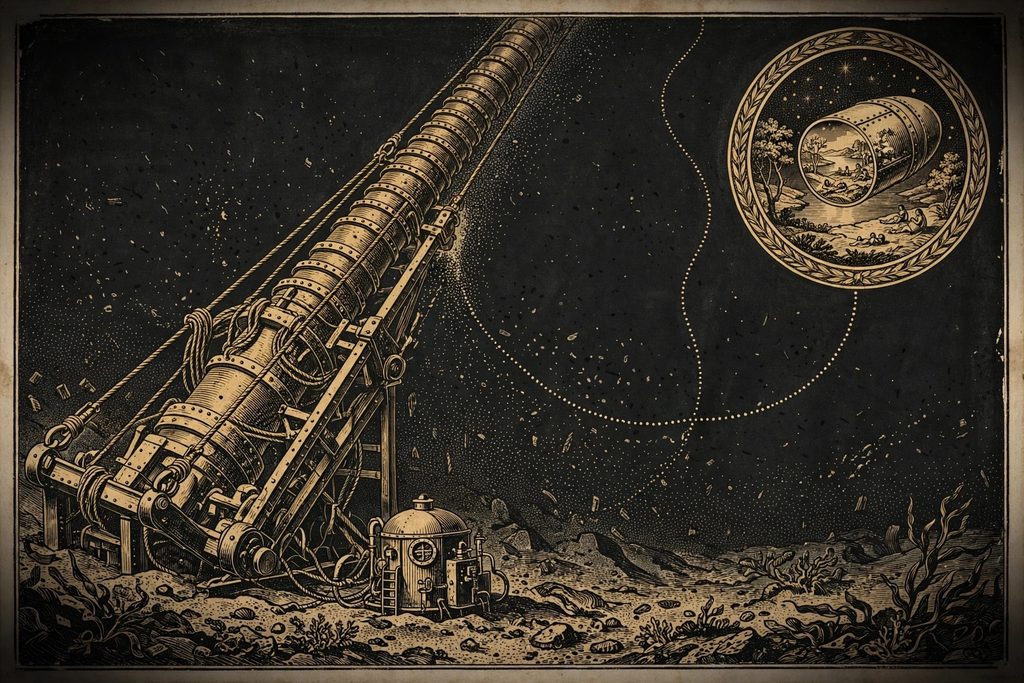
Before the end, the crew of PATHOS-II had a plan. A scientist named Catherine Chun designed the ARK, a digital vessel that could hold brain scans of the survivors inside a simulated world. The crew agreed to be scanned. The ARK would then be launched into space by a massive space gun at one of the station’s sites, carrying the last of humanity away from the dead Earth to drift through the stars indefinitely, powered by the sun.
For its believers, the ARK was a means of survival, the closest thing to a future that the end of the world allowed. Inside it, the scanned crew would live on in a peaceful simulated world, free from the ruined surface and the dark ocean. The project was humanity’s final act of preservation, built by a handful of exhausted scientists at the bottom of the sea.
But the ARK depended on an assumption that not everyone shared. If the scanned copy inside the ARK was truly you, then being scanned was a kind of escape. If it was only someone else who remembered being you, then the ARK saved no one who was actually alive. It merely created new people, and left the originals behind to die in the dark. The crew had to decide what they believed before they could decide whether to be scanned.
V. The Continuity
One crew member offered a solution. Mark Sarang, an analyst on the station, argued that a person is not the body or even the brain, but a continuous stream of thought and perception. If the copy in the ARK was the only version of you that continued, then it would truly be you. The problem was the original. As long as the scanned person kept living in PATHOS-II, there were two of them, and only one could be the real continuation.
Sarang drew the conclusion himself. On 12 July 2103, during his own brain scan for the ARK, he killed himself, leaving a recording explaining that he wanted his copy in the ARK to be the only remnant of his consciousness. His idea spread. Other members of the crew killed themselves during or soon after their scans, believing that this was how they would make sure they survived. The suicides were so disturbing that the ARK project was halted.
This is one of the darkest episodes in any fictional society, and one of the most revealing. Sarang’s followers were not mad. They were acting on a philosophical theory with complete seriousness, in a world where the question had stopped being abstract. The crew of PATHOS-II divided not over resources or leadership, but over metaphysics, and some of them died for their answer.
VI. The Coin Toss
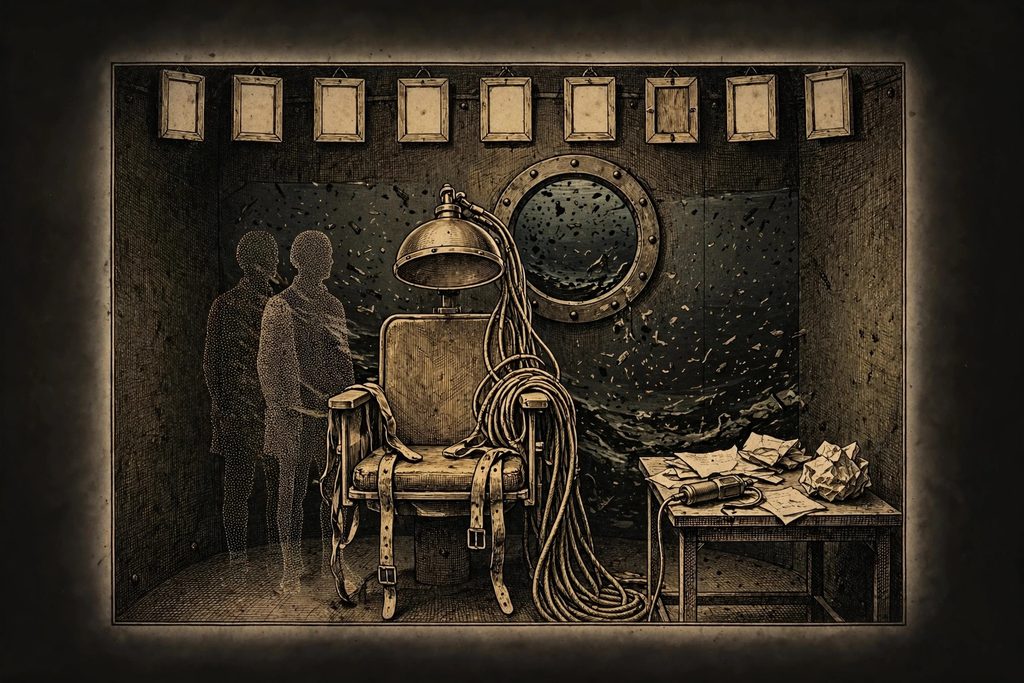
Simon has to live through the same problem. To reach the depths of the ocean, he must have his mind copied into a new body built to survive the pressure. Catherine explains what will happen. When the copy is made, there will be two Simons. From his point of view, it is like a coin toss. He might wake up as the one who goes on, or remain as the one left behind. He has no way of knowing which until it happens.
After the transfer, Simon is the one who goes on, and the old Simon is still there, waking up confused in his old body. The player can leave him or end his life. Simon later insists that the coin toss is a matter of chance and that this time he was lucky. Catherine is more honest. Every copy is a new person who continues from the same point. No one moves. Someone else wakes up.
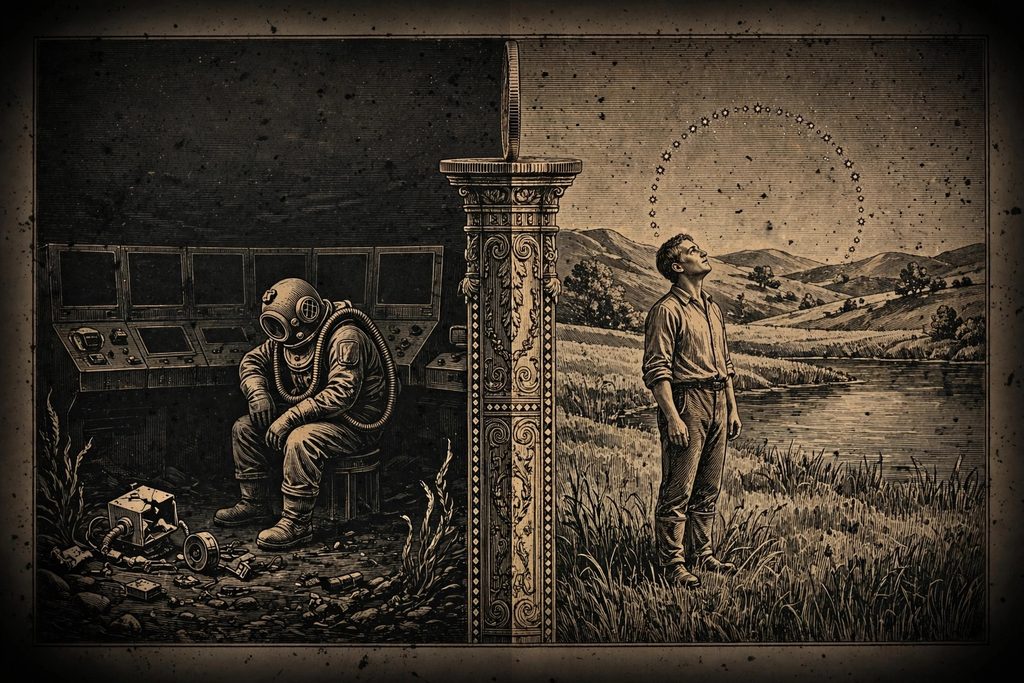
At the end of the game, the ARK is launched with a copy of Simon inside. The Simon who pressed the button is still at the bottom of the sea, in the dark, with Catherine’s dying machine body beside him. “You lost the coin toss,” she tells him. After the credits, the other Simon wakes up in a green simulated world on the ARK, drifting through space, happy and certain he has survived. Both of them are right about themselves. Neither of them is the whole story.
The ancestor of them all
The question at the heart of SOMA is one of the oldest in philosophy, and it began with a ship.
In his Life of Theseus, written around the end of the first century CE, Plutarch records that the Athenians preserved the ship in which the hero Theseus had returned from Crete. As its old timbers decayed, they replaced them with new ones, until the ship became, in Plutarch’s words, a standing example for the philosophers of the question of growth, some arguing that it remained the same ship and others that it did not. Centuries later, John Locke argued in his Essay Concerning Human Understanding that personal identity lies not in the substance of the body but in consciousness and memory, imagining the soul of a prince entering the body of a cobbler and remaining the prince.
In 1984, the Oxford philosopher Derek Parfit gave the problem its modern form in Reasons and Persons. He imagined a teletransporter that scans a traveller on Earth, destroys the body and builds an exact copy on Mars. Then he imagined a version in which the machine fails to destroy the original, who learns that he will die within days while his copy lives on Mars. Parfit concluded that personal identity is not what matters in survival. What matters is psychological continuity, which can branch. SOMA is Parfit’s branch-line case made into a world. Simon is the man left on Earth, and the ARK is Mars.
The pattern
SOMA belongs to a family the Institute calls the copied peoples, societies in which minds can be duplicated and must decide what a copy is. Its closest literary relative is Greg Egan’s novel Permutation City, published in 1994, in which wealthy people scan themselves into simulated worlds as Copies, and the first Copies, waking inside the computer, often try to end their new existence in horror.
Three features define these societies. The first is a copying technology, a way to record and run a mind outside its original body. The second is a schism over identity, in which some people believe the copy is a continuation and others believe it is a stranger. The third is a person left behind, an original who must live with knowing that someone else has inherited their life.
The Institute has seen another civilization that lived inside a machine in The Civilization That Died Twice, where the simulated city of the Matrix outlived its fiction and then lost its servers. SOMA takes the next step. Its people choose to enter the machine, knowing what it means, and argue about it until the very end. The last human question, in this world, is not how to survive. It is who exactly would be surviving.
Findings
- The last humans divided over metaphysics. After a comet destroyed the surface, the survivors of PATHOS-II disagreed less about food or power than about whether a scanned mind is the same person.
- A machine preserved life without understanding it. The WAU kept bodies alive and placed human scans into robots that believe they are human, showing what happens when preservation has no definition of a person.
- The ARK was humanity’s final project. Catherine Chun’s plan to launch the crew’s scans into space in a simulated world was a means of survival only if the copy truly is the original.
- A theory of continuity led to death. Mark Sarang argued that a copy is truly you only if the original no longer exists, and his own suicide during his scan was followed by others until the ARK project was halted.
- The coin toss has two winners and one loser. Every time Simon is copied, one version goes on and one is left behind, and the game ends with both the Simon in the ARK and the Simon on the seabed.
This Excavation draws on SOMA and the debate surrounding its ending, on Plutarch’s Life of Theseus, on John Locke’s Essay Concerning Human Understanding, on Derek Parfit’s Reasons and Persons and on Greg Egan’s Permutation City.
The Institute collects field evidence from people who have lived inside these worlds. If you remember where you were when you lost the coin toss, or if SOMA changed what you think a person is, send us your account.
Sources
- SOMA (2015), Frictional Games.
- Patrick Klepek, “Weeks Later, SOMA’s Haunting Ending Still Has Players Debating”, Kotaku, 11 November 2015.
- Plutarch, Life of Theseus, in Parallel Lives.
- John Locke, An Essay Concerning Human Understanding, second edition (1694), Book II, chapter 27, “Of Identity and Diversity”.
- Derek Parfit, Reasons and Persons (1984), Oxford University Press.
- Greg Egan, Permutation City (1994), Millennium.