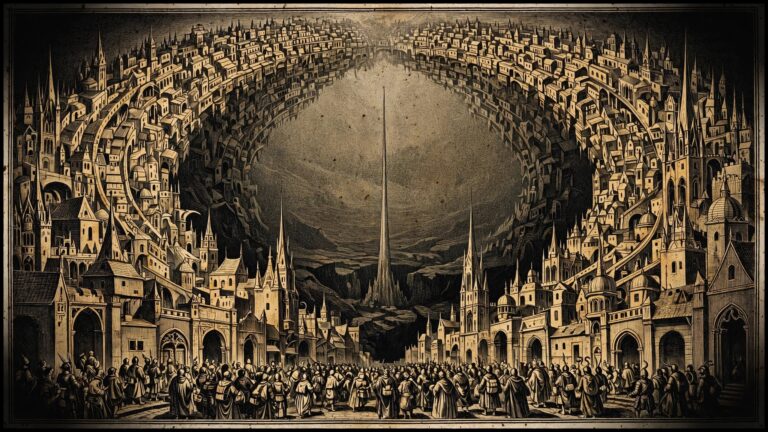


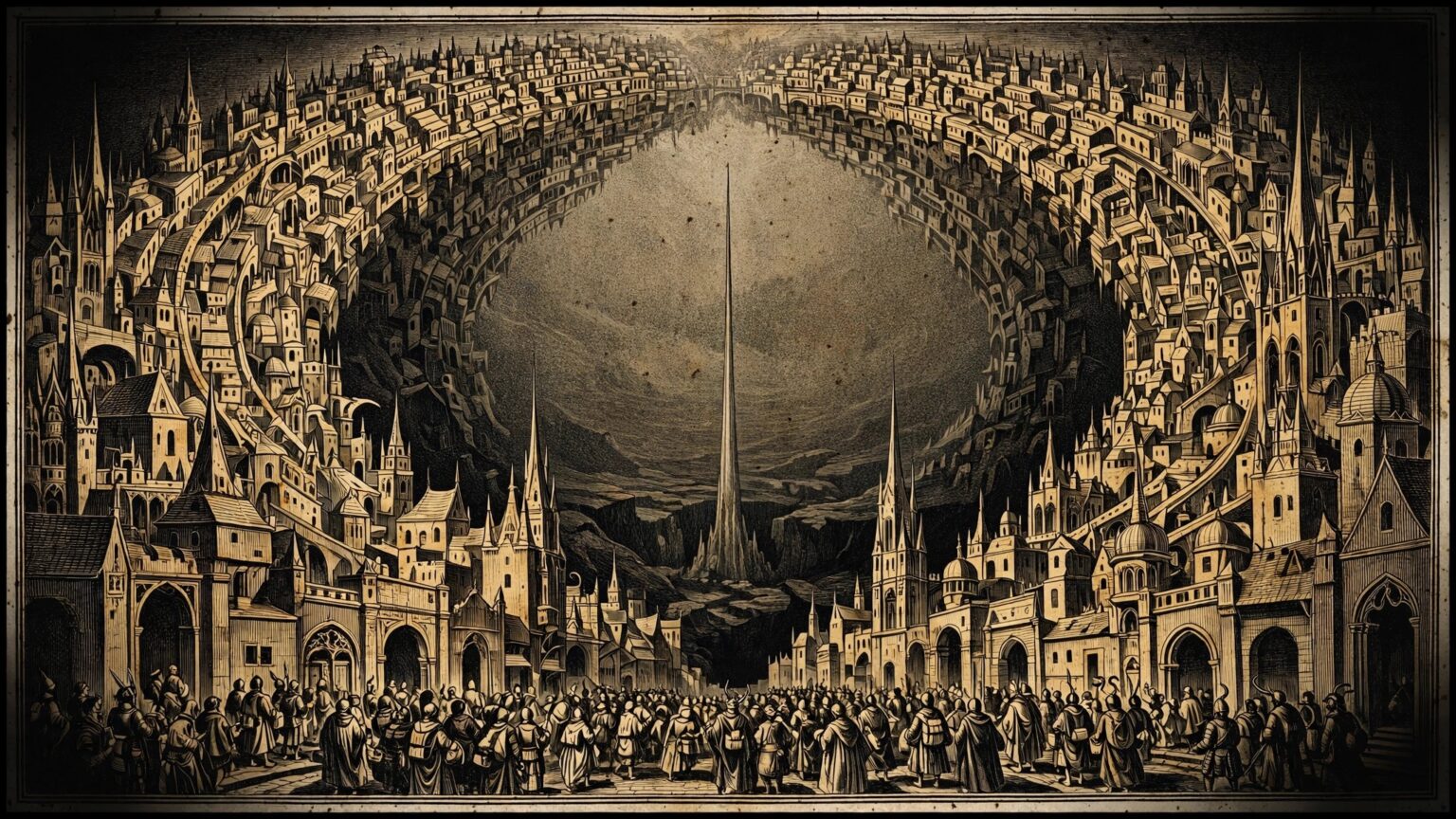
Most cities stand somewhere. Sigil stands everywhere. In the Planescape setting for Dungeons and Dragons, it is a city shaped like a ring, floating above an infinitely tall spire at the center of the multiverse, and connected by countless portals to every other plane of existence. Gods cannot enter it. Its ruler never speaks. Its politics are fought not over land or wealth, but over what is real. In Sigil, belief does not just guide people. It changes the world they live in.
Planescape was published by TSR in 1994 as a campaign setting for the second edition of Advanced Dungeons and Dragons, created by David “Zeb” Cook and illustrated most memorably by Tony DiTerlizzi. It became the basis of Black Isle Studios’ 1999 role-playing game Planescape, Torment, often named among the best-written games ever made, and returned in October 2023 as Planescape, Adventures in the Multiverse for the fifth edition of the game. Cook summarized its spirit in a phrase that its fans still repeat, “philosophers with clubs.”
The Institute has studied gods made by their worshippers in The Living Gods of Morrowind, and realms of the divine closed to mortals in The Island That Tried to Sail Into Heaven. Sigil turns both ideas upside down. It is a mortal city at the center of the cosmos, where the gods are the ones kept out, and where the ideas of ordinary people have the power to reshape heaven and hell.
I. The City of Doors
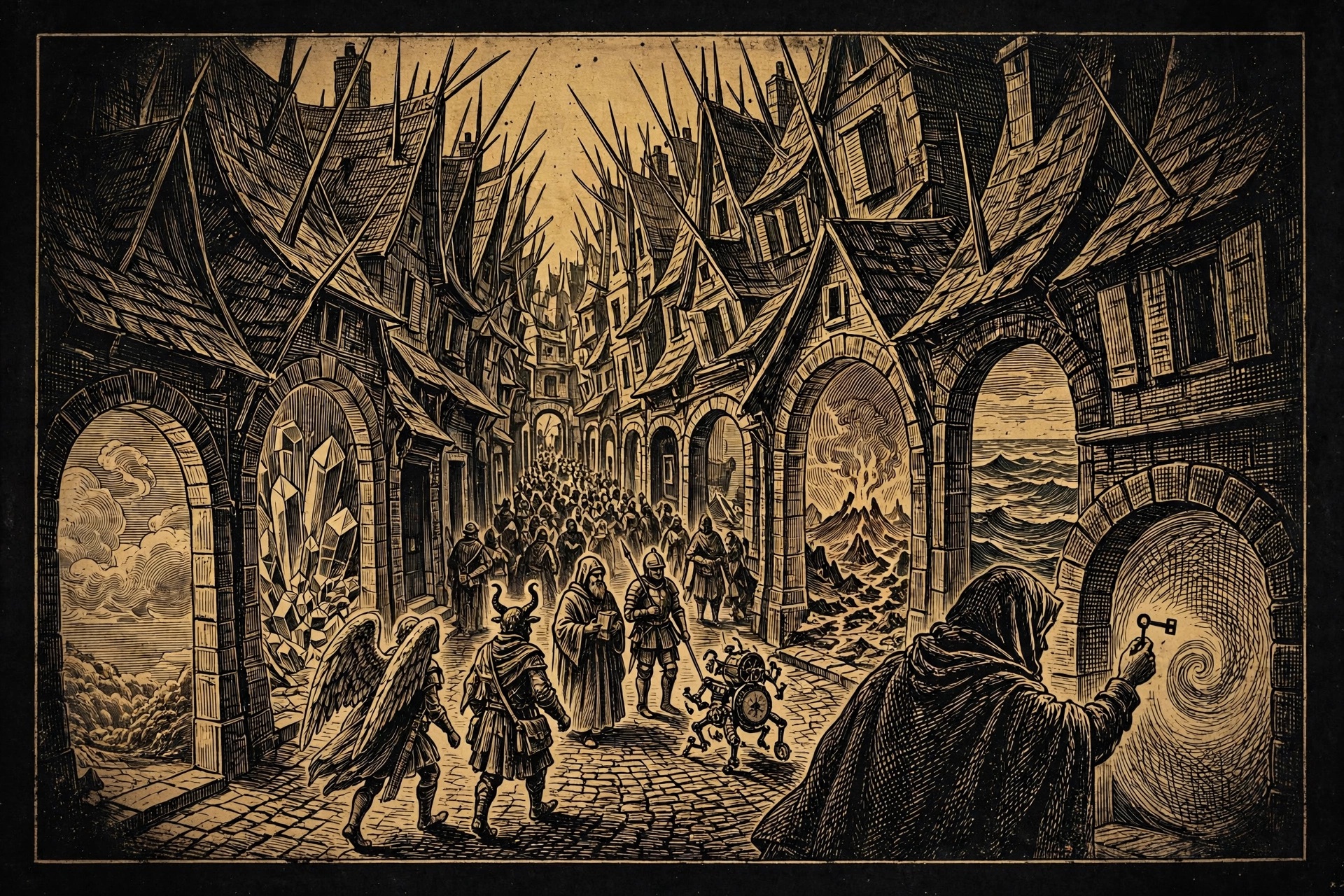
Sigil is shaped like a torus, a ring, and its streets run along the inside surface. There is no sky. Look up, and you see more of the city curving overhead. Light waxes and wanes without a sun. The ring floats above the Spire, an infinitely tall needle at the center of the Outlands, the plane that lies between all the others. In the cosmology of Planescape, that makes Sigil the closest thing the multiverse has to a hub.
Its other name is the City of Doors. Any bounded opening in Sigil, an archway, a window, a door frame or even a gap between two barrels, might be a portal to another plane, if you carry the right key. Keys can be objects, words, gestures or emotions. Entering and leaving the city is only possible through these portals, which is why Sigil is also called the Cage. Those without a key are trapped.
The result is the most cosmopolitan city in fiction. Through its portals come angels and demons, elementals, githzerai, modrons, travellers from every material world and creatures without names. Its streets mix every culture and every belief system in the multiverse. Its residents speak a slang called the cant, in which a fool is a berk, a respected person is a cutter, a secret is the dark of it, and newcomers from the ordinary material worlds are clueless primes.
II. The Lady of Pain
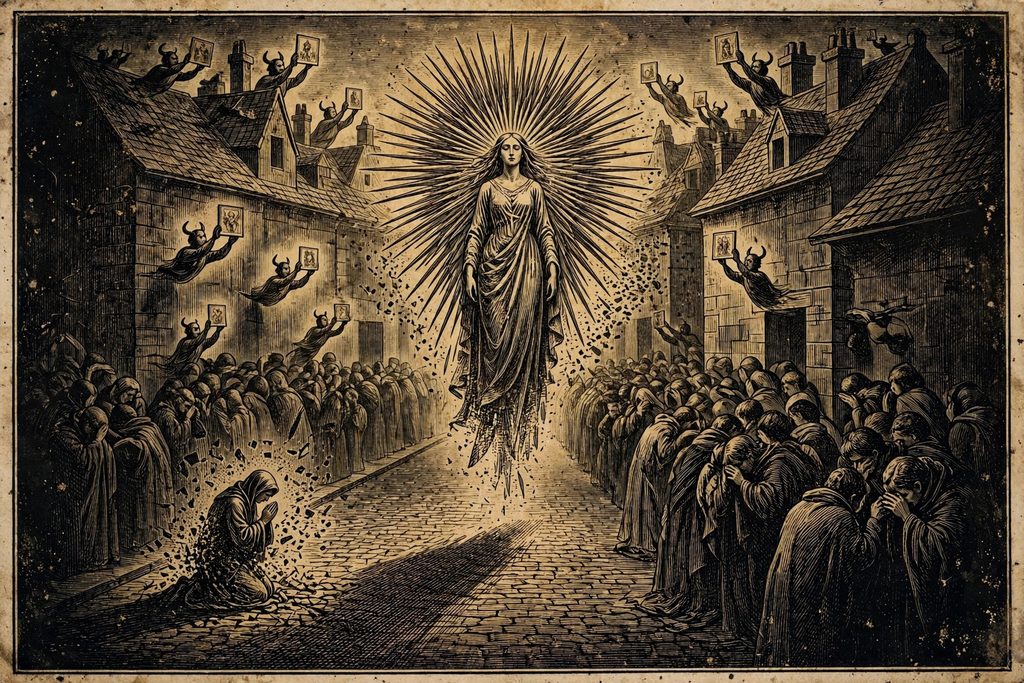
Sigil is ruled by the Lady of Pain. She is seen only rarely, gliding silently through the streets, a tall figure in a flowing gown whose face is surrounded by a halo of blades. She never speaks. Her shadow is said to flay those it falls on. No one knows what she is, where she came from or what she wants. She is simply the city’s sovereign, and the city is hers in the most literal sense. She can reshape its streets at will.
Her law has two famous articles. The first is that no god may enter Sigil. The powers of the multiverse, who rule entire planes, are barred from the city, and only their servants may pass through its portals. The second is that she must not be worshipped. Those who try are found with their skin flayed from their bodies. In a cosmos ruled by gods who live on devotion, Sigil is governed by a power that refuses it.
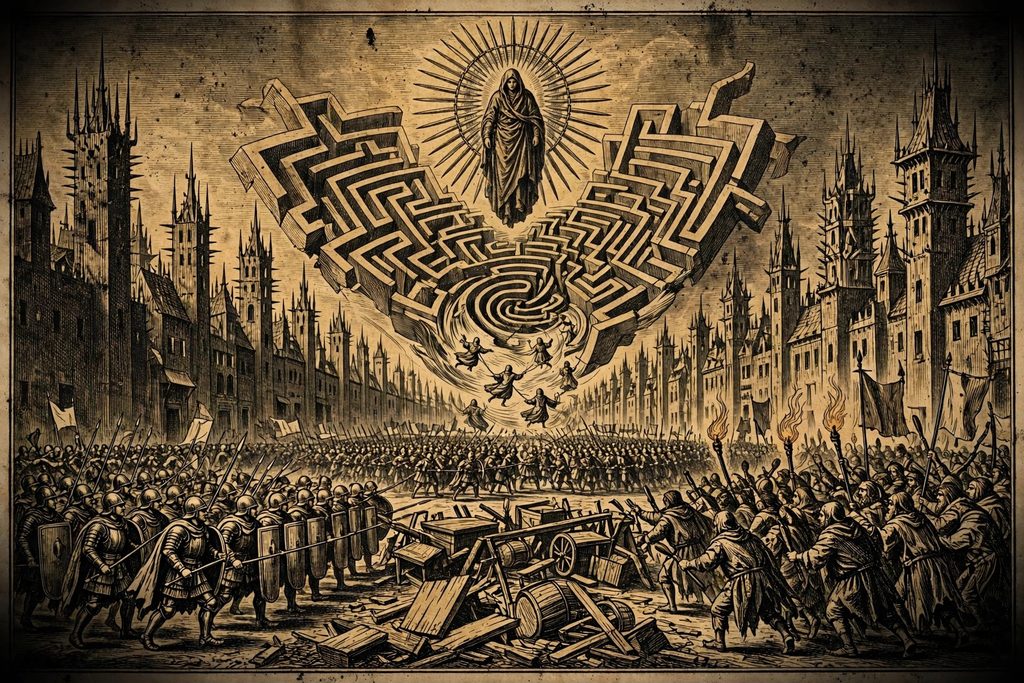
She enforces her will through two instruments. The dabus, silent servants who float above the ground and communicate in rebuses, pictures and symbols, maintain the city and keep order. And the Mazes, pocket dimensions created by the Lady, imprison those who threaten her rule in endless labyrinths with no exits. The punishment is unique to Sigil and greatly feared. It is not death. It is being removed from the multiverse entirely.
III. Philosophers With Clubs
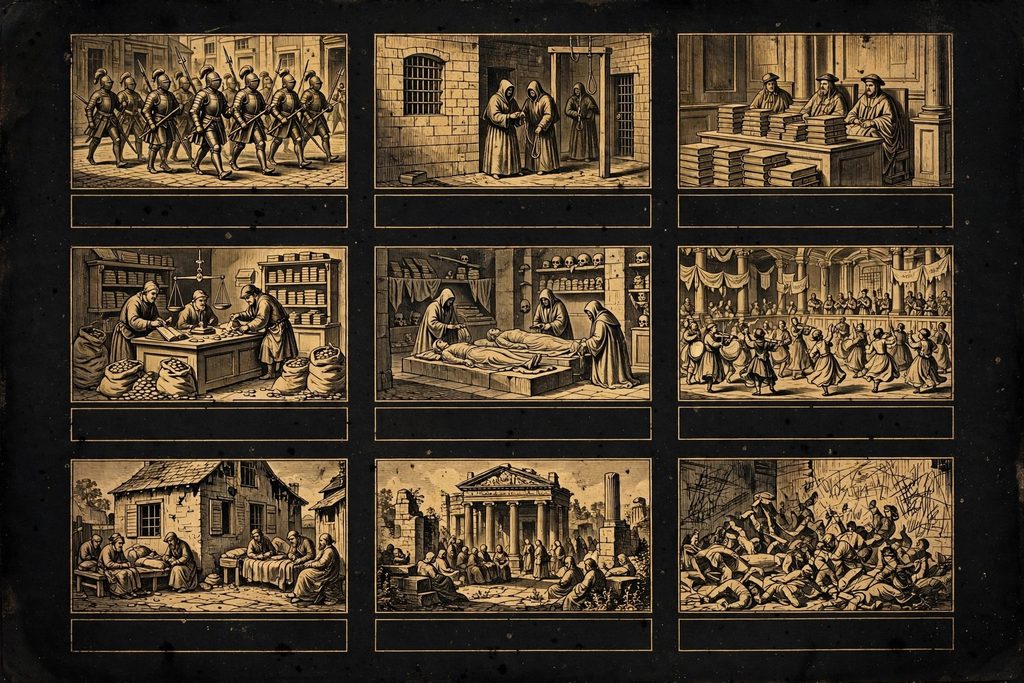
Because the Lady of Pain rules but does not govern, the daily life of Sigil belongs to its factions. There were fifteen of them, and each was built around a single belief about the nature of the multiverse. Each also ran part of the city, so that philosophy and administration were the same thing. To live in Sigil was to be policed, taxed, judged, buried and entertained by people with a theory of reality.
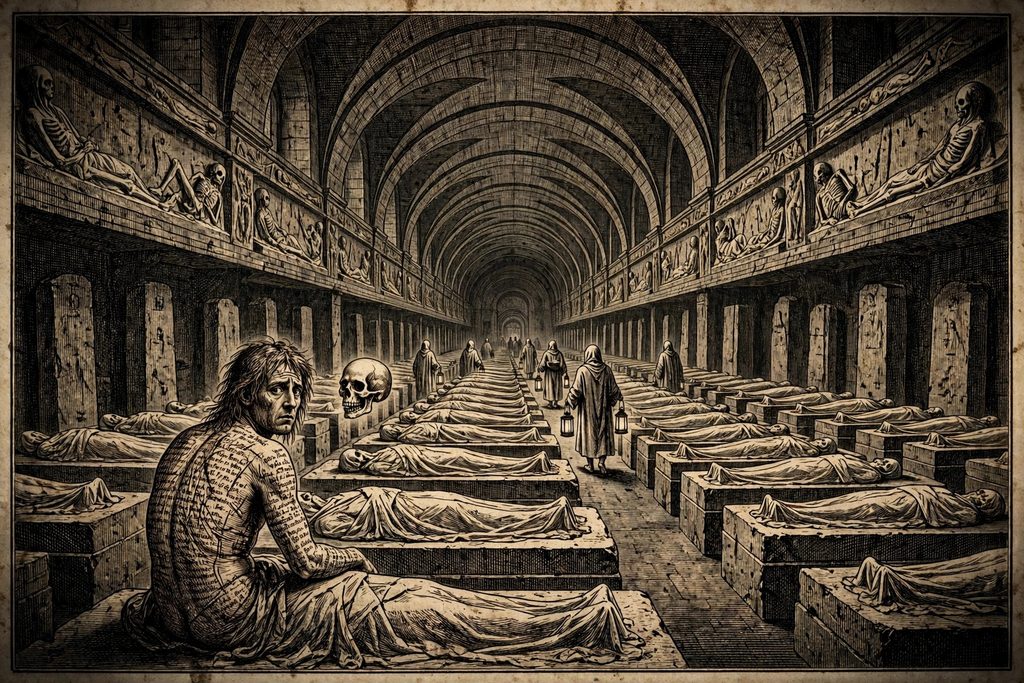
The Harmonium, who believed that peace requires everyone to accept a single order, served as the city’s police. The Mercykillers, who believed in justice without mercy, ran its prison and carried out its sentences. The Fraternity of Order, who believed the multiverse obeys discoverable laws, ran the courts. The Fated, who believed that people own only what they can take and keep, collected the taxes. The Dustmen, who believed that everyone is already dead and should seek a final, true death, ran the Mortuary. The Society of Sensation, who believed that truth can only be known through experience, ran the Civic Festhall, the city’s centre of art and pleasure.
Others served the city in stranger ways. The Bleak Cabal, who believed the multiverse has no meaning at all, ran the Gatehouse, an asylum and poorhouse. The Athar, who held that the gods are merely powerful beings rather than true divinities, sheltered those who had lost their faith. The Xaositects, who believed chaos is the truth of all things, refused to run anything. The result was a city where every institution was an argument, and where a quarrel about metaphysics could close the courts or empty the streets.
IV. A Cosmos Shaped by Belief
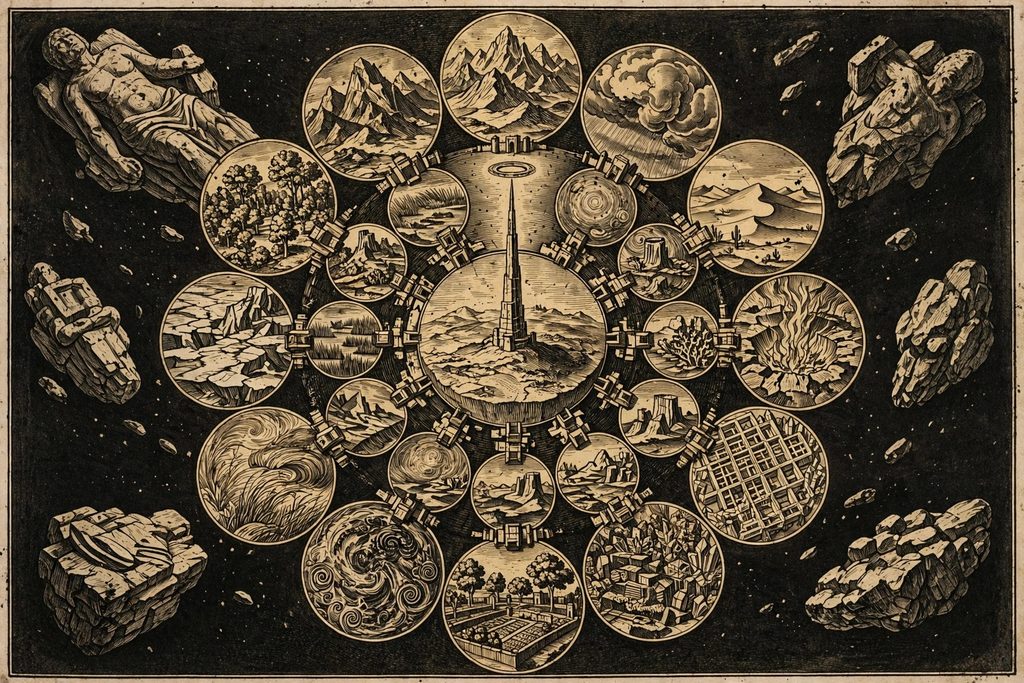
What gives Sigil’s factions their power is the cosmology around them. In Planescape, the outer planes, the heavens, hells and everything between, are shaped by belief. Each plane embodies an outlook, from absolute law to absolute chaos, absolute good to absolute evil. The gods draw their power from their worshippers. When a god is forgotten, it dies, and the bodies of dead gods drift in the Astral Plane like vast stone islands.
Belief can move whole towns. In the Outlands around the Spire stand the gate-towns, each built around a portal to one of the outer planes. If the people of a gate-town come to share the outlook of the plane beyond their gate too completely, the town can slide through and become part of that plane. Geography in Planescape is not fixed. It is a measure of what people believe, and it can change when they change.
This is the cosmology that makes the factions dangerous. They are not merely clubs of like-minded thinkers. In a multiverse where belief reshapes reality, an idea that spreads widely enough can change the structure of the cosmos. Every faction is, in principle, trying to remake the universe in its own image. Sigil, where all of them meet, is the place where the argument about reality is conducted in person.
V. The Faction War
The balance of the factions could not last. In the 1998 adventure Faction War, Duke Rowan Darkwood, leader of the Fated, attempted to overthrow the Lady of Pain and take Sigil for himself. The conflict spread through the city, and its streets became battlegrounds between philosophies with very real weapons. Order and chaos, law and anarchy, the living and the dead fought from ward to ward.
The Lady of Pain ended it. Most of the faction leaders were cast into her Mazes, and the factions lost their control of the city. Some were dissolved, some merged and some were driven out of Sigil entirely, to continue as sects on the planes beyond. The city that had been governed by fifteen philosophies was suddenly governed by none of them. Its civic institutions had to be rebuilt without the beliefs that had sustained them.
The Faction War is one of the rare moments when a fictional setting deliberately destroyed its own most beloved feature. Many fans regretted it, and later editions brought the factions back in various forms. But as an event in the history of a fictional civilization, it is revealing. Sigil’s sovereign tolerated every belief except one, the belief that the city could belong to a faction. When a philosophy tried to become a state, the Lady removed the philosophers.
VI. What Can Change the Nature of a Man
The most famous journey through Sigil is Planescape, Torment, released in December 1999 by Black Isle Studios, with Chris Avellone as its lead designer. Its hero, the Nameless One, wakes on a slab in the Mortuary of the Dustmen, covered in scars and tattoos, with no memory of who he is. He cannot die. Each time he is killed, he wakes again, and each time he loses part of his memory. His past selves have left messages for him written on his own skin.
Torment is a game built almost entirely of conversations, and its central question is the one Sigil’s cosmology makes literal. “What can change the nature of a man?” Its answers come from characters who embody different beliefs, and in a world where belief shapes reality, the answer matters. The game’s climax depends less on combat than on whether the Nameless One can understand himself, and its world reacts to who he chooses to be.
Torment shows what the setting was for. Planescape is not interested in heroes saving the world from evil. It is interested in what people believe, why they believe it and what their belief does to them and to the world. Sigil, where every belief in the multiverse passes through the same narrow streets, is a city designed to stage that argument. Its citizens live in a place where ideas are as dangerous as weapons, and as solid as stone.
The ancestor of them all
Sigil’s factions have a clear ancestor, and it is Greek. In the fourth and third centuries BCE, Athens became home to a group of philosophical schools that were far more than places of study. Plato founded the Academy around 387 BCE. Aristotle opened the Lyceum in 335 BCE. Epicurus established the Garden around 306 BCE, and Zeno of Citium taught from the Stoa Poikile, the Painted Porch, around 300 BCE, giving the Stoics their name. Each school had its own doctrine about the nature of reality, its own way of life and its own leaders, and members of rival schools argued, mocked and competed with each other for centuries.
The historian of philosophy Pierre Hadot argued that these schools were not abstract debating societies but communities devoted to a way of living, in which a theory about the universe dictated how one ate, spoke, grieved and died. That is precisely what Sigil’s factions are. The Dustmen’s pursuit of true death and the Sensates’ devotion to experience echo the Stoic and Epicurean arguments over pleasure, pain and fate. Ancient tradition even records the schools’ end in a form Sigil would recognize. In 529 CE, according to the chronicler John Malalas, the emperor Justinian forbade the teaching of philosophy in Athens, and the last philosophers of the Academy went into exile. A sovereign who would not tolerate rival claims to truth sent the philosophers away.
The pattern
Planescape belongs to a family the Institute calls the axis cities, places imagined at the center of the cosmos, where every world meets. Its closest literary relative is Jorge Luis Borges’ short story The Aleph, first published in 1945, in which a narrator descends into a Buenos Aires cellar and finds a point in space that contains all other points, from which he sees the entire universe at once.
Three features define these places. The first is centrality, a location that touches every other part of reality and through which all of it passes. The second is a sovereign who stands outside the ordinary order, whether a god, a mystery or a law that cannot be challenged. The third is a population of ideas, a community whose conflicts are not only political but metaphysical, because at the center of everything, beliefs collide directly.
The Institute traced the oldest form of this idea in The Tree at the Center of Every World, where the axis of the cosmos was a sacred tree connecting heaven, earth and the underworld. Sigil is the axis mundi rebuilt as a city. Where the old myths placed a tree, Planescape placed a ring of streets, crowded with philosophers, merchants and strangers from every world, under a ruler who will not be worshipped, in a cosmos that becomes whatever they believe.
Findings
- Sigil is a city at the center of the multiverse. Shaped like a ring floating above the infinitely tall Spire, it connects through countless portals to every plane, and can be entered or left only by those who hold the right key.
- Its ruler bars the gods and refuses worship. The Lady of Pain never speaks, keeps every deity out of the city and punishes those who worship her, maintaining order through the silent dabus and her inescapable Mazes.
- Its government was a set of philosophies. Fifteen factions, each built on one belief about reality, ran the city’s police, courts, prisons, taxes, mortuary and festhall, so that every institution was also an argument.
- In its cosmos, belief reshapes reality. The planes reflect the beliefs of their inhabitants, gods die when they are forgotten and whole towns can slide into another plane when their people’s outlook changes.
- Its ancestor is the philosophical city of Athens. The Academy, the Lyceum, the Garden and the Stoa, schools that taught whole ways of life, anticipated Sigil’s factions, down to their reported expulsion by an emperor who tolerated no rival truth.
This Excavation draws on the Planescape campaign setting and its later editions, on the Faction War adventure, on Planescape, Torment, on the history of the philosophical schools of Athens and Pierre Hadot’s account of them, and on Jorge Luis Borges’ The Aleph.
The Institute collects field evidence from people who have lived inside these worlds. If you ever played a faction member in Sigil, or remember the first time a berk called you clueless, send us your account.
Sources
- David “Zeb” Cook, Planescape Campaign Setting (1994), TSR.
- Monte Cook et al., Faction War (1998), TSR.
- Planescape, Torment (1999), Black Isle Studios.
- Planescape, Adventures in the Multiverse (2023), Wizards of the Coast.
- Pierre Hadot, What Is Ancient Philosophy? (2002), Harvard University Press.
- John Malalas, Chronicle, Book 18.
- Jorge Luis Borges, “The Aleph”, Sur (1945).