

Every mythology has a paradise that was lost. J. R. R. Tolkien wanted his invented world to have one too, and he built it with the care of a historian. In the Second Age of Middle-earth, the gods raised an island from the sea as a gift to the men who had fought beside them. For more than three thousand years, a race of long-lived kings ruled it, built fleets that sailed every ocean and taught the peoples of Middle-earth. Then, in a single catastrophe, the island was swallowed by the sea, and the shape of the world itself was changed.
The island was called Númenor. Its story is told in the Akallabêth, a chapter of The Silmarillion published in 1977, and in the essays and fragments collected in Unfinished Tales in 1980. Its survivors founded the kingdoms of Gondor and Arnor, which makes Númenor the ancestor of almost everything noble in The Lord of the Rings. Since 2022, Amazon’s series The Rings of Power has brought the island to the screen for millions of viewers who had never read about it.
The Institute has followed the trees of Tolkien’s world in The Tree at the Center of Every World and a kingdom that tried to forget its god in The Kingdom That Tried to Forget Its God. Númenor is the story of a civilization that could not accept the one limit its gods placed on it, and of what that refusal cost.
I. The Gift of the Sea
Númenor began as a reward. At the end of the First Age, the men known as the Edain had fought alongside the Elves against the great enemy Morgoth, and the Valar, the powers who govern the world, raised a new land from the sea for them to live in. It lay in the far west of the ocean, closer to the undying lands of the Valar than to Middle-earth. It was called Andor, the Land of Gift, and later Númenor, which in the common tongue became Westernesse.
Its people were given more than land. The Númenóreans lived around three times as long as other men. They grew taller, wiser and more skilled, and they kept close friendship with the Elves, who sailed to their harbours from the West. Their first king was Elros, the half-elven brother of Elrond, who chose a mortal life and was granted a lifespan of five hundred years. His descendants ruled the island in an unbroken royal line.
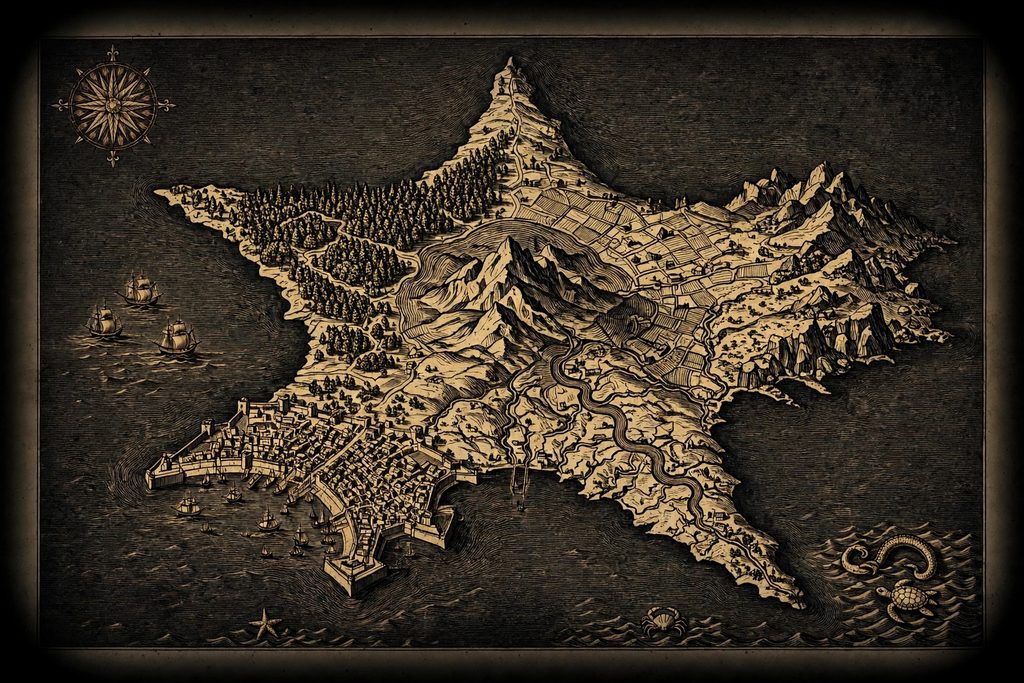
Tolkien gave the island a geography, a climate, rivers, trees and regions, as precisely as a gazetteer. In his essay describing it, the island has the shape of a five-pointed star, each peninsula with its own character, from the forests of the west to the harbours of the east. Númenor was not a vague fable. It was imagined as a real country, with a real history, so that its loss would feel like the loss of a real place.
II. The Mountain and the Ban
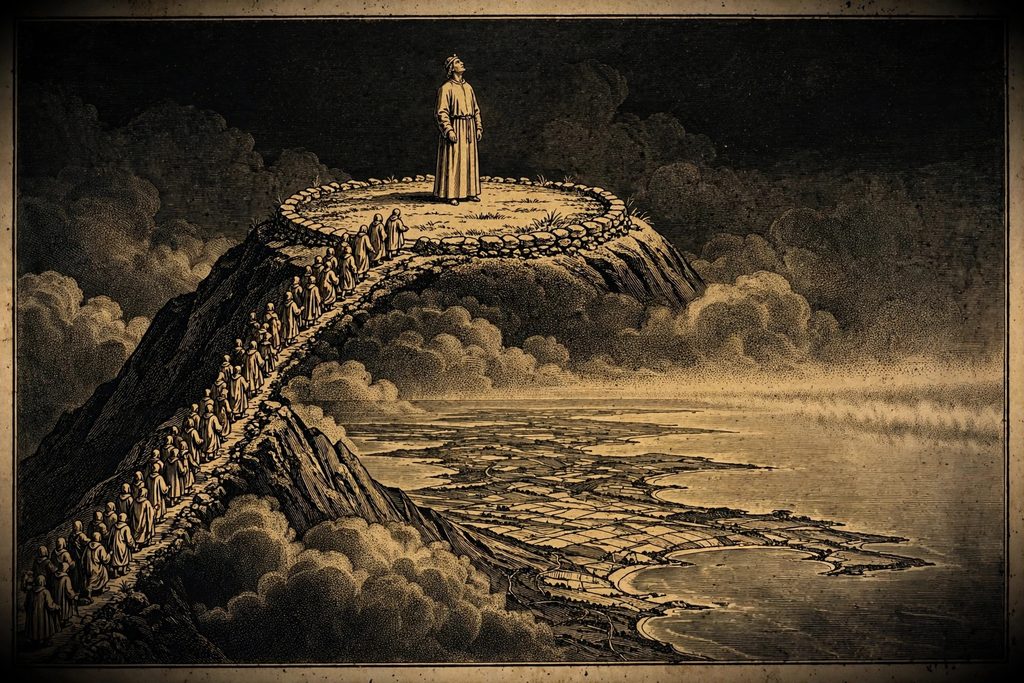
At the center of Númenor stood a single mountain, the Meneltarma, the Pillar of Heaven. On its summit lay an open hallow dedicated to Eru, the one God above the Valar. There was no temple, no image and no priesthood. Three times a year, at the feasts of spring, midsummer and autumn, the king climbed the mountain with his people and spoke prayers of hope, praise and thanksgiving, and at all other times the summit was silent. It was one of the simplest religions in all of fiction, a faith with a single sacred place and almost no ritual.
The gift of the Valar came with one condition, known as the Ban. The Númenóreans were forbidden to sail so far west that their own coasts disappeared from view. They could sail anywhere else in the world, and they did, but they could not set foot in the Undying Lands, where the Valar and the Elves lived. The Ban was meant as a protection. Mortal men could not become immortal by living in the land of the immortals. Their death was not a punishment but their nature, which the Elves called the Gift of Men.
The whole tragedy of Númenor grows from this one rule. A people given long life, wisdom, wealth and friendship with the gods was asked to accept a single limit, the edge of the horizon in the West. For centuries they did. Then they began to look at the sea and ask why.
III. The Fear of Death
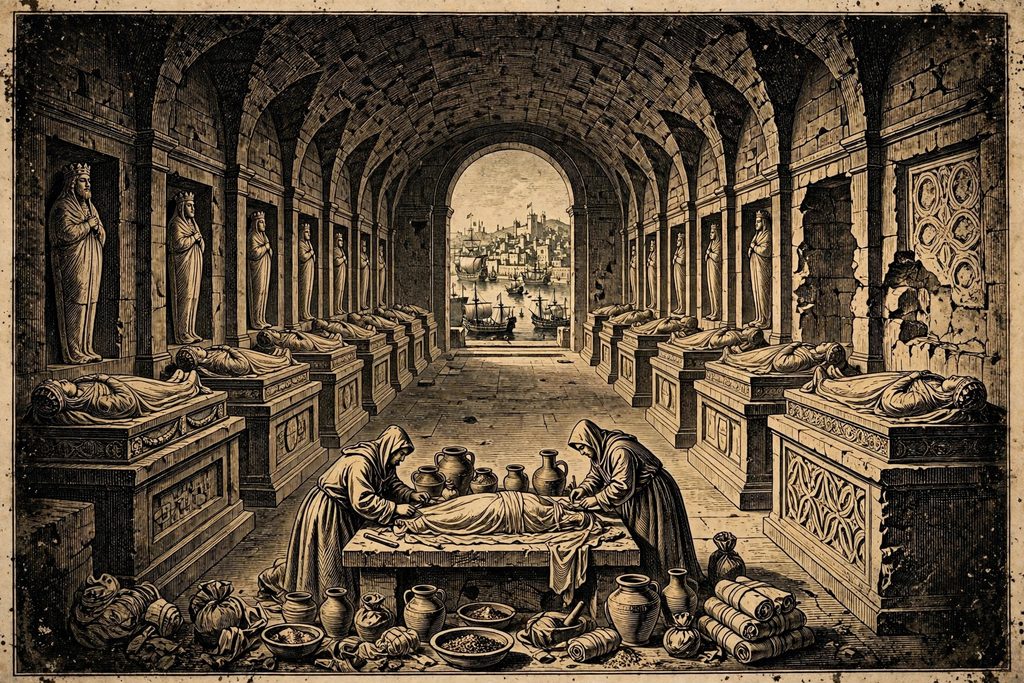
The decline of Númenor did not begin with a villain. It began with envy. As the centuries passed, the Númenóreans grew to resent the limit on their lives and the Ban that kept them from the Undying Lands. They began to fear death and to seek ways of delaying it. Their kings built great tombs, the art of embalming became an obsession, and the island filled with houses of the dead. A people who had been given three lifetimes now wanted all of time.
Their politics changed with their fears. The Númenóreans split into two parties. The King’s Men turned away from the Elves and the Valar, stopped speaking the Elvish tongues and claimed that the Ban was a tyranny. The Faithful, called the Elendili, the Elf-friends, kept the old ways and the old friendship, and were increasingly persecuted for it. The kings began to take titles in the Númenórean language instead of the Elvish one, and the old prayers on the mountain were neglected.
In Middle-earth, the change was felt as well. The early Númenóreans had come to the coasts of Middle-earth as teachers, bringing grain, tools and knowledge to the peoples there. Later, they came as lords, building fortresses and harbours, demanding tribute and ruling over the people they had once helped. A civilization afraid of its own death had become an empire.
IV. The Temple of the Dark
The last king of Númenor was Ar-Pharazôn the Golden, the most powerful ruler the island ever had. When he heard that Sauron, the servant of Morgoth, called himself King of Men in Middle-earth, he sailed east with an armada so vast that Sauron’s own armies deserted him. Sauron surrendered and was taken back to Númenor as a hostage. It was the greatest victory in the island’s history, and the beginning of its end.
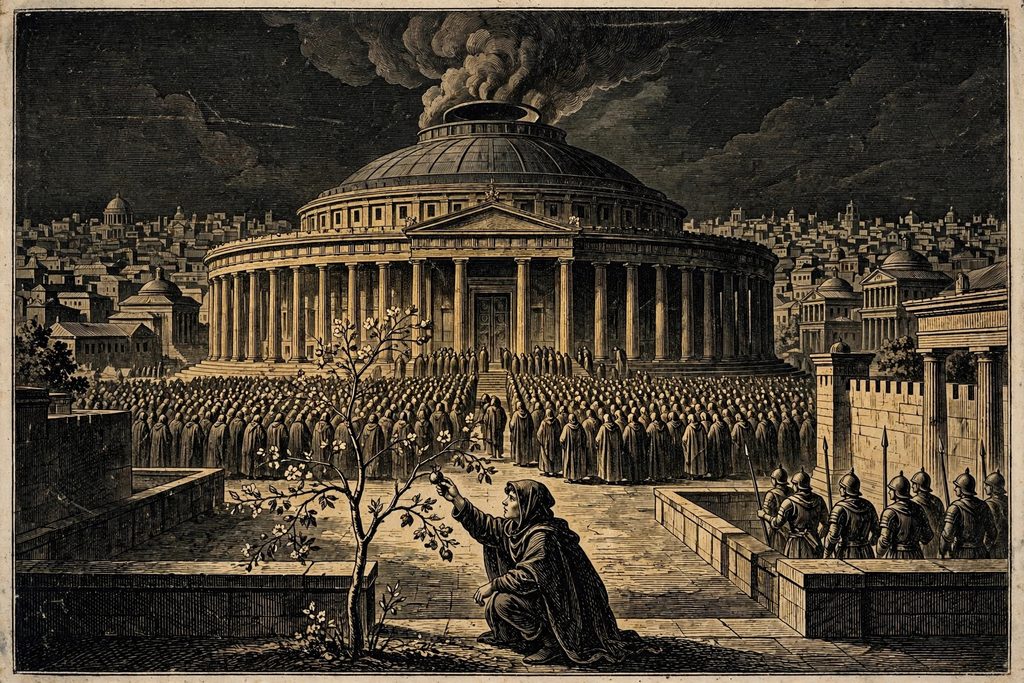
Within a few years, the hostage had become the king’s counsellor. Sauron told Ar-Pharazôn that the Valar had lied, that there was no Eru, and that the true lord of the world was Morgoth, the lord of the Darkness, who could grant the king everything he desired, even eternal life. A great domed temple was built in the capital of Armenelos, and the faith of Númenor was turned upside down. On its altar, the Faithful were sacrificed by fire.
The symbol of the change was a tree. In the king’s courts grew Nimloth, the White Tree of Númenor, descended from the light-giving trees of the West. At Sauron’s urging, it was cut down and burned on the temple altar. Before it fell, Isildur, grandson of the leader of the Faithful, risked his life to steal a single fruit from it. A religion of silence on a mountain had become a religion of smoke in a temple, and the living sign of the old faith had been fed to the new one.
V. The Downfall
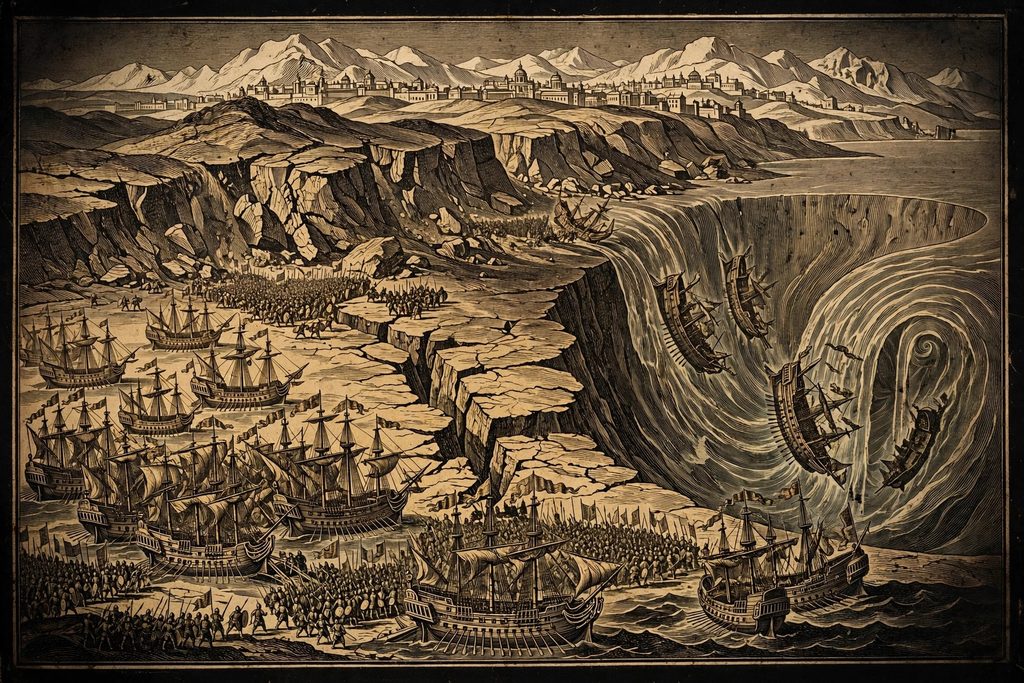
Growing old, and terrified of death, Ar-Pharazôn made the decision Sauron had been leading him toward. He would break the Ban, sail into the West and take immortality from the Valar by force. The greatest fleet the world had ever seen was built, and the king sailed beyond the sight of Númenor, across the forbidden sea, and set foot on the shores of the Undying Lands.
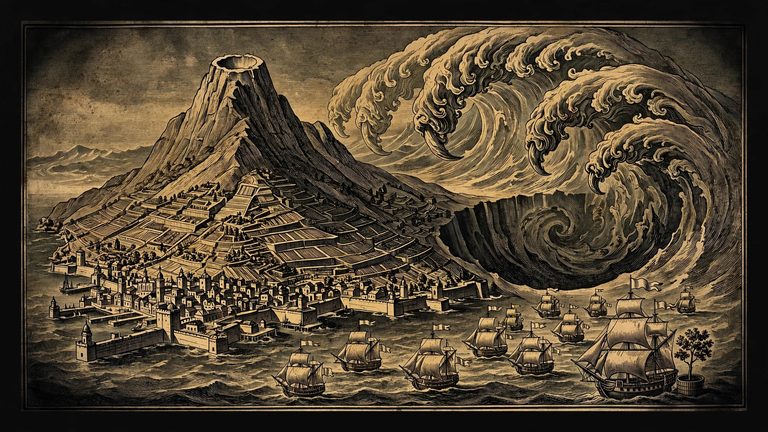
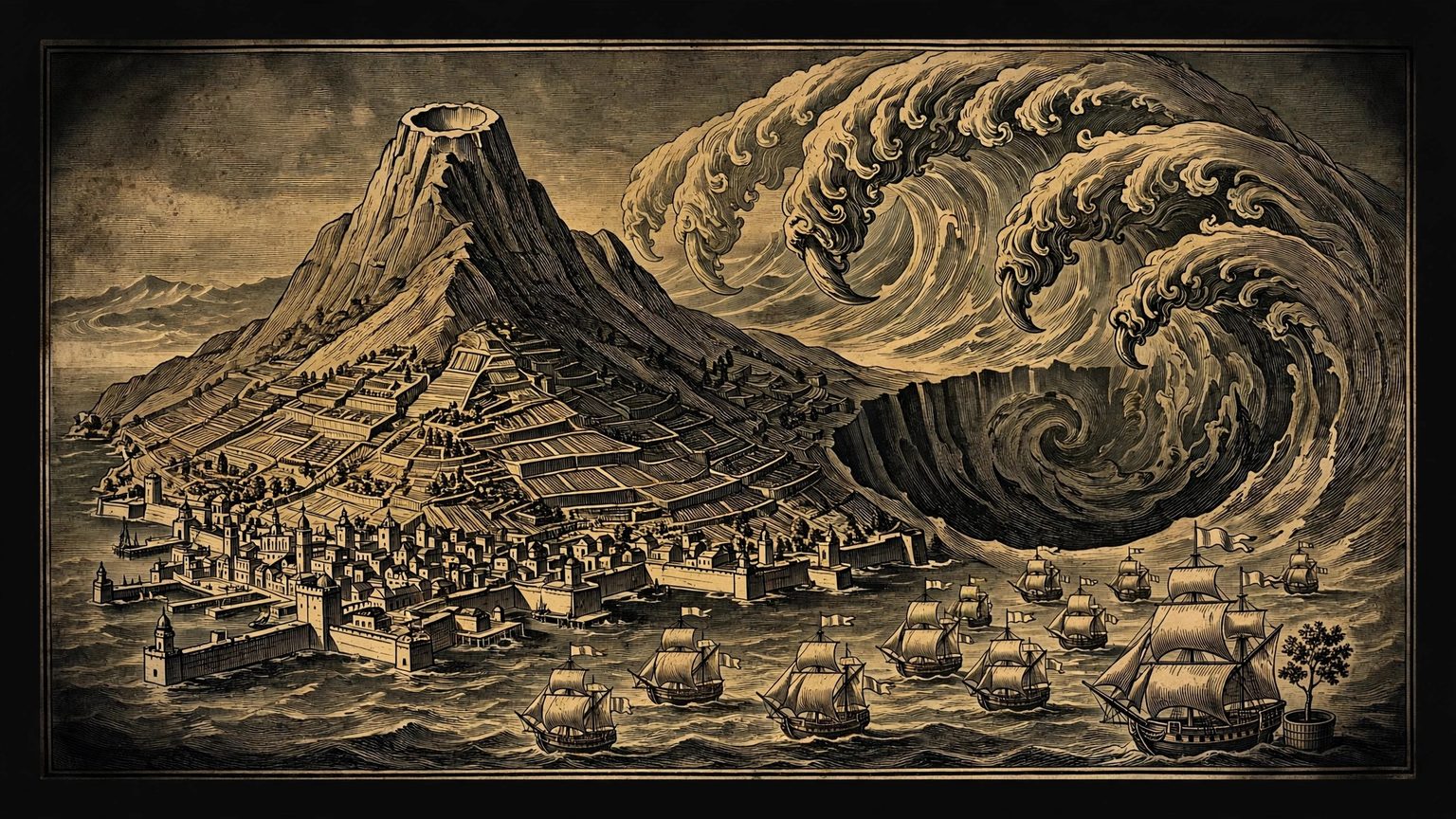
The Valar did not fight. They laid down their government of the world and called upon Eru. What followed was not a battle but an unmaking. The sea opened into a great chasm. The fleet was swallowed, and the king and his army were buried beneath falling hills. The Undying Lands were removed from the circles of the world. Númenor itself was overwhelmed by a great wave and sank beneath the sea, with its temple, its tombs, its cities and its mountain. The world, which had been flat, was made round. Only the Elves would ever again find the Straight Road to the West.
Tolkien gave the catastrophe a name in Elvish, Atalantë, the Downfallen. The resemblance to the Greek Atlantis was entirely deliberate. In his letters, Tolkien described a recurring dream of a great wave rising over green fields and trees, which he called his Atlantis complex, and which he gave to Faramir in The Return of the King. Númenor was the shape his private nightmare took when he wrote it into history.
VI. The Exiles
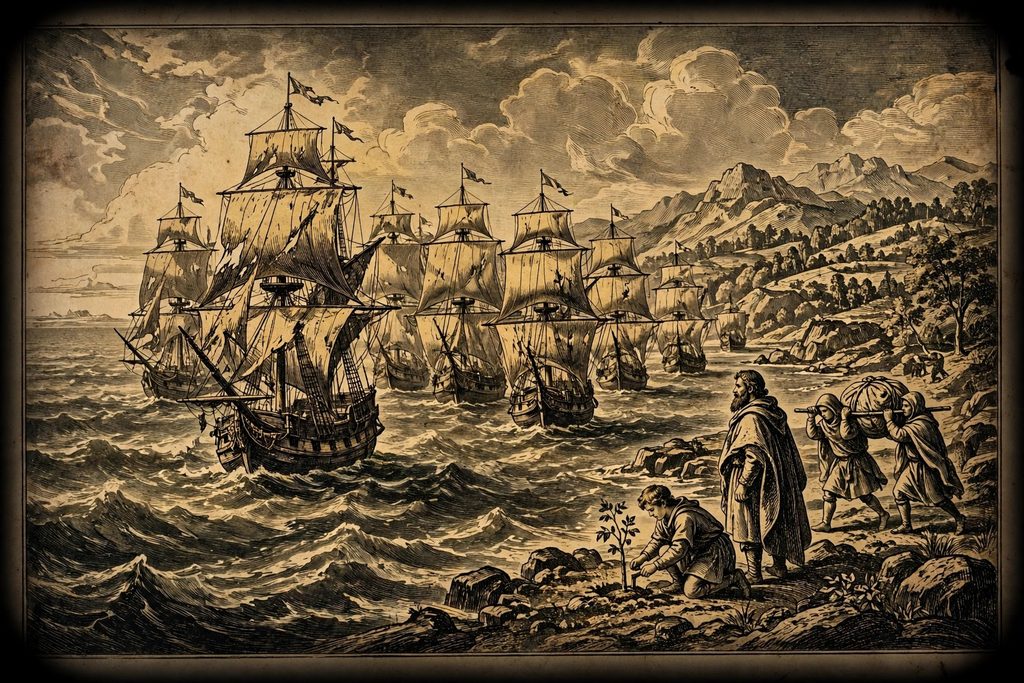
Not everyone drowned. Before the end, Elendil, the leader of the Faithful, prepared nine ships and loaded them with his people, with seven seeing-stones called palantíri and with the seedling grown from the fruit Isildur had saved. When the wave came, the nine ships were carried east on the storm to the coasts of Middle-earth. There Elendil and his sons founded two kingdoms in exile, Arnor in the north and Gondor in the south, and planted the White Tree in Gondor as the emblem of their line.
Everything that follows in The Lord of the Rings rests on this inheritance. The kings of Gondor, the rangers of the north, the city of Minas Tirith and the long wait for the return of the king are all memories of Númenor. Aragorn is the heir of Elendil, which makes him the heir of Elros and the last of the island’s royal line. When he finds the sapling of the White Tree on the mountain above Minas Tirith, he is reviving a tree whose ancestor Isildur saved from a burning temple.
The Númenóreans who survived also carried the island’s fear. Gondor in its decline repeated some of Númenor’s errors, building tombs more splendid than its houses and counting the generations of its stewards while the royal line was lost. Tolkien’s world is haunted by its drowned civilization. Every great city of men in Middle-earth is, in some sense, a memorial to an island that no longer exists.
The ancestor of them all
Tolkien did not hide his source. The ancestor of Númenor is Atlantis, and Atlantis was invented in Greece.
The story appears in two dialogues by Plato, the Timaeus and the Critias, written in the fourth century BCE. Plato tells it as an account passed from Egyptian priests to the Athenian lawgiver Solon. Beyond the Pillars of Heracles, the priests said, there once lay a great island, larger than Libya and Asia together, founded by the god Poseidon and ruled by his descendants, ten kings who governed according to sacred laws inscribed on a pillar of orichalcum, a mysterious metal found only on the island. The island was rich, powerful and admirably ordered, with concentric rings of land and water around its capital.
But the divine part of the Atlanteans faded as it was mixed again and again with mortal nature, and they grew greedy for power. They attacked the peoples of the Mediterranean and were defeated by ancient Athens. Then, in a single terrible day and night of earthquakes and floods, the island sank beneath the sea and vanished. Plato’s Critias breaks off at the very moment that Zeus gathers the gods to decide the Atlanteans’ punishment, and the rest of the dialogue was never written or does not survive.
Every element of Númenor is here. An island given by a god, ruled by a sacred royal line, admirable at first, corrupted by pride as its divine inheritance thins, punished by the sea in a single catastrophe. Tolkien added what Plato’s fragment lacks. He gave the island a religion, a fall into false worship, a reason for its pride in the fear of death, and survivors who carried its memory into a new world. Where Plato left a moral fable, Tolkien built a civilization and drowned it.
The pattern
Númenor belongs to a family the Institute calls the drowned civilizations, societies remembered as islands or cities swallowed by the sea as judgment for their pride. Beyond Atlantis, European legend is full of them. The Breton city of Ys, drowned when its gates were opened to the sea. The lost land of Lyonesse off the coast of Cornwall, sunk beneath the waves in Arthurian tradition. The Russian city of Kitezh, which vanished into a lake to escape its enemies and is said to be visible only to the pure of heart.
Three features define these civilizations. The first is a gift, a blessed origin, a divine founding or an age of unequalled prosperity. The second is a limit transgressed, a law broken, a gate opened, a horizon crossed, usually out of pride or desire. The third is survival through memory. The drowned city is gone, but someone escapes to tell the story, an Egyptian priest, a fleeing king, a ship carried east on the storm, and the story becomes the foundation of what comes after.
What makes Númenor unique among them is that Tolkien made the transgression a refusal of mortality itself. The Atlanteans of Plato wanted power. The Númenóreans wanted to stop dying. In that difference lies the moral center of Tolkien’s whole legendarium, the idea that death is a gift to be accepted rather than an enemy to be conquered. Númenor is the civilization that forgot this, and the sea was its answer.
Findings
- Númenor was a civilization given by the gods. Raised from the sea as a reward for the Edain, it was ruled for over three thousand years by the long-lived descendants of Elros and lived in friendship with the Elves.
- Its faith was simple and its limit was one. The Númenóreans worshipped Eru in silence on the summit of the Meneltarma, and the Ban forbade them only to sail west beyond the sight of their own coasts.
- Its fall began with the fear of death. Resentment of mortality split the island between the King’s Men and the Faithful, turned teachers into conquerors and opened the door to Sauron’s temple and its sacrifices.
- Its destruction changed the world. When Ar-Pharazôn broke the Ban and landed in the West, Númenor was drowned, the Undying Lands were removed and the world was made round.
- Its ancestor is Plato’s Atlantis. Tolkien named the catastrophe Atalantë, the Downfallen, and built on Plato’s island of divine kings drowned for their pride, adding a faith, a fall and survivors who founded Gondor.
This Excavation draws on J. R. R. Tolkien’s Silmarillion, Unfinished Tales and letters, on Amazon’s The Rings of Power, on Plato’s Timaeus and Critias, and on the drowned-city legends of Europe.
The Institute collects field evidence from people who have lived inside these worlds. If the fall of Númenor changed the way you read The Lord of the Rings, send us your account.
Sources
- J. R. R. Tolkien, The Silmarillion (1977), edited by Christopher Tolkien, including the Akallabêth.
- J. R. R. Tolkien, Unfinished Tales (1980), edited by Christopher Tolkien, including “A Description of the Island of Númenor”.
- The Letters of J. R. R. Tolkien (1981), edited by Humphrey Carpenter.
- J. R. R. Tolkien, The Fall of Númenor (2022), edited by Brian Sibley.
- The Lord of the Rings, The Rings of Power (2022 to present), Amazon MGM Studios.
- Plato, Timaeus and Critias (fourth century BCE).