

Travellers come to Yharnam because they are sick. The city, isolated in the mountains, is famous across the world for a single medical miracle. Its church can heal almost anything. The cure is administered by transfusion, and it is called blood ministration. Patients sign a contract, receive the blood and wake up in a city where the streets are full of burning effigies, barricaded doors and armed mobs hunting creatures that were human a few days ago.
This is the opening of Bloodborne, released in 2015 by FromSoftware and directed by Hidetaka Miyazaki. It is one of the most celebrated games of its decade, and one of the darkest religious fictions in any medium. At its center is an institution called the Healing Church, which turned a sacrament of ancient blood into the foundation of an entire city, and spent generations hiding what that blood was doing to its believers.
The Institute has excavated gods made by mortals in The Living Gods of Morrowind and a faith engineered by an order of women in The Religion Planted on Arrakis. The Healing Church belongs to a stranger category. Its sacrament is real, it works, and it is the disease.
I. The City of Blood Ministration
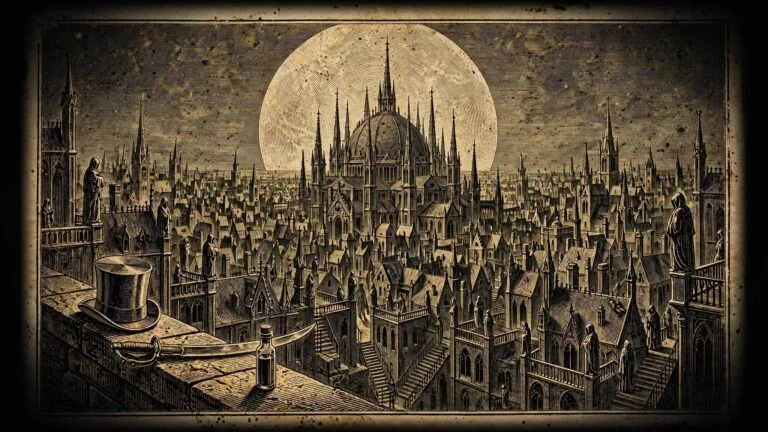
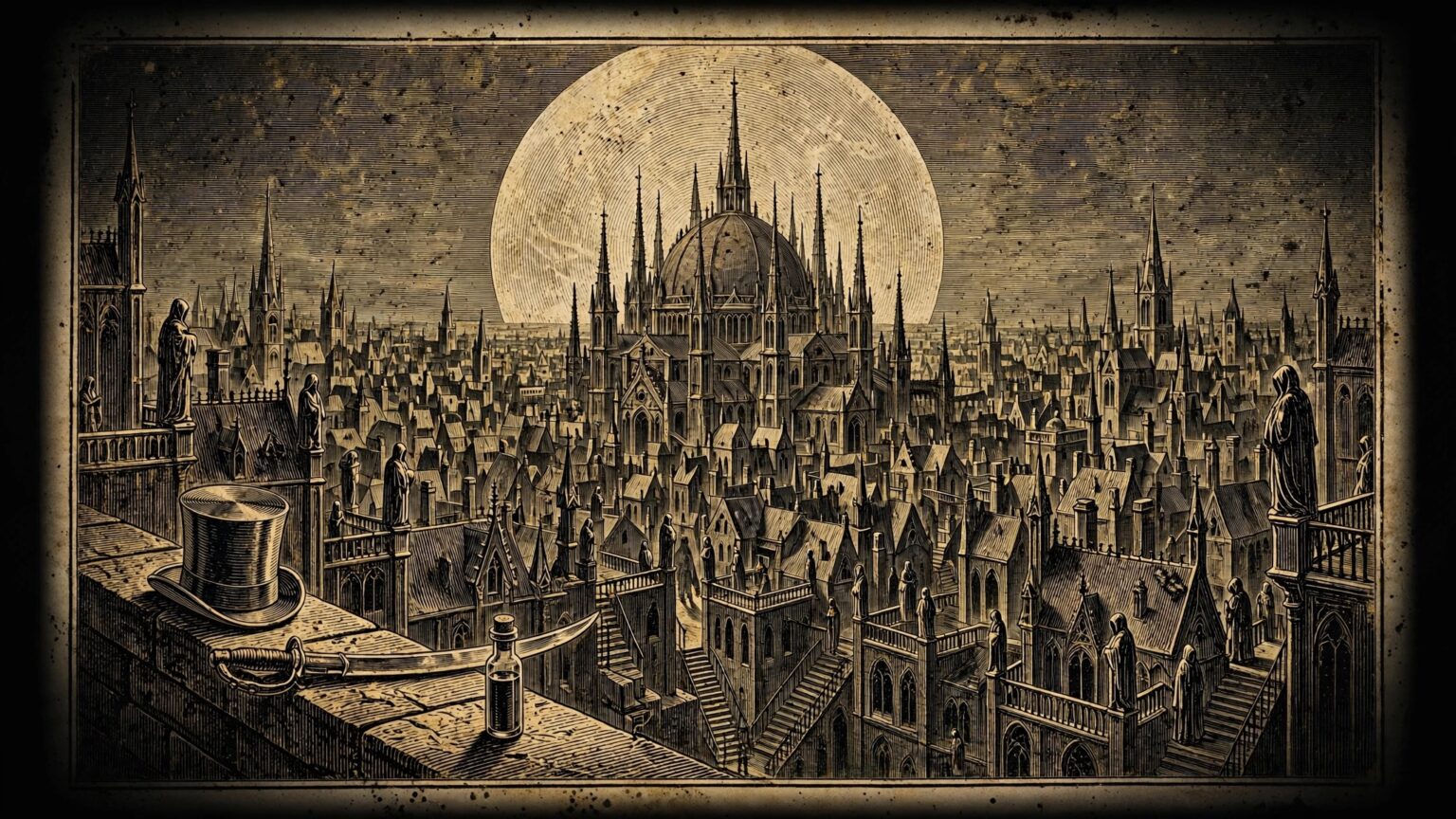
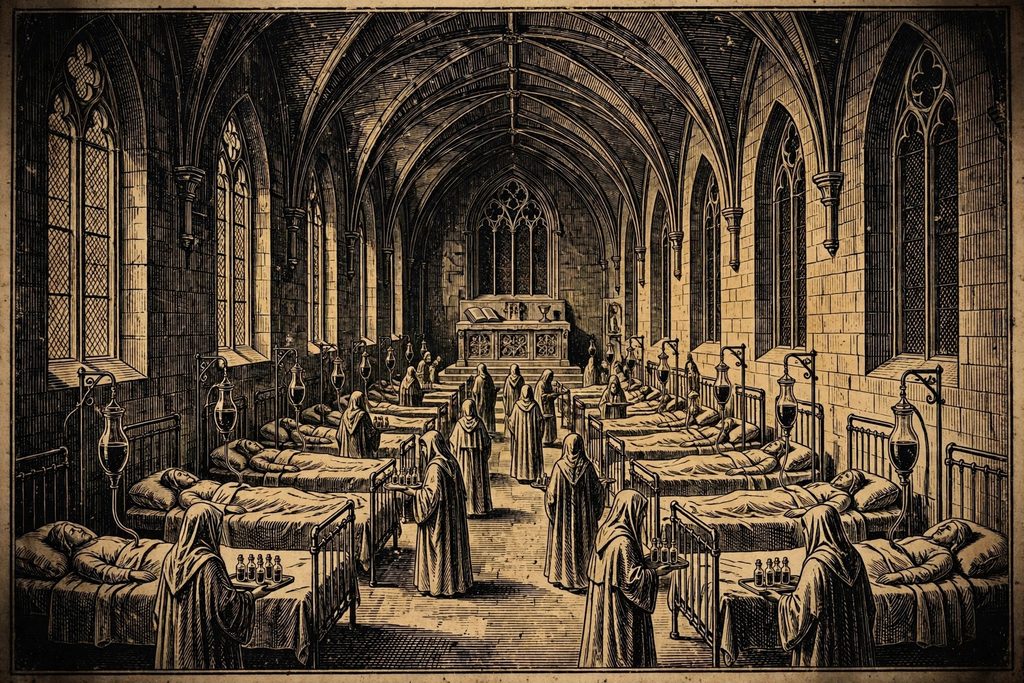
Yharnam is a city built vertically, a gothic maze of cathedrals, stairways, bridges, sewers and graveyards, with the look of a Victorian capital that has grown inward on itself. Its streets are full of churches, clinics and statues of hooded saints. Its people have one sacrament in common, and they take it the way other cities drink water. Blood ministration heals wounds, cures illness and, the church teaches, brings the faithful closer to the divine. The city even mixes it into drinks, a local specialty. To be Yharnamite is to have received the blood.
The cost arrives as a plague. The city calls it the scourge of beasts. Those who have received the blood begin to change, slowly or all at once, growing fur, claws and teeth, losing their minds and their speech. Every so often a night of the Hunt is declared, and hunters walk the streets to kill the beasts that used to be their neighbours. The player arrives on such a night, and by morning almost the whole city has turned.
What makes Yharnam an anthropological puzzle is that its citizens see no contradiction. The blood that heals them and the blood that turns them into beasts are the same blood, and the church that offers the cure also commands the hunters who kill the cured. The plague is not a punishment from outside the faith. It is the faith, working exactly as it was designed.
II. Byrgenwerth and the Old Blood
Yharnam was built on top of something older. Beneath the city lie the labyrinths of the Pthumerians, an ancient civilization that served beings the game calls the Great Ones, vast entities from beyond human understanding. The city itself is named after a Pthumerian queen. For centuries, its people lived above the tombs without knowing what lay inside them.
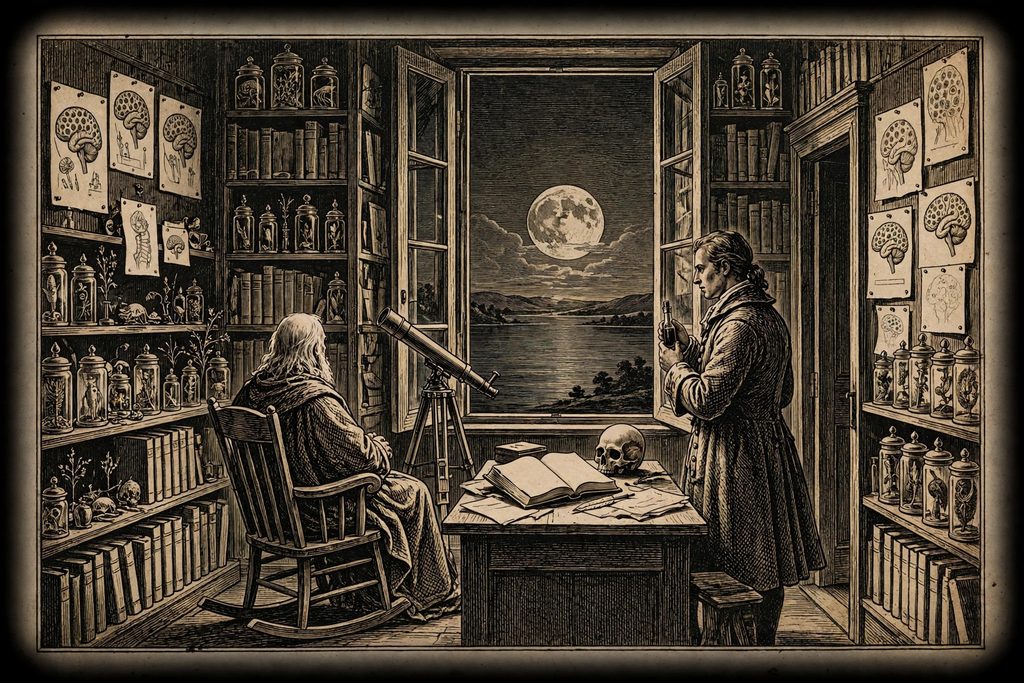
Then the scholars came. At Byrgenwerth, a college on the shore of a moonlit lake outside the city, a group of researchers led by a teacher called Master Willem descended into the labyrinths and found what the game calls the Old Blood, the blood of the Great Ones. Their discovery split the college in two. Willem believed humanity could approach the Great Ones only through insight, by lining the brain with eyes, as he put it, so that the mind could see what it was not built to see. His student Laurence believed the answer was in the blood itself. Willem’s warning to him has become the most quoted line in the game. “Fear the old blood.”
Laurence did not listen. He left Byrgenwerth with the blood and founded the Healing Church in Yharnam, becoming its First Vicar. The sacrament of the city was born from an academic quarrel, and its first priest was a scholar who had been told, by the man who discovered it, that it should never be used.
III. The Sacrament and the Scourge
The Healing Church presented blood ministration as a cure for every illness. Behind that promise, it was something else as well, a way of studying the Old Blood on an entire population. The city became a laboratory, and its believers became the subjects. In a hidden research hall behind the Grand Cathedral, the church’s scholars kept patients whose bodies the blood had transformed in ways the faithful were never allowed to see.
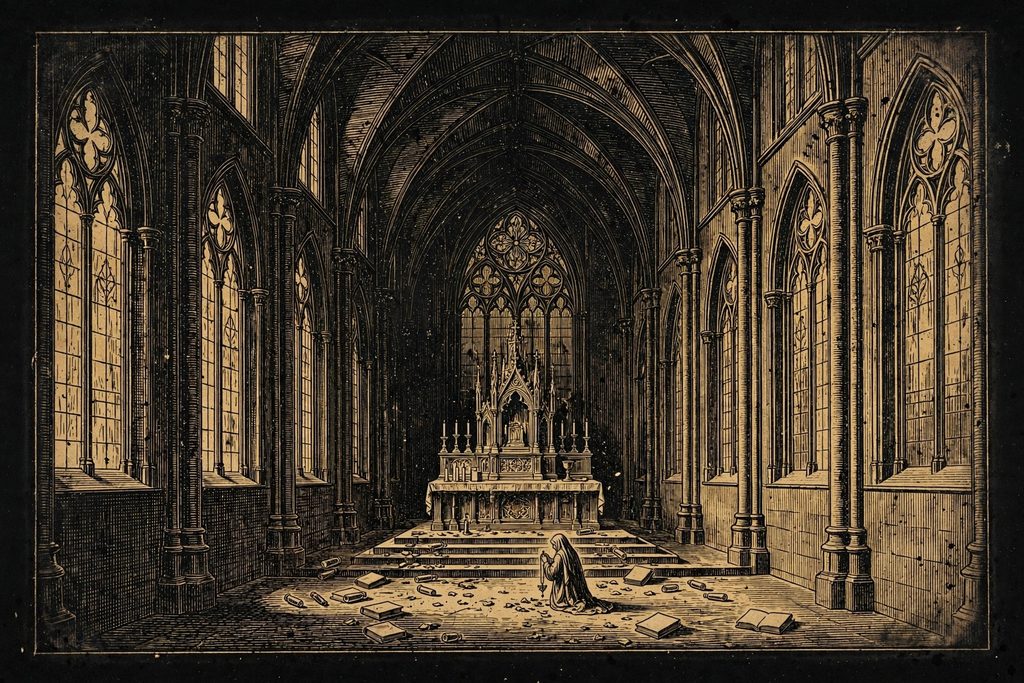
The scourge of beasts was the experiment’s side effect, and the church built an institution to manage it. Hunters, organized in workshops and sanctioned by the church, cleaned up what the sacrament produced. The church’s own clergy were not spared. Its founder, Laurence, ended his life as a beast, the first of the creatures now called Cleric Beasts. In the Grand Cathedral, the player meets Vicar Amelia, the church’s current leader, praying before Laurence’s skull. When the player approaches, she too transforms.
For a student of religion, this is the most striking feature of the Healing Church. It is not hypocritical in the ordinary sense. Its priests take the same sacrament as the people. They believe in it enough to be destroyed by it. The church lies about the cost of its sacrament, but it pays that cost itself, at every level of its hierarchy, all the way to its founder.
IV. The Choir and the Eyes of the Cosmos
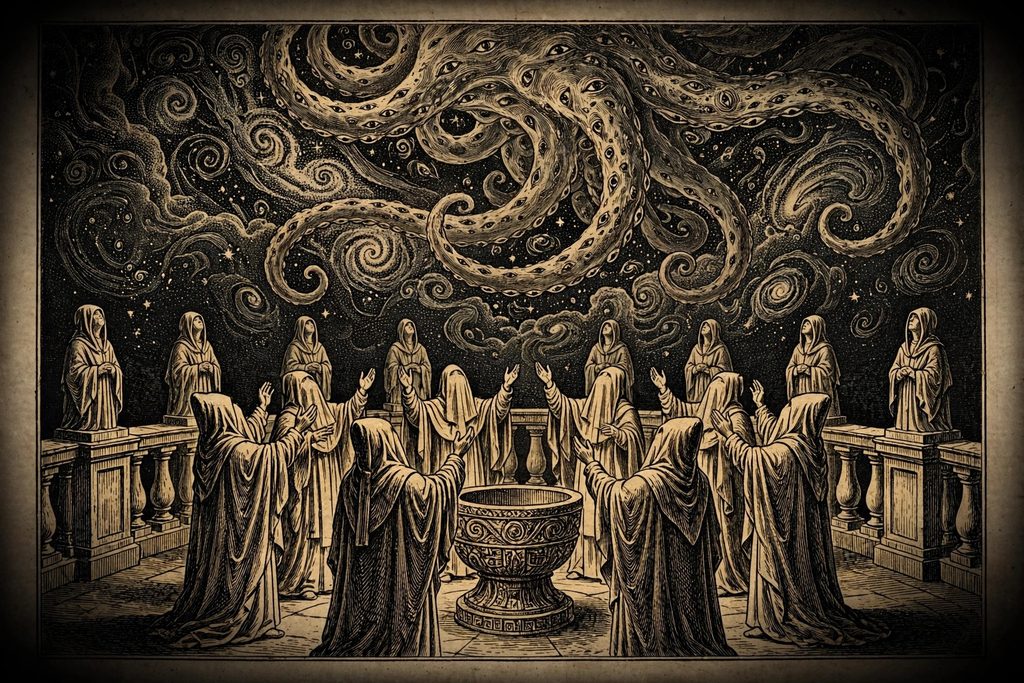
The church did not abandon Willem’s path entirely. At its summit stood an inner order called the Choir, who pursued the Great Ones not through the blood alone but through the heavens. Using a relic from the labyrinths, the Choir made contact with a Great One they called Ebrietas, Daughter of the Cosmos, and kept her in a hidden chapel known as the Altar of Despair. They believed the Great Ones could be reached in the stars, and that humanity could be lifted toward them. The Choir also experimented on the orphans in the church’s care.
The game turns this theology into a mechanic. As the player encounters forbidden things, they gain Insight, a measure of hidden knowledge. Insight makes new things visible. At higher levels, the player begins to see vast creatures clinging to the buildings of the city, creatures that were always there, and hears sounds that were always present. But Insight also makes the mind fragile, and those who know too much are more vulnerable to a kind of madness the game calls frenzy.
This is a religious idea with a long history. Revelation is dangerous. To see the divine is to be changed by it, and not always for the better. In Yharnam, there are two roads to the gods, the sacrament of blood and the discipline of insight, and both lead out of humanity. The Choir is the purest expression of the city’s faith, a priesthood that believed the goal of religion was to stop being human altogether.
V. Heresies and Hidden Sins
Every established church produces heresies, and the Healing Church had two famous ones. The first was Cainhurst, a castle of aristocrats across a frozen lake, whose queen, Annalise, received forbidden blood through a traitor from Byrgenwerth. Her court became the Vilebloods, a noble house that drank blood as a mark of its own superiority, and its queen sought to bear the child of a Great One. The church answered with a crusade. Its Executioners, led by a figure called Logarius, slaughtered the court of Cainhurst and sealed the queen away, immortal and alone.
The second heresy grew from inside the scholars’ own tradition. The School of Mensis, an offshoot of Byrgenwerth, attempted to reach the Great Ones through dreams and rituals in the village of Yahar’gul. Their ritual succeeded in a way that killed them all in the waking world and left their minds trapped in a nightmare.
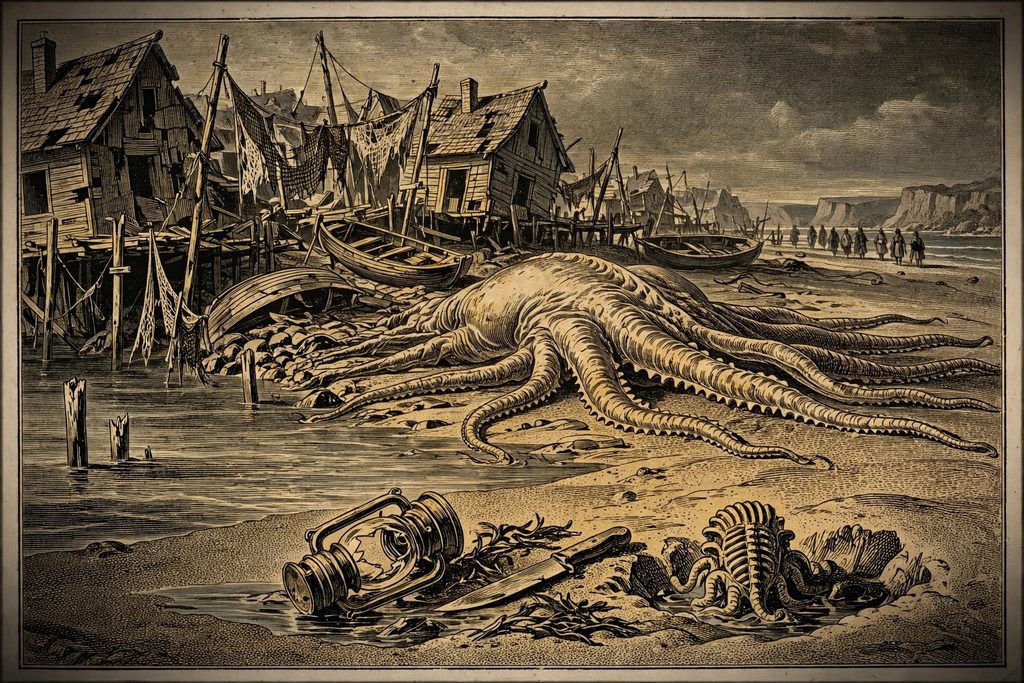
The deepest sin is revealed in the expansion The Old Hunters, released in 2015. On the coast near Byrgenwerth lay a fishing village whose people had lived beside a Great One called Kos, whose body had washed ashore. To reach the corpse and its secrets, the hunters of the scholars massacred the villagers. The survivors laid a curse on the hunters and their descendants, and the curse became the Hunter’s Nightmare, a dream-prison in which the old hunters wander forever. The church’s sacrament, it turns out, was founded on a massacre, and the Nightmare is the place where that history is kept.
VI. The Hunter’s Dream
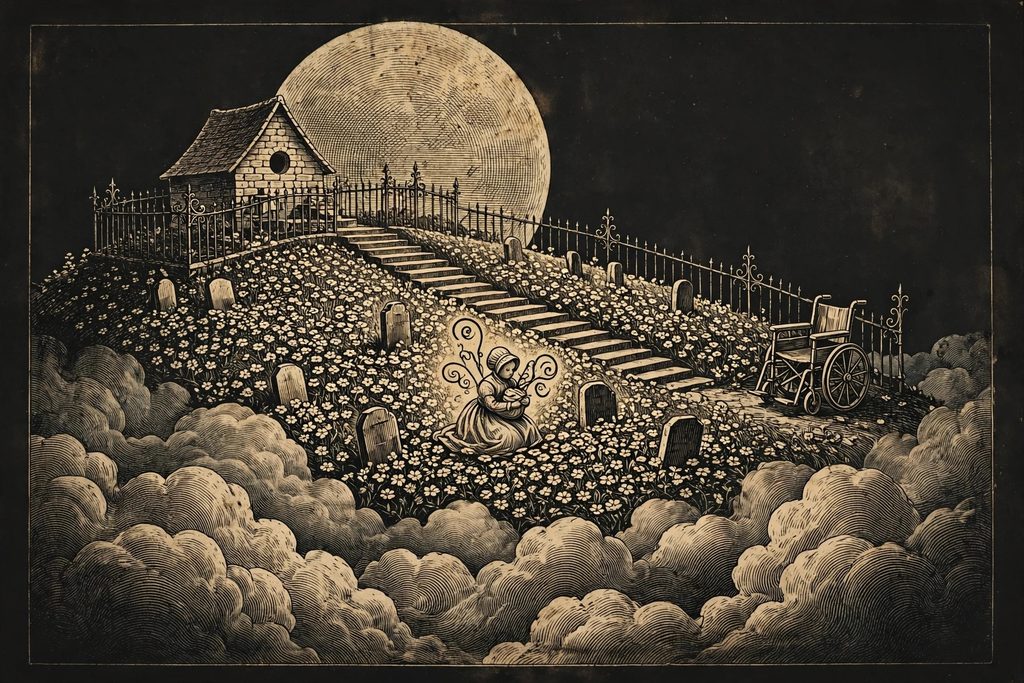
Above the waking city lies one more sanctuary, the Hunter’s Dream. It is a small workshop in a garden of white flowers, cared for by an old man in a wheelchair named Gehrman, the first hunter, and a silent doll in the shape of a woman. It is where the player returns between hunts, and like everything else in Yharnam, it was made by the church’s founder and the first hunter together, with the help of a being called the Moon Presence. The dream exists to keep the hunt going.
Bloodborne offers three endings, and each is a verdict on the city’s religion. In the first, the player accepts Gehrman’s mercy, dies in the dream and wakes up in the morning, free, with the sun rising over Yharnam. In the second, the player refuses and takes Gehrman’s place, becoming the new keeper of the dream for another generation of hunters. In the third, the player, having consumed relics of the Great Ones, defeats the Moon Presence and is reborn as an infant Great One.
That last ending is the most unsettling of all. Everything the Healing Church, the Choir and the scholars sought, the transformation of a human into something higher, is achieved by the player. The religion of Yharnam, which destroyed its city in pursuit of that goal, turns out to have been right about what was possible. It was only wrong about who would be allowed to reach it, and about what it would cost everyone else.
The ancestor of them all
The idea that blood can heal, purify and remake a human being is far older than gothic horror, and the ancient world tried it in ritual and in medicine.
In the late Roman Empire, followers of the Great Mother goddess Cybele performed a rite called the taurobolium, the sacrifice of a bull. According to a famous and much-debated description by the Christian poet Prudentius, the initiate stood in a pit beneath a wooden platform pierced with holes, and the blood of the bull slaughtered above poured down over his head, his face and his clothes, and he emerged soaked in it to be greeted as one made holy. Altars raised in Rome in the fourth century record initiates who had undergone the rite, and at least one describes its dedicator as reborn for eternity. Modern historians argue about how literally to read Prudentius, but the idea he recorded is clear. Blood was the doorway to a new life.
Medicine made the same bet. The Roman writer Pliny the Elder recorded that people suffering from epilepsy drank the blood of dying gladiators in the hope of a cure. In 1667, the French physician Jean-Baptiste Denys transfused the blood of a lamb into a young patient and reported a recovery. One of his later patients died, and transfusion was soon banned in France and abandoned across Europe for well over a century.
Yharnam fuses both traditions. Its blood ministration is a sacrament in the manner of the taurobolium and a treatment in the manner of Denys, a rebirth and a cure administered by the same church. And like both, it rests on the conviction that the blood of something greater can be taken into a human body without consequence.
The pattern
The Healing Church belongs to a family the Institute calls sacramental catastrophes, faiths built on the stolen substance of a god. Its literary ancestor is H. P. Lovecraft’s The Shadow over Innsmouth, published in 1936, in which a decaying fishing town has made a pact with beings from the sea through a cult called the Esoteric Order of Dagon, and its people slowly transform into something no longer human. The Fishing Hamlet of The Old Hunters is a direct descendant.
Three features define these faiths. The first is a sacrament taken from a divine body, the blood of a Great One, the heart of a dead god or the favour of the deep. The second is an institution that controls access to that sacrament and hides its cost from the faithful. The third is transformation, the believers changing into something other than human, whether as punishment, as side effect or as the secret goal of the religion itself.
The Institute has met the same structure in The Living Gods of Morrowind, where three mortals became gods by tapping the heart of a dead one, and in Hallownest, studied in The Kingdom That Tried to Forget Its God, where a forgotten divinity returned as a plague. Yharnam is the most extreme member of the family. Its church did not merely borrow the power of a god. It fed that power to an entire city, one transfusion at a time.
Findings
- Yharnam is a city built on a sacrament. Blood ministration, the Healing Church’s transfusion of ancient blood, heals the sick, binds the faithful and defines what it means to be a citizen.
- The sacrament is the plague. The same blood that heals causes the scourge of beasts, and the church that gives the cure also commands the hunters who kill the cured.
- The faith was born from a scholars’ quarrel. Laurence took the Old Blood from Byrgenwerth against the warning of his teacher Willem, “Fear the old blood,” and founded the Healing Church on it.
- The church’s history rests on hidden crimes. The crusade against Cainhurst, the experiments on orphans and the massacre of the Fishing Hamlet lie beneath its sacrament, preserved in the curse of the Hunter’s Nightmare.
- Its ancestors are ancient blood rites and early medicine. The taurobolium of Cybele promised rebirth through blood, and the first transfusions of the seventeenth century promised cure, the two hopes Yharnam combined.
This Excavation draws on Bloodborne and The Old Hunters, on the history of the cult of Cybele, on the early history of blood transfusion, and on the fiction of H. P. Lovecraft.
The Institute collects field evidence from people who have walked these worlds. If you remember the night you first understood what the blood was doing to Yharnam, send us your account.
Sources
- Bloodborne (2015) and Bloodborne, The Old Hunters (2015), FromSoftware, published by Sony Computer Entertainment.
- Prudentius, Peristephanon X, on the rite of the taurobolium (early fifth century).
- Pliny the Elder, Natural History, book 28 (first century CE).
- Holly Tucker, Blood Work, A Tale of Medicine and Murder in the Scientific Revolution (2011), W. W. Norton.
- Philippe Borgeaud, Mother of the Gods, From Cybele to the Virgin Mary (2004), Johns Hopkins University Press.
- H. P. Lovecraft, The Shadow over Innsmouth (1936).